Life in 1926

Each August, National Family History Month in Australia and New Zealand invites us to pause and look back. This year’s theme, Ancestors: Mundane to Magnificent, may be interpreted with a simple question: what did our people’s ordinary days actually look like and where, within the routine, did something like magnificence quietly live?

Carmel of Carmel’s Corner has created a Geneameme to celebrate Family History Month. Carmel’s idea for the Geneameme is to look at which of our ancestors were alive in 1926. She asks, “Who was alive in 1926, how old were they, what were their circumstances? Join in and post about your ancestors this Family History Month. 

I have chosen the maternal line first as it is relatively uncomplicated compared to my paternal line.

Maternal line in 1926

Christina Cameron Lock (Robbie) 1875 -1926 – my great grandmother, aged 50 in 1926.  

Christina wouldn’t have seen much of 1926 because she died on the 21st January of that year.  She left behind four adult children and her husband Reuben. Her Death Certificate says she died from Morbus Brightii (six months) and Apoplexy (2 days). Morbus Brightii or Brights Disease was a broad term for kidney disease or kidney failure. As a result her blood pressure would have risen to dangerous levels.  This would have resulted in the stroke that finally killed her.

Reuben Benjamin Lock -1872-1943 – aged 54 in 1926

The year of 1926 was a bad time for Reuben, my great grandfather.  Both his wife and his mother Emma Lock died that year.  His eldest daughter Myrtle left her husband taking her daughter with her and his second daughter Ruby divorced her husband after he ran off to New Zealand.  His two sons may still have been living at home but the eldest, Charles, was engaged to be married and would be leaving soon.  Claude, the youngest, had learning difficulties so his future was uncertain.

Reuben moved around Victoria chasing opportunities.  In 1926 he was a fruiterer in Terang but in previous years he had been a fishmonger and an agent for sourcing and supplying fish, fruit and vegetables. After Christina’s death he went back to Camperdown and returned to the occupation of fishmonger.  This was not before he married again on the 11th September 1926.  His new wife, Rosemary Emma, left him after two weeks owing to “disagreements on private matters”.

Reuben liked a drink at the pub and had had a long-suffering wife for 30 years.  His new wife obviously found life with him unbearable.

Myrtle May Hall (Lock) 1896 -1976 – aged 30 in 1926

My grandmother married Walter Sydney Hall in 1916 when she was 20 years old and went to live with him in his house in Railway Crescent, Williamstown, Victoria. She gave birth to my mother in 1917. It appears that Walter was not living at the home for much of that time but at his sister’s house nearby. In 1926, perhaps spurred on by her mothers’ death, Myrtle left Williamstown and took her nine-year-old daughter to Glebe in Sydney.  Here she continued her trade of dressmaking. Her day would have started early, lighting the fuel stove to heat the smoothing irons. By 9 am the clients would be arriving so Myrtle would be draping fabrics, pinning carefully and discussing the latest European fashions. On some days Myrtle might catch the tram to the city to select materials at Anthony Horderns or Mark Foys.  Most days she would be sewing on her Singer treadle sewing machine. This would be followed by hand finishing hems and buttonholes and attaching beadwork.

Walter Sydney Hall (1870-1933) aged 56 in 1926

!926 was the year my grandmother left my grandfather, although he appears to have been living at his sister’s house according to the electoral rolls.  He was a wood machinist at the Newport Railway Workshops. His day would be spent at either the dedicated log mill, sawmill or woodworking shop.  At this time roughly 2.700 men and women worked onsite maintaining and building Victoria Railways rolling stock. He may have been involved in producing framing and interior panelling for the red suburban electric Tait trains and country passenger cars.

According to Myrtle, Walter’s main fault was that he gambled away the money he earned.  The workshops were notorious for their gambling culture.  Men would receive their weekly wages and immediately hand it over to an “agent” for a race that afternoon. As a keen AFL player in his youth Walter may have played a game called Trugo invented by the railway workers at Newport. It used a heavy rubber mallet to strike a rubber ring through a set of goalposts and was designed to be played in central yards during lunch breaks to keep the men away from illegal card games and SP bookies.

Elsa May Hall (1917-1997) aged 9 in 1926

 Elsa, my mother, was born in 1917 in Williamstown to Myrtle (21) and Walter (47).  1926 was a year of upheaval for her. Taken out of her school in Williamstown she left her childhood home and her father for good.  Her grandmother had also died in January.  After searching for a new home she and her mother settled in Glebe, Sydney, NSW, where she started Forest Lodge Public School. While her mother spent her days making dresses for well-to-do ladies, Elsa made a close friend called Ruth and enjoyed playing netball at school.  Her greatest joy was riding her scooter along the road in Jubilee Park opposite her home.

Paternal Side in 1926

The father I grew up with and who died of a heart attack when I was 10, had a very strong influence on my life, despite the short time I had with him.  It was with amazement that I discovered when I was 64, through DNA, that he was not my biological father.  I have therefore chosen to write about both fathers and also the grandmother I grew up with.

Ella Maud Price (Ridgway) 1875-1965 – aged 51 in 1926

My grandmother was born in Picton, NSW, married John Price in 1904, had a son Linden in 1907 and lost her husband (a stationmaster) to a heart attack in 1913.  By 1926 she had spent years as a housekeeper for Mr Alfred Munro, a member of a large pastoral family in northern NSW.  He had his own property called Boonal, near Boggabilla. 

Her day would have started around 5.30am, lighting the fire in the wood stove and. making porridge, chops, damper and tea. Washing dishes, scrubbing kitchen tables, and managing the wood and water supply would be next. Beds had to be made, rugs shaken and slops emptied.  The midday meal would then be prepared as it was the main meal of the day.  Cleaning this up would be followed by baking bread, cakes and biscuits. Maybe mending, polishing and sweeping would take place.  Then the evening meal would be prepared with potatoes and other root vegetables peeled. After serving the evening meal the dishes would be washed and the kitchen tidied again. Ella may have had help to perform these tasks which would have given her time to look after the chickens, collect eggs, feed any orphaned lambs and take photographs.  This was her hobby and she enjoyed sending her pictures in to magazines along with articles about life in the bush and her strict views on the upbringing of children.

Linden John Ridgway Price (1907-1961) aged 19 in 1926

In 1926 my father Linden was living on the property called Boonal where his mother was a housekeeper.  He had attended Newington for three years but left at the age of 15 in 1922. He had spent some time as a trainee wool classer but didn’t take to it.  By 1926 the rabbit plague in Australia was widespread. Alfred Munro was keen to reduce the numbers of these creatures on his property so Linden and many other men spent their days trapping.  He would have been up early in the morning, rolled out his swag and eaten damper with hot billy tea. He would then saddle his horse and check each trap along the Macintyre River, resetting the traps with scented pollard bait. A quick death for the rabbits and he would make for his camp, skinning the rabbits and putting their pelts on wire frames.  He would salt the pelts to stop them from rotting, mend any broken traps and sharpen his blades. Life was made more difficult because of the impact of prickly pear.  The rabbits chose to burrow beneath the thickets as they offered protection from predators. The bristles would lodge in the skin and cause festering sores for anyone laying traps near the pear thickets.

Albert Henshall !892-1952 aged 34 in 1926

Albert was my biological father and all I know is my parents were married 14 years with no children.  They went to Mildura where they met Albert through business.  I was born in 1951 and totally unaware that my DNA would indicate Albert was my father.

In 1926 Albert was a Soldier Settler in Red Cliffs near Mildura. He was married and had two little girls. His grape growing enterprise on the block he had been allocated was not going to make his fortune so he soon branched out.  By 1926 he was concentrating on the commercial packaging, marketing and agency side of the grape growing industry. 1926 was the first full, uninterrupted, commercial harvest season.  He started up the Red Sun Packing Shed which processed and distributed the region’s dried vine fruits.  He also diversified as a real estate agent and auctioneer, ran for positions on dried fruit boards and became involved in local community activities such as setting up swimming clubs and regional sports.

What did our people’s ordinary days actually look like and where, within the routine, did something like magnificence quietly live?

I see hard work and suffering in this snapshot of life in 1926.  Reuben, who tried to make a living transporting fish, fruit and vegetables to inland towns, Christina, who died a miserable death without the advantages of modern medicine, Walter, who helped build the trains for the state of Victoria, Myrtle, who crafted beautiful dresses while her private life was in chaos, Elsa, who survived the tremendous upheaval in her young life and began to enjoy a new beginning, Ella, who worked hard from dawn until dusk on a lonely cattle station, Linden, who threw away opportunities but played his part working on his employer’s property and finally Albert, the WWI veteran, who grasped opportunity with both hands and became a successful businessman.
REFLECTIONS

The month of April was supposed to begin with a Blue Lagoon Cruise around the Yasawa Islands of Fiji. It was booked to celebrate my 75th birthday on board the Fiji Princess. Because of my diagnosis of Non-Hodgkins Lymphoma I had to cancel the cruise and as a result missed out on a harrowing shipwreck. The 55 metre MV Princess ran aground on a reef near Monuriki Island after a severe squall caused the ship’s anchor to drag, pushing it onto a reef. All 30 passengers and most of the 30 crew members were evacuated by the navy.  There were no casualties. I would have had my birthday dinner, gone to bed and then been woken in the dark by a loud crunch, told to grab my lifejacket and leave the ship at dawn. 

That is an alternate version of my life this year.  Instead, I underwent six rounds of R-CHOP chemotherapy, followed by a troubling PET scan and a laparoscopic biopsy. After an anxious week which I shared with my A-to-Z followers I received the all clear, at least until my next PET scan in July.  It was not all doom and gloom.  Friends and family rallied to the occasion and we enjoyed several glorious days away from the enforced isolation of home.

The comments and support from followers have been the highlight of my days in April.  I so much wanted to put Z for Zero as I waited for the results of the biopsy but late on the afternoon of the 30th April I had to post without the news.  Fortunately, the next day the doctor rang to say all was well so I ran up another post, this time Z for Zero.

I’m not going to list any names this year of the people who kept me going through the month of April.  You know who you are and I thank you with all my heart.  I have printed out all those signed up for this year’s A to Z so will try to visit everyone over the next few weeks.

Thank you to all those who make the A to Z possible each year.  Please keep it going. I’m thinking about next year’s focus but have no idea at this stage. All I know is that if it’s on, I’ll be there. 

Z for Zero

I know I have already posted my Z for Zooming Through April but I just had to let you know the news.

As a last resort I rang the doctor’s office at the hospital again today.  A different person answered, took down all the details and assured me she would contact the doctor as soon as possible.  I didn’t hold out much hope and went on with my day.

We were at Bunnings choosing plants for the rock wall when the phone rang.  It was the doctor!!!!!!

He told me he was currently in Melbourne and had not seen the results. There was some mix up because he thought I was operated on in the Private Hospital.  That had been changed to Wollongong Public Hospital as there was no time slot available.  Anyway, he had someone fax through the report and told me what I had was fat necrosis (dead fat in the abdomen caused by chemo treatment).  It is not cancerous, not life threatening and often goes away by itself.  This is what we had suspected all along but it was very pleasing to have confirmation.

So I’m cancer free. Of course, I will have PET scans every three months but I can live with that.  On Monday we are off to Paperbark Camp, a present from the family, to celebrate our wedding anniversary.

Thanks to all who followed my journey and cheered me along the way.  It was the A to Z and its  people that kept me sane over the past few months.

Cheers to everyone. John has opened the champagne!

Z for Zooming through April

I can’t say Zero, I can’t say Zen, because I’m still waiting. I’ve been chasing the haematologist all over town, leaving messages at his hospital rooms, his private practice and the haematology department at the hospital. Some people I spoke to on the phone said if the result is negative they often don’t contact the patient. I’ve waited until 5 o’clock Australian Eastern Standard Time so it’s time to put up the final post.

It has been a busy month with medical appointments sandwiched in between delightful trips to the country and city.

Let’s go back the day of the Laparoscopic Biopsy. I had been told to be at the hospital at 6.30am. I thought that was good news as the procedure would occur early and I might even be allowed to go home the same day.

I was awake when the alarm went off at 5.30 am.  By 6.30 I was sitting in the waiting room outside Day Surgery after John dropped me off.  A nurse came out calling my name so I went inside, stripped off, put on the split-back gown and an orange hat and lay and waited.

About eight o’clock I was wheeled in my bed to the room outside the operating theatre where I met the two anaesthetists.  The assistant anaesthetist was very funny, cracking jokes and taking my mind off what was ahead.  He said “I’m putting the funny stuff in you now”, as I was wheeled into the operating theatre.  As I looked around I began experiencing double vision and next thing I knew I was waking up in the recovery room. I think having an anaesthetic has improved a lot since my last one in 1993 when I had my wisdom teeth out. Then I had a mask on my face and had to count backwards from 10. 

Lunch arrived and I ate some of it with a cup of tea and a bit of carrot cake. I was soon up and walking and the nurse was able to tick key milestones off her list.

Then the good news arrived that I could go home.  I had ordered dinner and breakfast so I hoped someone got to eat it and it didn’t go to waste.

John had a lot of trouble finding me in Level 2, Block B West, but he got there in the end after a number of misdirections.  I had to call for the nurse when getting dressed as I didn’t realise it would hurt so much.  Also, I was still attached to leggings that pumped my legs, a very pleasant feeling, but not helpful when getting dressed.  I couldn’t even pick up my bag off the floor while in bed.  My jeans wouldn’t do up even though they were loose when I came in. I have just been pumped up with gas and obviously they didn’t pump it all out again!

After all the paper work to be discharged had been issued I threw up in the sink.  Didn’t tell anyone because they might have kept me in!

John suggested a wheelchair so while he went to get the car I was wheeled along many long corridors and into the lift. No wonder John got lost! He pulled up at the front door of the hospital and I was out of there.

I wondered when I would get the results. Would the doctor ring me or just make an appointment? I tried not to think about it too much.

A few days later:

I have now completed my NSW Fitness to Drive Medical Assessment which involved my GP checking my health record, discussing my current treatment and checking on my recent eye test. Easy peasy.

I also had my Health Assessment Check with the practice nurse. It covers medical history, blood pressure, continence, immunization, physical function (falls risk), cognitive function (memory/mood), and social support.

I knew I would have to memorise three objects so made sure I concentrated. Counting backwards by a large odd number was unexpected but I survived. I had to draw some geometric shapes and answer some pretty basic questions so I assume I passed with flying colours. The nurse gave me a brochure on assessment for Home Care. Apparently I should do this in case I need it sometime in the future or to be aware of what might be available to me now. .

The first few days after the laparoscopy were bearable in that each day saw an improvement in the ability to bend and twist without pain. The four small wounds were covered with waterproof steri strips so I could shower without worrying about infection.

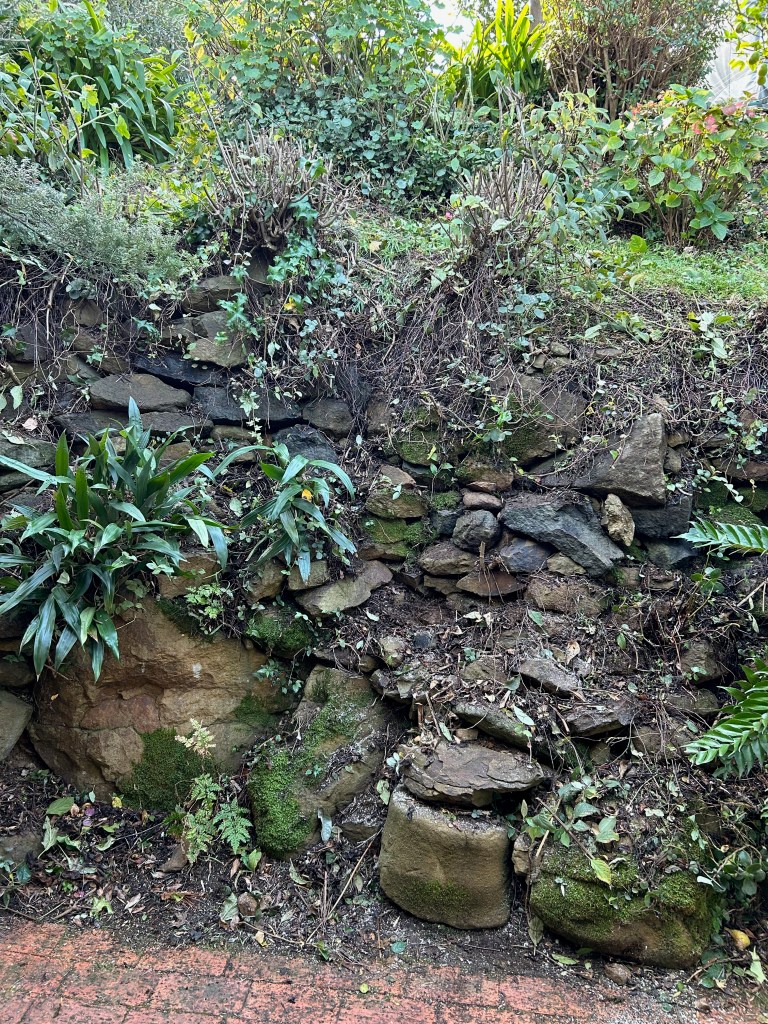
It was the ANZAC long weekend. The weather was calm and glorious. The only blight on the horizon was waiting for those biopsy results. Each day seemed to drag as I wondered when I should call the haemotologist for results. I couldn’t do anything until Tuesday as Monday was a Public Holiday. I kept myself busy gardening, which consists of chopping back ivy and other assorted creeping plants which cover our high rock wall. We even hacked out two sandpaper figs which were establishing themselves in the rocks.

Part of the rock wall. Still a lot of work to do.

At 11 o’clock on Tuesday I rang the doctor’s office. Yes, the results had arrived. Yes they had been forwarded to the doctor. He was seeing patients today and would contact me today or tomorrow. At 10 o’clock on Wednesday I rang again. The doctor would contact me if there was a problem or he needed to schedule a new appointment. What did that mean?

And now it is Thursday and I have heard nothing. I’m starting to think that might be good news but my faith in the Public Health System is shaken as until now communication and treatment has been prompt and efficient.

Hopefully in Reflections I will be able to tell you of further developments.

Y for Yo Yo Life

Life is a bit like a Yo Yo. The fact that the lymphoma has vanished is encouraging, although that is what I expected. It is the doubt cast over “possible malignant process in the mesentery” that causes concern.

The visit to the colorectal surgeon was an eye opener. Just as well I read the reviews about him online before attending the surgery. He didn’t have what one would call a bedside manner and mumbled as he talked so it was hard to understand everything he said but apparently he is very competent which is the most important thing.

He booked me into Wollongong Public Hospital for a laparoscopic biopsy of mesenteric lymph nodes in eleven days time. He couldn’t do it sooner and is going away in three week’s. He described the operation, especially the “exciting” bits where his face lit up with enthusiasm. Obviously he loves his job.

That means changing my medical appointment for my driver’s licence. In NSW, when you turn 75, you have to undergo a medical examination every year to prove you are still capable of being on the road. This time it will be accompanied by a Health and Welfare check which is funded by Medicare for the over 75s. That definitely does not apply to me, I keep thinking. I can’t be that old.

I have moved that appointment to thirteen days time so hope I’m up and about by then. As this is all happening in April, I hope to be able to inform you of the result of the biopsy by the time we get to Z.

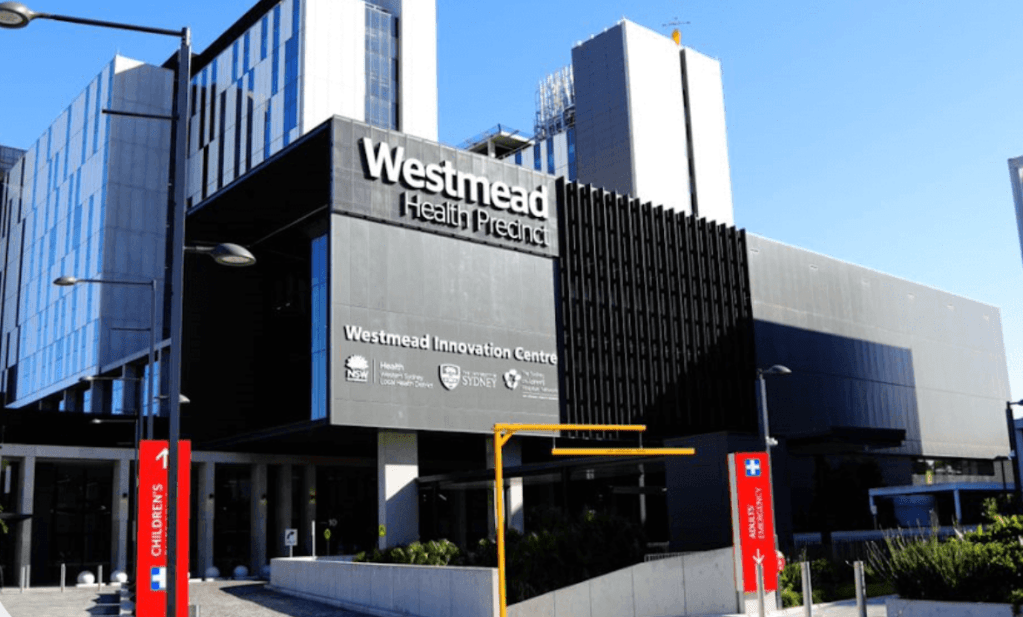
I have to consider the next option if the biopsy shows signs of lymphoma. The haemotologist offhandedly said if lymphoma recurred I would go to Westmead Hospital for CAR T-Cell Therapy and then I would be cured. Such confidence!

I thought I had better prepare for the worst so did some digging. Westmead Hospital is a leading centre in Australia for CAR T-Cell therapy. The specialised immunotherapy offered involves reprogramming a patient’s own T-cells to attack cancer cells. It involves an initial hospital stay of 10 to 14 days. Following discharge the patient must stay within one hour of the hospital for at least 30 days for close monitoring of side effects like cytokine release syndrome. The hospital is 1 hour and 20 minutes by car from my home and 33 minutes from my daughter.

That looks like a lot of driving! Let’s hope it doesn’t come to that but one has to be prepared. I wasn’t concerned when I spoke to the haematologist but reading the reports from the CT scan and the PET scan are considerably more scary.

Let’s hope Z is for Zero signs of lymphoma, Zero further treatment, and Zero worries. Or it could be Zen, a state of calm, peace and acceptance of the present moment.

X for an eXcursion to Wellness Afloat

With my laparoscopic biopsy scheduled for the 21st April I found out to my consternation that no swimming was allowed until the four incisions healed and that could take a month!

We had combined forces with my son to give Juliet a Wellness Sauna for her birthday. This involved jumping into Sydney Harbour between sessions of being slowly roasted so, as I was going too, we had to time it before the hospital visit.  

Friday the 17th April was forecast to be 29 Celsius which is very warm for the second month of Autumn. A rain storm was expected in the late afternoon and as our booking was for 2 o’clock I was a little apprehensive.  Any fears about jumping in with sharks were allayed as there is a netted enclosure off the pontoon.

Then I worried that saunas may be off limits after chemo.  I did a Google AI search which came up with mixed messages, but on the whole it seemed to say it was OK.

John waved me off on the train which was very crowded.  People were coughing so I worried I might catch something which would prevent my biopsy on Tuesday.

Changing trains at Redfern I found I was on the same carriage as Juliet so we travelled on to Circular Quay in a happy mood.

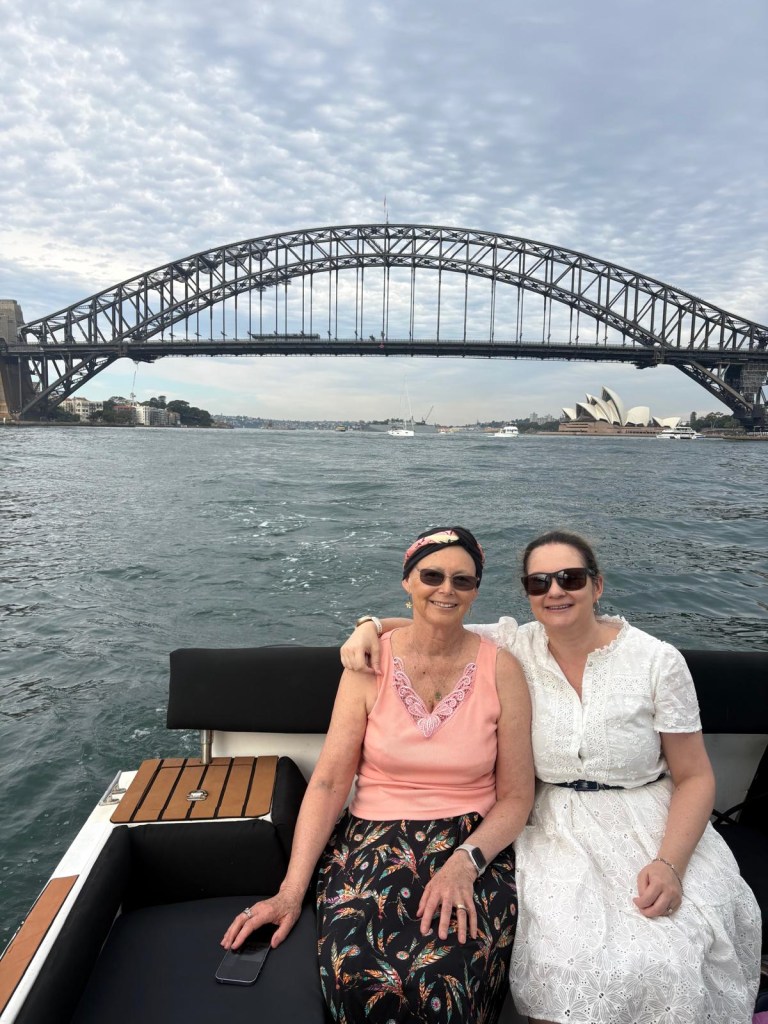
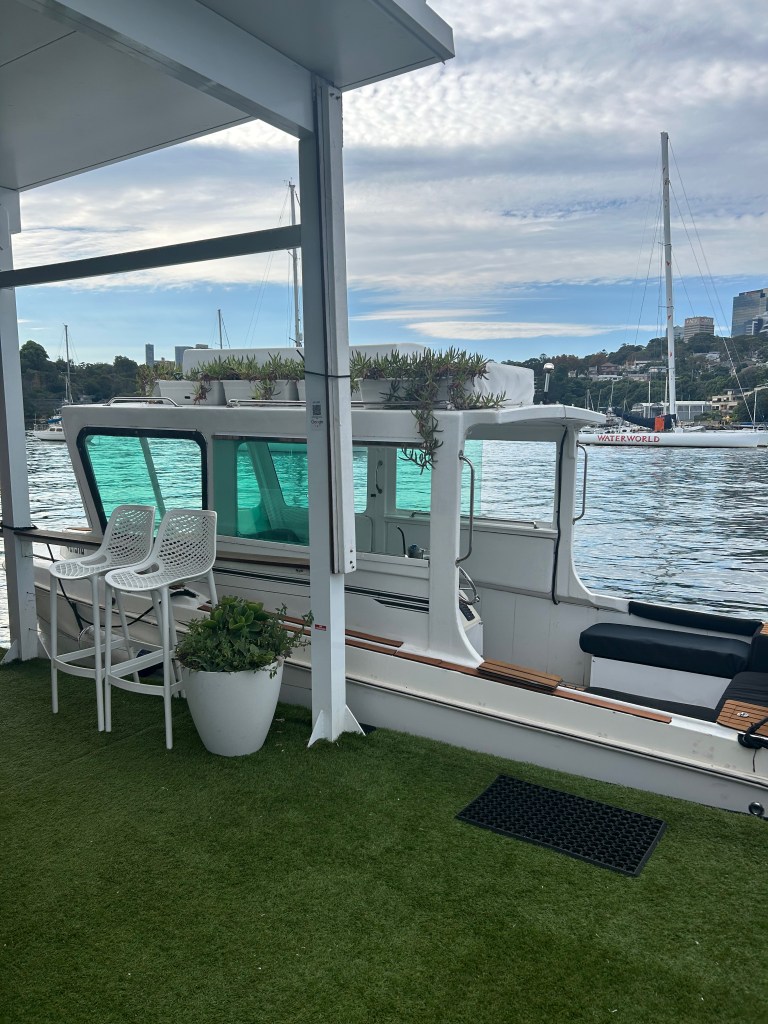
Lunch at a café overlooking Sydney Cove lightened our spirits even more although we spent a few anxious minutes looking for a “small white boat with potplants on the roof” while we waited at Campbell’s Cove.  We were pleased to find we were the only people on board and enjoyed a scenic boat ride where the driver stopped and took a photo of us with the bridge in the background.

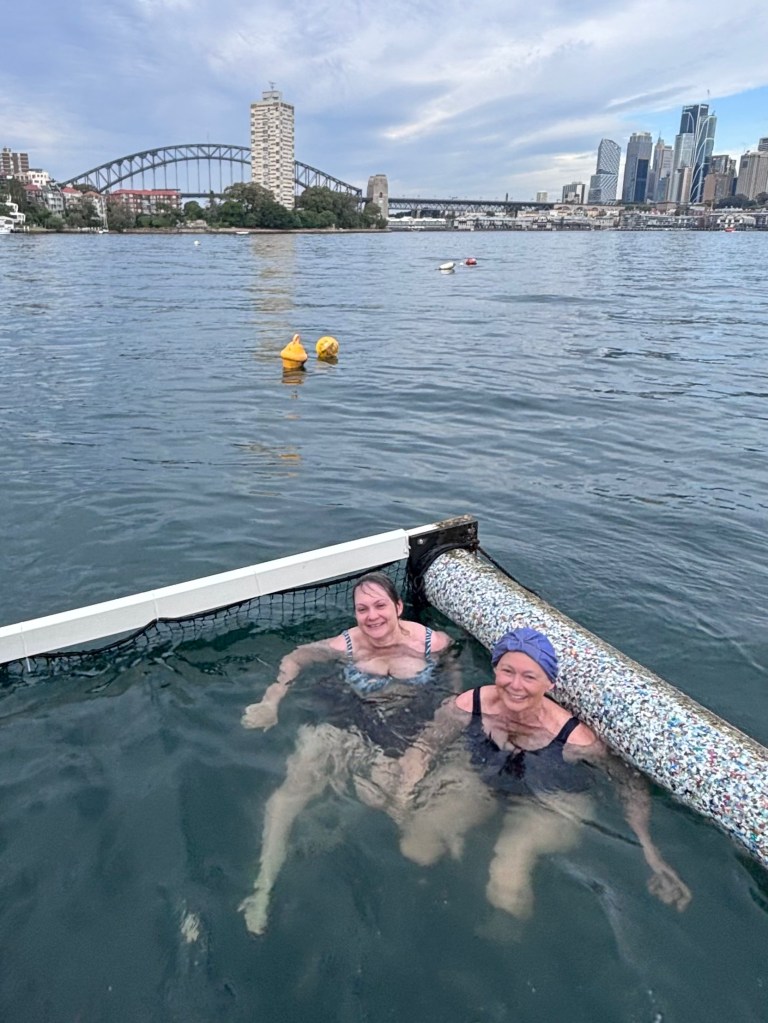
In front of the Coathanger

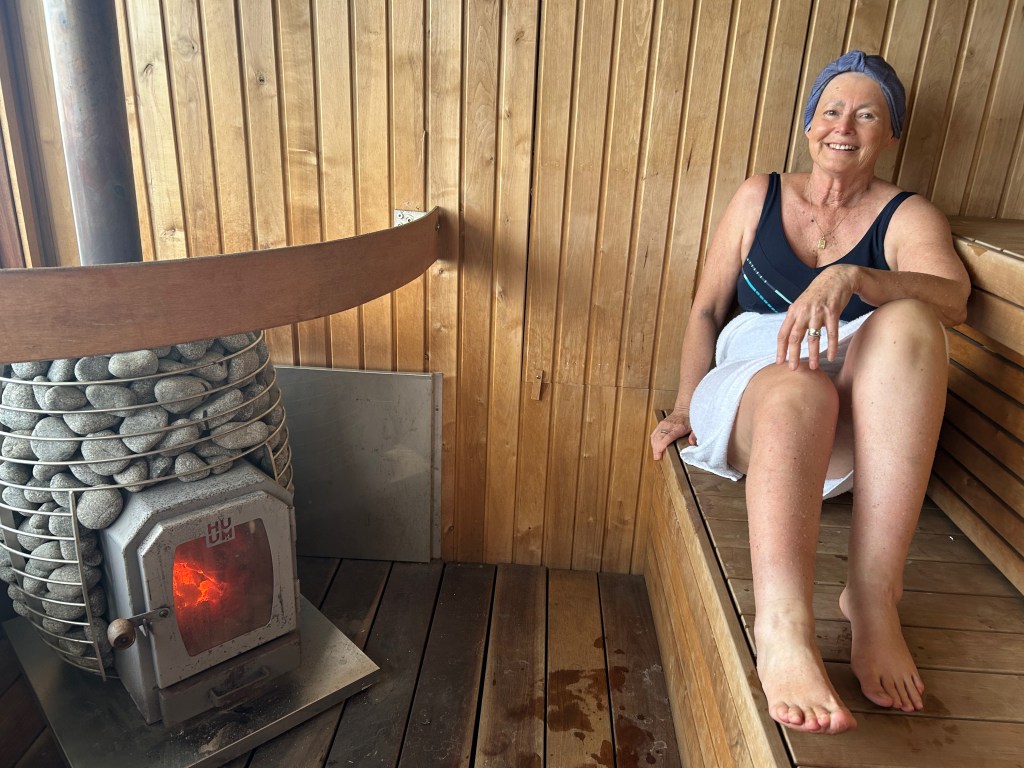
Our sauna was situated on a floating pontoon somewhere off Berry’s Bay. There was a deck covered with artificial grass and everything was made from recycled products except the wood which was sustainable timber.  Inside the sauna was a large picture window looking out over the harbour.  A wood burning stove surrounded by hot rocks provided the heat and a bucket of water with a ladle was designed to add a bit of steam and increase the humidity.

I’m enjoying the heat

After ten minutes we were glad to get out into the cooler air and didn’t hesitate to jump in the water which was cold at first but not unpleasant. The only problem was my cap floated off when I first jumped in so I was left bald headed.  Fortunately I was able to rescue it before it sank but should have learnt my lesson as next time it sank straight to the bottom.  I had other caps so didn’t have to go home in the train with a bald head.

Cooling off after a toasty sauna

Sitting on the pleasantly scented timber seats looking at the passing boats and the coals of the fire we talked companionably about many things.  I was so glad we were the only ones as it was possible to relax completely. Our guide sat in his boat to give us privacy but checked on us now and again to make sure we were all right.  Then he announced herbal tea was coming up in a few minutes so we used the fresh water cold shower and changed in the dressing rooms before having our tea and fruit.  This is “Wellness Afloat” so no alcohol is allowed and as the energy balls had nuts to which my daughter is allergic we had strawberries provided instead.

The boat with the pot plants on the roof

Our guide dropped us off at Barangaroo so we could catch the Metro to Central.  He promised to fish out my cap but I told him not to worry as I’ve plenty more. I’ve got a feeling he is going to find it at the bottom of that net and we are going to have to work out a way to get it back.  As a keen recycler he is not just going to throw it in the bin!

The trip home flew by as I read a book on my phone.  It takes an hour and a half, travelling through the Royal National Park and coastal villages with the lights of Wollongong ahead, welcoming me home.

W for Wending our Way to the Highlands (again)

After my last round of chemotherapy in January it took at least three weeks to start feeling well enough to go out into the world.  My doctor suggested four weeks as a benchmark for restarting Aqua Fit and Gym classes so with this in mind I felt able to book a Mothers’ Day present given in May, 2025.

It was a Mystery Picnic.  It could be booked for Sydney, Hunter Valley and various country locations but I chose the Southern Highlands because it was closer and we were beginning to feel the effects of the war in Iran on our fuel prices.

After consulting the weather forecast I booked a day which promised to be warm and sunny but not too hot. The first task was to determine where we were going.  The website gave a series of clues once we had redeemed our gift.

The first clue sent us to Fitzroy Falls but as there was no food to be picked up and we had been there many times before, we gave it a miss, thereby saving 16 kilometres worth of fuel.

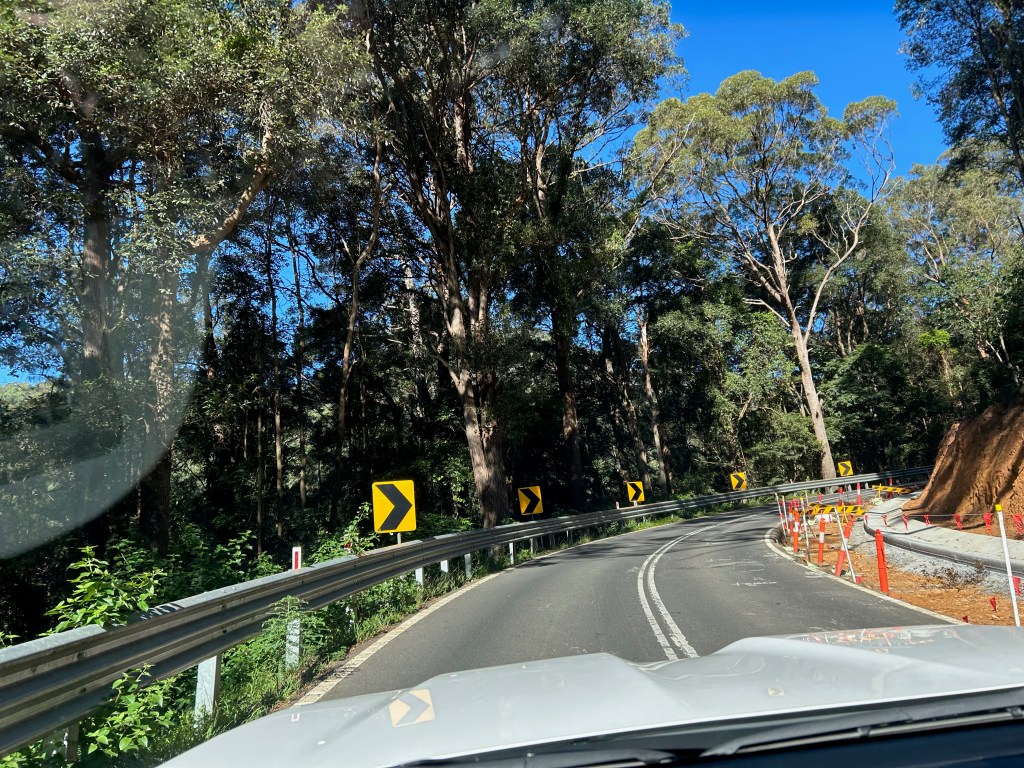
The next stop was Moss Vale so we elected to drive up Macquarie Pass.  It is undergoing some maintenance at the moment so we waited at a stop sign for a long time while traffic snaked along the single lane beside us.  Still, the sky was blue, the trees tall and magnificent and we were out on a mystery picnic so no time for complaining.

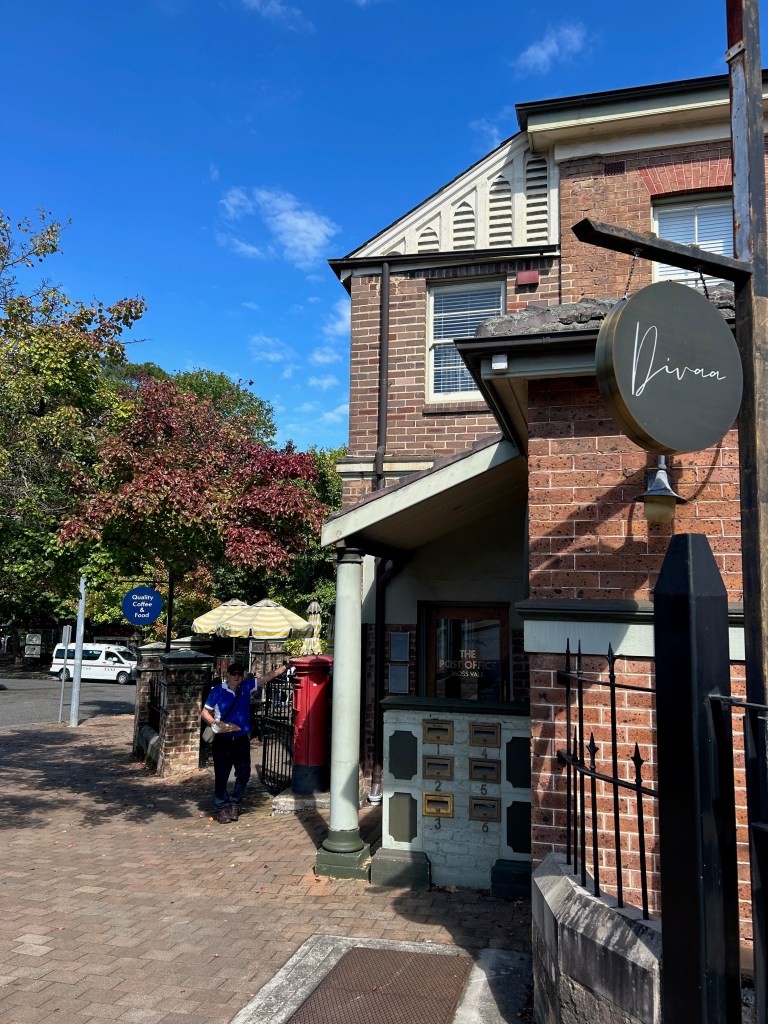
At Robertson we paused at Moonacres Kitchen, a favourite coffee shop, for a flat white and a pastry. Very nice but we should have waited until we reached the first stop of the mystery picnic which was the Moss Vale Post Office. Built in 1891, the same year as Keiraville Public School, it was a Post Office for 100 years.  PO’s all over the country have been abandoned as they have moved into smaller, more modern premises. They have often been turned into character filled galleries, cafes and restaurants.  The old Moss Vale PO underwent significant restoration in 2017 and now serves breakfast, lunch and beverages in a beautiful heritage setting.  We were able to choose two sweet treats from the cake cabinet which we took away with us for our picnic.

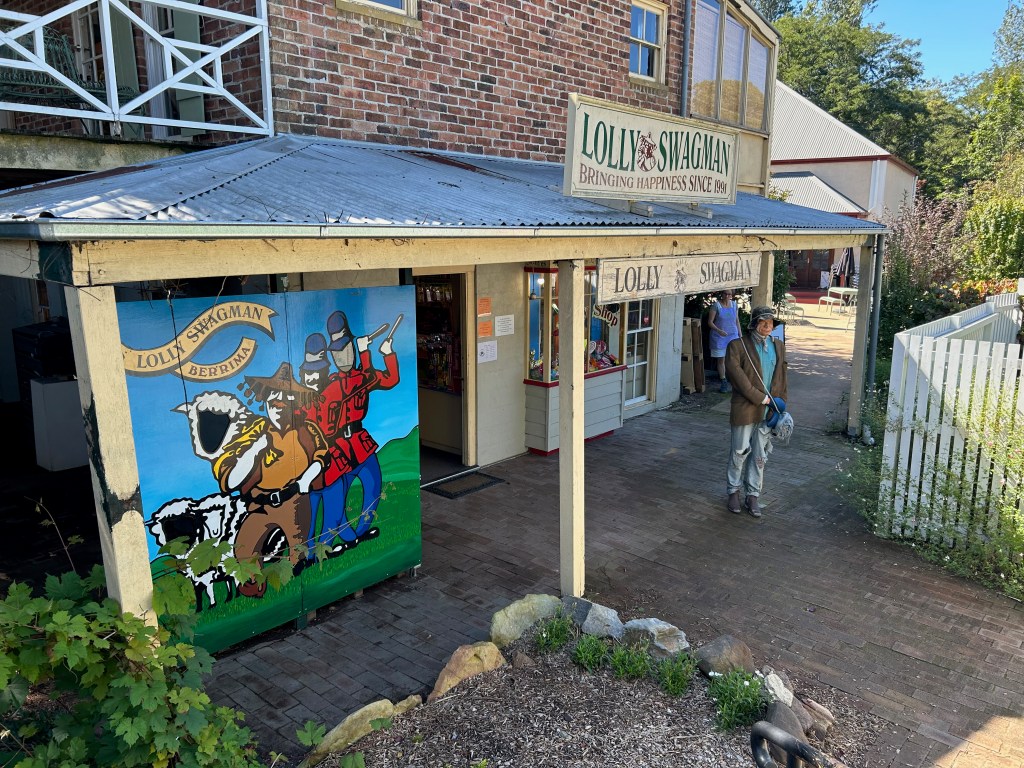
I had worked out the clues the day before so we would know where we were going so the next destination was the town of Berrima, ten kilometres away.  Our object was to find the Lolly Swagman, a shop selling fudge, as well as other lollies and sweets of all descriptions..  While I might try to avoid fudge as a general rule, it was free, so why not?  In fact, it was very tasty, two thick slices of plain chocolate  plus cherry ripe. Of course we didn’t eat it then.  Might spoil our mystery lunch!

The next three destinations were all in Bowral, another ten kilometres away.  I am very familiar with this town as I went to Bowral High School for six years.  It has become a popular destination for day trippers from Sydney, especially at the weekend.

It was suggested we go and look at the Mary Poppins Statue but we skipped it this time.  We have seen the one in Maryborough, QLD and it seems Bowral is claiming PL Travers as well as Don Bradman even though both of these Australian icons were born elsewhere.

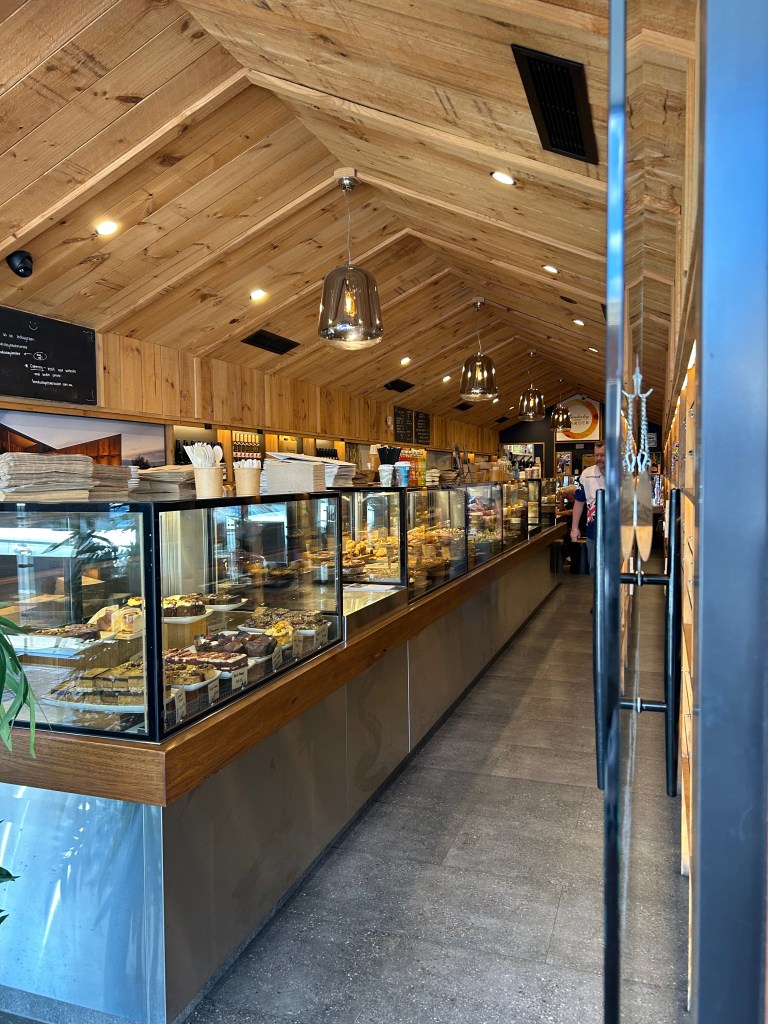
The Bendooley Estate Larder in Bong Bong Street, Bowral had us salivating as we entered the door.  John bought a pie for his dinner that night as I was going to book club. We picked up the mystery picnic wraps for our lunch and were on our way to Janek’s Café, a short walk down the street and around the corner on the Corbett Plaza.  I only had to say my name and we were advised to take two soft drinks from the fridge. 

Further down Bong Bong Street at the Raw and Wild Market Café we were handed a delicious looking antipasto platter.

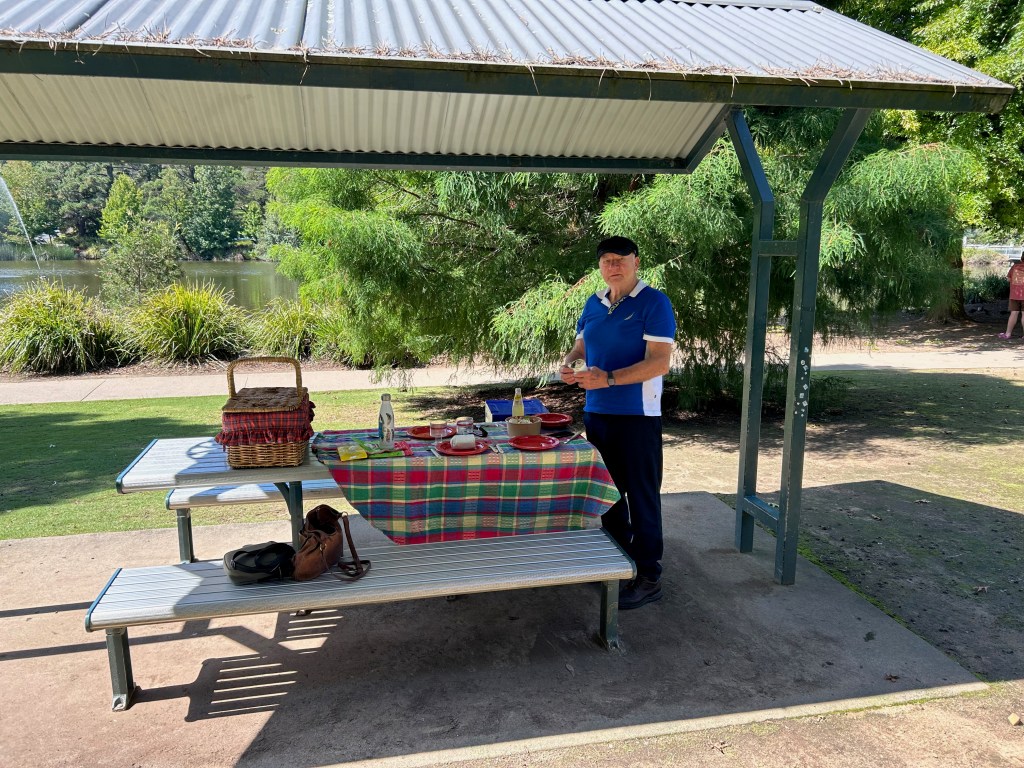
Seven kilometres on was our picnic destination at Mittagong’s Lake Alexandra.  We found a covered picnic table, hauled our esky and picnic basket down the hill and enjoyed our feast.  There was far too much food to eat in one session so it ended up lasting us for a couple of days.  A bus load of school children were noisily eating their lunches nearby (but not too close)  making me think back to my first home prac which I completed in 1970 at Mittagong Public School, just behind the lake.

Lake Alexandra is man-made, created in 1875, and was used to supply water to steam engines carrying coal to the Fitzroy Iron Works. I was interested to read that the lake was formed accidentally when an embankment was built to transport coal and coke from the back of Mount Alexandra to the iron works. Since the 1890s it has been a public recreational park.

It was time to head home, this time along the Hume Highway and down to Wollongong via the Picton Road. What a great day and a great present from my family!

V for Valiant Nurses of WWI

As today is ANZAC Day I thought to write about the book that has been keeping me company for the past few weeks.  It is “The Daughters of Mars”, the 29th novel by Thomas Keneally.  Probably best known for his book Schindler’s Ark, made into the movie Schindler’s List, Keneally sets this book in the First World War, on the hospital ships off Gallipoli, the medical facilities on Lemnos and off to the Western Front in war torn Europe.

I read it as a book a couple of years ago and enjoyed it, as much as you can enjoy a book about death and destruction.  This year it was nominated by our book club for the April discussion.  I decided to listen to as an audio book this time and found it was available on BorrowBox.

There are quite a few characters so it may be worthwhile noting their names and a few characteristics to avoid confusion, whichever way you choose to experience this book.

The story begins with two sisters.  Naomi, the older one, has escaped the dairy farm in northern NSW and is nursing in Sydney.  She appears confident and sophisticated compared to her younger sister Sally, who stayed on the farm with her parents and is a nurse in a country hospital.

Like most siblings they have their differences, but they find themselves on the same ship setting sail for Egypt.  Later, as their hospital ship hovers off Gallipoli, taking on board the wounded from that skirmish, I thought of my biological father who was wounded on the beach and taken by barge to such a hospital ship.  

Note: For those who don’t know me and think that having a father who experienced Gallipoli is an impossibility, I have written a blog called A is For Ancestry. My father was nearly 60 when I was born and was 22 when he enlisted in WWI. His experience at Gallipoli can be read in X Marks the Spot. In the blog I changed Bert’s name to Ted as some of his children (my half brothers and sisters) were alive at the time.

Anyway, I think it added to my fascination with the book to imagine Bert joking with the nurses as he followed the same route from Egypt to Gallipoli, then to Lemnos, Rouen and Amien.

One of the most riveting parts of the book is the episode where the Archimedes, a hospital ship, is torpedoed as it approaches the Dardanelles.  By now we have become acquainted with the various characters and their different personalities so that the drama of the ship sinking and their attempts to save themselves and others is heart stopping.

Keneally goes into considerable detail describing the wounds and methods of treatment the soldiers experienced. I find this fascinating and try to imagine myself as a WWI nurse. I really don’t think I would have the courage.  Their dedication in impossible circumstances with often limited training transformed them into a new version of their former selves.

There are romances, as you would expect, mostly low key and threatened with the constant fear of separation. They blossom with the background of war but also the novelty of exploring new places.

I won’t give away the ending except to say some reviewers find it awkward and unworkable. I disagree. What it does is distance the reader from their immersion in the book. Maybe it is necessary to come up for air after five years of dealing with the slaughter and mutilation of “the war to end all wars”.

U for Under the Bridge

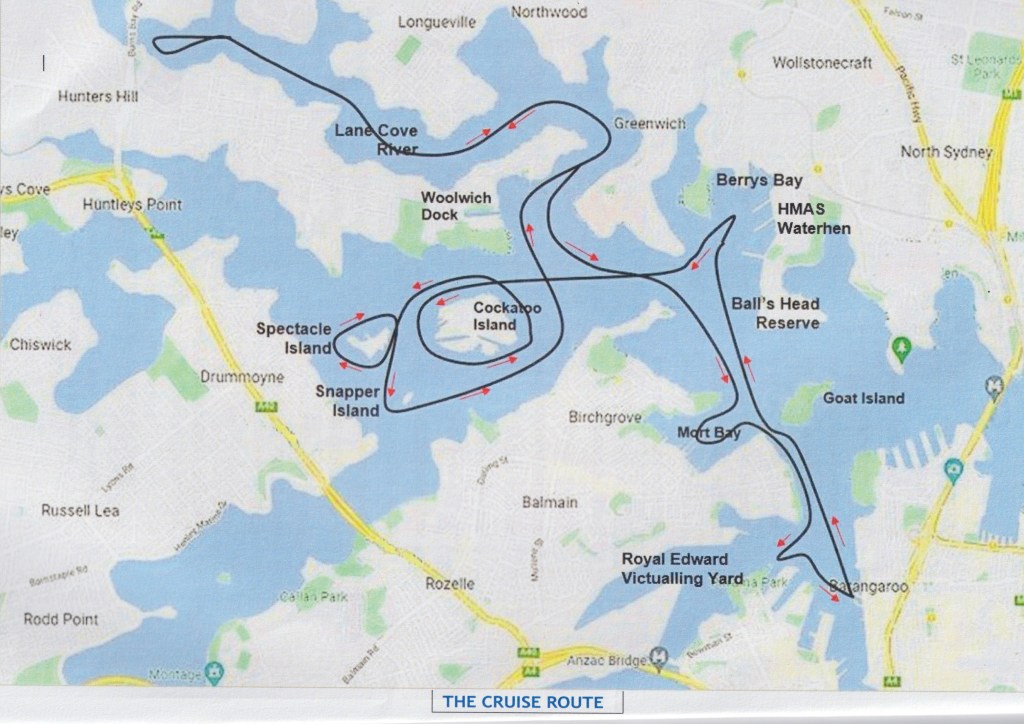
On Friday 13th March we planned to meet our friends at King Street Wharf number 3 and board the MV Bennelong for a Naval Historical Society Cruise of Port Jackson, west of the Sydney Harbour Bridge. This was first discussed and booked well before my diagnosis but was to happen three weeks after my last chemo so I hoped I would be well enough to enjoy it.

Naval Cruise of Port Jackson west of the Sydney Harbour Bridge

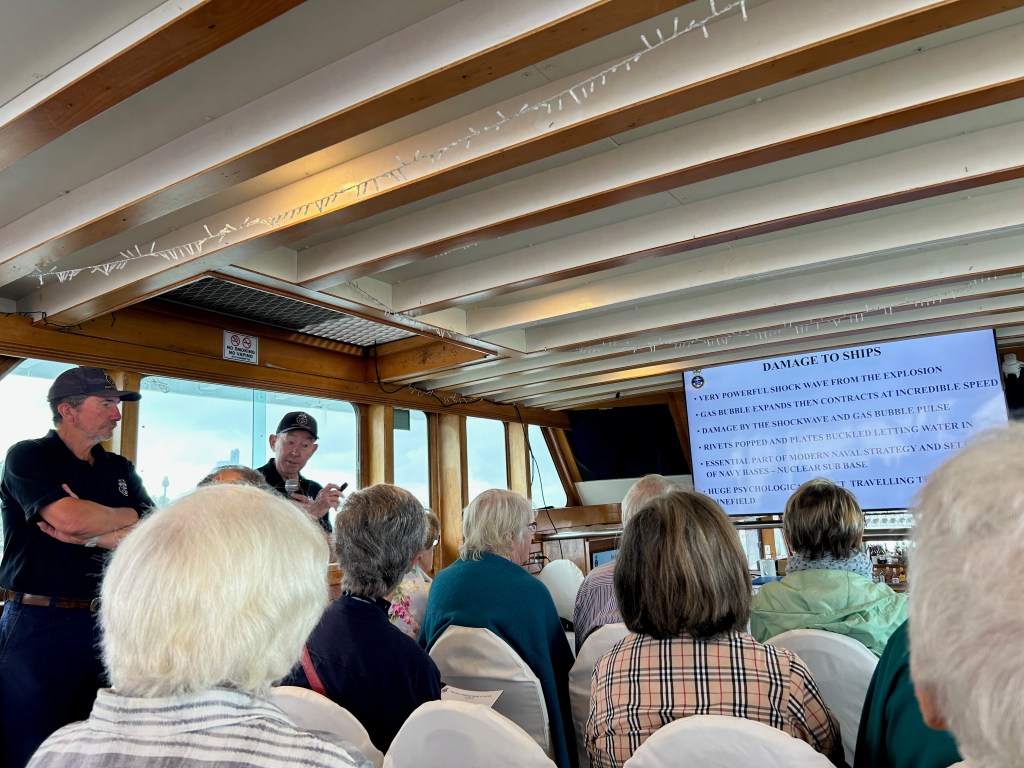
Unfortunately, one of our friends was ill and his wife came alone, understandably disappointed with having to do so. We were soon settled in the main cabin with a huge crowd of people, a screen in front of us and a couple of volunteers narrating.  I grew increasingly uncomfortable as I considered the stuffy air I was breathing, so when the announcement was made for morning coffee and masses of people headed for the tables, I escaped to the top deck.  Here the air was fresh and the view was spectacular. 

Trapped in a stuffy cabin

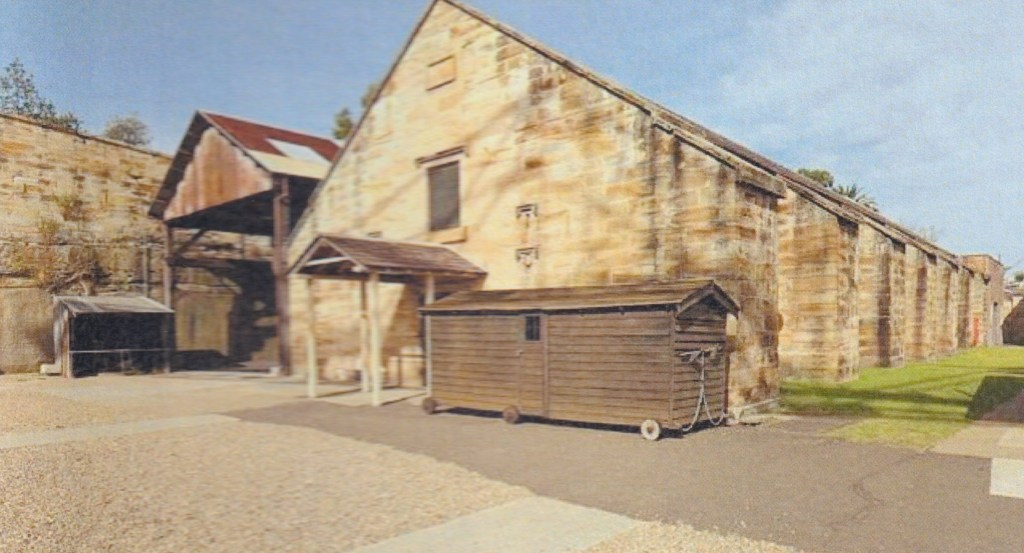
The tour visited four islands and HMAS Waterhen.  After leaving Barangaroo we passed Goat Island. In 1831 a quarry was established here to supply sandstone for the Sydney settlement. Convicts were housed on the island to mine the sandstone. In 1839 storerooms were built on the island to house gunpowder. 

Specially vented store rooms were built by the convicts to house naval and general gunpowder Photo from Naval Historical Society of Australia

As we approached Balls Head we were told the cliff face was once a quarry which was opened in 1940 to rebuild a graving dock at Garden Island. I couldn’t take a photo because I was still trapped on the downstairs deck.

A graving dock is a permanent, reinforced concrete basin built at the edge of a waterway used to construct, repair, or maintain ships below the waterline. It operates by flooding the dock to float a vessel in, sealing it with a watertight gate, and pumping out the water to leave the ship supported on keel blocks.

We sailed on to HMAS Waterhen which had once been the name of a ship but in 1962 was established as a support base for six mine sweepers. Waterhen is now the Navy’s lead establishment for mine warfare. The base is occupied by professional sailors and home to mine countermeasure equipment and technology.

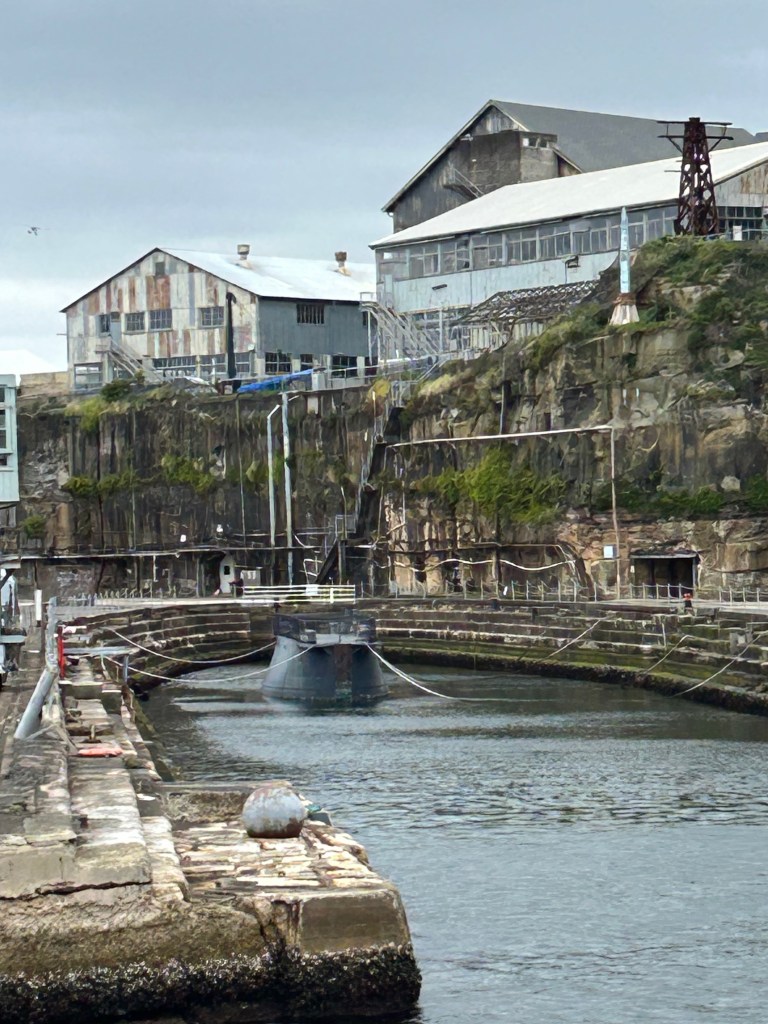
We circumnavigated Cockatoo Island which became a convict prison in 1839.  The Fitzroy Dock was built by convicts and completed in 1857.  The dockyards were the home of ship building, with the last ship, HMAS Success, completed in 1984.  It closed in 1992, the last project being the refit of the submarine HMAS Orion. 

Cockatoo Dockyards

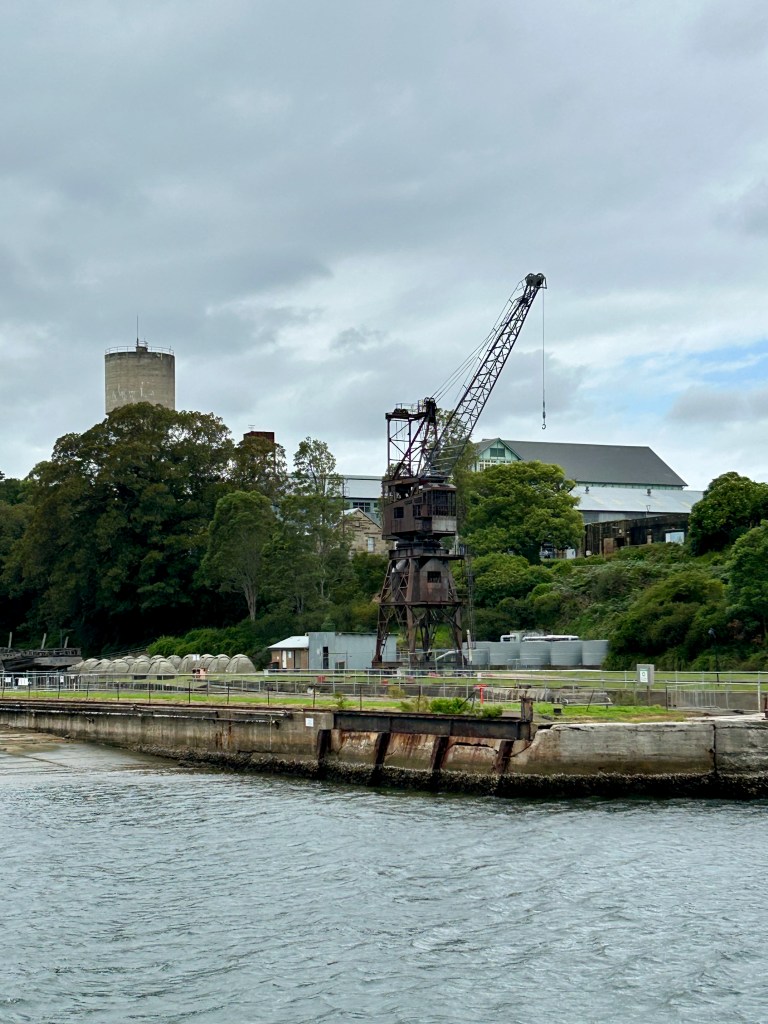
Aeroplanes were also designed and built here between 1929 and 1934, including for Charles Kingsford Smith, who is famous for completing the first transatlantic flight from the USA to Australia in 1928. Two of the cranes on Cockatoo Island have been restored and operate for public viewing.  The rest have disappeared or are unused.

A working crane with glamping tents on the left hand side

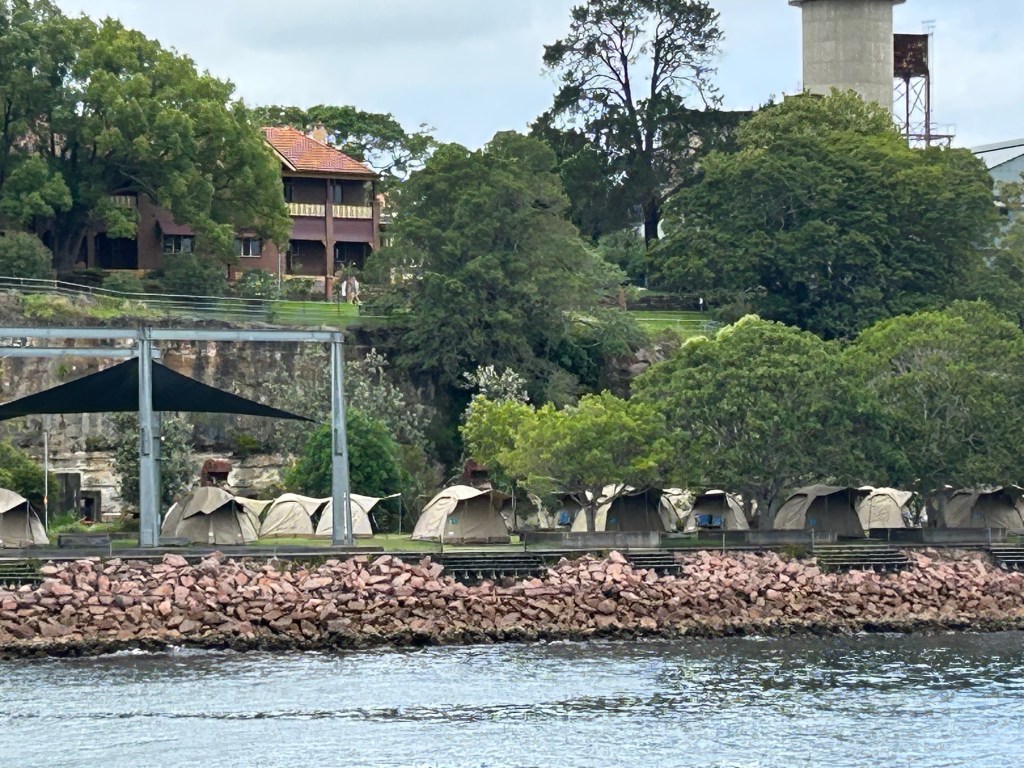
Rows of Glamping Tents overlooked the water.  We had planned to stay here with friends a little over a year ago but contracted Covid the day before we were to go.  At least today’s excursion on the water was happening and nothing prevented us from enjoying it.

Glamping tents on Cockatoo Island

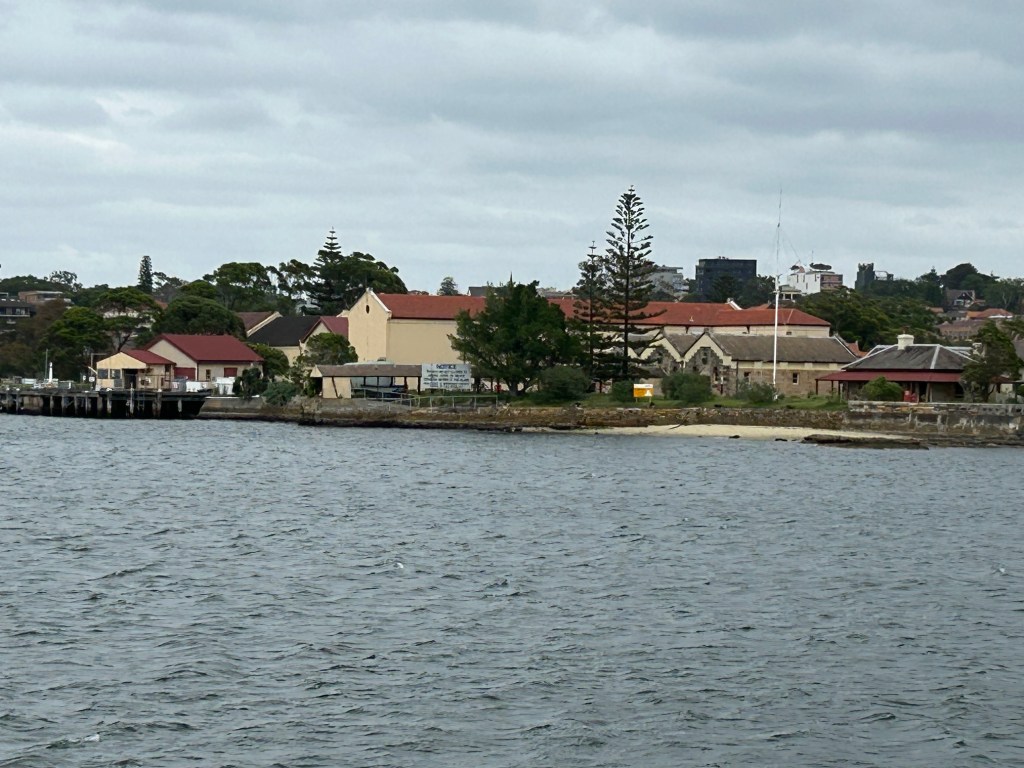
A small island named Dawes Island and renamed Spectacle because of its similarity to a pair of opera glasses captured our imaginations as it is for sale by the Navy.  A number of historic buildings cover the small densely built island where spoil from the old Balmain Coalmine enlarged it considerably. Buildings include the magazine, built 1856, cooperage, barracks, residence and a railway line. The island is the oldest naval explosives manufacturing and storage complex in Australia. Originally built to store gunpowder, the complex was converted to store naval munitions in 1893.  It was used for shell filling in WW1, making small calibre ammunition in WW2 but has not been active since then except for storage. Until recently it housed the Naval Repository, a collection of relics and artefacts and was open for inspection but we were told that everything has been moved to another location and the island is waiting for a new owner.

Spectacle Island

A friend of mine suggested that a number of us from our aqua group should buy it and turn it into a retirement resort for ourselves. 

 “Only if it has a helicopter for hospital visits,” said I, thinking of all those trips to hospital I have made in the last few months.

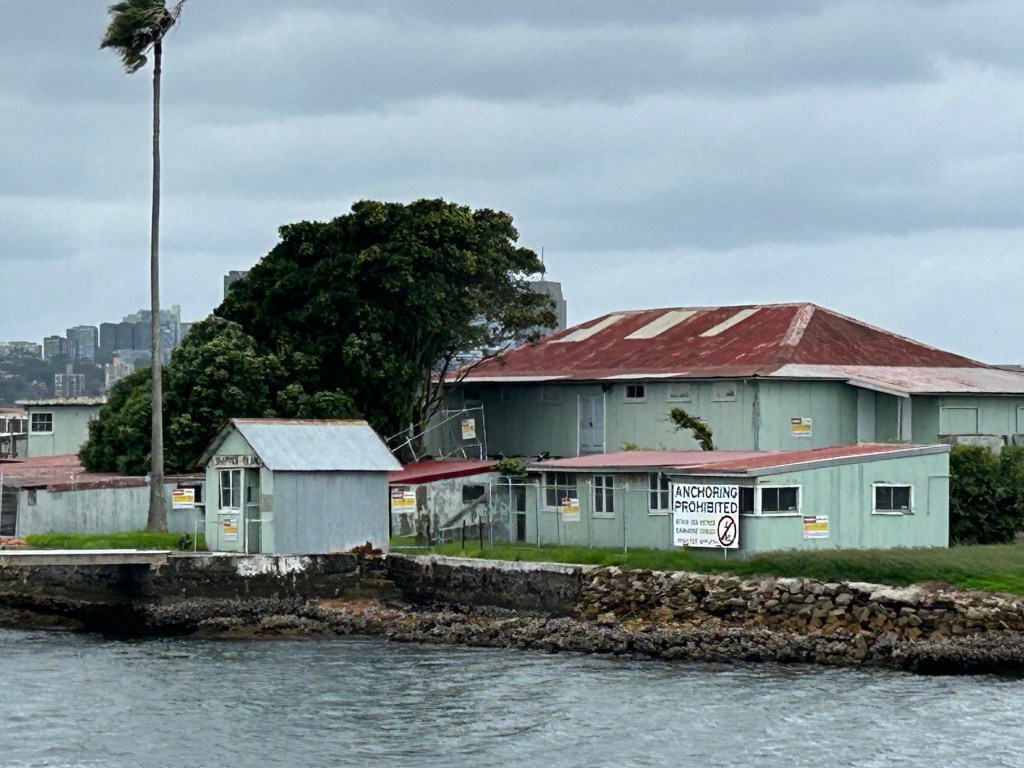
The smallest harbour island is Snapper Island.  As it was so small it was rarely visited although in WW1 it was used to store ship’s parts. In the 1930s the island was levelled and made into a ship shape with mining spoil.  It became a base for training sea cadets but in WW2 it was used by the US Military and the Royal Navy. It returned to the Sea Cadets until the 1960s.  A friend of mine told me she went there to a Scout Camp with her son in the 1980s and would prefer to forget the experience.

Snapper Island

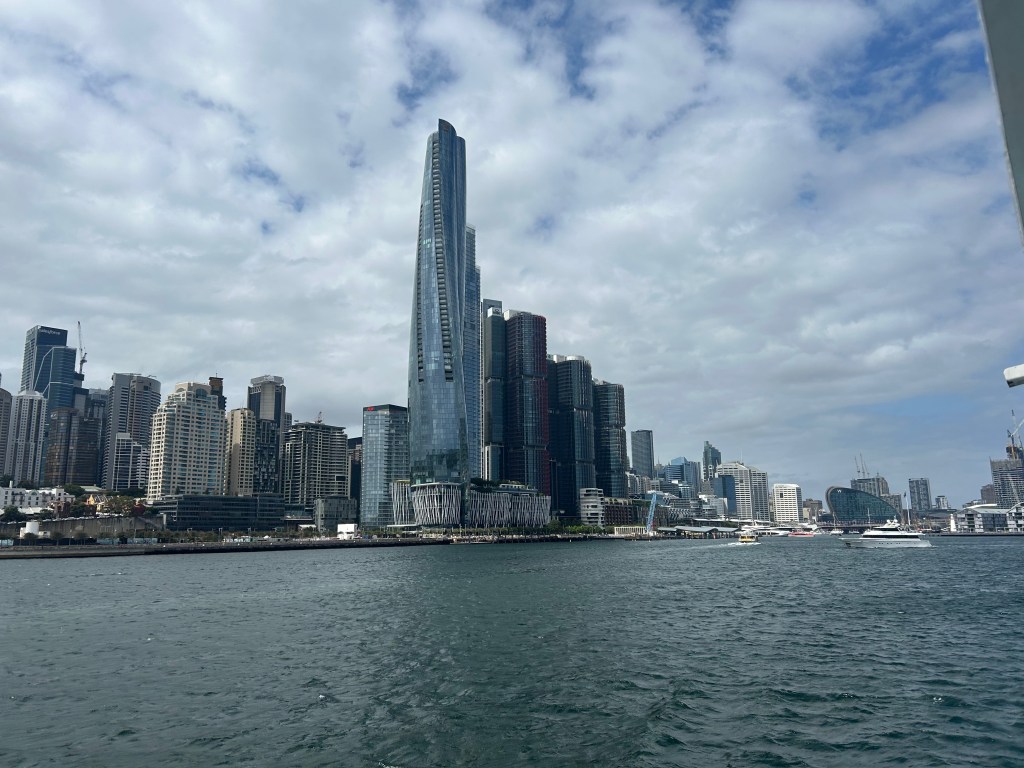
As we returned to Barangaroo we passed Mort Bay where Sydney’s first graving dock was built in 1855. During WW2 14 Bathurst Class Minesweepers and 4 River Class Frigates were built here. There were shipyards at what is now Pyrmont, Barangaroo and Darling Harbour.  These places are now home to offices, restaurants and high-rise accommodation.

Heading back to Barangaroo

So ended our day on western Sydney Harbour.  We considered visiting the Maritime Museum at Darling Harbour but I was flagging and looking forward to a rest at the hotel so we walked the 1.5 kilometres back.

We thought we would eat at one of the many restaurants near the hotel but forgot it was a Friday night.  At 6.30 pm there were long queues of people outside most of the eateries.  Still very conscious of people and germs I wasn’t keen to join them.  Just near our hotel we found two spare seats in an Indonesian Restaurant called  D’Penyetz & D’Cendol  (a chain with over 100 outlets worldwide) where we were relieved to sit and eat tasty food.

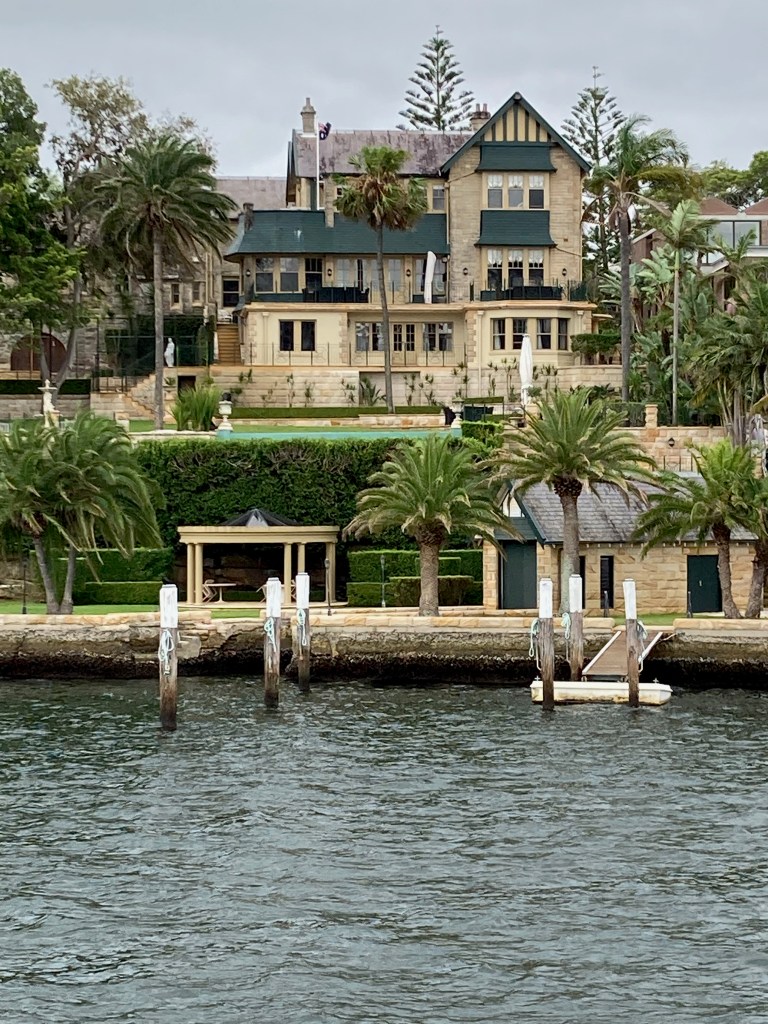
Just so you can see how the other half lives here is a fantastical waterfront house.

Imagine cleaning all those windows!

T for Travelling Onwards

The Sydney Harbour Cruise had been planned for six months, well before my diagnosis, so I had wondered if I would actually make it.  My granddaughter Cordelia* was having a birthday the day before and I was keen to give her the bracelet and book of stories on the actual day so it combined nicely with our other plans.

Fortunately, I felt better on Thursday, March 12 than I had previously so I was excited at the prospect of staying in a hotel, eating out, meeting up with family and going on a harbour cruise with friends.  I had waited a long time to escape from my prison so when the Uber arrived at my front door I couldn’t believe it was really happening. As a precaution on the train I wore my super-efficient mask which was suffocating to say the least. The hour and a half train trip flew by, we changed at Central for Town Hall and then wheeled our luggage to Rydges, Darling Square.

The room was ready so we gratefully dropped off our bags and examined the view.  It was of a plain, walled courtyard with a table and two chairs, not over inviting but very private.

After coffee and chicken burritos at a nearby cafe we began a long walk to Darling Harbour.  The area has changed so much over the last few years with new high-rise buildings promising expensive accommodation for the lucky ones.  My legs were protesting trying to keep up with John.

A rest and nap back in the room was essential, followed by a shower and dressing for dinner. We decided to walk again so my legs have really had a workout. It was about 1.5 kilometres down Sussex Street and then along the waterfront before we reached the Lotus restaurant.

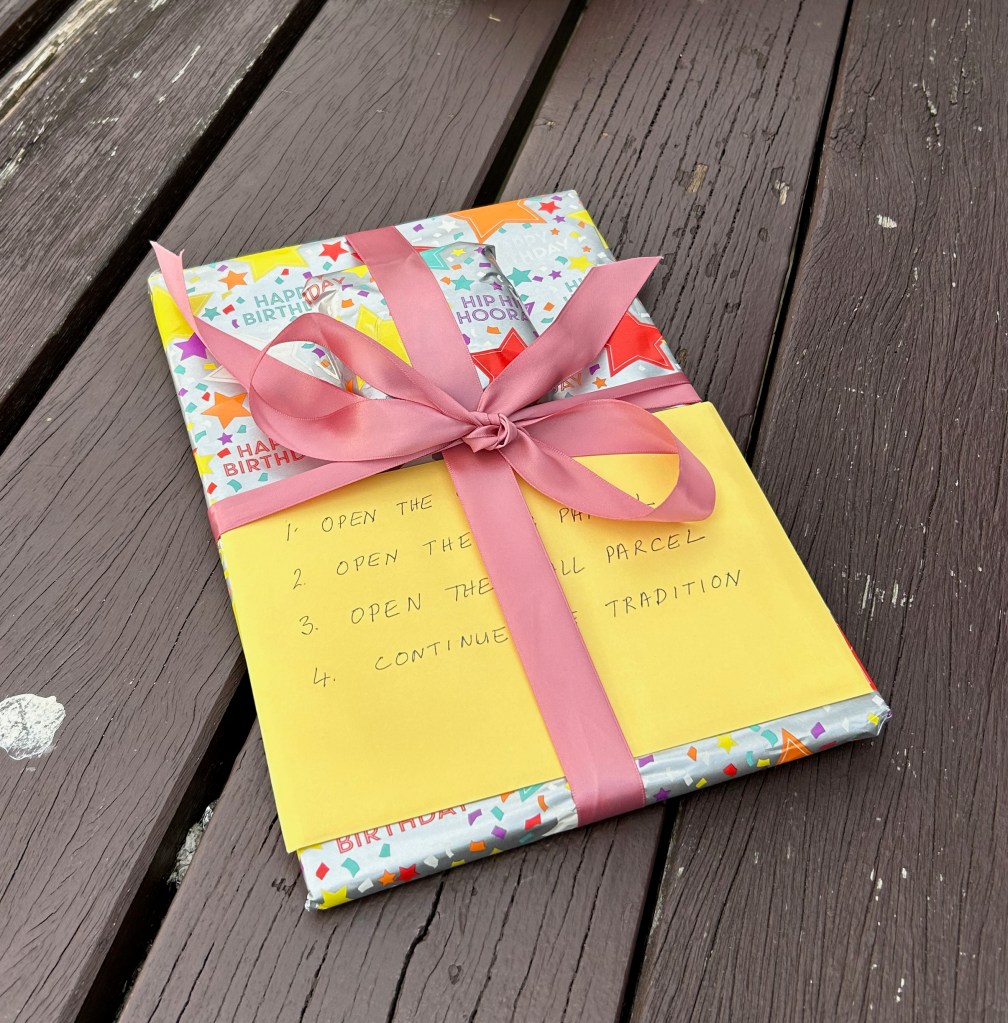
Juliet and Sebastian arrived first, followed by Duncan*, Juliet’s husband, who, because he had a cold, sat at the other end of the table from me. Cordelia was late from her drama class but arrived in time to open her present before the food arrived. The instructions were as follows.

  1. Open the card
  2. Open the large parcel
  3. Open the small parcel
  4. Continue the tradition

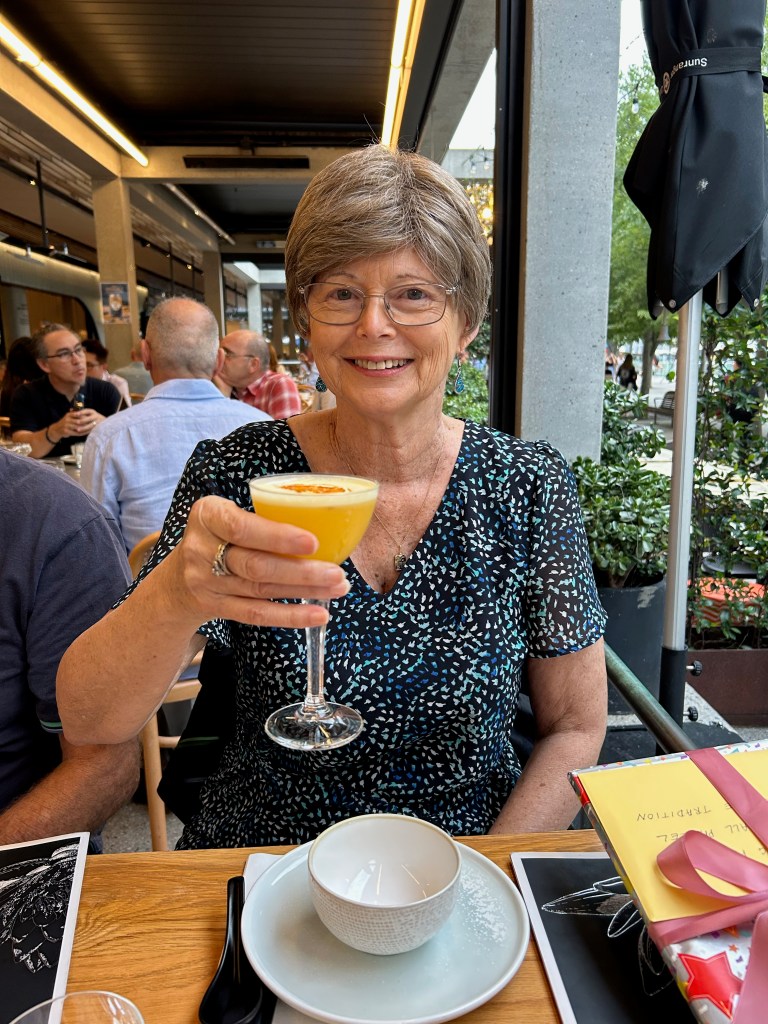
Juliet promised to keep watch over the bracelet and Cordelia eagerly scanned the book, promising to read it properly later.  The meal was a banquet so no thinking was required and it was quite delicious. Feeling decadent I ordered a mocktail which was small and expensive but what did it matter.  I was free!

Enjoying a mocktail wearing a wig

Always ready for a new experience I followed the others next door to Yo Chi where the formula is to choose ice cream and toppings (fresh fruit and/or lollies) and then have whole thing weighed.  In the interests of economy and good health, John and I shared a dish. We were surprised to hear Cordelia and Sebastian singing a song together at the piano.  Apparently on Thursday anyone who is brave enough to sing for their icecream gets it for free!

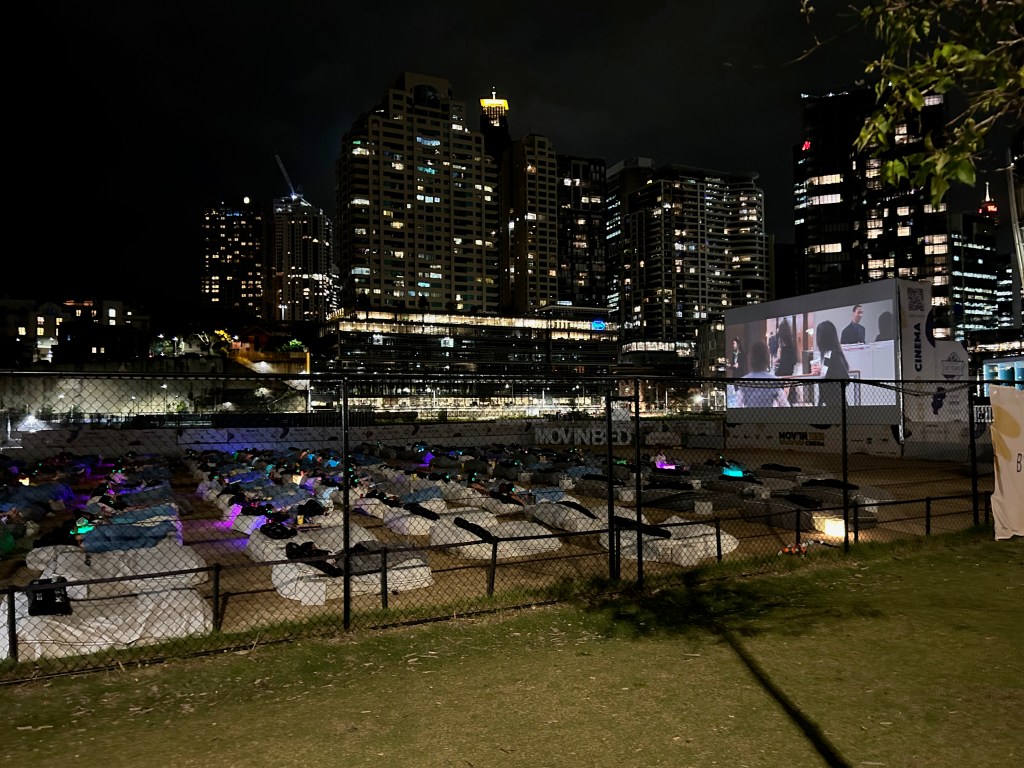
As we strolled to the Barangaroo Metro Station we passed an amazing sight.  Rows of people were lying on mattresses watching an outdoor movie. It was the premises of “Move’in Bed”.

Set on 280 tonnes of pristine white sand, this one‑of‑a‑kind event lets you watch hit movies from the cosy comfort of 150 cloud‑like queen-sized beds, all positioned in front of Australia’s largest outdoor cinema screen.

It was my first trip on the new Metro but after only two stops we bid farewell to the family and left the train at Gadigal.  A short walk and we were back at the hotel.  So far so good.  Everything was running like clockwork and I was tired but feeling almost normal.

  • Not his real name