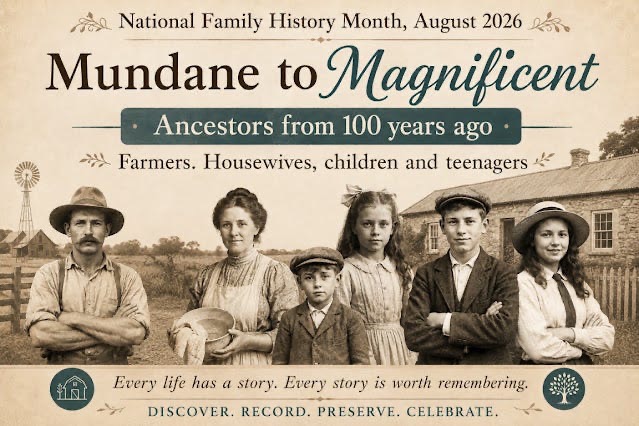
Each August, National Family History Month in Australia and New Zealand invites us to pause and look back. This year’s theme, Ancestors: Mundane to Magnificent, may be interpreted with a simple question: what did our people’s ordinary days actually look like and where, within the routine, did something like magnificence quietly live?
Carmel of Carmel’s Corner has created a Geneameme to celebrate Family History Month. Carmel’s idea for the Geneameme is to look at which of our ancestors were alive in 1926. She asks, “Who was alive in 1926, how old were they, what were their circumstances? Join in and post about your ancestors this Family History Month.
I have chosen the maternal line first as it is relatively uncomplicated compared to my paternal line.
Maternal line in 1926
Christina Cameron Lock (Robbie) 1875 -1926 – my great grandmother, aged 50 in 1926.
Christina wouldn’t have seen much of 1926 because she died on the 21st January of that year. She left behind four adult children and her husband Reuben. Her Death Certificate says she died from Morbus Brightii (six months) and Apoplexy (2 days). Morbus Brightii or Brights Disease was a broad term for kidney disease or kidney failure. As a result her blood pressure would have risen to dangerous levels. This would have resulted in the stroke that finally killed her.
Reuben Benjamin Lock -1872-1943 – aged 54 in 1926
The year of 1926 was a bad time for Reuben, my great grandfather. Both his wife and his mother Emma Lock died that year. His eldest daughter Myrtle left her husband taking her daughter with her and his second daughter Ruby divorced her husband after he ran off to New Zealand. His two sons may still have been living at home but the eldest, Charles, was engaged to be married and would be leaving soon. Claude, the youngest, had learning difficulties so his future was uncertain.
Reuben moved around Victoria chasing opportunities. In 1926 he was a fruiterer in Terang but in previous years he had been a fishmonger and an agent for sourcing and supplying fish, fruit and vegetables. After Christina’s death he went back to Camperdown and returned to the occupation of fishmonger. This was not before he married again on the 11th September 1926. His new wife, Rosemary Emma, left him after two weeks owing to “disagreements on private matters”.
Reuben liked a drink at the pub and had had a long-suffering wife for 30 years. His new wife obviously found life with him unbearable.
Myrtle May Hall (Lock) 1896 -1976 – aged 30 in 1926
My grandmother married Walter Sydney Hall in 1916 when she was 20 years old and went to live with him in his house in Railway Crescent, Williamstown, Victoria. She gave birth to my mother in 1917. It appears that Walter was not living at the home for much of that time but at his sister’s house nearby. In 1926, perhaps spurred on by her mothers’ death, Myrtle left Williamstown and took her nine-year-old daughter to Glebe in Sydney. Here she continued her trade of dressmaking. Her day would have started early, lighting the fuel stove to heat the smoothing irons. By 9 am the clients would be arriving so Myrtle would be draping fabrics, pinning carefully and discussing the latest European fashions. On some days Myrtle might catch the tram to the city to select materials at Anthony Horderns or Mark Foys. Most days she would be sewing on her Singer treadle sewing machine. This would be followed by hand finishing hems and buttonholes and attaching beadwork.
Walter Sydney Hall (1870-1933) aged 56 in 1926
!926 was the year my grandmother left my grandfather, although he appears to have been living at his sister’s house according to the electoral rolls. He was a wood machinist at the Newport Railway Workshops. His day would be spent at either the dedicated log mill, sawmill or woodworking shop. At this time roughly 2.700 men and women worked onsite maintaining and building Victoria Railways rolling stock. He may have been involved in producing framing and interior panelling for the red suburban electric Tait trains and country passenger cars.
According to Myrtle, Walter’s main fault was that he gambled away the money he earned. The workshops were notorious for their gambling culture. Men would receive their weekly wages and immediately hand it over to an “agent” for a race that afternoon. As a keen AFL player in his youth Walter may have played a game called Trugo invented by the railway workers at Newport. It used a heavy rubber mallet to strike a rubber ring through a set of goalposts and was designed to be played in central yards during lunch breaks to keep the men away from illegal card games and SP bookies.
Elsa May Hall (1917-1997) aged 9 in 1926
Elsa, my mother, was born in 1917 in Williamstown to Myrtle (21) and Walter (47). 1926 was a year of upheaval for her. Taken out of her school in Williamstown she left her childhood home and her father for good. Her grandmother had also died in January. After searching for a new home she and her mother settled in Glebe, Sydney, NSW, where she started Forest Lodge Public School. While her mother spent her days making dresses for well-to-do ladies, Elsa made a close friend called Ruth and enjoyed playing netball at school. Her greatest joy was riding her scooter along the road in Jubilee Park opposite her home.
Paternal Side in 1926
The father I grew up with and who died of a heart attack when I was 10, had a very strong influence on my life, despite the short time I had with him. It was with amazement that I discovered when I was 64, through DNA, that he was not my biological father. I have therefore chosen to write about both fathers and also the grandmother I grew up with.
Ella Maud Price (Ridgway) 1875-1965 – aged 51 in 1926
My grandmother was born in Picton, NSW, married John Price in 1904, had a son Linden in 1907 and lost her husband (a stationmaster) to a heart attack in 1913. By 1926 she had spent years as a housekeeper for Mr Alfred Munro, a member of a large pastoral family in northern NSW. He had his own property called Boonal, near Boggabilla.
Her day would have started around 5.30am, lighting the fire in the wood stove and. making porridge, chops, damper and tea. Washing dishes, scrubbing kitchen tables, and managing the wood and water supply would be next. Beds had to be made, rugs shaken and slops emptied. The midday meal would then be prepared as it was the main meal of the day. Cleaning this up would be followed by baking bread, cakes and biscuits. Maybe mending, polishing and sweeping would take place. Then the evening meal would be prepared with potatoes and other root vegetables peeled. After serving the evening meal the dishes would be washed and the kitchen tidied again. Ella may have had help to perform these tasks which would have given her time to look after the chickens, collect eggs, feed any orphaned lambs and take photographs. This was her hobby and she enjoyed sending her pictures in to magazines along with articles about life in the bush and her strict views on the upbringing of children.
Linden John Ridgway Price (1907-1961) aged 19 in 1926
In 1926 my father Linden was living on the property called Boonal where his mother was a housekeeper. He had attended Newington for three years but left at the age of 15 in 1922. He had spent some time as a trainee wool classer but didn’t take to it. By 1926 the rabbit plague in Australia was widespread. Alfred Munro was keen to reduce the numbers of these creatures on his property so Linden and many other men spent their days trapping. He would have been up early in the morning, rolled out his swag and eaten damper with hot billy tea. He would then saddle his horse and check each trap along the Macintyre River, resetting the traps with scented pollard bait. A quick death for the rabbits and he would make for his camp, skinning the rabbits and putting their pelts on wire frames. He would salt the pelts to stop them from rotting, mend any broken traps and sharpen his blades. Life was made more difficult because of the impact of prickly pear. The rabbits chose to burrow beneath the thickets as they offered protection from predators. The bristles would lodge in the skin and cause festering sores for anyone laying traps near the pear thickets.
Albert Henshall !892-1952 aged 34 in 1926
Albert was my biological father and all I know is my parents were married 14 years with no children. They went to Mildura where they met Albert through business. I was born in 1951 and totally unaware that my DNA would indicate Albert was my father.
In 1926 Albert was a Soldier Settler in Red Cliffs near Mildura. He was married and had two little girls. His grape growing enterprise on the block he had been allocated was not going to make his fortune so he soon branched out. By 1926 he was concentrating on the commercial packaging, marketing and agency side of the grape growing industry. 1926 was the first full, uninterrupted, commercial harvest season. He started up the Red Sun Packing Shed which processed and distributed the region’s dried vine fruits. He also diversified as a real estate agent and auctioneer, ran for positions on dried fruit boards and became involved in local community activities such as setting up swimming clubs and regional sports.
What did our people’s ordinary days actually look like and where, within the routine, did something like magnificence quietly live?
I see hard work and suffering in this snapshot of life in 1926. Reuben, who tried to make a living transporting fish, fruit and vegetables to inland towns, Christina, who died a miserable death without the advantages of modern medicine, Walter, who helped build the trains for the state of Victoria, Myrtle, who crafted beautiful dresses while her private life was in chaos, Elsa, who survived the tremendous upheaval in her young life and began to enjoy a new beginning, Ella, who worked hard from dawn until dusk on a lonely cattle station, Linden, who threw away opportunities but played his part working on his employer’s property and finally Albert, the WWI veteran, who grasped opportunity with both hands and became a successful businessman.


 The Curry Apple Orchard