U for Under the Bridge

On Friday 13th March we planned to meet our friends at King Street Wharf number 3 and board the MV Bennelong for a Naval Historical Society Cruise of Port Jackson, west of the Sydney Harbour Bridge. This was first discussed and booked well before my diagnosis but was to happen three weeks after my last chemo so I hoped I would be well enough to enjoy it.
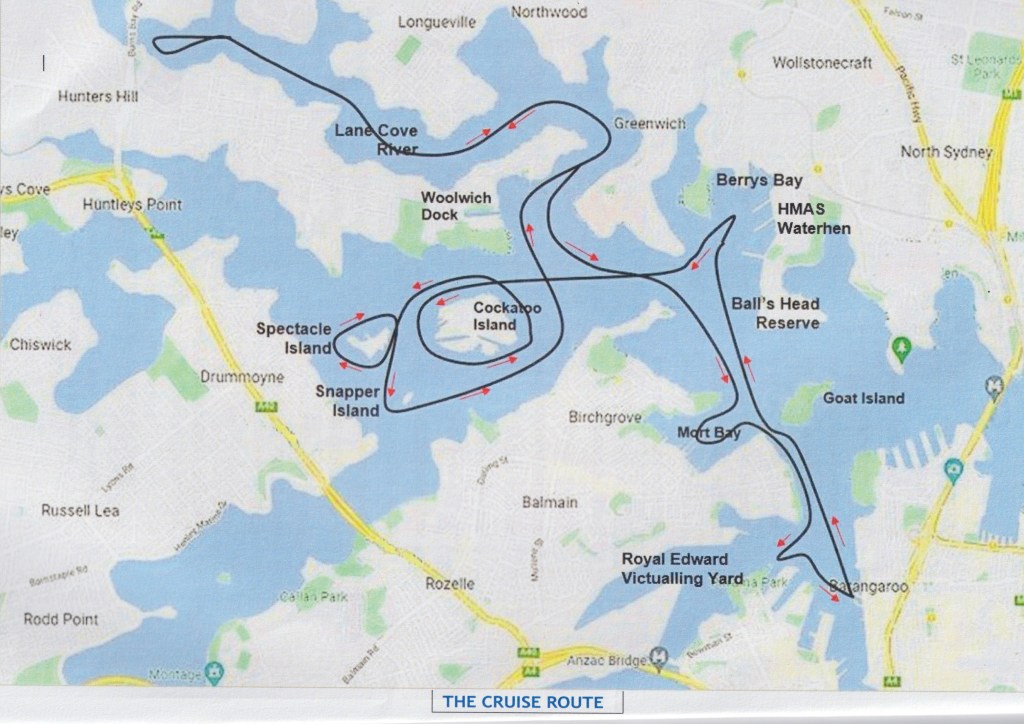
Naval Cruise of Port Jackson west of the Sydney Harbour Bridge

Unfortunately, one of our friends was ill and his wife came alone, understandably disappointed with having to do so. We were soon settled in the main cabin with a huge crowd of people, a screen in front of us and a couple of volunteers narrating.  I grew increasingly uncomfortable as I considered the stuffy air I was breathing, so when the announcement was made for morning coffee and masses of people headed for the tables, I escaped to the top deck.  Here the air was fresh and the view was spectacular. 
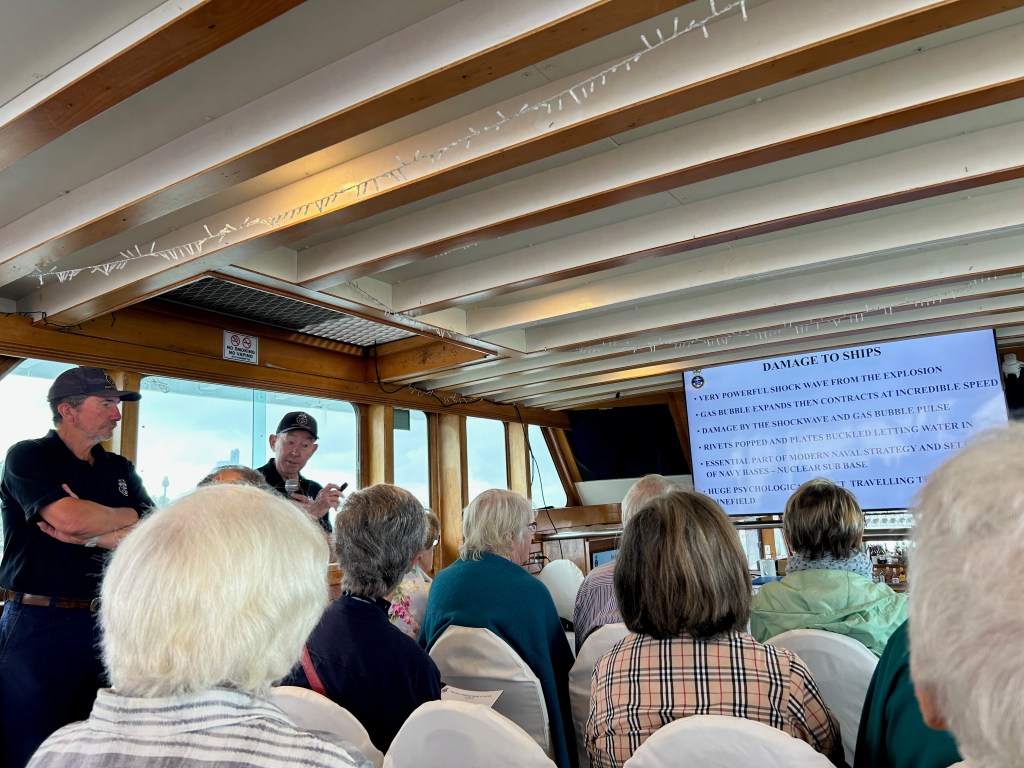
Trapped in a stuffy cabin

The tour visited four islands and HMAS Waterhen.  After leaving Barangaroo we passed Goat Island. In 1831 a quarry was established here to supply sandstone for the Sydney settlement. Convicts were housed on the island to mine the sandstone. In 1839 storerooms were built on the island to house gunpowder. 
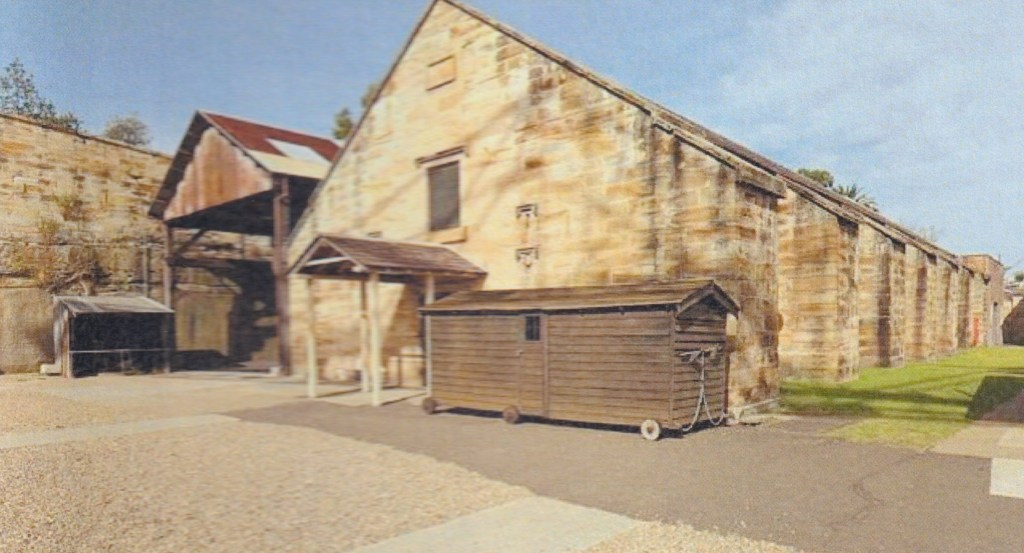
Specially vented store rooms were built by the convicts to house naval and general gunpowder Photo from Naval Historical Society of Australia

As we approached Balls Head we were told the cliff face was once a quarry which was opened in 1940 to rebuild a graving dock at Garden Island. I couldn’t take a photo because I was still trapped on the downstairs deck.

A graving dock is a permanent, reinforced concrete basin built at the edge of a waterway used to construct, repair, or maintain ships below the waterline. It operates by flooding the dock to float a vessel in, sealing it with a watertight gate, and pumping out the water to leave the ship supported on keel blocks.

We sailed on to HMAS Waterhen which had once been the name of a ship but in 1962 was established as a support base for six mine sweepers. Waterhen is now the Navy’s lead establishment for mine warfare. The base is occupied by professional sailors and home to mine countermeasure equipment and technology.

We circumnavigated Cockatoo Island which became a convict prison in 1839.  The Fitzroy Dock was built by convicts and completed in 1857.  The dockyards were the home of ship building, with the last ship, HMAS Success, completed in 1984.  It closed in 1992, the last project being the refit of the submarine HMAS Orion. 
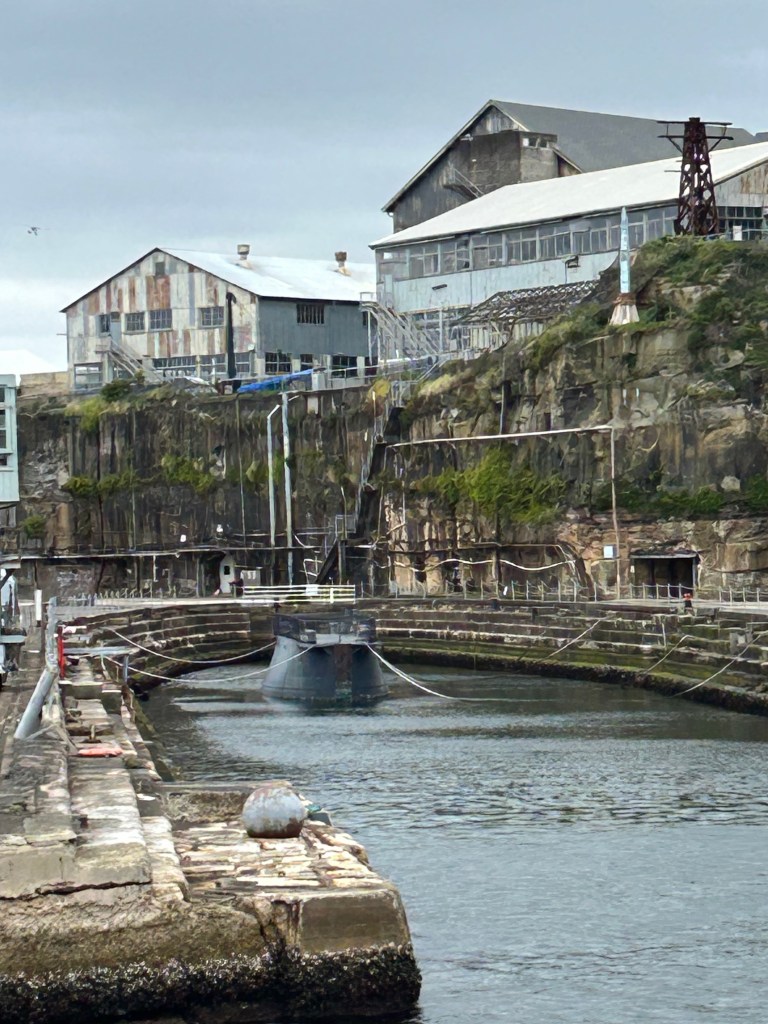
Cockatoo Dockyards

Aeroplanes were also designed and built here between 1929 and 1934, including for Charles Kingsford Smith, who is famous for completing the first transatlantic flight from the USA to Australia in 1928. Two of the cranes on Cockatoo Island have been restored and operate for public viewing.  The rest have disappeared or are unused.
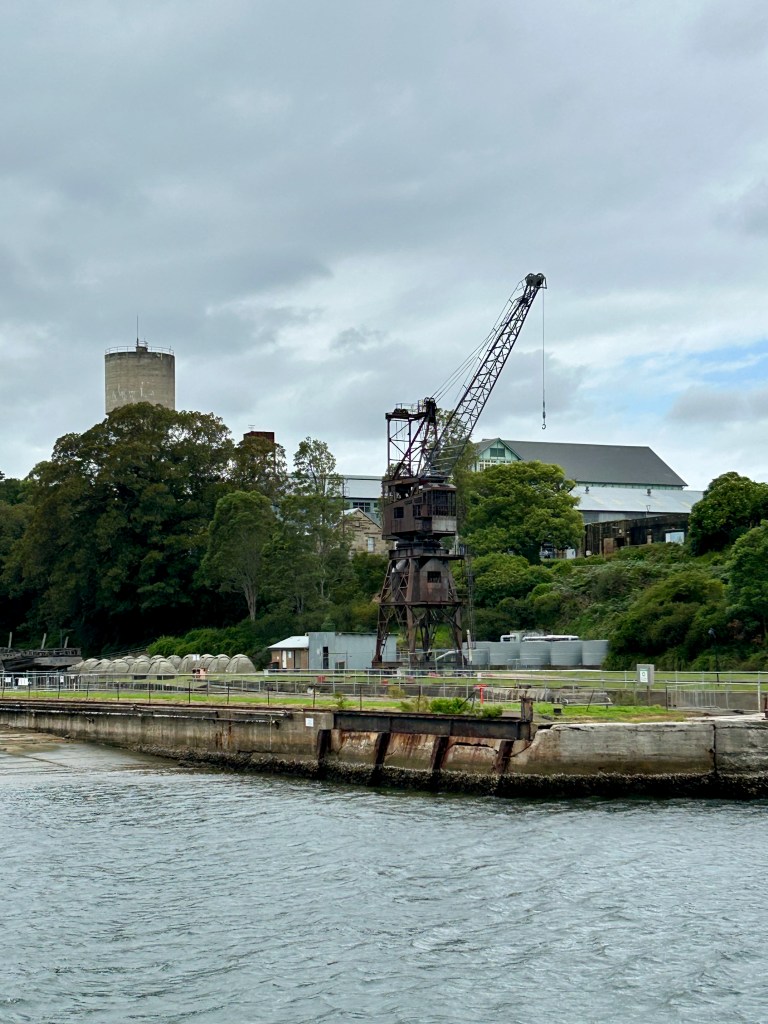
A working crane with glamping tents on the left hand side

Rows of Glamping Tents overlooked the water.  We had planned to stay here with friends a little over a year ago but contracted Covid the day before we were to go.  At least today’s excursion on the water was happening and nothing prevented us from enjoying it.
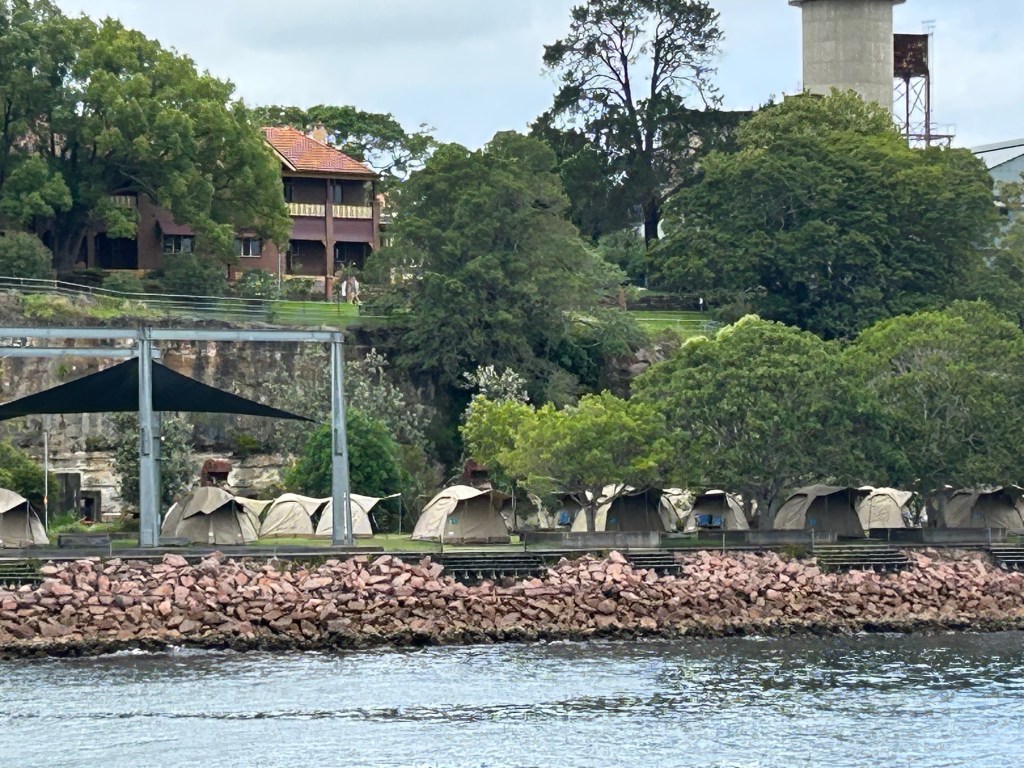
Glamping tents on Cockatoo Island

A small island named Dawes Island and renamed Spectacle because of its similarity to a pair of opera glasses captured our imaginations as it is for sale by the Navy.  A number of historic buildings cover the small densely built island where spoil from the old Balmain Coalmine enlarged it considerably. Buildings include the magazine, built 1856, cooperage, barracks, residence and a railway line. The island is the oldest naval explosives manufacturing and storage complex in Australia. Originally built to store gunpowder, the complex was converted to store naval munitions in 1893.  It was used for shell filling in WW1, making small calibre ammunition in WW2 but has not been active since then except for storage. Until recently it housed the Naval Repository, a collection of relics and artefacts and was open for inspection but we were told that everything has been moved to another location and the island is waiting for a new owner.
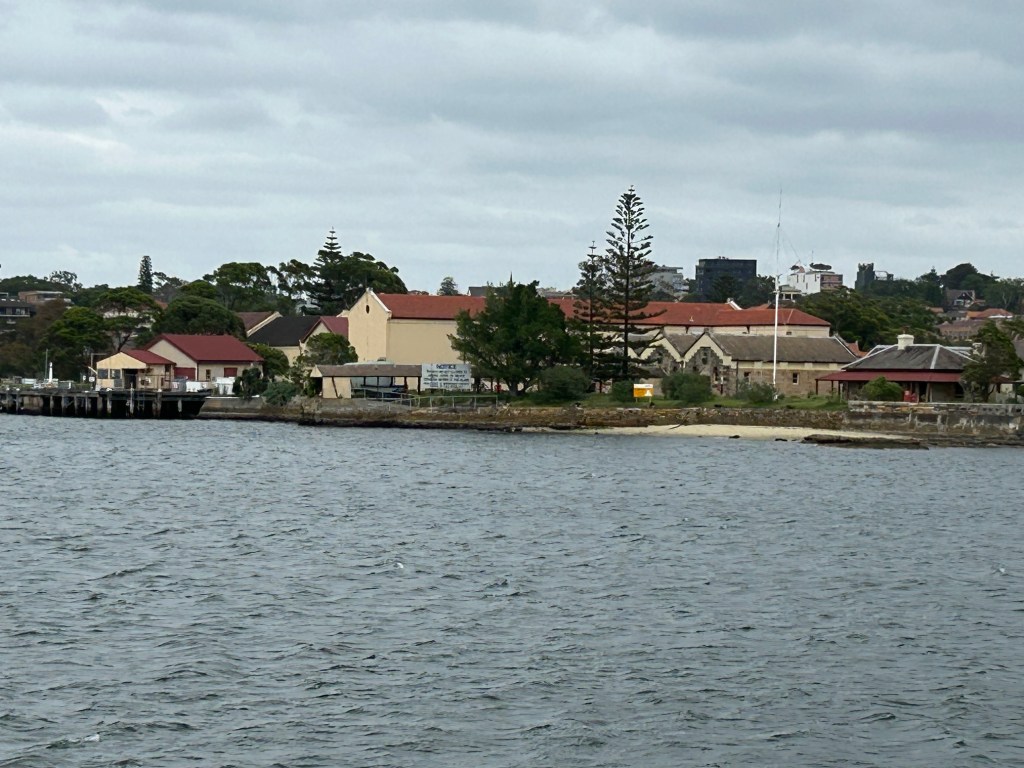
Spectacle Island

A friend of mine suggested that a number of us from our aqua group should buy it and turn it into a retirement resort for ourselves. 

 “Only if it has a helicopter for hospital visits,” said I, thinking of all those trips to hospital I have made in the last few months.

The smallest harbour island is Snapper Island.  As it was so small it was rarely visited although in WW1 it was used to store ship’s parts. In the 1930s the island was levelled and made into a ship shape with mining spoil.  It became a base for training sea cadets but in WW2 it was used by the US Military and the Royal Navy. It returned to the Sea Cadets until the 1960s.  A friend of mine told me she went there to a Scout Camp with her son in the 1980s and would prefer to forget the experience.
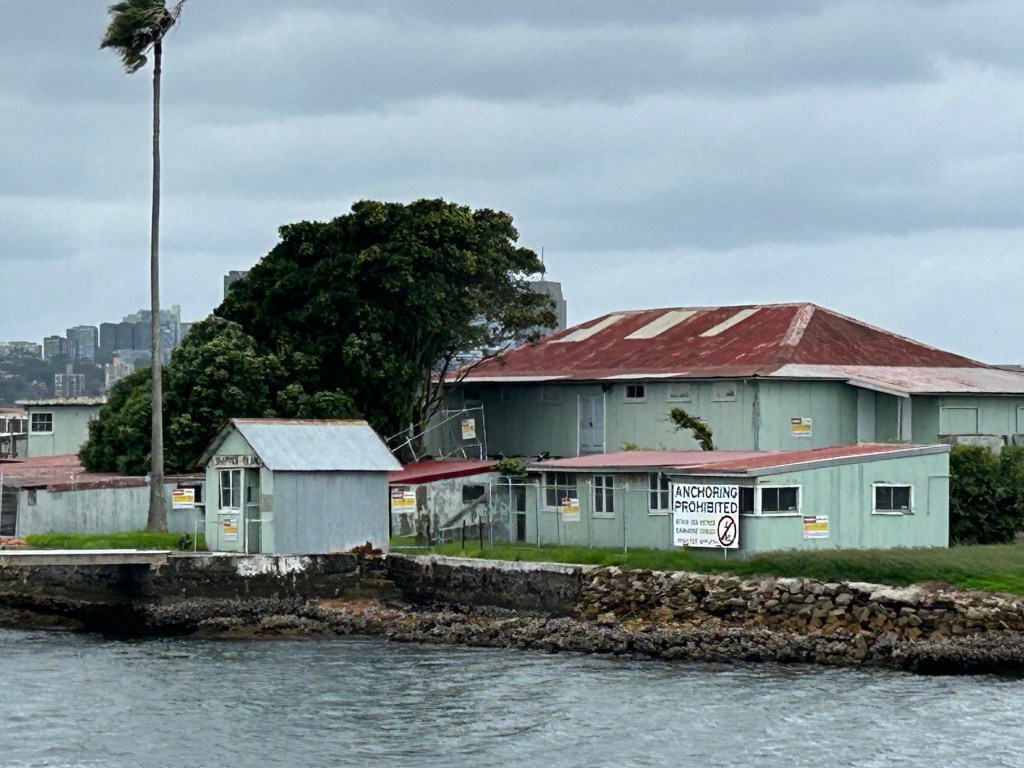
Snapper Island

As we returned to Barangaroo we passed Mort Bay where Sydney’s first graving dock was built in 1855. During WW2 14 Bathurst Class Minesweepers and 4 River Class Frigates were built here. There were shipyards at what is now Pyrmont, Barangaroo and Darling Harbour.  These places are now home to offices, restaurants and high-rise accommodation.
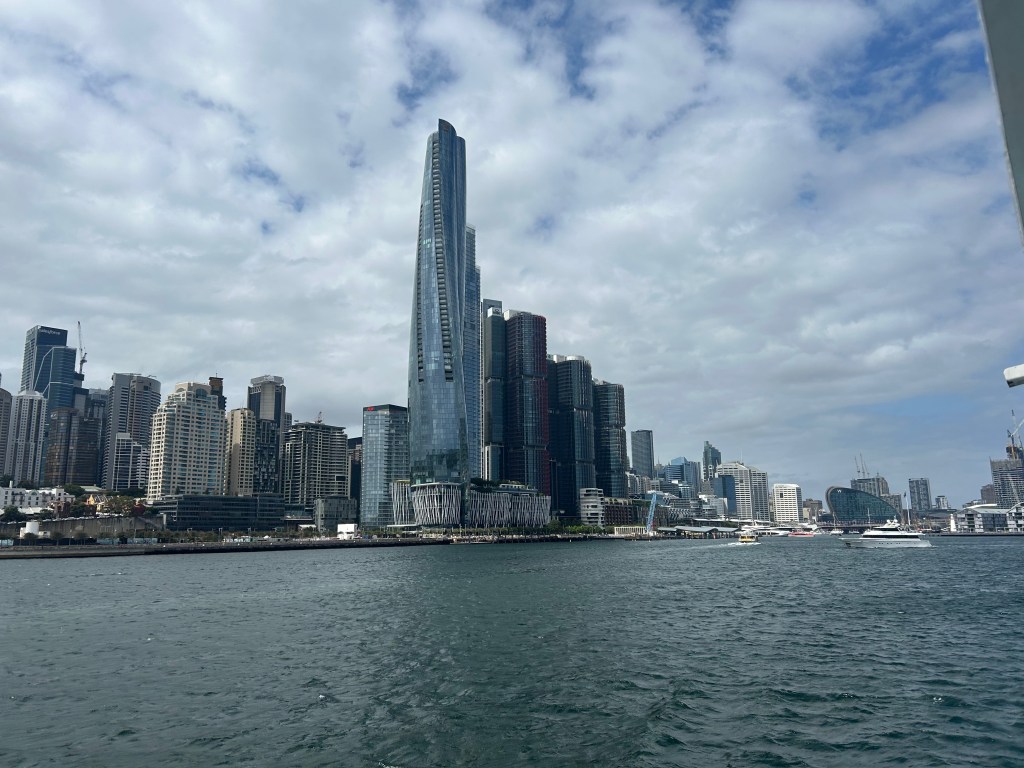
Heading back to Barangaroo

So ended our day on western Sydney Harbour.  We considered visiting the Maritime Museum at Darling Harbour but I was flagging and looking forward to a rest at the hotel so we walked the 1.5 kilometres back.

We thought we would eat at one of the many restaurants near the hotel but forgot it was a Friday night.  At 6.30 pm there were long queues of people outside most of the eateries.  Still very conscious of people and germs I wasn’t keen to join them.  Just near our hotel we found two spare seats in an Indonesian Restaurant called  D’Penyetz & D’Cendol  (a chain with over 100 outlets worldwide) where we were relieved to sit and eat tasty food.

Just so you can see how the other half lives here is a fantastical waterfront house.
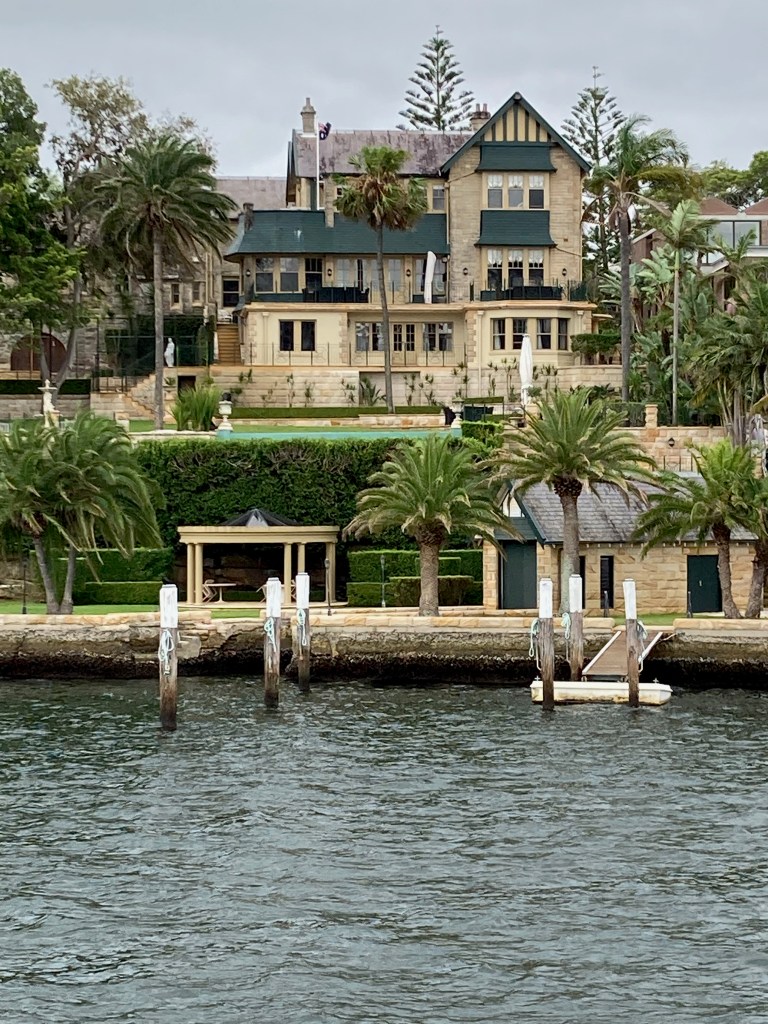
Imagine cleaning all those windows!

T for Travelling Onwards

The Sydney Harbour Cruise had been planned for six months, well before my diagnosis, so I had wondered if I would actually make it.  My granddaughter Cordelia* was having a birthday the day before and I was keen to give her the bracelet and book of stories on the actual day so it combined nicely with our other plans.

Fortunately, I felt better on Thursday, March 12 than I had previously so I was excited at the prospect of staying in a hotel, eating out, meeting up with family and going on a harbour cruise with friends.  I had waited a long time to escape from my prison so when the Uber arrived at my front door I couldn’t believe it was really happening. As a precaution on the train I wore my super-efficient mask which was suffocating to say the least. The hour and a half train trip flew by, we changed at Central for Town Hall and then wheeled our luggage to Rydges, Darling Square.

The room was ready so we gratefully dropped off our bags and examined the view.  It was of a plain, walled courtyard with a table and two chairs, not over inviting but very private.

After coffee and chicken burritos at a nearby cafe we began a long walk to Darling Harbour.  The area has changed so much over the last few years with new high-rise buildings promising expensive accommodation for the lucky ones.  My legs were protesting trying to keep up with John.

A rest and nap back in the room was essential, followed by a shower and dressing for dinner. We decided to walk again so my legs have really had a workout. It was about 1.5 kilometres down Sussex Street and then along the waterfront before we reached the Lotus restaurant.

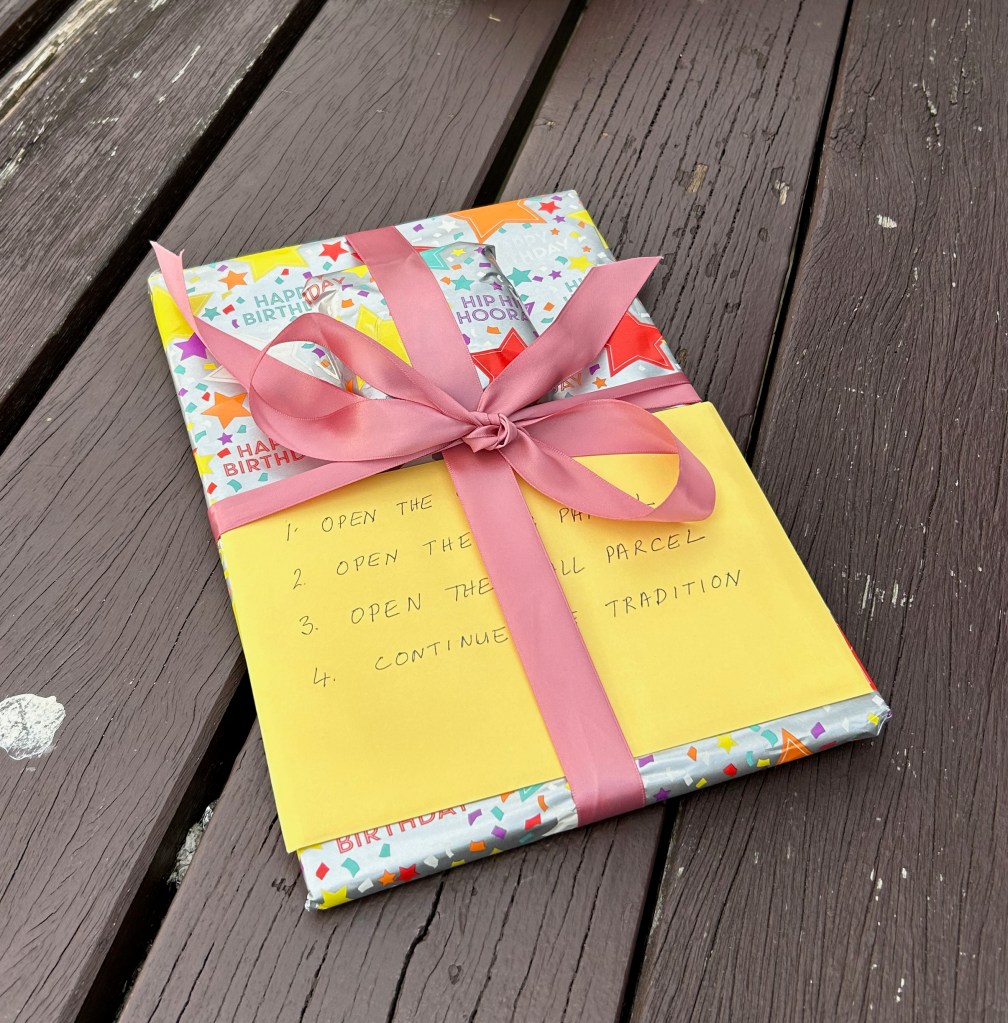
Juliet and Sebastian arrived first, followed by Duncan*, Juliet’s husband, who, because he had a cold, sat at the other end of the table from me. Cordelia was late from her drama class but arrived in time to open her present before the food arrived. The instructions were as follows.

  1. Open the card
  2. Open the large parcel
  3. Open the small parcel
  4. Continue the tradition

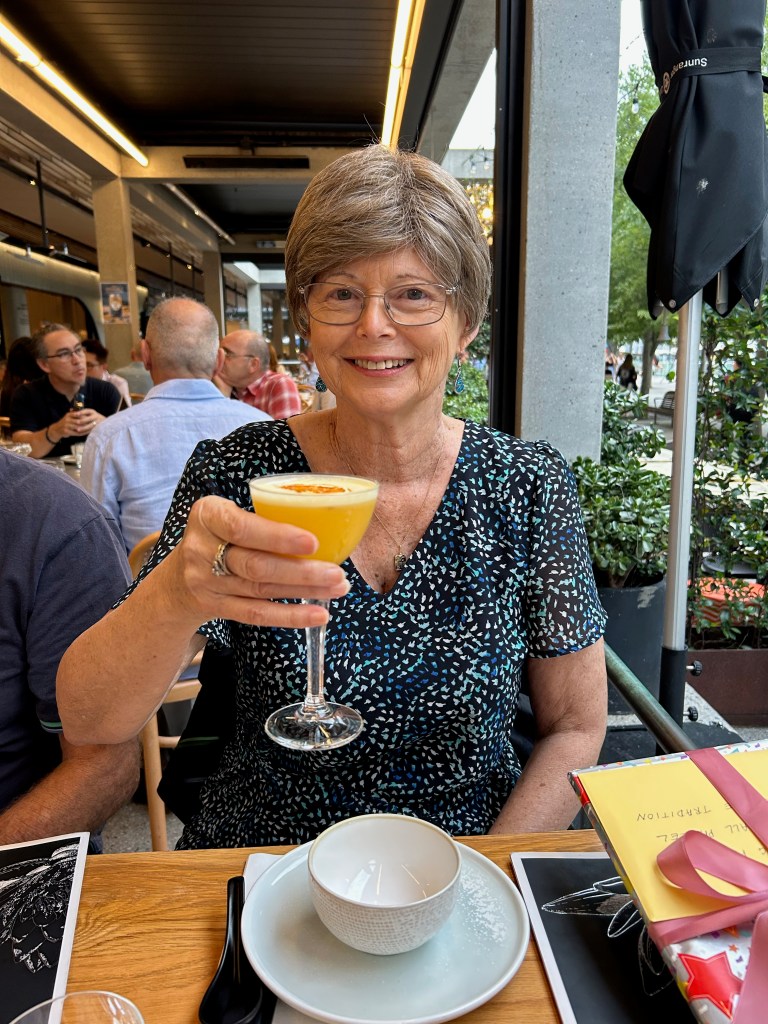
Juliet promised to keep watch over the bracelet and Cordelia eagerly scanned the book, promising to read it properly later.  The meal was a banquet so no thinking was required and it was quite delicious. Feeling decadent I ordered a mocktail which was small and expensive but what did it matter.  I was free!

Enjoying a mocktail wearing a wig

Always ready for a new experience I followed the others next door to Yo Chi where the formula is to choose ice cream and toppings (fresh fruit and/or lollies) and then have whole thing weighed.  In the interests of economy and good health, John and I shared a dish. We were surprised to hear Cordelia and Sebastian singing a song together at the piano.  Apparently on Thursday anyone who is brave enough to sing for their icecream gets it for free!

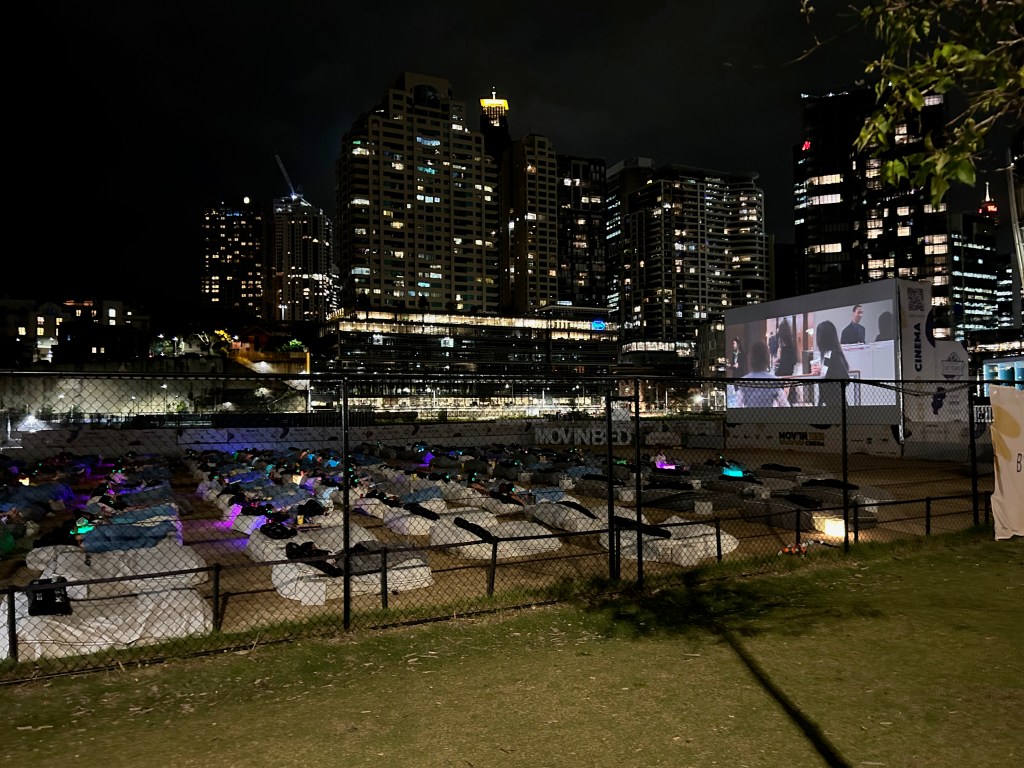
As we strolled to the Barangaroo Metro Station we passed an amazing sight.  Rows of people were lying on mattresses watching an outdoor movie. It was the premises of “Move’in Bed”.

Set on 280 tonnes of pristine white sand, this one‑of‑a‑kind event lets you watch hit movies from the cosy comfort of 150 cloud‑like queen-sized beds, all positioned in front of Australia’s largest outdoor cinema screen.

It was my first trip on the new Metro but after only two stops we bid farewell to the family and left the train at Gadigal.  A short walk and we were back at the hotel.  So far so good.  Everything was running like clockwork and I was tired but feeling almost normal.

  • Not his real name

Zeitgeist: Living in the ’70s

Those were the days my friend

We thought they’d never end

We’d sing and dance forever and a day

We’d live the life we choose

We’d fight and never lose

Those were the days, oh yes, those were the days.

Those Were the days – Mary Hopkin – 1968

Zeitgeist is a very useful Z word that means ‘the defining spirit or mood of a particular period of history as shown by the ideas and beliefs of the time.’ (Google’s English Dictionary provided by Oxford Languages).  

A word often used to describe the ‘70s is ‘liberation’ as opposed to the ‘60s which could be defined as the beginning of ‘anti-establishment values and alternative philosophies’.  

Author Tom Wolfe called it the ‘the “me” decade’ where people became more concerned with the individual rather than the community. 

For Will and Joanne it was a time of opportunity. They were both able to complete a university education with help from the government. They could afford to buy land and build a house, despite interest rates rising to 18%. They both had guaranteed jobs as soon as they finished their teacher training. Unlike their parents, they had a smooth path through life.

They had seen a change in arts, music and culture from the antiwar sentiments and political unrest carried over from the ‘60s to the disco scene of the second half of the decade.  They also saw a trend towards violence in the movies they watched.  Clockwork Orange and Straw Dogs were disturbingly menacing and The Exorcist was frankly terrifying.

Joanne and Will read about the Watergate scandal in America, rejoiced at the end of the war in Vietnam and were concerned at the invasion of Afghanistan by the Soviets in 1979 and the Iranian Revolution in the same year. It seemed that as soon as one crisis ended another began.

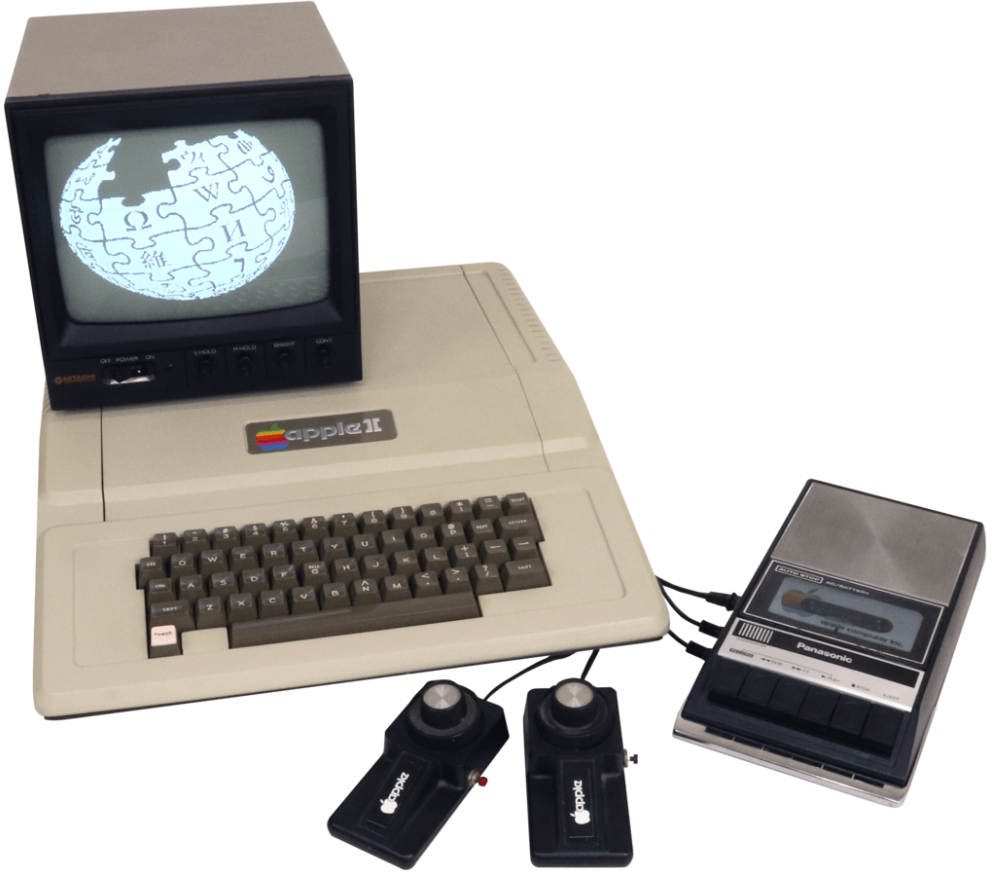
Computers took up a whole room at the beginning of the ‘70s but the small Apple 2 personal computer made its debut in 1977. Joanne and Will wouldn’t see computers in schools until the mid ‘80s. Personal computers, mobile phones and tablets were fantasies belonging to science fiction. Information was found in books, journals and newspapers and news was heard hourly on the radio and watched every night between 6 and 7.30pm.

Apple II in typical 1977 configuration with 9″ monochrome monitor, game paddles, and Red Book recommended RQ-309DS cassette deck
Date
9 June 2019
Source
Own work
Author
FozzTexx

The ’70s allowed Joanne the freedom to decide when she would have a baby by using the contraceptive pill. Advances in medical science saw the first child conceived by in-vitro fertilization born in 1978 causing fierce debate in Joanne’s circle of friends.

For homosexuals, the time of hiding and fear of prosecution was coming to an end. South Australia legalised homosexuality in 1975, followed by the Australian Capital Territory in 1976. It would take a while before the whole country was on board but it was a start. In 1978 the first Gay and Lesbian Mardis Gras was held in Sydney to highlight the discrimination against gay people.

The first Mardi Gras entrants from 1978 at the 30th Annual Gay and Lesbian Mardi Gras in Sydney in 2008. Photograph: Jane Dempster/AAP

The 1971 South Africa rugby union tour of Australia was not something Joanne would have chosen to attend, but Will was keen. Anti-apartheid protestors appeared, letting off smoke bombs. Joanne was frisked as her long black coat could be hiding all sorts of weapons. There was no more sporting contact with the Springboks until the 1990s when apartheid had been abolished.

Another form of protest was the Aboriginal Tent Embassy set up in 1972 (it’s still there) opposing the exploration licences granted to big companies to mine traditional Aboriginal land. The 1975 Land Bill saw the beginning of land rights for Aboriginal people.

Establishment of Aboriginal Tent Embassy on Australia Day, 26 January 1972 National Museum Australia

Although seen by many as unions holding the country to ransom the Green Bans of the early ’70s saved the historic Rocks area of Sydney which was destined to go under the jackhammer, along with many other historical buildings in Sydney.

NSW Builders Labourers Federation Union secretary Jack Mundey is arrested during the ‘green bans’ at The Rocks in 1973 which saved the historic buildings of Sydney’s birthplace

Australia’s performance in the 1976 Olympics in Montreal was so poor the Prime Minister, Malcolm Fraser set up an inquiry and the Australian Institute of Sport was established. The old attitude that the talented sportsperson will make their own way to the top was gone forever.

Daylight Saving was introduced in 1971 in N.S.W., Queensland, Victoria, South Australia and the A.C.T. The following year Queensland discontinued it as many farmers found it disruptive. Most of the country has stuck with it ever since. Compulsory front seat belts were introduced in 1969 with the intention of saving lives. 1971 saw them mandatory on all seats. The 1970s also saw a change in the attitude to drink driving. In 1968 a new law meant a driver could be breath tested only after an accident or driving offence. However it took until 1980 before the legal limit dropped from 0.8 to 0.5 and 1982 before random breath testing began.

One of the images used by Volvo to market the seatbelt safety in its Amazon model. Picture: Volvo

The change to the metric system was another feature of the 1970s. In 1974 Joanne found herself suddenly teaching mathematics totally in metric. Conversions were not encouraged. Shops were only allowed to advertise in metric. The success of conversion has been attributed to the fact it was planned across all sectors of society, all states and the federal government were on board, the speed of the change was rapid, the whole of the population changed together and the benefits were continually reinforced.

Australia Post released stamps to commemorate the nation’s conversion to metric.(Supplied: Australia Post)

The 1970s and 1980s saw 120,000 southern Asian refugees migrate to Australia. People arrived by boat and air from Vietnam and as Australia had no refugee policy at the time, the Fraser government developed it on the run and a policy of resettlement and multiculturalism emerged. Although many Australians were opposed to refugee resettlement the government did not succumb to public anxieties the way they do today.*

Looking back at the 1970s, even though there were aspects which were universal, there were also some changes which reflect the unique nature of the Australian people. Their acceptance of regulation and new ideas contrasts to other countries where the right of the individual was considered more important than the needs of the community. Although the country was rocked by a constitutional crisis it picked itself up and continued to work towards the common good. It was an era of freedom, but not at any price. It was a time of change, but a greater appreciation of heritage was developing.

As Joanne flew back from America in 1977 she read a flight magazine which inspired her next class project. It was all about Renewable Energy. It cited Solar energy, Geothermal energy, Wind energy, Hydropower and maybe a few more as being the way of the future. Proposed as an attempt to reduce pollution and take the place of dwindling non-renewable resources it seemed like it would solve many problems. There was not even a discussion about global warming in those days. Pollution was the word on everyone’s lips. Plastic was becoming the scourge of the world. Scientists were alarmed at the growing hole in the ozone layer and aware of the link to chlorofluorocarbons. Slip-Slop-Slap emerged in the early ’80s as a sun protection campaign in Australia and New Zealand to beat the deadly solar rays.

Cancer Council’s Slip Slop Slap campaign
Updated 11 Oct 2017, 5:59pm
ABC News

So what was the Zeitgeist of the ’70s? Liberation? Opportunity? Recognition of minorities? Multiculturalism? Freedom? Regulation? Medical miracles? Scientific advances? Standing up for your beliefs? Unapologetic hedonism?

I think I’ve written enough in the last 26 posts so will leave it up to you to decide.

*Thanks to Rachel Stevens of The Conversation (Misha Ketchell, Editor) for the article We can’t compare Australia’s intake of Afghan refugees with the post-Vietnam War era. Here’s why.