
The name Sandakan has a wonderfully exotic sound. When our travel agent gave us someone else’s itinerary which included Sabah, now part of Malaysia, on the traditional island of Borneo, we couldn’t wait to make it ours. Things didn’t quite work out as planned which made me decide to be my own travel agent in future but I have to tell you about the Gomantong Edible Birds’ Nest Cave, the Sukau River Lodge, the trip up the Kinabatangan River watching for proboscis monkeys and orangutans, the Sepolik Orangutan Centre with the orphaned orangutans, the English Tea House high on a hill in Sandakan, the Memorial Park to the soldiers of the Sandakan Death March and the Agnes Keith saga of “Land Below the Wind”.
Are you ready?
Wednesday, 22nd July, 2009 Kota Kinabalu, Sabah
We were awake before alarms started going off around 4.30am. By 5.30 we were anxiously looking for our pick-up vehicle. 5.45am and we were very anxious. We gave up and took a taxi. The 45 minute flight itself was interesting, over mountains and rivers. We were astonished at the extensive plantations of oil palm trees (Elaeis guineensis) which had replaced the traditional rainforest. When I say extensive you’ve got to believe it.
At Sandakan Airport we were met by M who was very well spoken but looked seriously unfit. He seemed to have difficulty moving and the sweat poured off him in the intense heat. First stop was the Sepolik Orangutan Centre where we were to transfer to our minibus. M did not inspire us with confidence as he disappeared, leaving us alone in front of a small café. Close to us a charismatic guide was surrounded by adoring tourists pressing notes into his hands and farewelling him with genuine remorse. However, our fate was to be with M who waved us in the direction of the minivan and explained there would be two vans travelling together as there were eleven of us in the group. The other bus left but ours would not start. After a while John and any other male around who thought he knew about cars had a go at starting it. The key went in the ignition but would not turn. About half an hour later the driver finally realised he was using the wrong key. Finally on our way we encountered our next problem in the small town of Kota Kinabatangan. M indicated that we could stop for a coffee break but we found the real reason for the interruption soon enough. One of the passengers on the other van had come to realise that he was travelling inland and not to the jetty where the boat left for Turtle Island. This was especially galling for us as we had wanted Turtle Island in out itinerary but the travel agent had “stuffed up”. Oh well! The other passengers had to wait an hour on the side of the road in a hot minivan while a taxi came for the errant tourist. At least we had cold tea and iceblocks to while away the time.
Finally on our way we turned off to the Gomantong Caves where swiflets construct edible nests from a glutinous secretion, produced from salivary glands under the tongue. The Cave Swiflets that live here in the thousands make two types of nest, commonly referred to as white nests and black nests. Both are edible and they are used to make the Chinese delicacy birds nest soup.

A slippery wooden walkway followed the inside edge of the cave. Above us were the valuable birds’ nests and a few swifts darting around. The bats were mainly sleeping so were few in number. Below and inside the walkway was guano (the excrement of birds and bats). A handrail divided the walkway from the stinking mess below but I grabbed it only to let go in horror as it was covered not only in guano but cockroaches, dead and alive. Where there were missing wooden slats on the walkway I was forced to grab the handrail again, gingerly, with the tips of my fingers. I noticed M had stayed outside. On our way around the cave we found one tiny bat on a rock and a baby swiftlet that had fallen from a nest. We were all pleased to see the sunlight again and voted unanimously on the bus afterwards that the climbing of slippery rope ladders in those smelly caves to gather birds’ nests, would be one of the worst ten jobs in the world.
Here is a newspaper extract concerning the current value of birds’ nests. (2009)
By Niluksi Koswanage and James Pomfret
SABAH, Malaysia (Reuters Life!)
The nests are woven by the saliva of the Asian male swift, and when prices went as high as $2,500 a kg (2 lbs) last year, teams would work round-the-clock to prise them off the walls of the 25-storey high Goamantong cave in eastern Sabah state.
Now, as the global economic recession reduces the appetite for luxury items in China and beyond, Asri and other harvesters spend most of their time outside the cave, smoking and keeping an eye out for thieves eager to make off with the nests despite the drop in market prices and demand.
“We are stuck. There are many birds’ nests to collect but we have been told by our bosses to take less because prices are falling and people from China are losing interest,” Asri said.
Consumers in China and Taiwan prize swifts’ nests as a health tonic, aphrodisiac and status symbol, earning the delicacy its “caviar of the east” nickname. Goamantong nests are among the most exquisite in the world as there are less impurities like feathers and grit, traders say.
So the other job we considered on a par with the nest gatherer was the job of nest guard, high up inside the cave on a platform, in the dark, with the smells and the insects, bats and bird droppings.
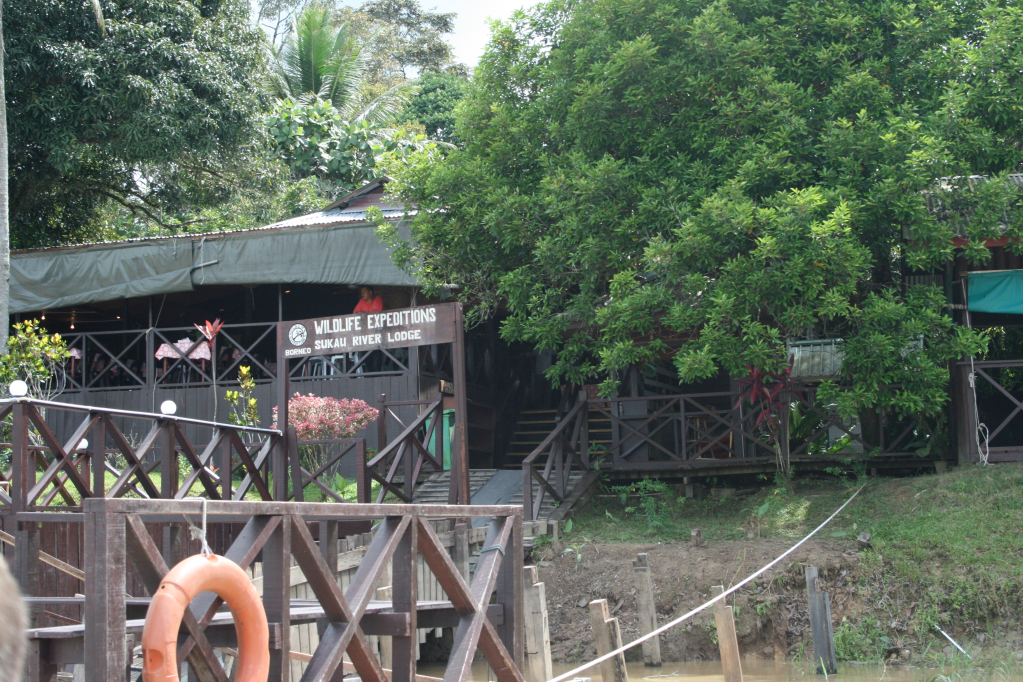
A short walk along a jungle track brought us back to the minivan. In less than an hour we had reached the wide, brown Kinabatangan River. Here we boarded a launch and crossed the river to the Wildlife Adventure Tour’s own lodge. At first sight it looked run-down and ramshackle but we were immediately served a lunch of rice, chicken, fish and vegetables. I especially liked the stir-fried eggplant and jackfruit. Our rooms were quaint little dark green lodges on stilts which looked authentically Malay. Although spartan they contained necessities such as an air conditioner and a shower. There were twin beds, each with a mosquito net over it. The windows also had screens but it was comforting to have double protection. Showered and refreshed we walked back to the jetty for our river trip in search of monkeys and other wildlife.

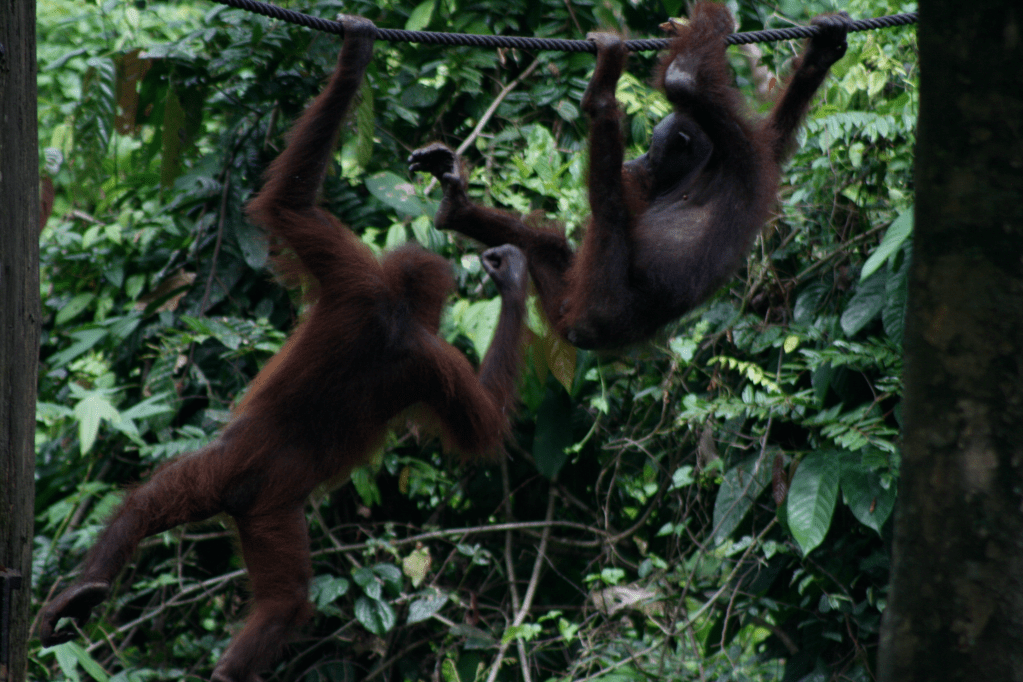
This is where the best memories and the worst experiences blur together. I became so hot I nearly passed out as there was no cover over the boat. Only when the sun slipped behind the trees could I enjoy the scenery around me. We spotted numerous macaques, proboscis monkeys, a striped snake and at the very end of the cruise, a pair of orangutans. They looked like kings of the jungle as they balanced easily on branches at the tops of the tallest trees.

Back at the lodge we showered again before dinner. There was freshly made fried rice and some tasty barbecued meat. John bought us each a can of beer which we consumed while chatting to some of the other people on other tours. The proposed slide shows and insect walks did not eventuate, and although annoyed that M couldn’t be bothered, we weren’t sorry to retire to our stilt house and sleep under our mosquito nets.

Thursday, 23rd July, 2009, Sukau River Lodge
The alarm woke me in the middle of a dream but on the whole I slept well. M had promised to be there in the morning to hand us over to our new guide as he was staying another day so I decided to give him a few RM in appreciation for his efforts. However he wasn’t there so he missed out.
We were quite happy to leave, said goodbye to our two Danish friends and had an uneventful journey to Sepolik Orangutan Park. At the Sepolik Orangutan Centre there were hundreds of people, many tour guides and very little direction. We were told by our guide to “wait here for Mr G” after which hundreds of people poured past us into a small theatre, all escorted by their efficient and capable guides. Where was Mr G? Finally we saw our former guide and asked after our new escort. Mr G had been lounging around having a cigarette and enjoying himself, unaware, or so it seemed, of our existence. The two guides argued over whether we should see the film now or after the orangutan feeding. Mr G lost so we squashed in on top of the other 250 people in the theatre to hear the end of an explanation of what the Orangutan Centre was all about. The film was very informative, explaining how people try to raise orphan orangutans in their homes. The orangutans become too big and too strong to handle and the owners don’t know what to do with them. The orangutan centre prepares them to re-enter the wild. At the feeding table we saw about five orangutans. We stood on a seat at the back and watched over the heads of the other two to three hundred people.
Back on the bus we arrived at the Sandakan Hotel. It is about a three star standard but is in a very good central position. We had a brief rest before organising a taxi to take us to the Death March Memorial. It cost RM60 return, with the taxi driver waiting for us, having a siesta under the trees. As he said, “How else would you get back to the hotel?”
THIS MEMORIAL MARKS THE SITE OF A PRISON CAMP OF SURVIVORS OF THE FIRST DEATH MARCH FROM SANDAKAN TO RANAU FROM JANUARY TO APRIL 1945.
OF THE 2,000 AUSTRALIAN SOLDIERS OF THE 2ND A.I.F. AND 750 BRITISH SOLDIERS OF THE BRITISH ARMY WHO LEFT SANDAKAN ONLY 6 AUSTRALIAN SOLDIERS SURVIVED.
ON THIS ACTUAL SPOT VX52128 GUNNER ALBERT NEIL CLEARY 2/15TH FIELD REGIMENT, ROYAL AUSTRALIAN ARTILLERY WAS CHAINED TO A STAKE AND BEATEN AND STARVED FOR 11 DAYS UNTIL HE FINALLY DIED ON 20 MARCH 1945. AGED 22 YEARS.
THIS MEMORIAL ALSO COMMEMORATES THE COURAGE AND BRAVERY OF THE LOCAL PEOPLE OF SABAH, WHO SO GALLANTLY ASSISTED THE PRISONERS-OF-WAR AGAINST OVERWHELMING ODDS.
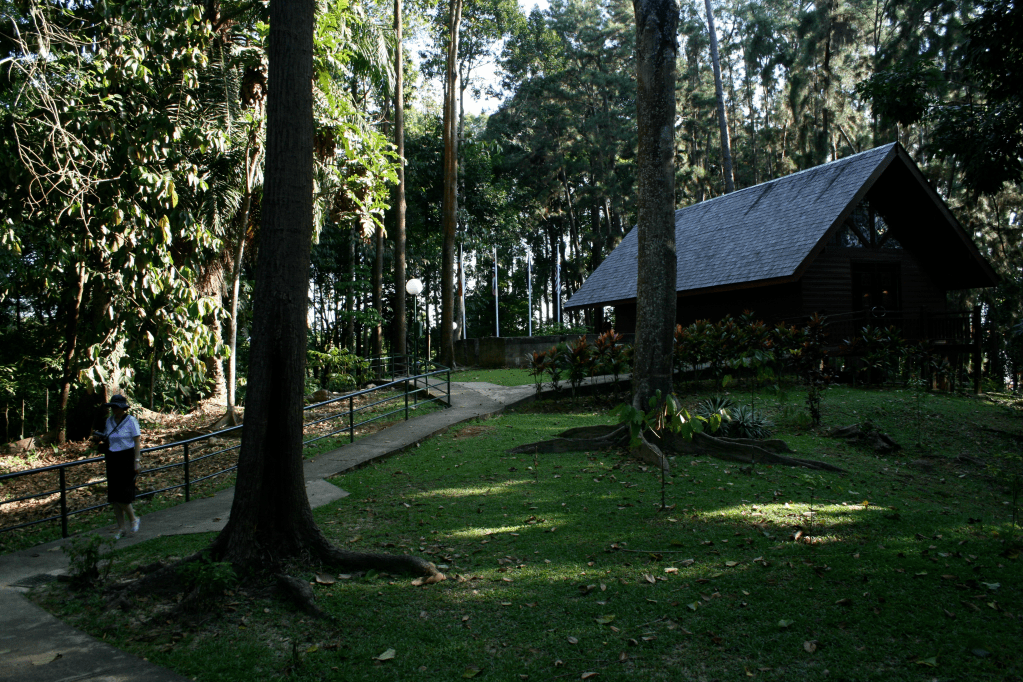
I could write a hundred pages or more about the Prison Camp but will leave it until U for Understanding Sandakan. It was a very peaceful place with trees and lakes and birds. It was hard to imagine what took place here on this spot 64 years ago. The remains of some of the machinery, water tanks and pipes of the prison camp were scattered around the park and a chapel-like building with a scale model of the camp as it was stood at the crest of a hill.
On the way back we asked the taxi driver if the Agnes Keith House would be open. We had read it was near the English Tea House so when he said “Yes, you want English Tea House?” we decided to take a risk at getting home afterwards and go there. The Agnes Keith House was closed but we decided we needed cheering up after the Death March Memorial and headed off for an English tea. Our table was overlooking the sea but because I indicated I liked the gazebo it was immediately cleared and made ready for us. John was chatting to some people on the croquet lawn when he discovered I’d moved. We enjoyed our coffee with scones and cream so much that we decided to come back for dinner.

Instead of getting a taxi back we walked the “hundred steps” to the bottom. The road and steps were covered in moss with gaps and holes in numerous places so we thought it might be dangerous in the dark. That night we went back up in a taxi but we walked down the main road to come back to the hotel which didn’t take very long.
Dinner in our gazebo was very pleasant overlooking the Sulu Sea in a perfect temperature. We shared a papaya and scallop entrée, had red bream with rice and snow peas for mains and bread and butter pudding (me) and mango pie(John).

The music was from the war years and the atmosphere was magical. It was a truly memorable evening.
Friday, 24th July, 2009, Sandakan, Sabah
After breakfast, we walked up the hundred steps to the Agnes Keith House. This is how Lonely Planet describes it.
This atmospheric two-storey colonial villa, Newlands, tells the story of American writer Agnes Keith and her British husband Harry, the Conservator of Forests in North Borneo. They lived in Sandakan from 1934 to 1952 and spent three years in Japanese internment camps during WWII.
As the day had not become too hot (it was only about 28 degrees Celsius) the walk was quite pleasant. We fell in love with the house as soon as we entered. The ground floor has high ceilings and polished floors. It consists of two large rooms with a broad staircase in the middle. I noted there was a dining room with a refrigerator and a lounge room. The absence of a kitchen was explained by a room across a breezeway where the cooking would have been performed by the servants.
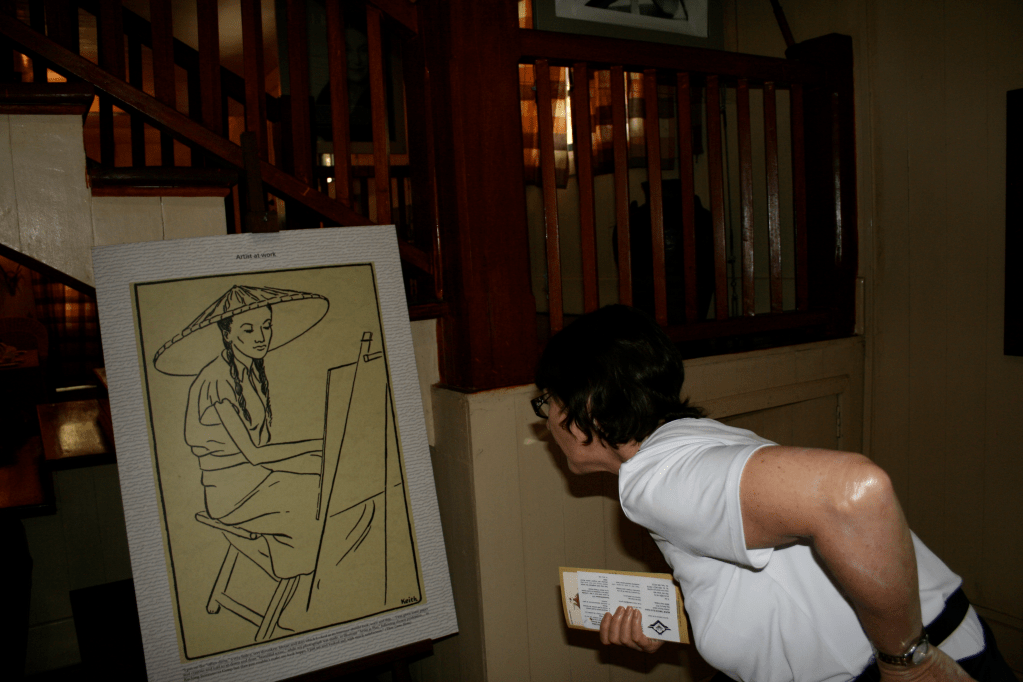
Upstairs were two huge bedrooms and a study. Each bedroom had a spacious ensuite off one end. In the master bedroom the queen sized bed was in the centre of the room “to catch the breezes” with all the other furniture against the walls.
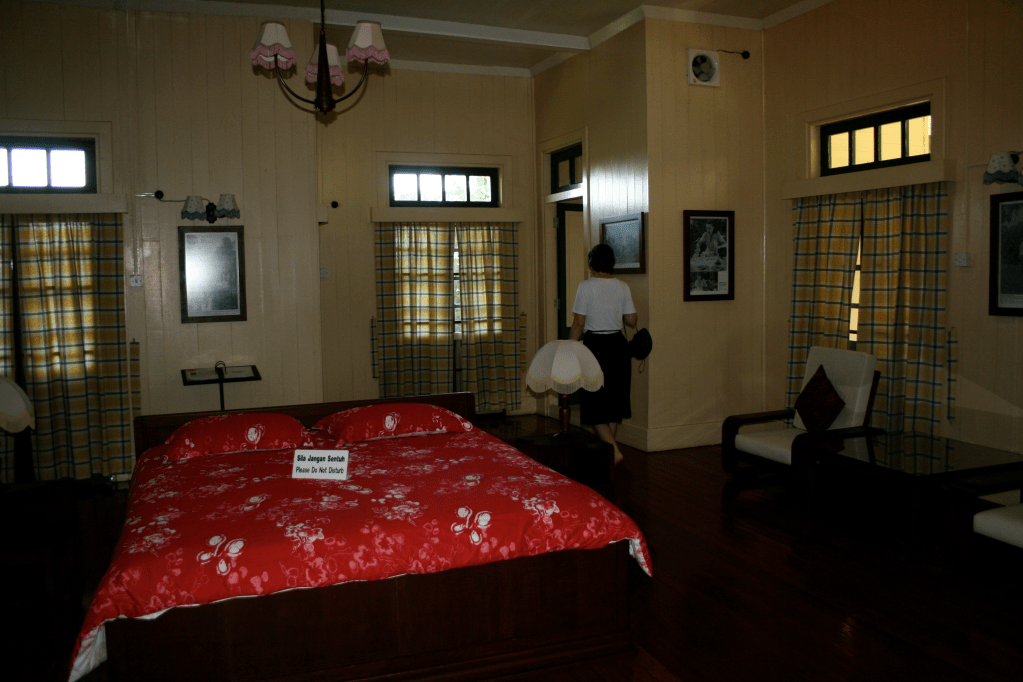
We read about the life of Agnes, her husband Harry and their son and daughter. I intend to buy or borrow her books – “Beneath the Wind, Three Come Home and White Man Returns”. They are about pre-war Sandakan, being captured by the Japanese and returning after the war.
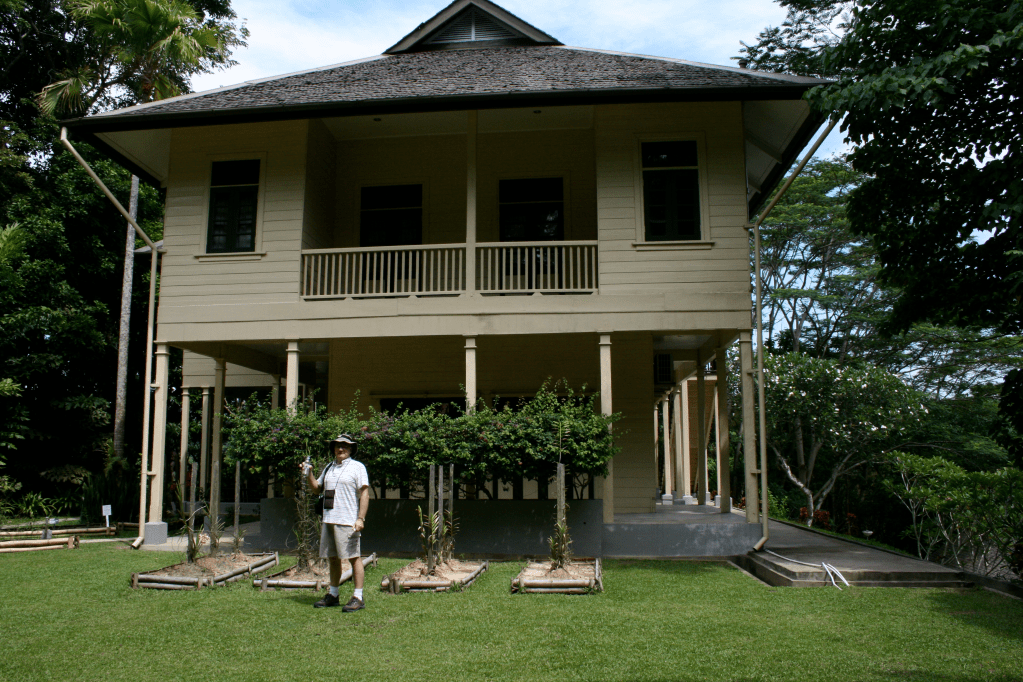
Reading the books afterwards I learnt how Agnes, Harry and their son were imprisoned during the war but survived. Coming back to their home they found it burnt to the ground. It was rebuilt as an almost exact replica of their former home. However, Borneo after the war would never be the same and when “White Man Returns” they find their days in Sandakan are numbered.
 The Curry Apple Orchard
A lot of the trip sounds rather challenging except for the nice afternoon tea and dinner. The Sandakan death march is so sad.
LikeLiked by 2 people
If I had organised it myself I would have used Trip Advisor to select a recommended tour group. Ours was the least organised I have ever been on.
LikeLike
Such a pity about the tour schemozzles, Linda. The name Sandakan has always meant violence and cruelty to me because of the way POWs were treated. It’s a wonder any of them survived the vicious conditions.
LikeLiked by 1 person
I’m going to write about it in more depth in the letter U on Anzac Day. As for the schemozzles they make good memories.
LikeLiked by 1 person
I am looking forward to reading U before I comment on Sandakan.
LikeLiked by 1 person
It is truly said that the Chinese will eat almost anything – even bird-spit soup, and their medicine ascribes ridiculous properties to things too…
LikeLiked by 1 person
Over 2000 years they probably have got quite a few things right.
LikeLike
Yes some things are of course right, but crushed dried seahorses as an aphrodisiac or remedy for heartache just because they mate for life is just endangering a whole species by confusing symbolism with science I think.
LikeLiked by 1 person
Sounds interesting. I like the photo of the cave — one has to look twice to see it properly 🙂
Ronel visiting for S:
My Languishing TBR: S
Speedy Steeds
LikeLiked by 1 person
That was the one photo I didn’t take. It is from an East Malay newspaper so I will need to acknowledge it.
LikeLike
Quite the adventure. You are intrepid travellers.
LikeLiked by 1 person
Well we were. We seemed to have quietened down since Covid.
LikeLiked by 1 person