
On previous visits to England we visited the homes of Jane Austen, the Bronte Sisters and DH Lawrence. This time (2012) our plan was to explore the countryside made famous by Thomas Hardy’s novels. We decided to stay near Dorchester where the novel The Mayor of Casterbridge is based.
Just before our arrival in Dorchester we noticed the figure of a man carved on the hill in chalk. He is known as the Cerne Abbas Giant and his origins are uncertain. Some believe he represents the Roman god Hercules and is over 1500 years old. Others say it is a caricature of Oliver Cromwell and is only about 350 years old. It is one of three white figures cut into chalky hillsides, the others being the Long Man of Wilmington in East Sussex and the Uffington White Horse in Berkshire.

In Dorchester we found the building reputed to be the home of the Mayor of Casterbridge in Hardy’s story of the same name.

To reach Thomas Hardy’s birthplace we took a ten minute walk through woodland from the National Trust car park in Upper Bockhampton . Hardy’s father was a builder and stonemason and Hardy in his early years was an architect. After five years working in London he returned to this house because of failing health. This is where he wrote Under the Greenwood Tree and Far from the Madding Crowd.

We then visited Max Gate, the house Hardy designed himself, built by his father and brother. Here he wrote Tess of the D’Urbervilles and Jude the Obscure (known as Jude the Obscene at the time) as well as lots of poetry. The National Trust have taken over both houses and it was only recently (before 2012) that tenants had moved out. Max Gate is a huge contrast to the thatched cottage and is a very comfortable “town home”.

On the recommendation of the B&B owners we drove to The Saxon Arms at Stratton for some tasty sailfish on a bed of green weeds.
After another huge English breakfast where we chatted to a couple here for the trout fishing (or at least he was as she was about to hit the shops), we set off for Plymouth via the Jurassic Coast. As we were driving we saw a sign to Chesil Beach so turned in along the three quarter mile track. The size of the shingle varies from as big as oranges at the Portland end to the size of peas at the West Bay end. It is said that in days of old smugglers could tell exactly where they were when they landed on the beach by the size of the pebbles. If you’ve ever read “On Chesil Beach” by Ian McEwen you might remember this was something the two main characters planned to investigate before fate stepped in.
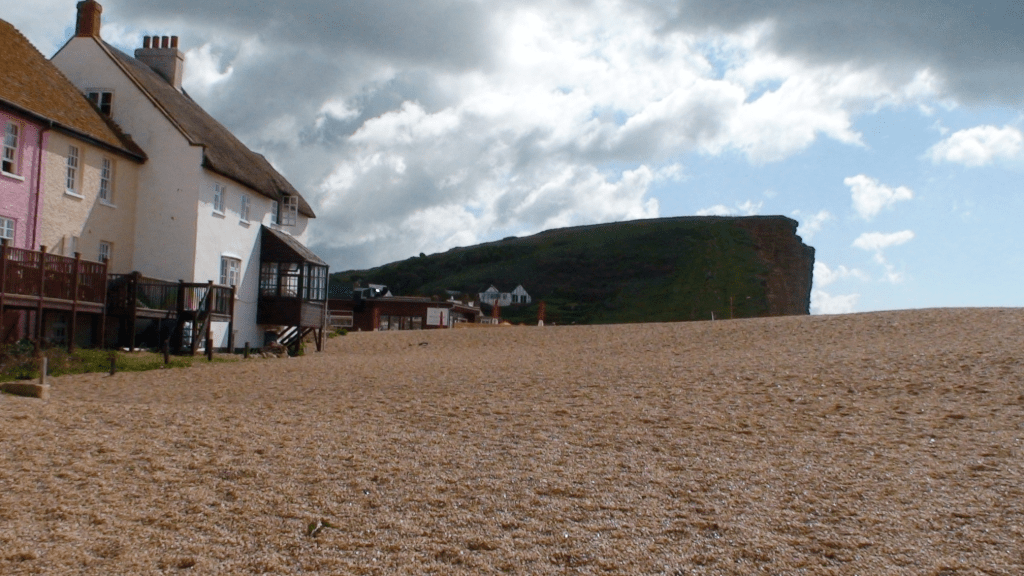
We bypassed Exeter and drove around the edge of Dartmoor Forest. I couldn’t see any forest. It was all rolling fields, hedges and stone walls. Our Sat Nav brought us directly to the Premier Inn we had stayed in eight years ago. It is right in the middle of Plymouth and across from the Barbican, accessed by a swing bridge. The Barbican area consists of several streets which retain the character of the original fishing town as much of Plymouth was bombed to pieces in the Second World War.
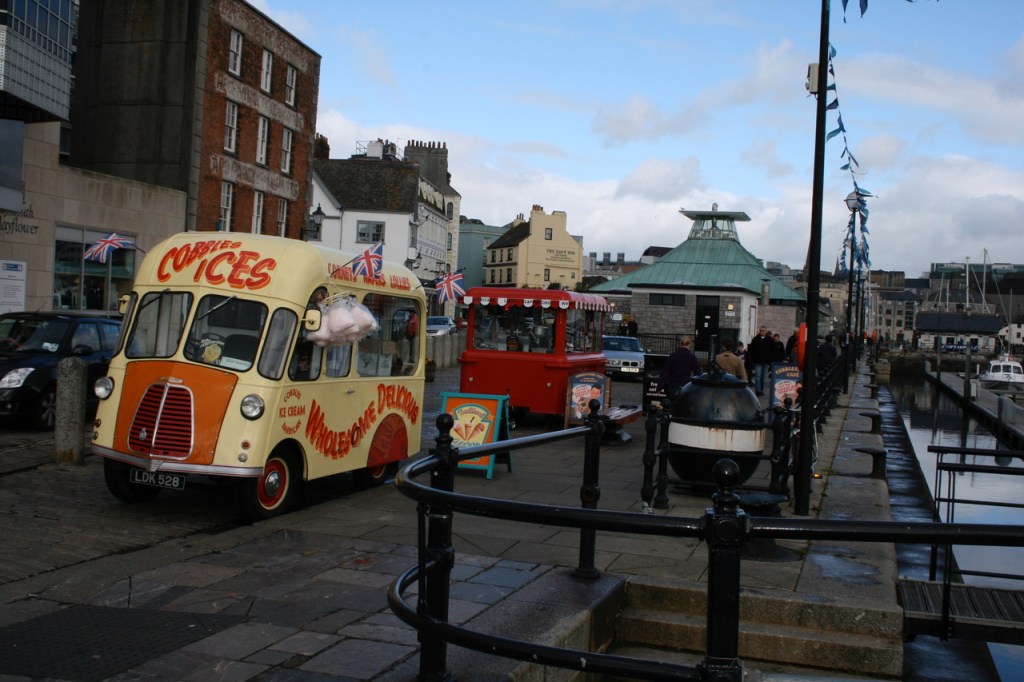
After grabbing a quick lunch near our accommodation we dropped the car off at the Hertz depot. John discovered he’d had a dodgy prawn so what should have been an enjoyable exploration of Plymouth became a rush to get back to the safety of our room.
We did manage to explore the waterfront and read the sad story of Raleigh’s Lost Colony, an early settlement in America which vanished between 1587 and 1590. Also saw the plaque to the Mayflower in 1620. So long ago!
I left him resting and went off to find dinner, avoiding the dodgy prawn place. The Barbican was shaping up for a busy Saturday night with people dressed to kill disappearing up narrow laneways into interesting looking night spots. I found what appeared to be a safe haven for a lone female at The Thai House and had a very tasty Pad Thai with a glass of white wine.
Fortunately John was well enough to sail across the Bay of Biscay to Spain the following day.
 The Curry Apple Orchard
I loved revisiting Thomas Hardy’s books. They were written in a time that was very different to now.
LikeLiked by 1 person
I always think of Tess telling Angel about her past. If only she had kept quiet! He realised too late what he had lost.
LikeLike
Whereas today Tess could have taken D’Urbeville to court for “ravishing” her against her will.
LikeLike
this was very interesting to read.
LikeLiked by 1 person
Great photos too!
LikeLiked by 1 person
Thanks
LikeLike
Hi Linda – my first visit to you this year – we live in Bronte country but my late mother lived in Dorchester. You mention the stone size on Chesil Beach and there is more to it – above the waterline, the gradation goes in one direction but below it, they are sorted by wave action in the opposite direction – quirks of nature eh!
Visiting from how-would-you-know.com
LikeLiked by 1 person
Fascinating local knowledge. We lived for a year in Staffordshire (2004) which was a great spot from which to explore many parts of Britain.
LikeLike
My mom painted a thatched cottage like the one in the photo! Thanks
Beth
https://bethlapinsatozblog.wordpress.com/
LikeLiked by 1 person
It looks beautiful but I wouldn’t want to live in it. Makes a great painting.
LikeLike
I haven’t read Tess of the D’Urbervilles in years, we studied it at University. Visiting Max Gate, the house where he wrote it is neat.
Stopping in from A-to-Z: https://brewingcoffeetwistingwordsbreakingpencils.ca/2023/04/07/fortune-glory-tantalizing-twenty-seven-book-review/
LikeLiked by 1 person
I studied it at school and it made a lasting impression.
LikeLiked by 1 person
I enjoy your photos of places I’ll never be able to see
LikeLiked by 1 person
Thanks Jeanne
LikeLiked by 1 person
You had me at visiting the Bronte sisters!
Stopping by from A-Z,
Dream
https://thedreamgirlwrites.wordpress.com/2023/04/07/farbe/
LikeLiked by 1 person
You can read about the Bronte visit here.
https://argonautsite.wordpress.com/2021/04/26/v-for-visits-from-our-daughter/
LikeLiked by 1 person
Thank you 🙂
LikeLiked by 1 person
Great photos!
Ronel visiting for F:
My Languishing TBR: F
Fiery Farralis
LikeLike
Beautifully written. Nice photos.
LikeLiked by 1 person