

Breakfast next morning was a fresh baguette from St Pardeaux, a beautiful little town beside the dam wall of a huge lake. John had read about the village of Oradour-sur-Glane and was keen to see it for himself so we parked outside the museum and read explanations in French, English and German. We saw old super 8 footage of people in the town picnicking, swimming and walking hand-in-hand before the day that changed their lives forever.
A tunnel led under the road to the preserved town where time stood still on June 10th, 1944.
It would take a book to write about what we saw there, so we bought one, describing the town before the Nazis arrived, how the men, women and children were separated, how the men were shot and burned in a barn, how the women and children were herded into the church which was set on fire and destroyed. The town has been left as a memorial and a new town built beside it. The roofless buildings bear signs to show that here was the butcher, the doctor, the baker, the tobacconist, the school… over 600 people lost their lives that day.
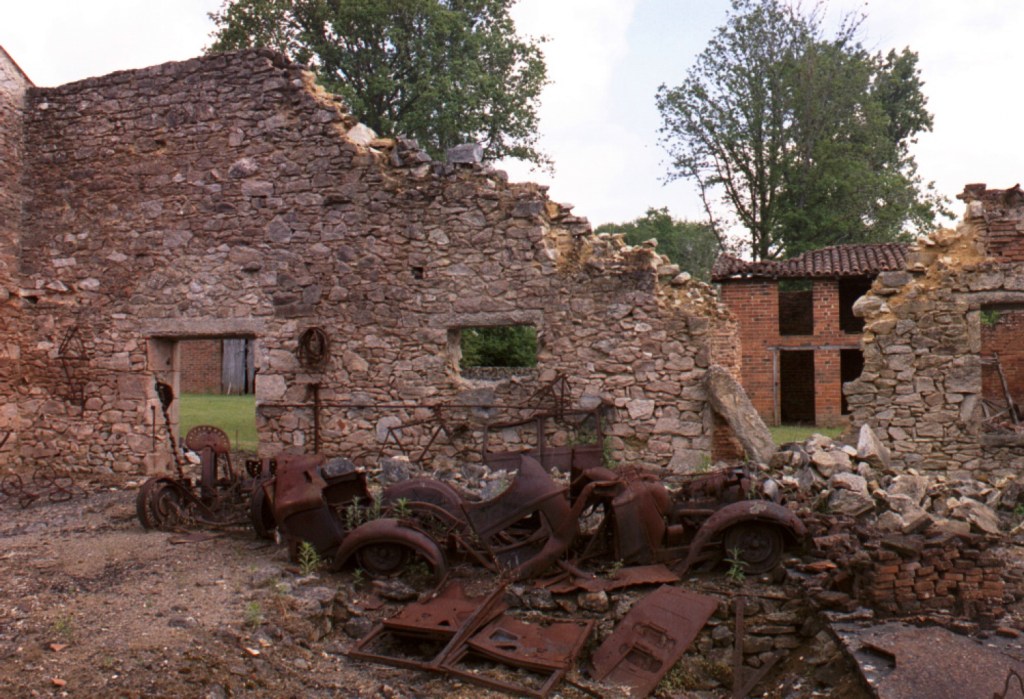
The stories of those few who escaped are incredible. Only one woman escaped alive from the church. Madame Rouffanche ran to the end of the locked building where she placed the stepladder used to light the candles, behind the alter, climbed up and threw herself out the window. Despite being shot five times she was able to reach a garden of peas where she buried herself in the soft earth until late the next day. The woman and baby who tried to follow her didn’t make it.

Robert Hebras, 19 years old at the time, was at the back of the barn with the men when the machine guns opened fire. He lay under the bodies of others, hoping to avoid detection. When the barn was set on fire he and four others escaped through a door to the next building. As the fire followed them and Nazis appeared with guns they cut through the walls with their knives to the next barn and the next. The fire followed them and two more men lost their lives. Then there were three. One was so badly wounded he could not continue. Guards patrolled all the doors leading to the outside world. The two waited and finally escaped to freedom, seeking refuge in another village.

In a reflective mood we sat in the sun outside a hotel in the new town of Olonzac. As we ate our lunch we rejoiced in the fact that we were alive and the dark days of war were over for this part of the world.
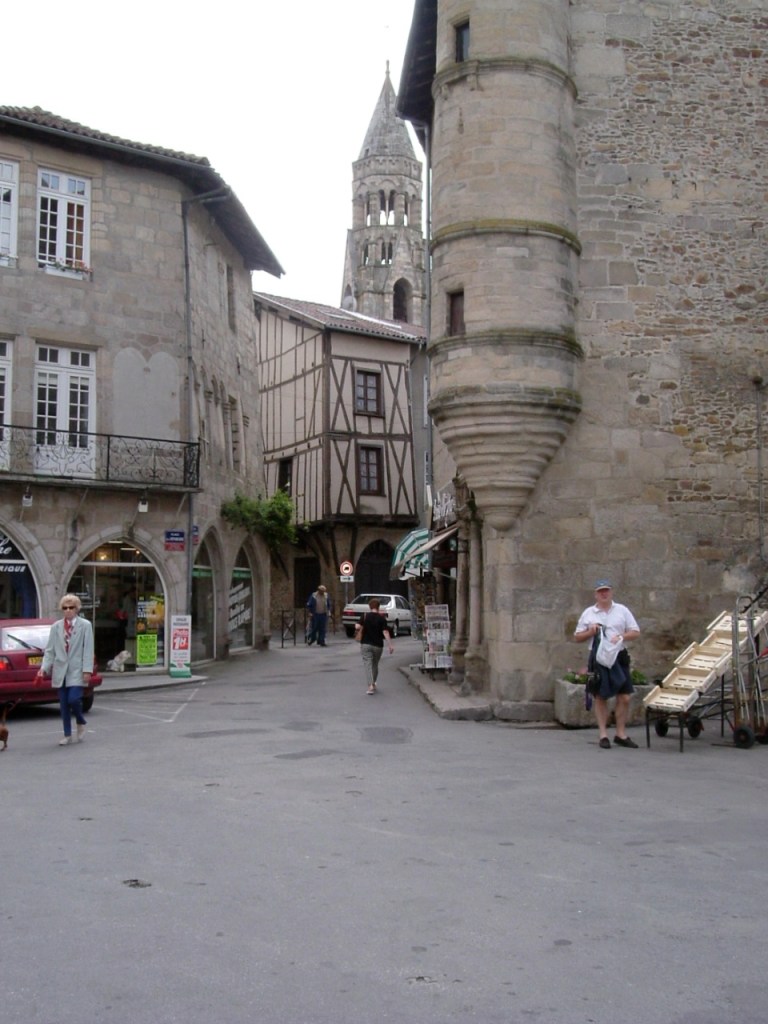
I was keen to visit St Leonard de Noblat, 22 kilometres the other side of Limoges and was confident I could navigate around the city. However we ended up in the middle of town caught up in a huge traffic jam. John didn’t appreciate that it was an excellent opportunity to see the sights. We finally arrived at St Julien, driving down to the river to check out the camping area. To our great disappointment it was closed. Even though we could have camped by the river we were getting low on water and needed to charge the video camera. Back we went the short distance to St Leonard de Noblet which has a medieval village at its centre, took some photos, bought some cerises (cherries) and set about finding a camping spot for the night.
Missing the turn to a caravan park we continued to travel north, ending up on the A20. It was then we saw a camping sign so pulled into a chateau with great relief. It was a pleasant, grassy spot with deer, very tall pine trees and of course the incredible chateau.

Continuing further north the next day we chose an alternative route and arrived in a little town called Loches. As we arrived by lunchtime it gave us time to explore the town. We were pleasantly surprised as the caravan park was walking distance to the castle, chateau and church and had shady, grassy pitches and a stream running through it.

We couldn’t wait to walk up the steep road to the castle towering over the town. Built in the 11th century, it consists of towers, dungeons, underground tunnels and beautiful terraces. We took a tour which was in French so unfortunately I was unable to understand any of it. However I did find out that after the liberation of Orléans, Joan of Arc met Charles VII at the royal residence in Loches on 22nd May 1429 and convinced him to be crowned and become the legitimate king of France. Obviously things went downhill for her after that.

All too soon we were heading back to Paris to drop off our Camping Car, spend a night at a hotel and then fly back to Luton.
We had a wonderful night in Paris at the end, staying in an old hotel which had wooden beams in the ceiling and a stone lined breakfast room two levels below the ground where the wine and food used to be stored. It was near Place de La Republique in the Bastille area and opposite a good restaurant where we had dinner.
Reality confronted me the next day as I had to start the reports which all the other teachers had been working on for the last week. C’est la vie.
 The Curry Apple Orchard
The story of Oradour-sur-Glane is appalling. I don’t understand why they would do that – what advantage to kill innocent people 😦
You seem to have had great luck with delightful camping spots and lovely villages and chateaux.
LikeLiked by 2 people
Apparently the German troops were told that someone in the village was helping or hiding some members of the Resistance. It appears it was another village anyway where that was happening, not that it makes the crime any less heinous.
LikeLiked by 1 person
I might add the soldiers were members of the Waffen SS who were renowned for their war atrocities.
LikeLiked by 1 person
My memories of a visit to Oradour sur Glane will stay with me always. The quiet peace of the day, the ruined buildings and vehicle act as a silent but powerful memorial to those whose lives were taken.
LikeLiked by 2 people
It’s an unforgettable place for sure.
LikeLike
I much prefer this kind of self-organised tours than the one where everything is set before taking off 😉
@JazzFeathers
The Old Shelter – The Great War
LikeLike
Another great post, Linda. So enjoying this series.
LikeLiked by 1 person
Thanks for keeping up. I’m having trouble reading other posts because mine are now taking more time. My diaries are running out.
LikeLike
So much horror in the world. I realize there is a lot of beauty, but humans can be so incredibly horrifying.
LikeLiked by 1 person
Enjoyed this tour of western France, despite the war horrors. We lived in France when I was very young and I’ve not been back since. It really looks incredible!
LikeLiked by 1 person
Thanks for this post; and I will be back to try to catch up on other posts in the series..
This trip must have truly been one for reflection.. I cannot imagine the horrors that happened then (and unfortunately horrors of other kinds still happen today).. I read so many books (fiction and non-fiction) in the recent months that were about WWII and each time the reading tore at my heart a little..
Kennings Or The Many Different Ways To View Things
LikeLike
We need to visit sites like Oradour-sur-Glane, sad at the time but a reminder of what can happen. Lest we forget.
LikeLiked by 1 person