 -to find a gaol
in one of the loveliest spots
formed by the hand of nature
in one of her loneliest solitudes
creates a revulsion of feeling
I cannot describe…
William Smith O’Brien
A day trip to Maria Island on a glorious sunny day is a far cry from the various incarnations of this beautiful but blighted island. As my diary shows, we were happy and excited to visit on February 18, 2010.

After arriving at Triabunna on Tasmania’s east coast, we walked around the waterfront to the Information Bureau to check on departure times for the Maria Island ferry. It leaves at 9.30 tomorrow and we think we will take our bikes. It will be $50 each plus $10 for the bikes. We will have to take morning tea, lunch, fruit, water, bikes, helmets and suncream…
Another wonderful day. The weather was perfect for our trip to Maria Island. We rode the bikes to the jetty and paid for our tickets. Once on the island, our first stop was the commissariat store which is an attractive brick building containing information about the island. It is one of the few remaining buildings from Maria Island’s first period of European occupation.
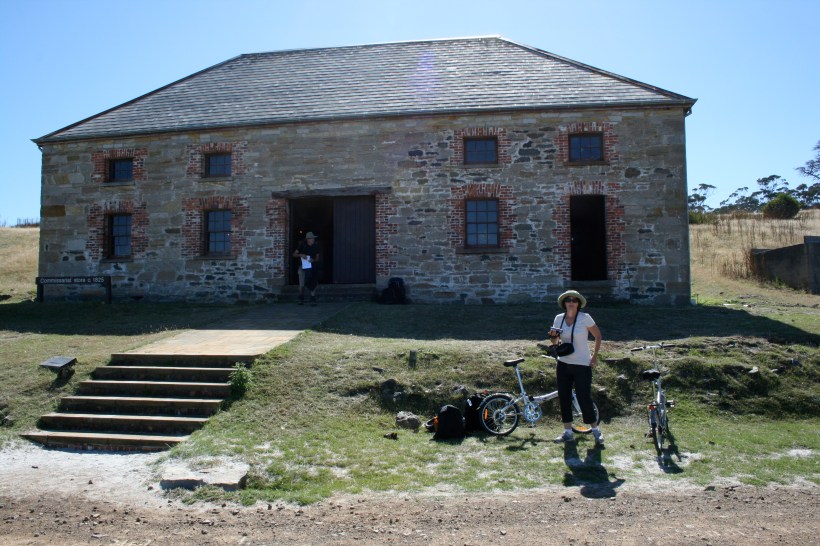
THE FIRST CONVICT ERA 1825-1832
Fifty convicts arrived with their military escorts. They were light offenders, many of whom had already completed service on farms. It was easy to escape as the mainland was only four kilometres away. Discipline was considered lax but trades and skills were taught in an effort to reform the prisoners. The closure in 1832 was a result of the success of the more productive and disciplined settlement at Macquarie Harbour.
THE SECOND CONVICT ERA 1842-1850
The Maria Island settlement of Darlington became a Convict Probation Station and most convicts were employed in agricultural tasks. However, in 1847, Darlington was cleared of all convicts to receive 369 prisoners, directly from England, under a new development in the convict system known as Task Work. Early in November 1849, the Irish political prisoner, William Smith O’Brien (convicted of High Treason) was sent to the island. A friendship developed between the Assistant Superintendent-in-Charge, Samuel Lapham, his daughter and O’Brien resulting in scandal, especially when O’Brien made an unsuccessful attempt to escape to the United States in an American whaler.
THE FIRST INDUSTRIAL ERA 1884–1896
On 17 April 1884, an Italian entrepreneur, Diego Bernacchi arrived with a vision to develop the island. By October 1886 thousands of vines and hundreds of mulberry plants were thriving. The Maria Island Company was floated in 1887 to add agriculture, cement, timber and fishery to the enterprises already undertaken. Signor Bernacchi was resident Managing Director, and Darlington was renamed San Diego. The bustling township of over 250 people had a school, shops, butcher, baker, blacksmith, shoemaker, post office, etc. Then, in 1892 the company went into liquidation and Bernacchi departed for London.
THE SECOND INDUSTRIAL ERA 1920–1930
Bernacchi didn’t give up. After WWI he was back, forming a small company which resulted in a Cement Works opening in 1924. He died a year later believing his pioneering dreams were realised. However, the Great Depression put an end to the enterprise in 1930.
Properties were gradually acquired so that in 1971 the island was declared a Wildlife Sanctuary and in 1972 it became a National Park.
Back to the diary.
Armed with maps of cycling tracks we decided to head off to French’s Farm and hopefully further on to McRae’s Isthmus and Ocean Beach which was supposed to rival Freycinet’s Wineglass Bay. The first stop was Darlington Township. It is a mixture of convict buildings and a number of additions by Bernacchi including the Coffee Palace, the front of which is open to tourists. What we would have given for a coffee! Unfortunately, there is no food or drink on the island except water.
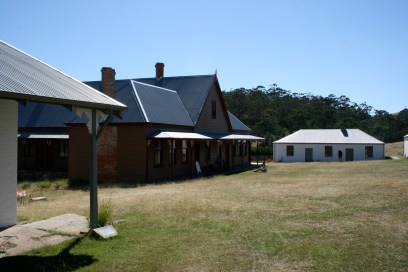
We only rode far as the turnoff to Return Point as the road became sandy and difficult to negotiate. We probably only had about three kilometres to go to French’s Farm. When the track was not sandy or uphill it was very rocky.
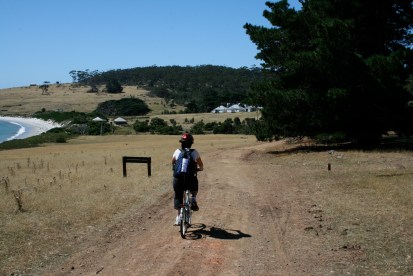 I didn’t fall off but it was close a few times. On the way back we stopped for lunch overlooking Four Mile Beach. At the Painted Cliffs we left the bikes and walked along the edge of the sandstone exposing layers of gold, bronze and cream. The patterns are caused by groundwater percolating through the sandstone and leaving traces of iron oxide. Weathering in honeycomb patterns and undercutting by the action of the sea have created a photographer’s paradise.


On the way back we called into the Darlington township again, this time to read about William Smith O’Brien, a political prisoner from Ireland who lived in one of the cottages in the convict settlement for two years. It appears he was quite an honourable character, trying to right the wrongs of the political and social mess that was Ireland.
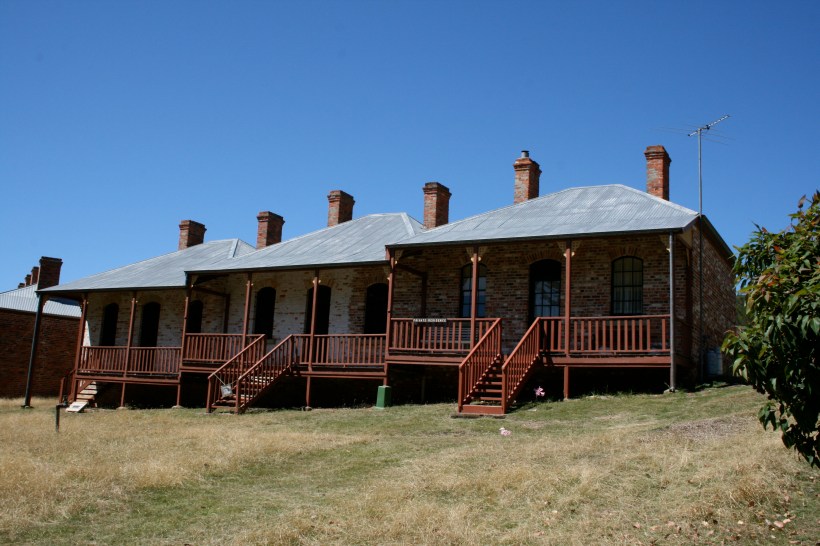
Back at the Store we ate our apples and considered the next walk/ride. This was to the Fossil Cliffs. We left the backpacks in the store and just took our cameras and bikes. John had brought a heavy bike lock which we didn’t use and cursed it all day.

The fossil cliffs are made of shell and coral fossils which are 290 million years old. The cliff exposure is recognised as one of the best examples of lower Permian strata in the world. Bernacchi used them as a source of material for his cement works which operated until 1930. From the quarry on the edge of the ocean, we had a good view of Mt Bishop and Clerk and saw kangaroos and Cape Barren Geese. We could see Schouten Island to the North and beyond that, Freycinet Peninsula.


Returning to the store, we collapsed exhausted on the comfy lounges. I thought I would just lie there and never get up.


Great photos – looks different to what I expected.
I remember riding hired bikes around Rottnest Island and my then quite young daughter getting very tired and emotional – some people passed us and remarked “not a happy camper”, a phrase that we invoke from time to time.
For me Maria Island is very well known as a disease free sanctuary for Tasmanian Devils. I think I also have some forebear (not direct) who was guarding the convicts in the 1840s – just looked it up my 5th great uncle Benjamin Bayly 1979 – 1850 died on Maria Island – magistrate and late captain 21st Fusiliers.
Regards
Anne
fellow A to Zedder
https://ayfamilyhistory.com/2019/04/15/m-is-for-marylebone/
LikeLiked by 1 person
I would love to return to Rottnest and hire a bike. There wasn’t time on our last visit. On another note, I wonder what killed Benjamin Bayley?
LikeLiked by 1 person
The Tasmanian name index which might lead me to a death record is down. 1850 before civil registration so cause of death might not be mentioned. I found a couple of death notices but no newspaper report. He had a nice grave and some descendants have erected a plaque https://www.findagrave.com/memorial/175497109/benjamin-bayly thanks for prompting me to follow up 🙂
LikeLiked by 1 person
This is such rich and interesting history, Linda. It really comes to life with your photos. Thank you for sharing this with us.
LikeLiked by 1 person
Biking and beaches sounds like you made quite the memory. I really like your blog:
LikeLiked by 1 person
Looks like a wonderful…and energetic…day
LikeLiked by 1 person
I loved the history interspersed with your diary of your cycling visit. And of course the photographs. The layered of sandstone and “Loneliness” were my favorites. In the history, I liked hearing about the Irish political prisoner, and wonder if he did any political organizing after he got to Tasmania. And your last sentence, as you collapsed on those comfy couches: “I thought I would just lie there and never get up”!
LikeLiked by 1 person
What a detailed response! Thanks for your interest.
LikeLiked by 1 person
We are planning a trip to Tasmania next month. Just a short one so I am not sure if I will get to Maria Island but I was pleased to re-read your post as I plan our trip there.
LikeLike