(North and Central Italy)

Our first tour ended in Munich so we found the railway station and bought second class tickets to Venice. I was dreading the seven hour trip in the heat but it was a magnificent train journey. The compartment was air conditioned, the scenery of soaring, snowy mountains was spectacular and most of the time we had six seats to ourselves. As the train pulled into Venice we were surrounded by water. Off the train and onto a ferry we saw the city bathed in the golden light of sunset. When I was a small child I would look at a picture of Venice every night before bed and say to myself, “one day I will go there.” Now I was living the moment I had dreamed about all those years ago.
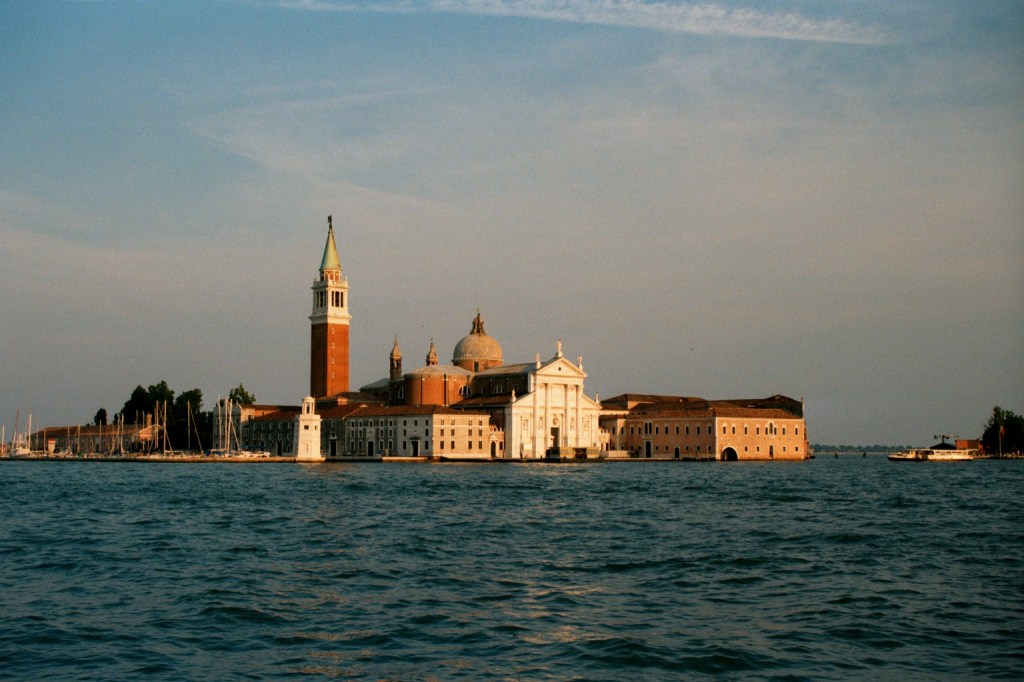
After 17 stops we arrived at the jetty of The Lido and found that our hotel, the Giardinetto, was conveniently opposite. The room was as small as a room can be, not much bigger than the king size bed but it was air conditioned and had an ensuite so we were happy.
We had some very pleasant meals in the Lido, near our hotel. It may be different now but in 2004 the beach side of The Lido was fenced off for paying guests and it looked rather run down. After a hot and exhausting day in Venice with our three-day ferry passes we were able to nip back to the Lido when we felt like it or visit Murano to look at the glass. I loved Venice despite the masses of tourists. We would spend the day walking or sitting in Piazza San Marco watching the people interact with the pigeons and listen to the seven piece orchestra playing for the overcharged coffee drinkers. Only once did we have dinner there and all I can say is we did not choose well.

Piazza San Marco 
Gorgeous Venice
We joined up with the second tour group at a lovely hotel in the middle of nowhere on the far outskirts of mainland Venice. It had a pool, a rare commodity on our tours.
As a group we returned to Venice by ferry, this time visiting San Marco’s Basilica with a guide. Although decorated with glass mosaic and gold it couldn’t quite match Melk for sheer ornateness and was very dark inside. A fellow member of the group had the same name as my husband but was considerably older. He collapsed in the Piazza San Marco in the intense heat so John and I gently lowered him down and a doctor in our group checked his pulse. I went off to the glass blowing demonstration leaving the men with their patient. The other John Curry recovered and was able to continue the tour.
I was impressed with the highways we travelled along that afternoon. They were built high above the ground, parallel with the Adriatic. Orchards began to appear and we stopped for an afternoon coffee and apple slice before arriving at our hotel in Perugia. The Ilgo Hotel was a pleasant surprise, up on a mountain top. Our window looked out over a steep hill of apple trees and cypress. As we returned from our excellent dinner we could hear a band playing at the front of the hotel but nothing stopped me from sleeping like a log.
Then we were in Assissi where St Francis’s bones are kept. It was a hilltop village which was inundated with tourists but was still picturesque and charming. We returned to Perugia, starting our exploration at the bottom of the hill and ascending a number of escalators until we reached the town at the top. Around the city was a wall which we admired as we ate our lunch. Back on the bus we travelled to Lake Trasimeno, the fourth largest lake in Italy. It was suffering from an excess of overflow and was on the nose.
Leaving Umbria we passed into Tuscany and stopped for the night in Sienna. Our room on the third floor was hot with no fan but its redeeming feature was the large French doors opening onto a balcony furnished with a table and five chairs. So of course we invited some other members of the group for drinks on our balcony.
The next day was to be quite different as we were going to the Isle of Elba. I still recall my father quoting, “Able was I ere I saw Elba”, a palindrome describing Napoleon’s feelings when banished to the Island. Driving to Piombina, we boarded the Moby Love along with our bus. On Elba we picked up a guide called Carla who travelled with us to Napoleon’s residence on the top of a hill. Here he had a good view of ships arriving and departing so chose to have the farmhouse rebuilt to suit his purpose. Napoleon’s period of exile on the island lasted only 9 months, but during his stay the Emperor worked to make many improvements on the island, including to the internal road network. Cut off from the allowance guaranteed to him by the Treaty of Fontainebleau and aware of rumors that he was about to be banished to a remote island in the Atlantic Ocean, Napoleon escaped from Elba on February 26, 1815 and made his way to France.

The water was very clean and clear although the beaches were pebbles. We couldn’t find anywhere to get changed so I contemplated swimming fully clothed. Common sense prevailed and I had to content myself with wading up to my knees.
On our return to the mainland excitement grew in the bus as we glimpsed the Leaning Tower of Pisa. We had to wait until the next day to see the icon up close.
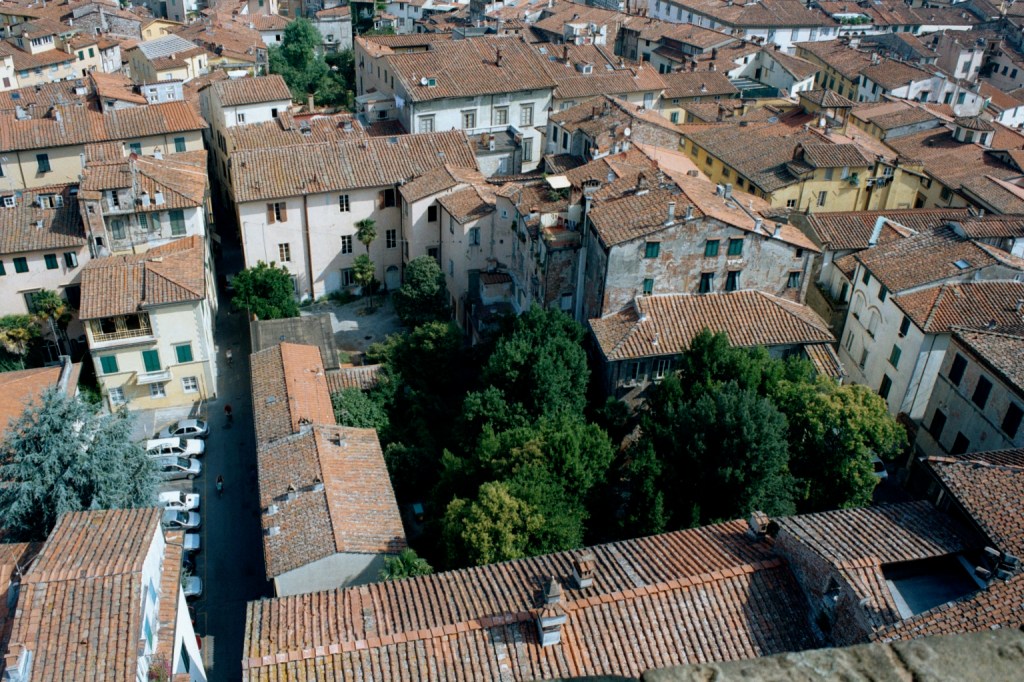
Although the plan was to see the Leaning Tower, we visited Lucca first. I climbed up a tower with trees growing out the top while John stayed below and organised iced coffees.
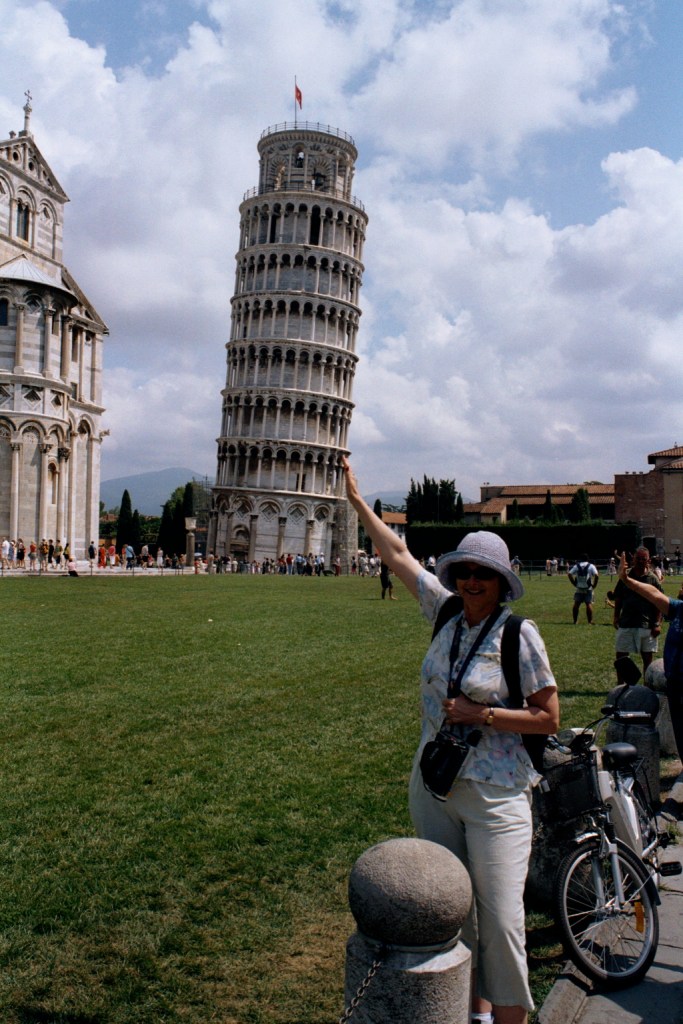
Then we were in Pisa, taking the usual ridiculous photos with the tower balanced on one hand. We both decided not to climb the tower but found a good lunch spot where we could sit and watch other people clambering up. According to one who did it she found it quite terrifying as she walked out onto the wildly sloping ledge at the top of the spiral staircase.

We spent three nights in Montecatini which is a spa town visited by mainly older Italians who stayed in the many guesthouses and spent each evening sitting on the footpaths watching the entertainment of fashion parades and bands. It was a case of musical rooms for us at the Minerva Palace. The first smelt of smoke, the second was small and dark with no air conditioning and the third faced the street, had air conditioning and was quite satisfactory.
The Town of Fine Towers, or San Gimignano, was our destination on the following day. About fourteen towers survive in the hilltop town, circled by high stone walls.
Not to be outdone by my efforts John climbed a tower this time while I listened to a harpist singing and playing near the old town well.

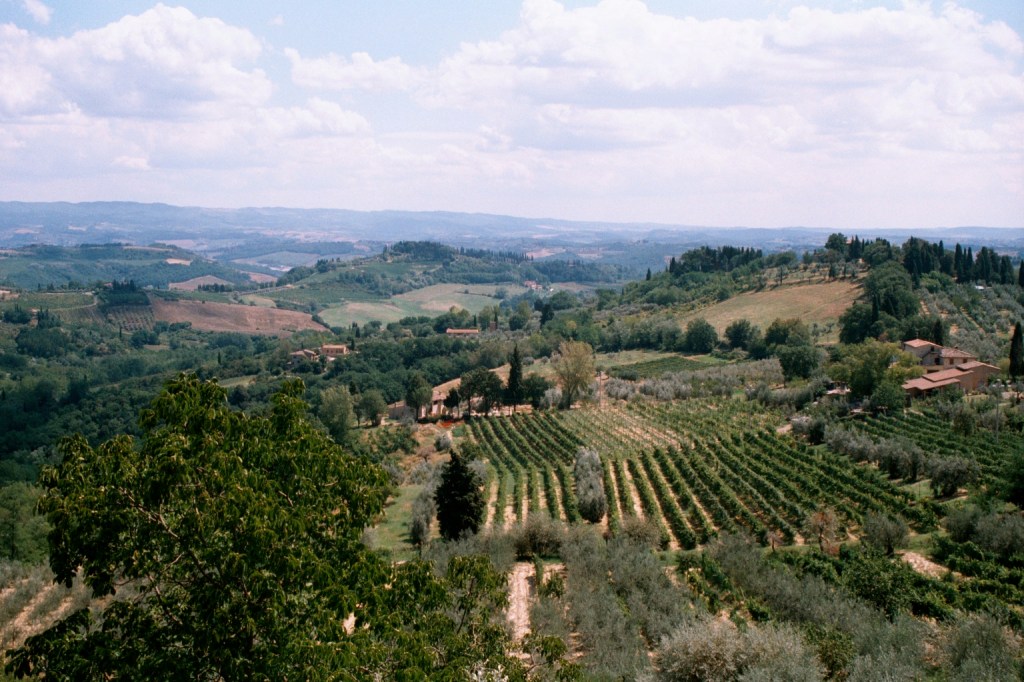
Many a bottle of Chianti had been shared in our youth, with a candle later stuck in the round bottle enclosed in a straw basket. I discovered this bottle style was called a fiasco and enjoyed its contents with some bread and meat as we stood outside a castle in the Chianti Vineyards.
Florence was hot and wall to wall people but we visited the Uffizi Gallery and saw works by Botticelli, Michaelangelo and Leonardo da Vinci. I was especially impressed with “Birth of Venus”. Crossing the Ponti Vecchio we walked alongside the Anno River. It looked rather polluted but people were sunbaking on a large rock in the middle in the blazing heat. Our visit to Florence was all too short as we were whisked back to the Minerva Palace for a farewell meal.

Sunbaking on the Anno 
Ponti Vecchio
Unlike most of the others in our group who flew straight home from Marco Polo Airport we were staying another day on the outskirts of Venice in a very boring suburb called Quarto D’Attiro. It was a Sunday but luck was on our side when we found a great little trattoria. The spaghetti with prawns and artichokes was so good we went back there for dinner. Tomorrow we would be back home in Chasetown to find out if summer really exists in Britain.
 The Curry Apple Orchard