
An annual event which we rarely miss is the Caravan Camping Holiday Supershow at Rosehill Gardens Racecourse in Sydney. In 2009 it attracted 80,000 visitors and displayed the latest caravans, motorhomes, camper trailers and accessories. Included in the 400 exhibition stands was information on destinations and holiday parks around Australia.
Our aim was to buy a caravan. We were selling our A’van, also inspired by the same show nine years earlier and moving on to something more comfortable. Our requirements were simple, we thought. It should be no more than 20 feet long as it had to fit in a small space in our back yard. As an aside, we seem to talk about caravan length in feet, even though we have been metric for nearly fifty years. It had to be light enough to be towed by our Toyota Prado. It also had to be self-contained, with its own bathroom, so that we could free camp when necessary. We also thought semi-offroad would be desirable for gravel and dirt roads.
We visited all the well-known caravans on display and found to our annoyance that not one caravan fitted the bill. The biggest problem was weight. The heavier suspension required to make a van even semi-offroad took it over the 2.5 tonne limit when fully loaded.
After a day of looking inside and under vans our heads were spinning. We were going to give up and go home when my husband said, “Let’s go and have another look at the Lotus.”
I must admit we were both smitten by the way it was decorated and that is what drew us back. The only downside was the conventional leaf spring suspension. However, we could have the van raised 2 inches in the build and larger tyres added so that we had extra clearance.
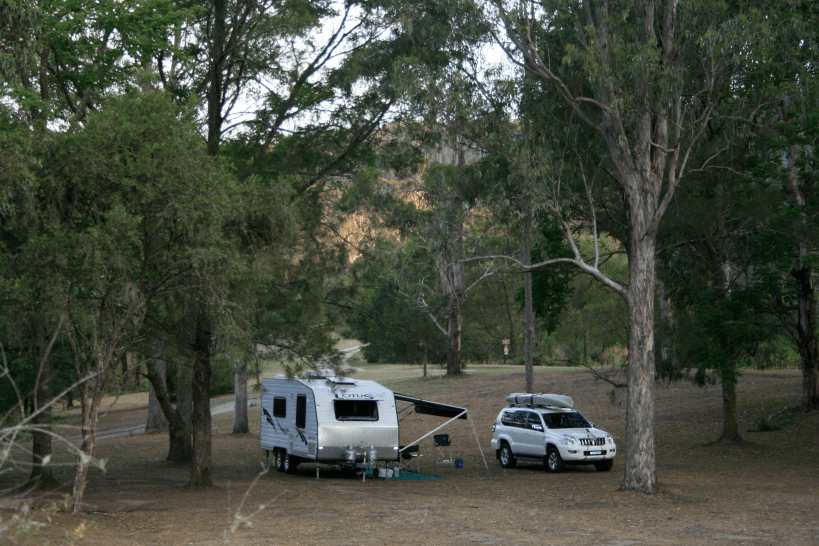
The van was beautiful. It was called an Uptown because it was just that bit more luxurious than most vans. It was only 19 feet long but in that space was a shower, sink, toilet and washing machine across the back. Café seating in leather and a fold-out table on one side faced a sink, gas stove and row of cupboards on the other. A full-sized fridge with separate freezer stood opposite the door and finally at the front a queen-sized bed sported a striking duvet cover. Presentation certainly sells a van. The windows were large and used a system of fly-screens attached to block-out shutters covered by slimline venetian blinds. The cupboards were light honey coloured, smooth and curved, reminiscent of a past era and yet looking surprisingly modern.

There were three points to attach a TV, including one outside, an air conditioner in the ceiling, a Four Seasons hatch and a Heki hatch. The bed lifted up with gas struts to reveal a large storage area underneath. Outside, at the front, was a tunnel boot which meant the overall length of the van was kept to a minimum.

We found ourselves signing the paperwork at the end of a long day, just as everything was closing. Had we made the right decision?
We were in for a long wait of five months while our caravan was built. The Lotus factory is in Campbellfield in Victoria, 800 km south of our home. However, the caravan dealer at the show was in Tweed Heads, 900 km to the north. We could have cancelled the order and reordered it in Victoria, but decided it would still be chilly when the caravan was ready so heading north was a better option.
Five months later we loaded the Prado with everything we thought we needed for the van and drove north. The first night we stopped at a motel in Coffs Harbour. The following night we settled into a cabin at a caravan park in Tweed Heads. A quick visit to the dealer to check on our new purchase before handover the next day rang some alarm bells.
The checker plate along the side was a narrow strip instead of the wide strip we had ordered.
The dealer was all concern. “I’m sure we can get that changed.”
The outside door kept sticking and finally a piece broke off the top.
“We’ll put another door on before tomorrow!”
John was disgruntled about the checker plate but it didn’t worry me at all. I was nervous about remembering all there was to know about the new van as it was much more complex than our little old A’van.
Next morning we turned up with the Prado for its introduction to the Uptown. We would be using Hayman Reece Weight Distribution Hitches which required a special towbar. The car also had to have an electric brake controller added. We also bought a Trail-a-Mate jack to support the van when not attached to the car.
Off we went to the caravan park. John expertly manoeuvred it into its space and we attached power cords, water hoses, drain hoses, wound down the supports and extended the awning. I made up the bed and filled the fridge and the cupboards. As I turned some lights on we decided to have a celebratory drink before preparing dinner on our first night.
That’s funny. The lights are getting dimmer. Oh no! There are no lights at all!
Fortunately we had the phone number of the dealer, who by now was at home. He promised to come around early in the morning. In the meantime, the thought of cooking in the dark was not appealing as our spirits were by now very low, so we put the fridge on gas and went out to a club for dinner.
The next day the dealer replaced the battery charger and all was well. I had learnt something new. Even if we were plugged into electricity, the lights would not work if the battery was flat.
Our woes were not over yet. Later that same day I found water leaking under the sink. The drain hose had a hole in it. Another phone call to the dealer and he was there within minutes. Apparently, the drain had been tied too tightly and split the pipe.
What else could go wrong, we wondered? Another few days and we started to relax. So much so that we took off for new pastures without any more mishaps.

Over the years we have made a few changes to the van, just as you might to a house and its contents. We always found the bed a bit short and a bit hard. We had the bed base extended so that we can add a piece of foam when it is pulled out. We also bought a foam overlay so now it is as comfortable as the bed at home.

Driving out to Lawn Hill we encountered a corrugated road which shook us pieces so we wondered what would greet us when we opened the door. The fold up table had come away from the wall but otherwise nothing was damaged.
Over time we have changed most of the lights to LED. The microwave and washing machine were both replaced in the last five years. We had a scare with the gas stove which had exploded in a couple of other vans. We were told not to use it and turn the gas off. Then we were told we could use it except for the front left burner. Finally, we were told we were OK. The ban did not affect our model.

A recent improvement was the addition of a diesel heater. Some people install their own but as we are retired schoolteachers, not engineers, we preferred to leave it to the experts. Now, with our movable solar panels, gas fridge and hot water and diesel heater we are equipped to camp away from civilization, electricity and amenities. It is also useful when a caravan park is fully booked but may have some unpowered sites. No more cold nights, shivering and unable to get warm.
When is a van too old? Uptown Girl is now 14. She has been well maintained so hopefully has a few years in her yet. We certainly don’t plan to buy another van or a motorhome so she will have to last as long as we do. I wonder what happens to old caravans? I know some end up on properties, covered with a tarp and providing accommodation for itinerant workers. There must be caravan graveyards where it would be possible to find spare parts. Most caravans in Australia use a lot of the same products for windows, doors, air conditioners, stoves, hatches etc. In the end, it is the plastic parts that go. They just start to crumble from too much sun. I’m thinking of the exhaust hatches in the bathroom which must be cleaned very gently.
At the moment there are 109 Aussie built brands and six imported. How they can all stay in business beats me but in 2017 there were 20,000 caravans a year being built and now it could be more. The waiting time for a new van can be over a year and the difficulty acquiring imported parts has everyone longing for the days when everything was made in Australia.
Lotus are now known for their rugged off road vans which are bigger, heavier and more expensive than ours. They have an annual get together in Queensland where they all camp for a week and share ideas and the latest developments. It’s not really our thing but I like to keep in touch with their Facebook page and monitor the questions and answers posed by other owners. It has a policy of no undue criticism of the brand to avoid becoming a whinge fest. Instead owners talk about their experiences, give travellers tips and offer advice when asked.

 The Curry Apple Orchard