
L for Lotus Life

An annual event which we rarely miss is the Caravan Camping Holiday Supershow at Rosehill Gardens Racecourse in Sydney. In 2009 it attracted 80,000 visitors and displayed the latest caravans, motorhomes, camper trailers and accessories.  Included in the 400 exhibition stands was information on destinations and holiday parks around Australia.

Our aim was to buy a caravan.  We were selling our A’van, also inspired by the same show nine years earlier and moving on to something more comfortable.  Our requirements were simple, we thought.  It should be no more than 20 feet long as it had to fit in a small space in our back yard. As an aside, we seem to talk about caravan length in feet, even though we have been metric for nearly fifty years. It had to be light enough to be towed by our Toyota Prado.  It also had to be self-contained, with its own bathroom, so that we could free camp when necessary.  We also thought semi-offroad would be desirable for gravel and dirt roads.

We visited all the well-known caravans on display and found to our annoyance that not one caravan fitted the bill.  The biggest problem was weight.  The heavier suspension required to make a van even semi-offroad took it over the 2.5 tonne limit when fully loaded.

After a day of looking inside and under vans our heads were spinning. We were going to give up and go home when my husband said, “Let’s go and have another look at the Lotus.”

I must admit we were both smitten by the way it was decorated and that is what drew us back.  The only downside was the conventional leaf spring suspension.  However, we could have the van raised 2 inches in the build and larger tyres added so that we had extra clearance.

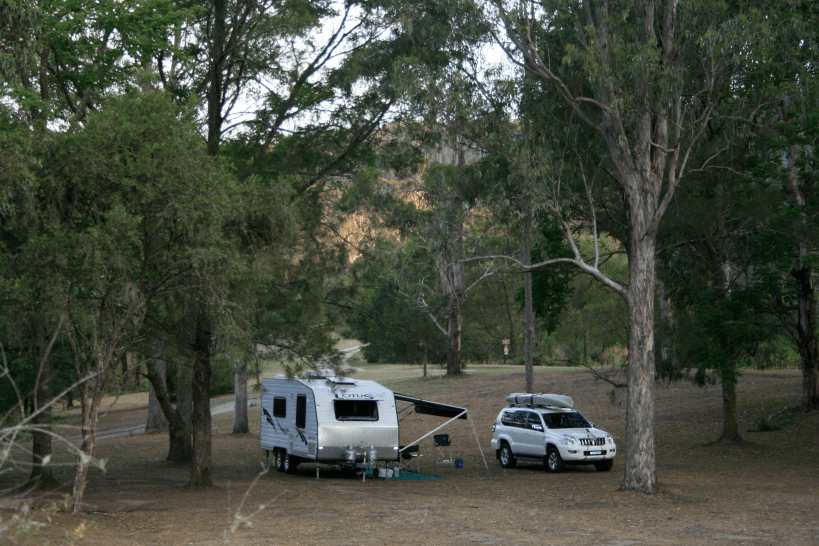
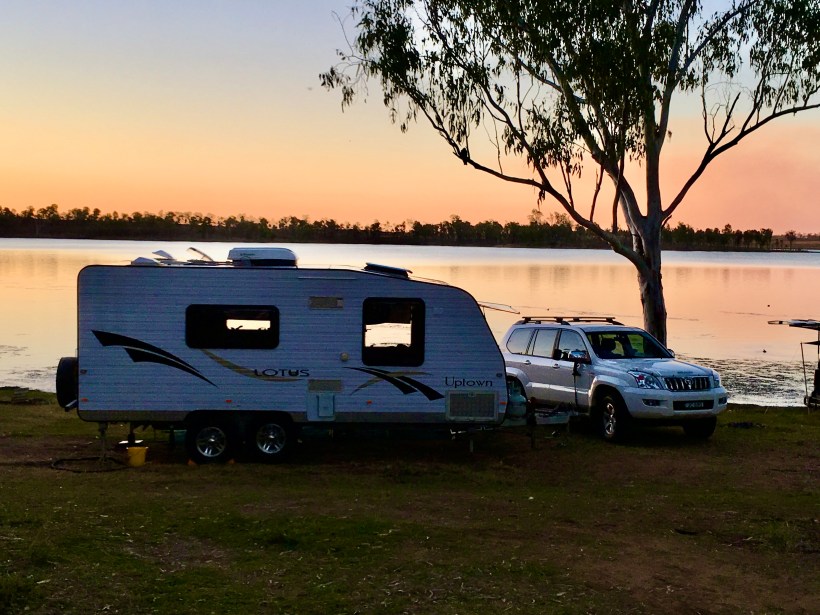
The van was beautiful.  It was called an Uptown because it was just that bit more luxurious than most vans.  It was only 19 feet long but in that space was a shower, sink, toilet and washing machine across the back.  Café seating in leather and a fold-out table on one side faced a sink, gas stove and row of cupboards on the other. A full-sized fridge with separate freezer stood opposite the door and finally at the front a queen-sized bed sported a striking duvet cover.  Presentation certainly sells a van.  The windows were large and used a system of fly-screens attached to block-out shutters covered by slimline venetian blinds. The cupboards were light honey coloured, smooth and curved, reminiscent of a past era and yet looking surprisingly modern.

The show van that captured our attention

There were three points to attach a TV, including one outside, an air conditioner in the ceiling, a Four Seasons hatch and a Heki hatch. The bed lifted up with gas struts to reveal a large storage area underneath. Outside, at the front, was a tunnel boot which meant the overall length of the van was kept to a minimum.

So many choices to make

We found ourselves signing the paperwork at the end of a long day, just as everything was closing.  Had we made the right decision?

We were in for a long wait of five months while our caravan was built. The Lotus factory is in Campbellfield in Victoria, 800 km south of our home.  However, the caravan dealer at the show was in Tweed Heads, 900 km to the north.  We could have cancelled the order and reordered it in Victoria, but decided it would still be chilly when the caravan was ready so heading north was a better option.

Five months later we loaded the Prado with everything we thought we needed for the van and drove north.  The first night we stopped at a motel in Coffs Harbour. The following night we settled into a cabin at a caravan park in Tweed Heads. A quick visit to the dealer to check on our new purchase before handover the next day rang some alarm bells.

The checker plate along the side was a narrow strip instead of the wide strip we had ordered.

The dealer was all concern.  “I’m sure we can get that changed.”

The outside door kept sticking and finally a piece broke off the top.

“We’ll put another door on before tomorrow!”

John was disgruntled about the checker plate but it didn’t worry me at all. I was nervous about remembering all there was to know about the new van as it was much more complex than our little old A’van.

Next morning we turned up with the Prado for its introduction to the Uptown.  We would be using Hayman Reece Weight Distribution Hitches which required a special towbar.  The car also had to have an electric brake controller added.  We also bought a Trail-a-Mate jack to support the van when not attached to the car.

Off we went to the caravan park.  John expertly manoeuvred it into its space and we attached power cords, water hoses, drain hoses, wound down the supports and extended the awning.  I made up the bed and filled the fridge and the cupboards. As I turned some lights on we decided to have a celebratory drink before preparing dinner on our first night. 

That’s funny.  The lights are getting dimmer.  Oh no!  There are no lights at all!

Fortunately we had the phone number of the dealer, who by now was at home.  He promised to come around early in the morning.  In the meantime, the thought of cooking in the dark was not appealing as our spirits were by now very low, so we put the fridge on gas and went out to a club for dinner.

The next day the dealer replaced the battery charger and all was well.  I had learnt something new.  Even if we were plugged into electricity, the lights would not work if the battery was flat.

Our woes were not over yet.  Later that same day I found water leaking under the sink.  The drain hose had a hole in it.  Another phone call to the dealer and he was there within minutes.  Apparently, the drain had been tied too tightly and split the pipe.

What else could go wrong, we wondered? Another few days and we started to relax.  So much so that we took off for new pastures without any more mishaps.

On the road at last

Over the years we have made a few changes to the van, just as you might to a house and its contents.  We always found the bed a bit short and a bit hard.  We had the bed base extended so that we can add a piece of foam when it is pulled out. We also bought a foam overlay so now it is as comfortable as the bed at home.

A very comfy bed

Driving out to Lawn Hill we encountered a corrugated road which shook us pieces so we wondered what would greet us when we opened the door.  The fold up table had come away from the wall but otherwise nothing was damaged.

Over time we have changed most of the lights to LED. The microwave and washing machine were both replaced in the last five years.  We had a scare with the gas stove which had exploded in a couple of other vans.  We were told not to use it and turn the gas off.  Then we were told we could use it except for the front left burner.  Finally, we were told we were OK. The ban did not affect our model.

Cooking with gas

A recent improvement was the addition of a diesel heater.  Some people install their own but as we are retired schoolteachers, not engineers, we preferred to leave it to the experts. Now, with our movable solar panels, gas fridge and hot water and diesel heater we are equipped to camp away from civilization, electricity and amenities.  It is also useful when a caravan park is fully booked but may have some unpowered sites. No more cold nights, shivering and unable to get warm.

When is a van too old?  Uptown Girl is now 14.  She has been well maintained so hopefully has a few years in her yet.  We certainly don’t plan to buy another van or a motorhome so she will have to last as long as we do. I wonder what happens to old caravans?  I know some end up on properties, covered with a tarp and providing accommodation for itinerant workers. There must be caravan graveyards where it would be possible to find spare parts.  Most caravans in Australia use a lot of the same products for windows, doors, air conditioners, stoves, hatches etc. In the end, it is the plastic parts that go.  They just start to crumble from too much sun.  I’m thinking of the exhaust hatches in the bathroom which must be cleaned very gently.

At the moment there are 109 Aussie built brands and six imported.  How they can all stay in business beats me but in 2017 there were 20,000 caravans a year being built and now it could be more.  The waiting time for a new van can be over a year and the difficulty acquiring imported parts has everyone longing for the days when everything was made in Australia.

Lotus are now known for their rugged off road vans which are bigger, heavier and more expensive than ours.  They have an annual get together in Queensland where they all camp for a week and share ideas and the latest developments.  It’s not really our thing but I like to keep in touch with their Facebook page and monitor the questions and answers posed by other owners. It has a policy of no undue criticism of the brand to avoid becoming a whinge fest. Instead owners talk about their experiences, give travellers tips and offer advice when asked.

A modern Lotus Caravan

K for Kayaking at Kealakekua

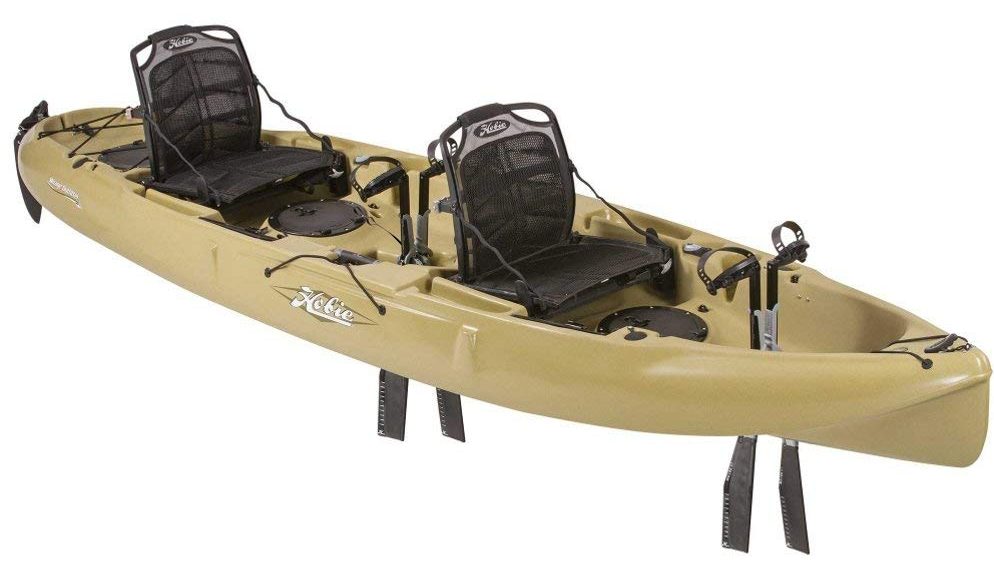
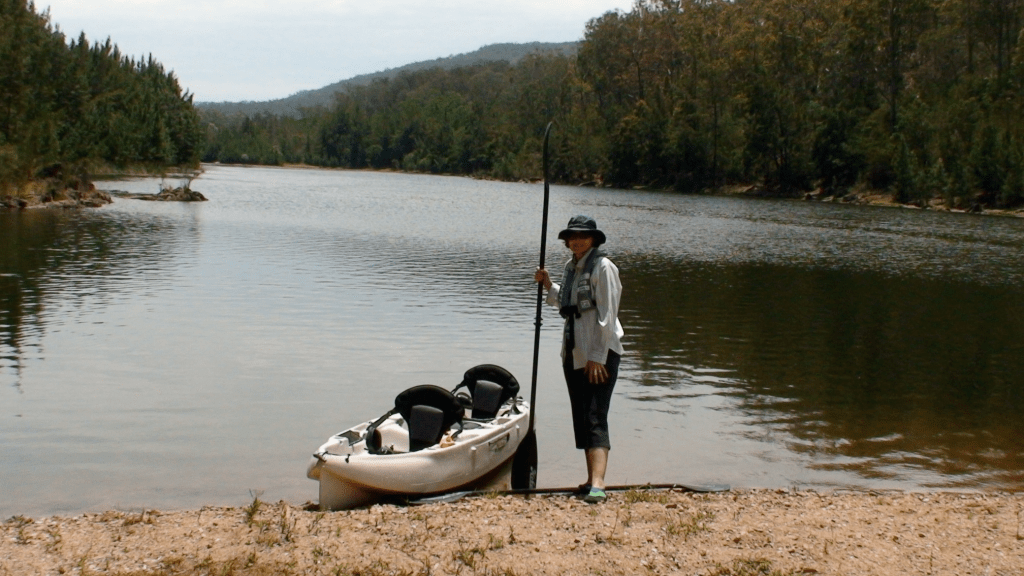
It’s hard to keep us away from boats. Back in 2005 we were impressed by a kayak called a Hobie Outfitter with a Mirage Drive.  Instead of paddling with oars the boat was propelled using pedals.  We tried a tandem kayak on the water and next thing we knew we were the proud owners of this amazing vessel. Hebe 2, as we called it, travelled on the roof of our car as far as Airlie Beach before powering through the choppy waters of the Whitsundays.  We caught fish from it off the Town of 1770 and pedalled up the Maroochydore River.  On the South Coast of NSW our favourite kayaking spot was Lake Conjola but we also put it in on the Upper Shoalhaven at Coolendel.


There were a couple of problems.  First of all it was quite heavy and lifting it onto the roof of the car required considerable effort from the two of us. One of the pedals was tricky to fit and one of the seats refused to stay in place.  After ten years we hadn’t used it for a while so we advertised it and shortly after waved goodbye.

Exploring the Shoalhaven River

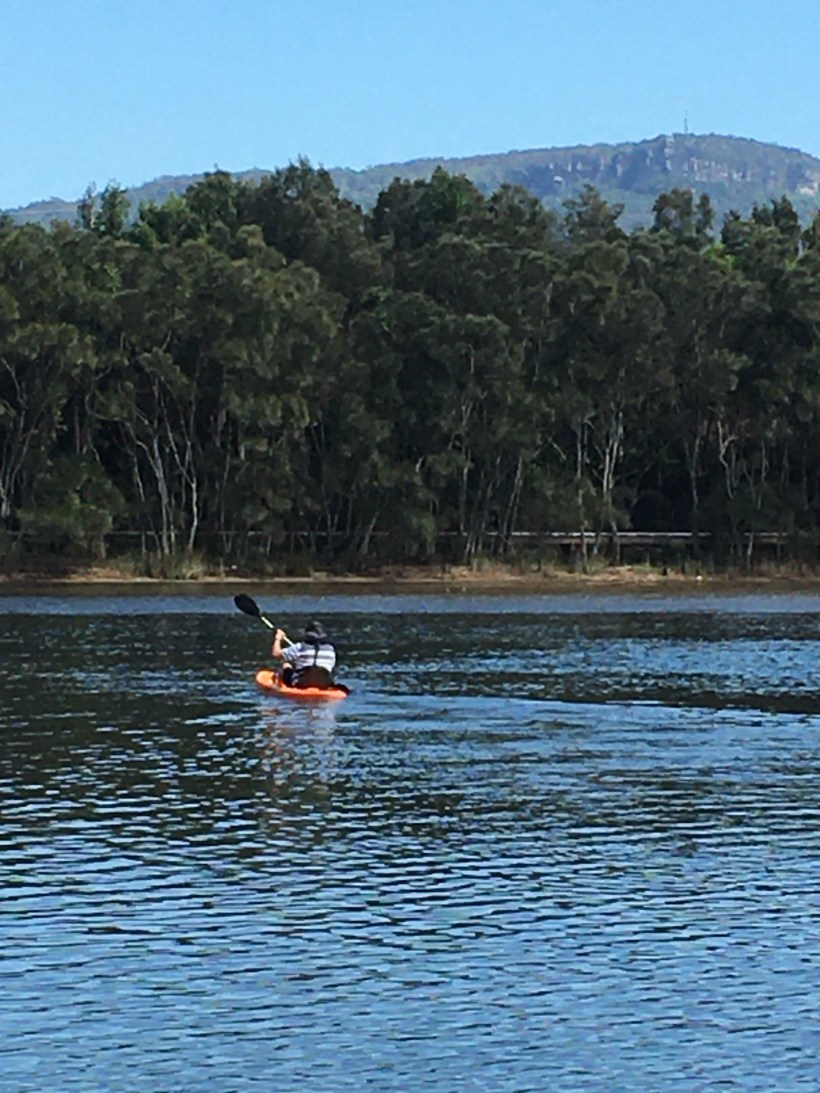
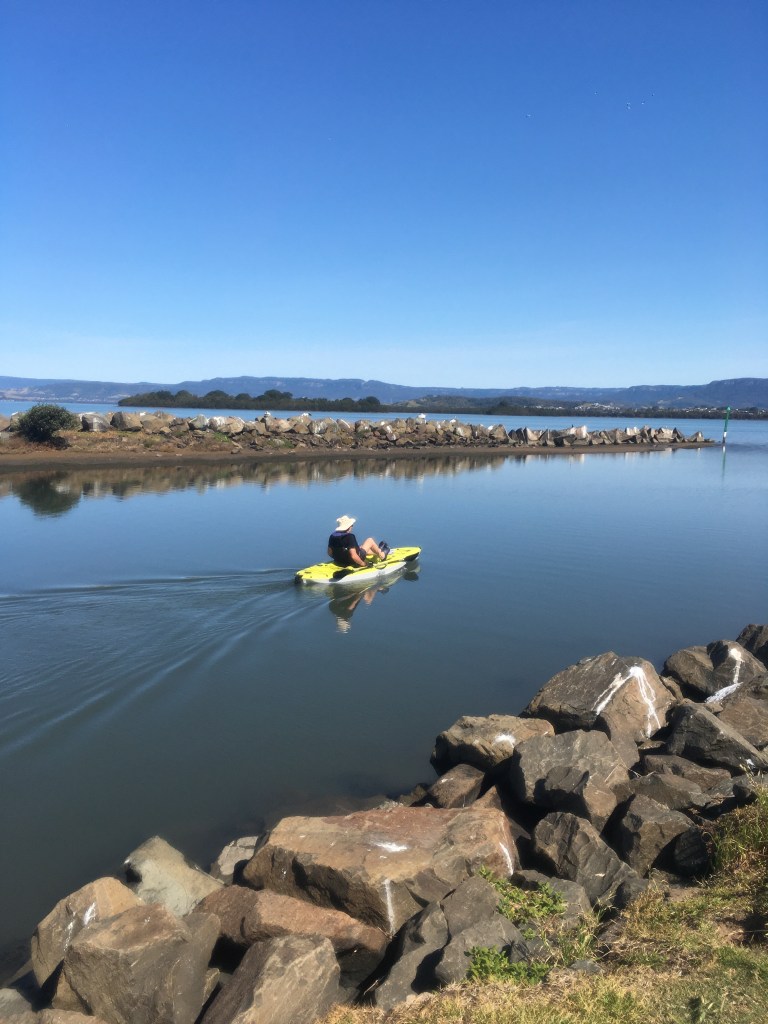
So we were without a boat but it wasn’t until Covid lockdowns limited our lives that we really missed it.  I saw a small, single version of a Hobie called a Mirage Passport for sale at the local BCF and snapped it up. 

Lake Illawarra, NSW

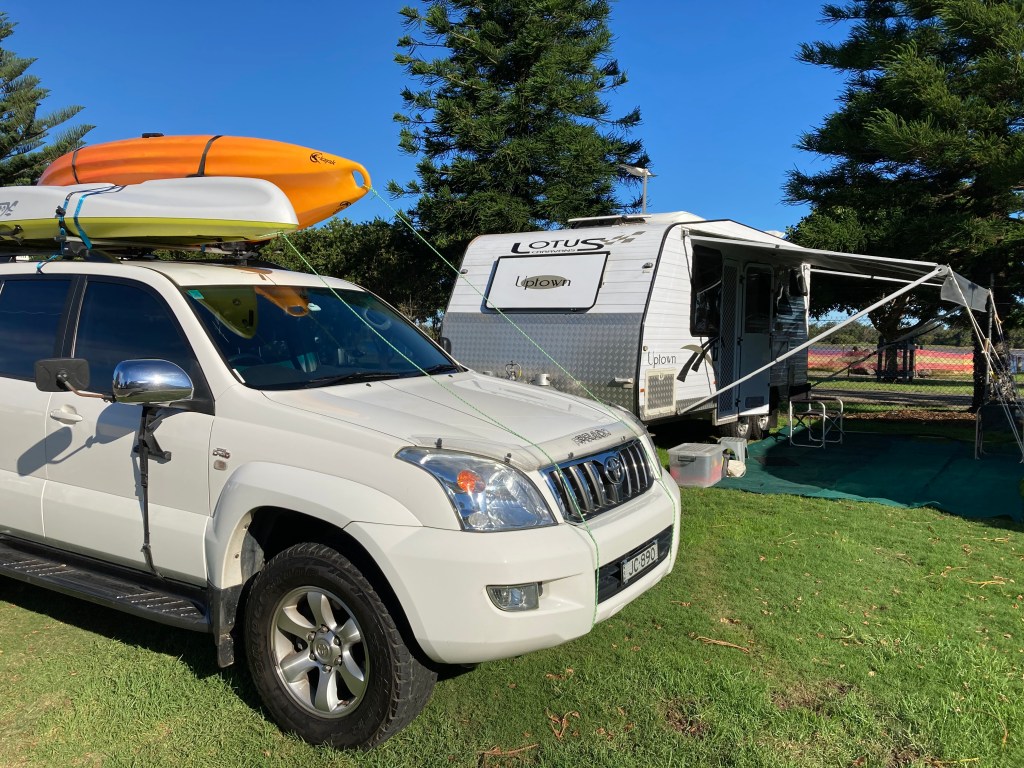
 We also bought a regular kayak off our son so one of us paddles and the other one pedals. We had to buy an extra roof rack to hold the second kayak but as they are both lighter than the original Hobie they are easier to transport.

Carrying two kayaks

We have only kayaked once overseas and the purpose of the exercise was not so much to experience a paddle on the water, but to get to a particular place. John has always been a fan of Captain James Cook, visiting his school near Great Ayton, the town where he first worked (Staithes) and Whitby, where he was apprenticed to a ship owner.  We knew when going ashore from the Pride of America in Kailua Kona on the island of Hawaii (Big Island),  that we would be close to the place of his death so we thought it would be a perfect opportunity to visit the site.

Once on the jetty we asked the woman at the Information booth how to go about seeing the Captain Cook Memorial.  She said there was no easy way to get there except by boat.  Road access is a poor option as it involves a long, hot and difficult walk at the end.  There were boat tours but they were expensive and designed for snorkelling, not to see the memorial.  She suggested we go with a private tour and pointed to a man in a blue shirt called Ken.  Shortly after his wife Marylou arrived and between them they said we could do a tour and go on a kayak ride to the memorial.  They just needed two more people.  

We tried to convince a few people but most of them said they were not interested in kayaking.   Finally a young couple from Florida, Chris and Tammy, agreed to go. They weren’t sure if they wanted to kayak but Marylou said they could go on to The Place of Refuge National Park while we were paddling.  First stop was the Kona Joe Coffee Plantation.  The coffee is grown on trellises and the setting was wonderful up in the hills.  We could see our ship in the far distance.  We drank coffee samples and tried chocolate coated coffee beans.  The two went very well together. 

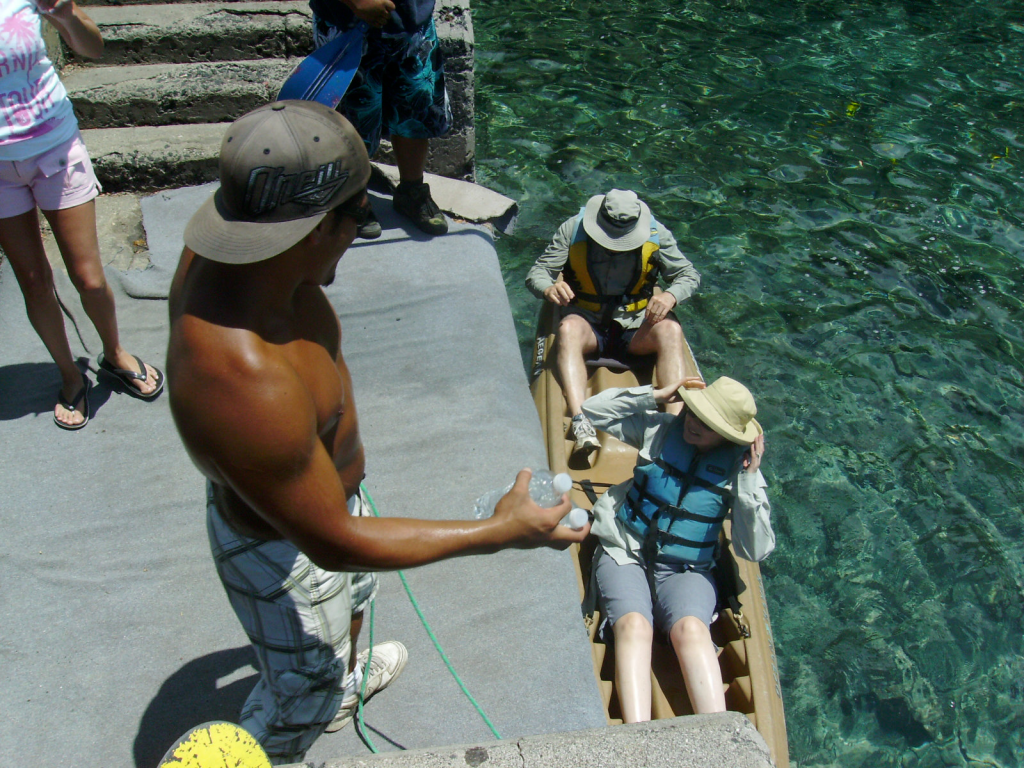
The kayaks, owned by a woman called Regina, were rather old and faded. So were the lifejackets. We had the seats changed for some more comfortable ones that actually had a seat in them, put on our swimmers in the change sheds,  and soon were on the water of Kealakekua Bay. We both laughed at the bung in the bow made of a piece of rolled up paper.  We were told it would take 45 minutes to reach the memorial so we paddled hard, knowing that the other couple might be waiting for us.  They hired a kayak too but went to an area not far from where we launched to watch the spinning dolphins.

Us climbing awkwardly into the kayak

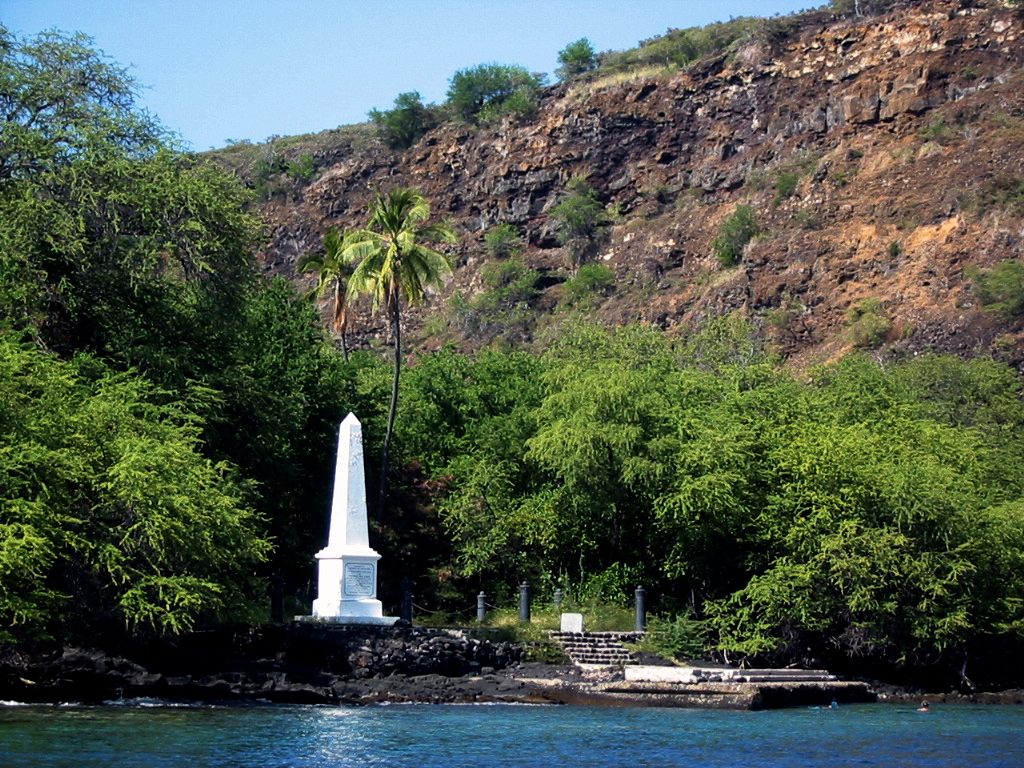
The paddle went well and we arrived in a rocky area surrounded by a number of other much newer kayaks belonging to a snorkelling group. We asked a few people how to get to the memorial but most didn’t know it was there.  We had to climb through some bushes before we found the path and from then on it was straight forward.  The memorial was erected 100 years after Cook’s demise, by the British. I stood there and tried to imagine what took place, two hundred and thirty-two years before.

It was an unfortunate series of events that led to a very grisly end for the famous navigator. Many local inhabitants rue the day Cook set foot in Hawaii as their way of life was changed forever, which is maybe why his memorial is so isolated.

Cook’s Memorial. Photos attributed to nein09

There are various versions of what happened but the following account is generally accepted. When the two ships of Cook’s expedition returned to Kealakekua Bay after a mishap at sea, they were not greeted with enthusiasm as they had worn out their welcome on their first visit.  For whatever reason, one of the longboats was stolen from the Resolution. To try and get it back Cook attempted to kidnap the ali’l nui (supreme ruler) of the island.  One of the chiefs angrily approached Cook, who reacted by striking him with the broad flat side of his sword. The chief grabbed him and hit him with a shark-toothed club.  Cook fell to the sand and was stabbed in the chest with a metal dagger by the personal attendant of the ali’l nui.

The water was clear and clean in 2010, and there was time for a short swim in amongst the yellow fish before we started paddling back.  The others had been amongst the dolphins and watched us return so they too paddled back to the launching spot.

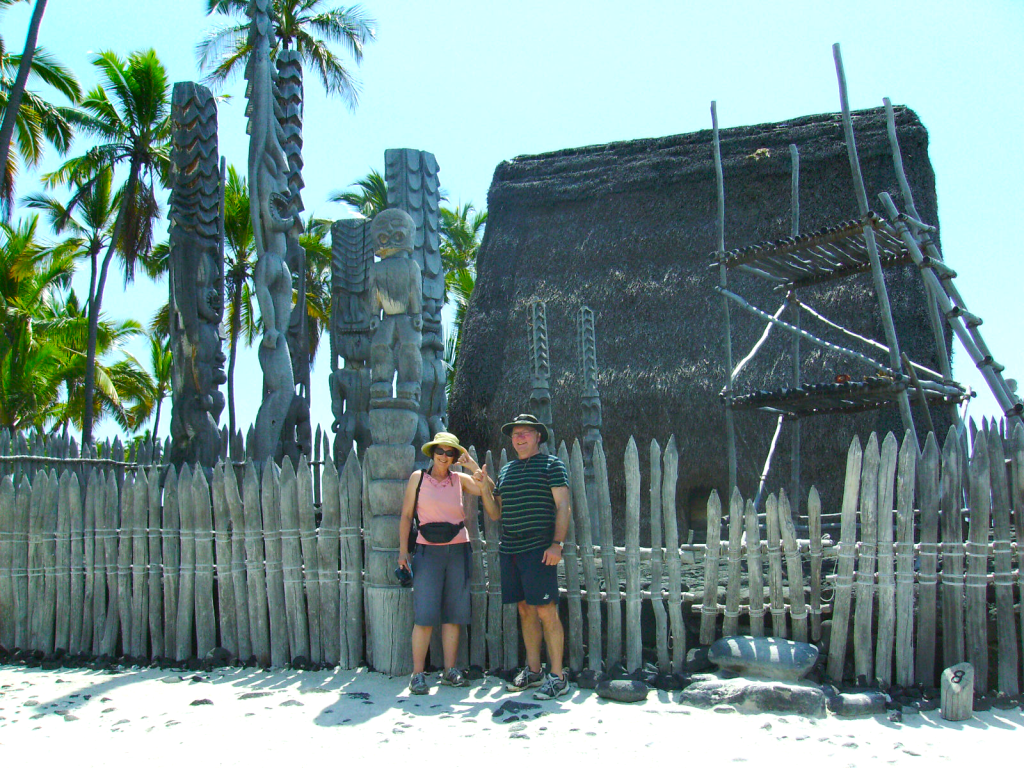
We thought our tour was over but more was to come.  We were driven to The Place of Refuge, a National Park called Pu’uhonua o Konaunau.  This is where the ali’i established a residence and also where people could seek refuge or absolution.  It was a lovely setting right on the sea with clean blue water, sand and black lava.  Massive dry stone walls had been built across the area, separating the royal grounds from the Place of Refuge. 

The Place of Refuge

We had started the day with only a vague idea of what we wanted to do but we ended up doing so much more.

J for Jurassic Falls

Do you recall the scene in the Steven Spielberg movie “Jurassic Park” where a helicopter lands beside a waterfall on Isla Noblar?  In the background, John William’s upbeat, brassy fanfare fills the viewer with a sense of awe and anticipation.

I can still feel the excitement the day we disembarked from the “Pride of America” to take our own helicopter flight over the fabled “Jurassic Falls” in Kauai. 

We had been told to look for a white Ford van. Our driver was standing at the entrance to the shed with an Island Helicopters sign. 

Once at the airfield we met the other people who were to fly.  There was one Englishman from Milton Keynes, newlyweds from Texas and another man on his own from somewhere in the USA.

I was so excited!

It was a small helicopter with no spare room but I had a big window beside me all the way to the floor.  We had uninflated lifejackets around our middle ready for the unthinkable and were given noise cancelling Bose headphones to wear.  Lift off was quiet and gentle.

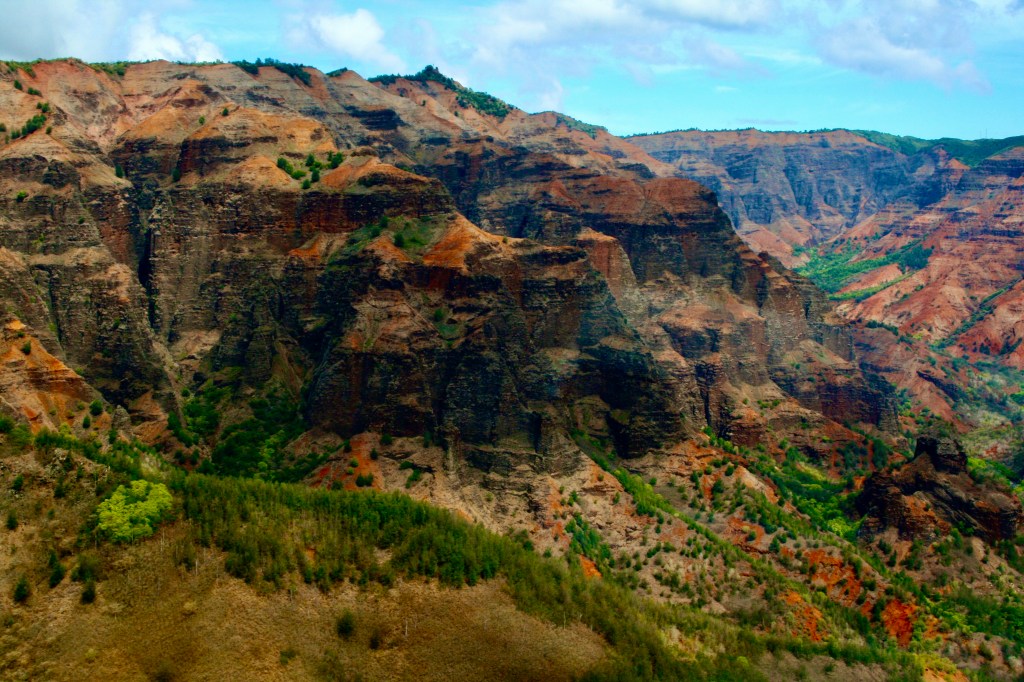
As we flew over Hanapepe Valley, classical music, although surprisingly not the Jurassic Park theme, played in the headphones and I just sat there with my mouth open in amazement as I looked at the serrated ridges below me.

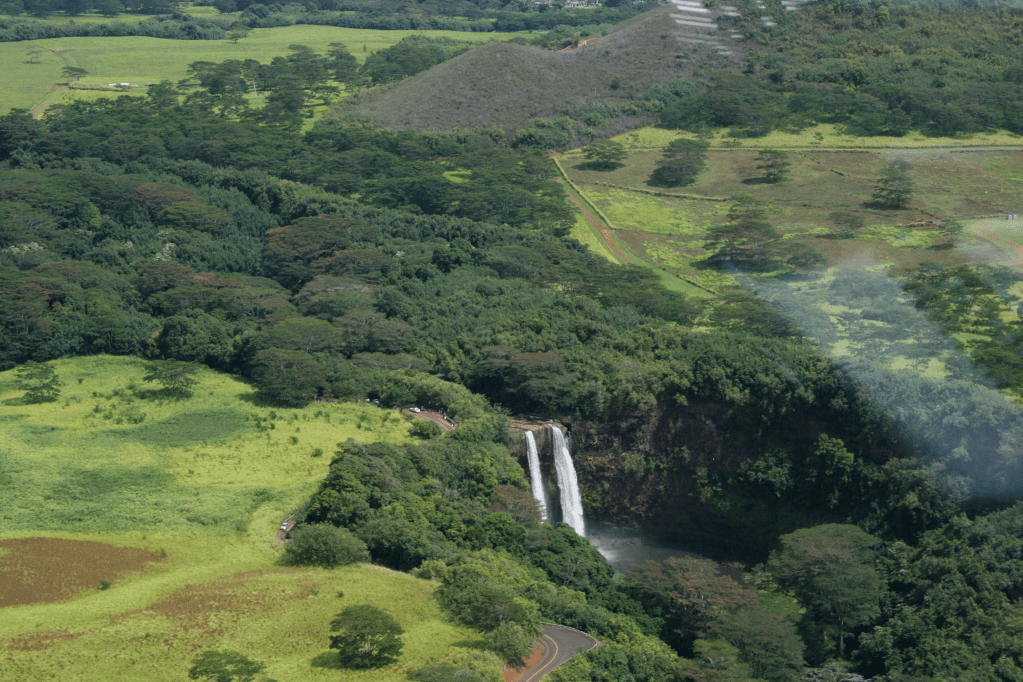
 Jurassic Park Falls came into view (correctly known as Mana Waiapuna) and I wished I’d paid the extra $100 to land there and walk around. 

Canyon after canyon appeared.  First Olokele and then Waimea Canyon, named the Grand Canyon of the Pacific by Mark Twain.  

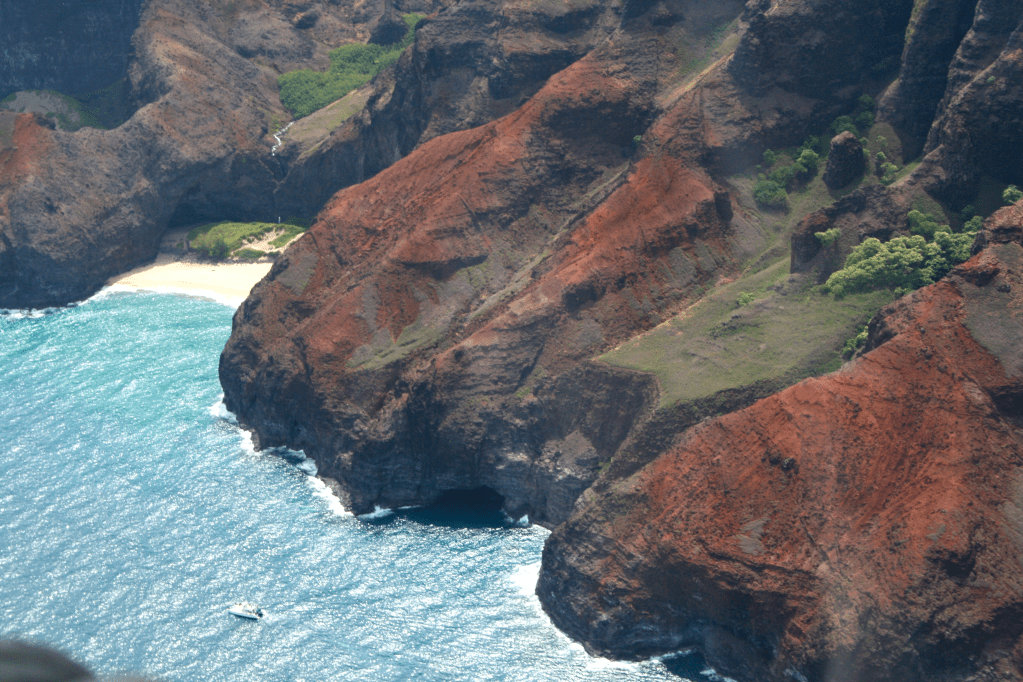
We were all oohing and aahing but then the Na’pali Coast came into view.  The pilot choreographed the flight so that each scene opened up before us like a slide show. Curving, white, perfect beaches with no access other than by water were sometimes joined by rock tunnels to the next beach.  We could see small flotillas of kayaks gathered in the ocean.  We flew over Hanalei Bay which made me wonder if that is where Puff the Magic Dragon came from.  

By this time I thought the best must be over but we had even more spectacular sights to come.  The crowning glory was Mt Waialeale (try to pronounce that!), the wettest spot on earth with 450 to 500 inches of rain a year.  Fortunately it wasn’t raining when we were there.  We hovered in the centre of a crater with 5000 foot walls and 3000 foot waterfalls.  This was a time when the word awesome was just right.  

It wasn’t all over yet.  We flew over Wailna Falls which apparently has been used in a TV show called Mystery Island.  I didn’t want it to stop but after an hour’s flying we gently landed at the airfield.

I may never travel in a helicopter again but I think if you are going to do it once this is the place to do it. We were lucky we had fine weather, especially around Mt Waialeale. It was a magnificent end to our seven day Pride of America cruise around Hawaii.

I for Impressions of Provence

We have been fortunate that we have been able to travel extensively since retirement, so choosing one place that stands out above all others is hard.  I think my choice of Provence is a combination of ancient buildings, beautiful scenery, fascinating history, perfect weather and wonderful food and wine.  What more could you ask for? Oh, and staying for a whole week in an amazing 300 year old house!

Imagine a long train journey across France, arriving at Avignon in pouring rain on a Sunday afternoon, picking up a rental car and driving on the “wrong” side of the road to nearby St Remy. Feel the relief mixed with alarm when we are ushered into a very old building with a strange musty smell, the water dripping off our clothes onto the blue and white tiled floor.

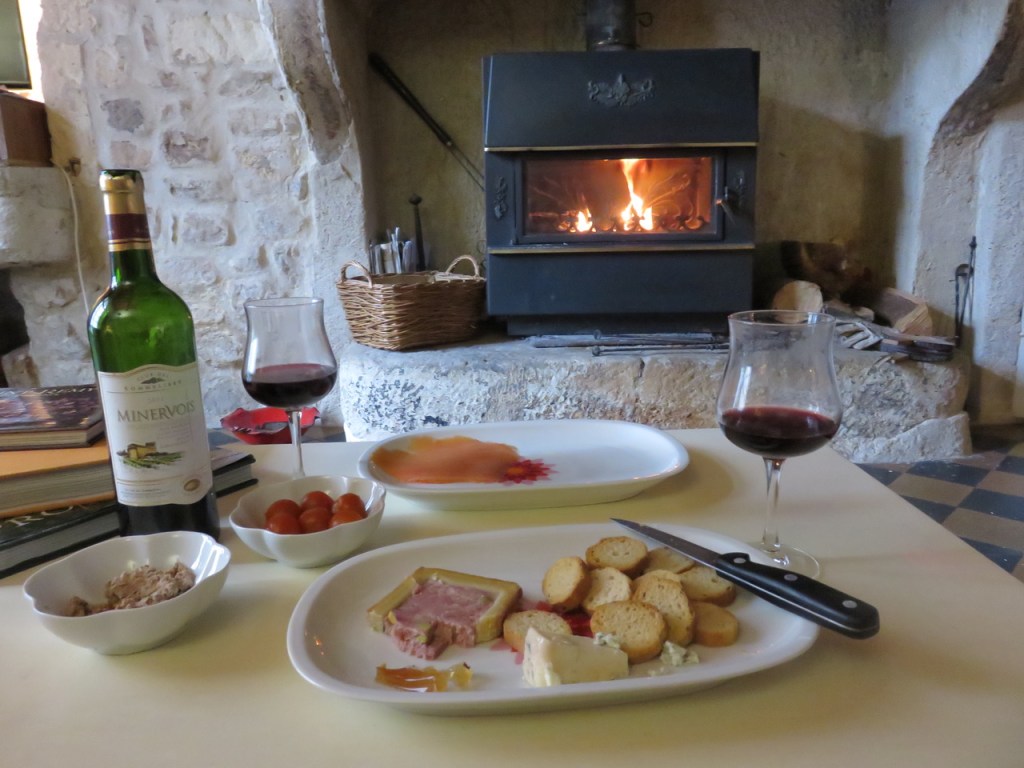
Our host leaves us with a bottle of wine, milk and a stack of fuel beside a wood burning stove.  Soon we have the fire going and are making inroads into the bottle of wine.  However, we have no food, so, seeing that the rain has eased we venture out into the street.  Alas, every store appears to be shut.  Finally, we find a charcuterie where we can buy terrine, pate, smoked salmon, tiny tomatoes, cheese and crispbreads. Oh, and a bottle of Minervois red wine.

Back at the house, with our feast laid out and a roaring fire, we suddenly feel our spirits rise.
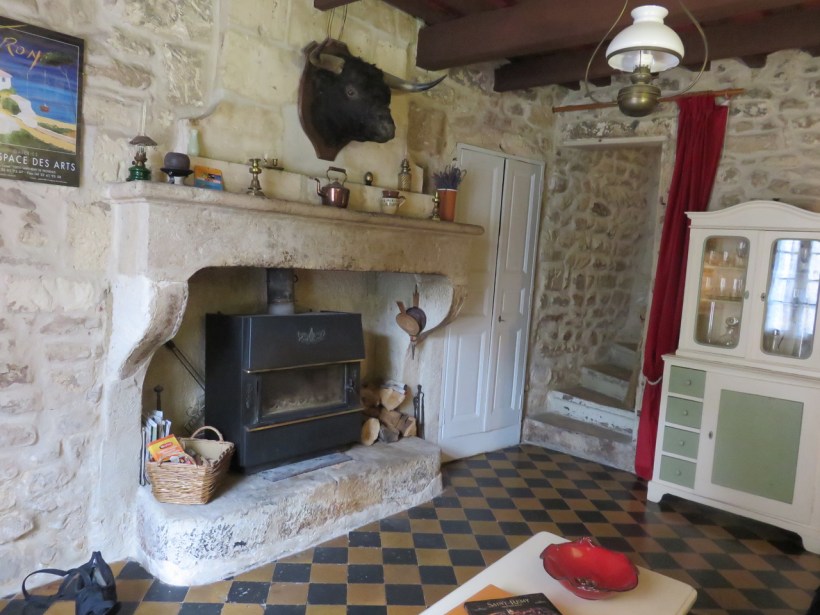
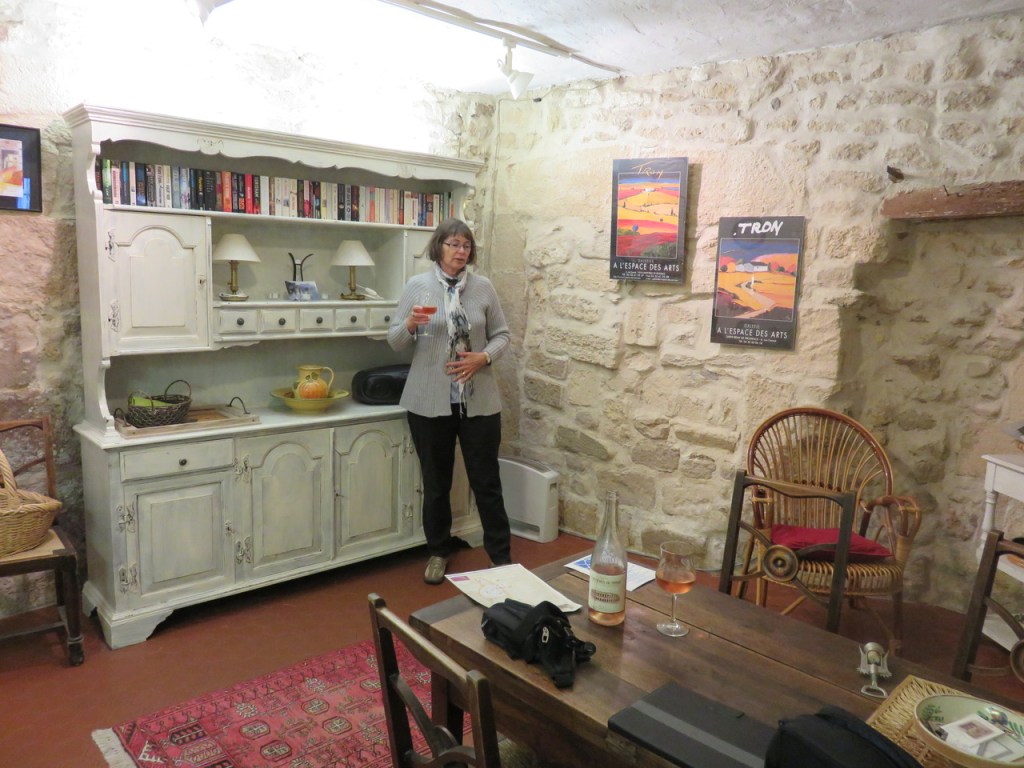
The room was amazing, with a huge stone fireplace above which hung a large bull’s head.  A corridor led to a windowless kitchen, lined with stone walls and filled with a huge green dresser and a large dining table.  Worn stone steps with a rope railing led to the bedroom with a four-poster bed complete with a roof and curtains.  On one wall was huge bookcase, the contents of which I studied carefully.  Many of the books were in French or German but I found one in English called “Birdsong” by Sebastian Faulks, which was set around the time of World War One.  How appropriate, I thought, as we had just been on a tour of the WW1 Battlefields in France and Belgium.  Imagine my surprise when I found the characters Stephen and Isabella actually ran away to St Remy!  When we left, the owner kindly gifted me the book as I hadn’t finished it.

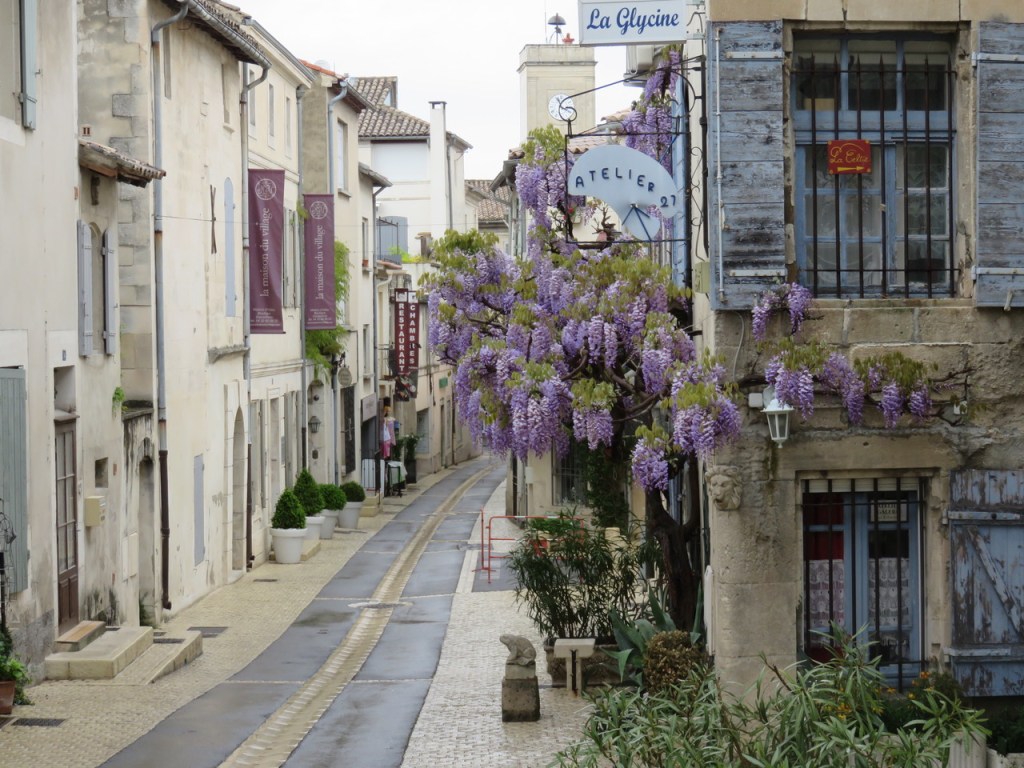
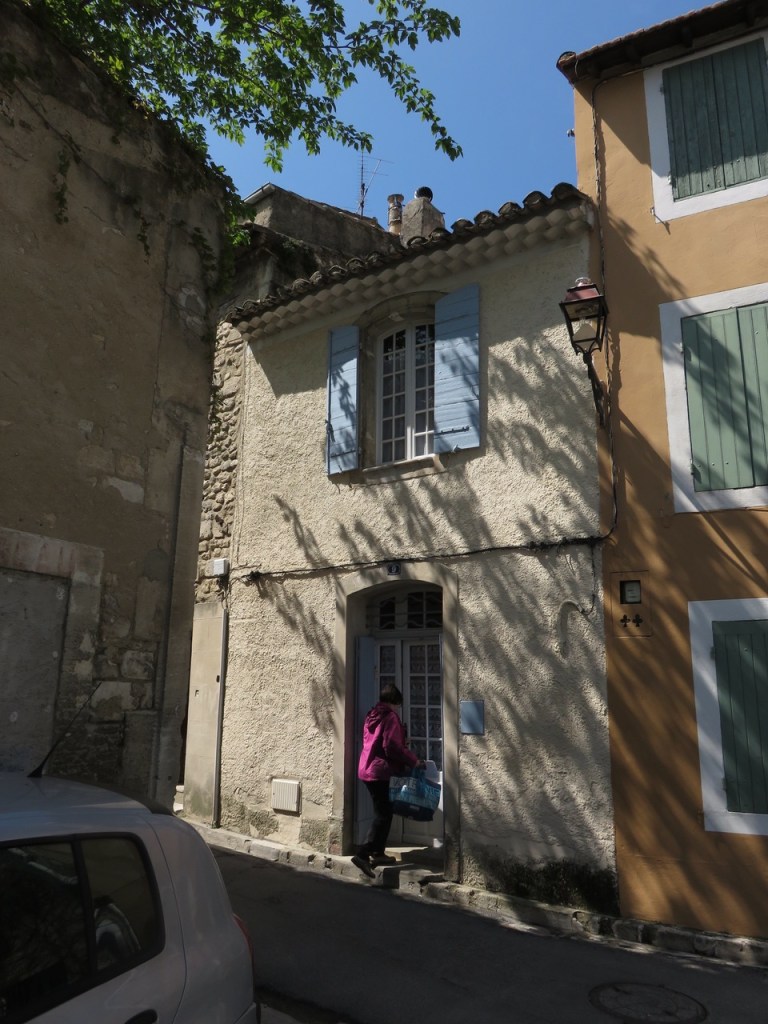
Staying in St Remy was like living in a picture book.  The grey stone houses with blue shutters were adorned with flowering purple wisteria.  Bright pink Judas Trees added colour to the light green spring leaves behind which loomed the barren rocks of the Alpilles.

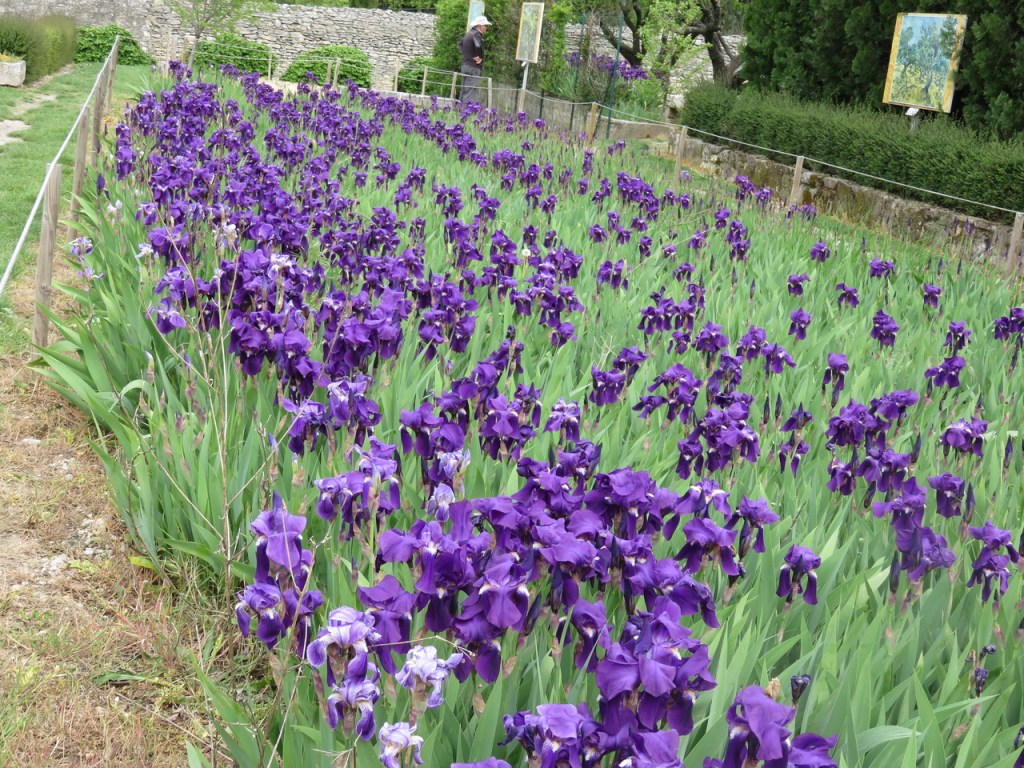
Nearby at the Monastere St Paul de Mausoleum where Vincent Van Gogh spent some time undergoing psychiatric treatment, masses of purple irises were blooming alongside reproductions of his paintings. 

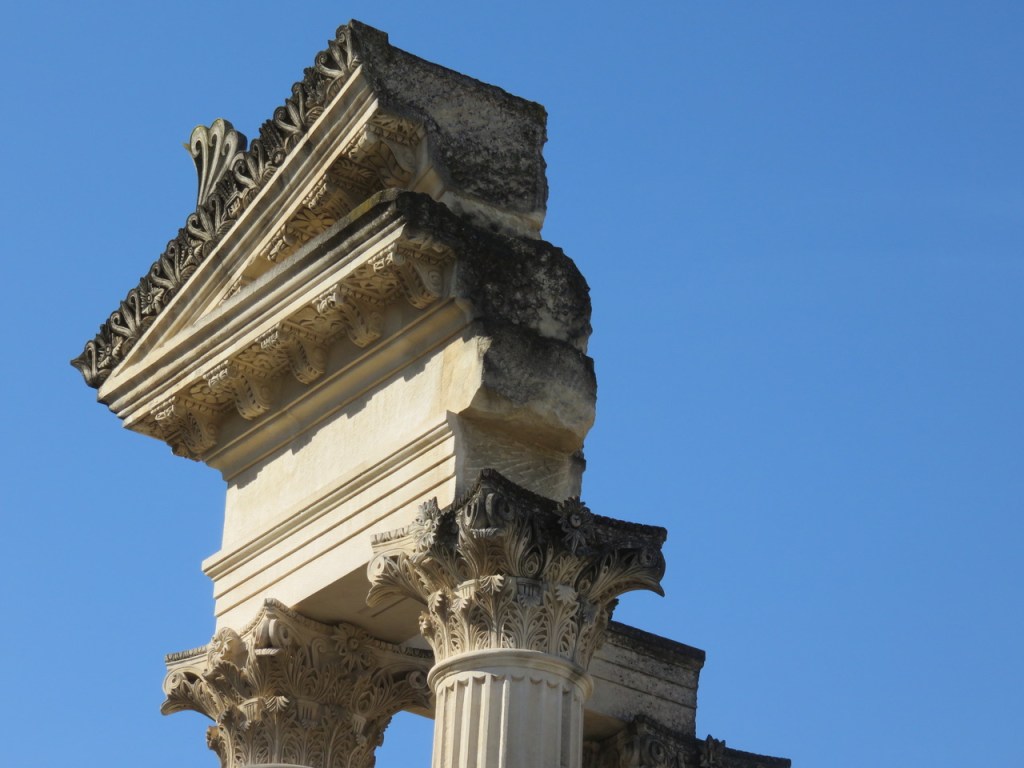
Roman ruins from before and after the birth of Christ stood largely intact.  The Glanum Archaeological site was occupied from the 6th or 7th Centuries BC and became a  Roman colony around the birth of Christ until 260 AD when Alamannic invasions forced the inhabitants to move to what is now the town of St Remy.

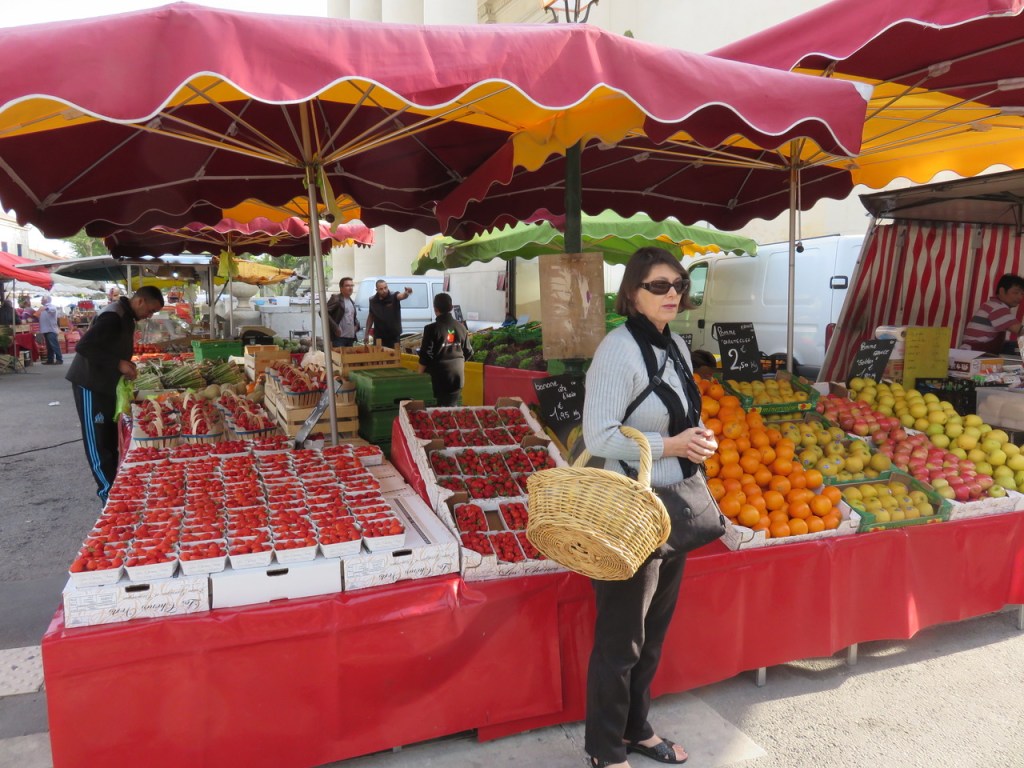
Wednesday was market day so we were up early to see the stalls being set up. The specialties of the region were lavender products, colourful ceramics, white asparagus which is in season and of course the local cheese, processed meat and pink rose wine. As the stores opened we tasted cheese and savoury things on bread and pieces of cake until we had filled our basket with goodies for lunch.

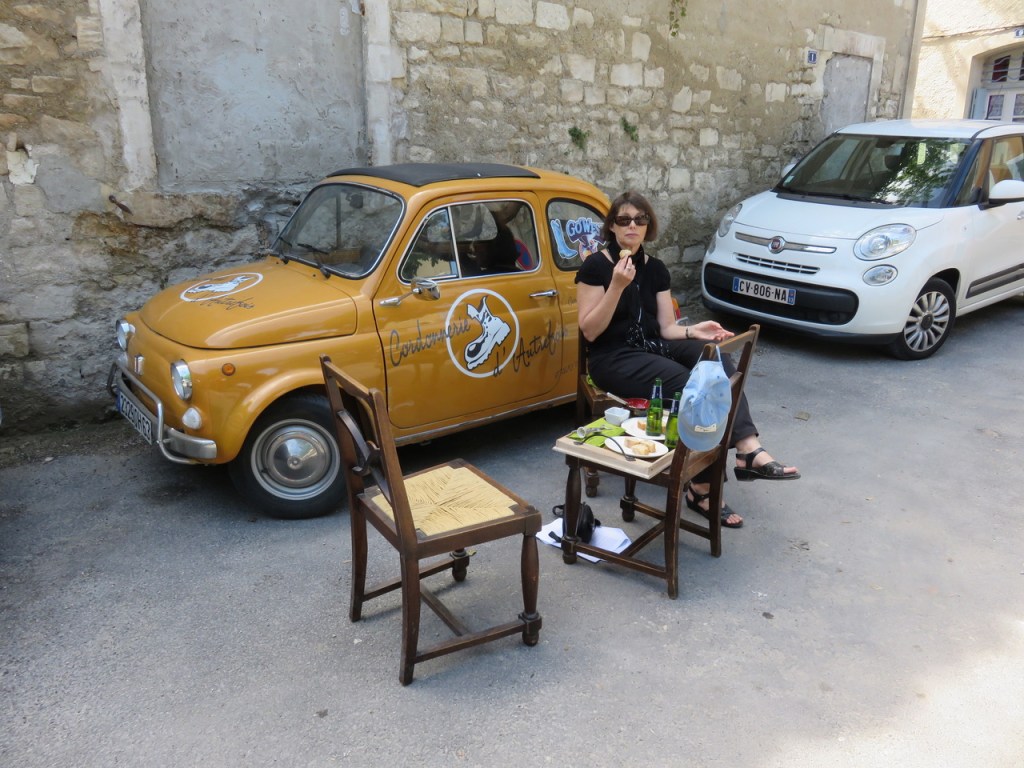
 It was such a lovely sunny day that we didn’t fancy eating in our “cave”.  The square opposite our front door was used as a car park but it had trees and was surrounded by ancient buildings so what better place to have a picnic.  We dragged three chairs outside, brought out the baguette, the jars of pistou rouge and creme d’Ail, the olives and the cheese, two bottles of 1664 and two quiches warmed up in the oven. 

I related to a quote in a newspaper article left by one of the previous visitors in our house.  
It said, “One of the great pleasures of the siesta is that you wake up twice in the same day, and if it’s a good day and everything’s going right, then you get double the pleasure.”

Well, we enjoyed a nap after our busy morning, in our big, comfy four poster bed, looking through the open window at blue sky, stone buildings and fresh, spring green leaves on the trees before “a brief stretch of blessed afternoon oblivion”. (Thanks to Chris Stewart, The Mail on Sunday)

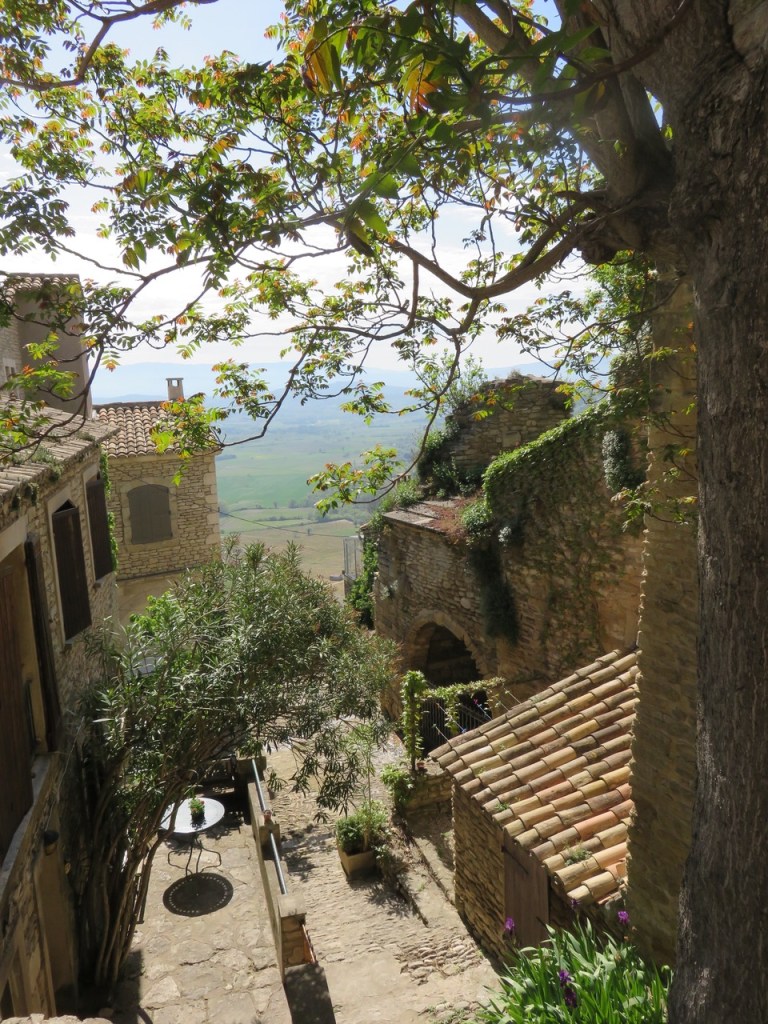
Tearing ourselves away from St Remy we drove to the villages of Gordes and Roussilon, perched on the top of steep hills and overlooking the valleys below. The Luberon is to the North East of St Remy in the Vaucluse area.  After driving through green fields and about 400 roundabouts we began to climb steeply to the village of Gordes. Unexpectedly there was a huge crane in the middle of the medieval village.  It was lowering rocks onto a building site which was most probably a renovation or repair.  A number of trucks were parked in the street making it difficult to pass even on foot but despite all this the views were breathtaking between the stone houses and the castle built on the rock.  The outlook would have been useful for spotting approaching armies or people up to no good. 
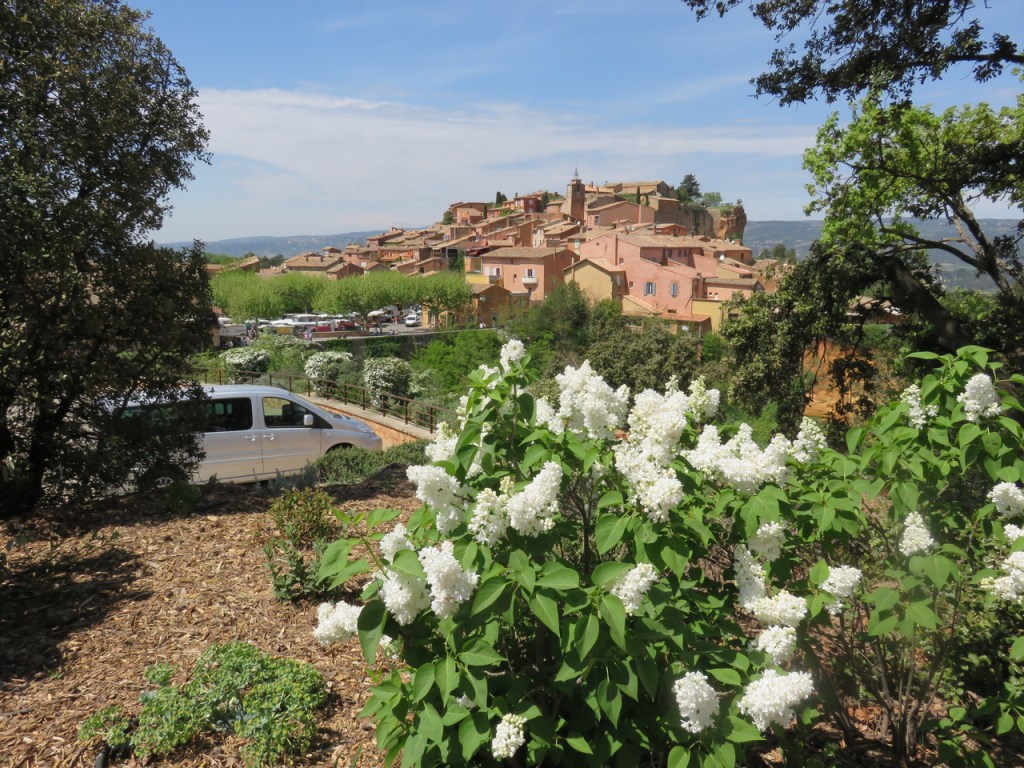
The next perched village was quite different.  Situated near ochre pits, Roissillon has a decided orange glow about it.  Again it was high on a mountain top and we had to park before walking up the hill.  

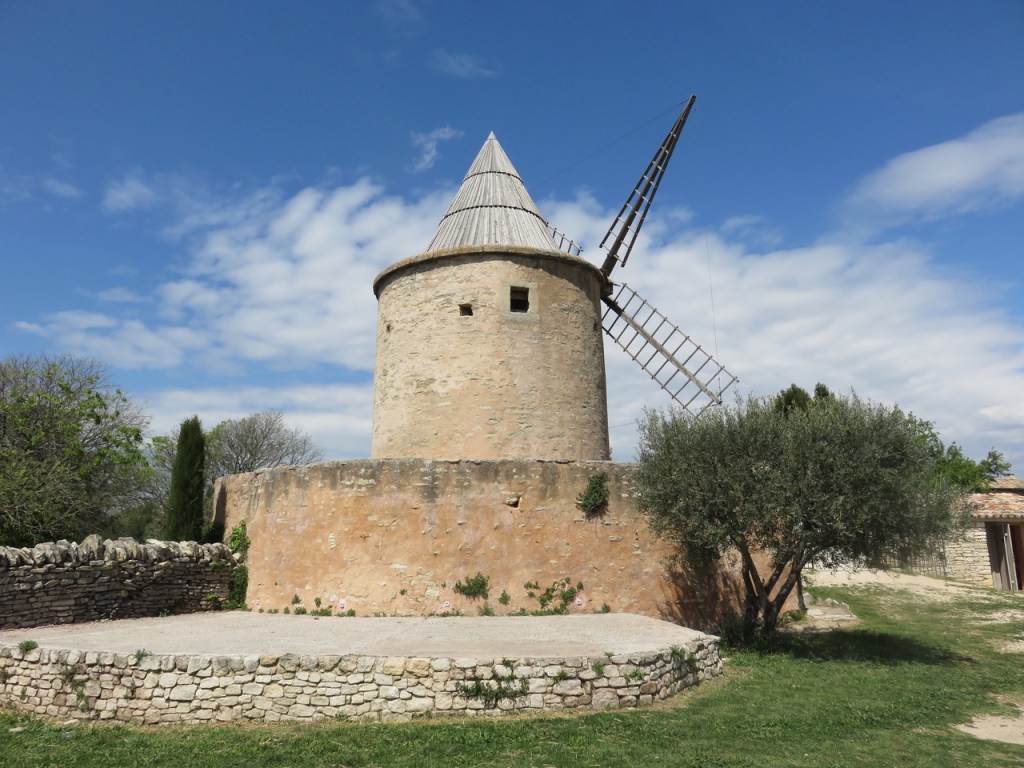
Our final town for the day, Goult, had been recommended by Stu Dudley on Trip Advisor, whose notes I was following.  He said if he had to live in the Luberon that is the town he would choose.  It is far from being touristy and had a calm and peaceful air.  It was not as high as the other towns which is why it was probably in better condition.  Here we had dessert and coffee before walking around the village and finding a windmill.  

Although I had plans to continue the journey to Bonnieux (where Peter Mayle lived, of “A Year in Provence” fame), John said, “let’s call it a day.”  He was probably right as trying to visit too many places at once means the last ones are not enjoyed.

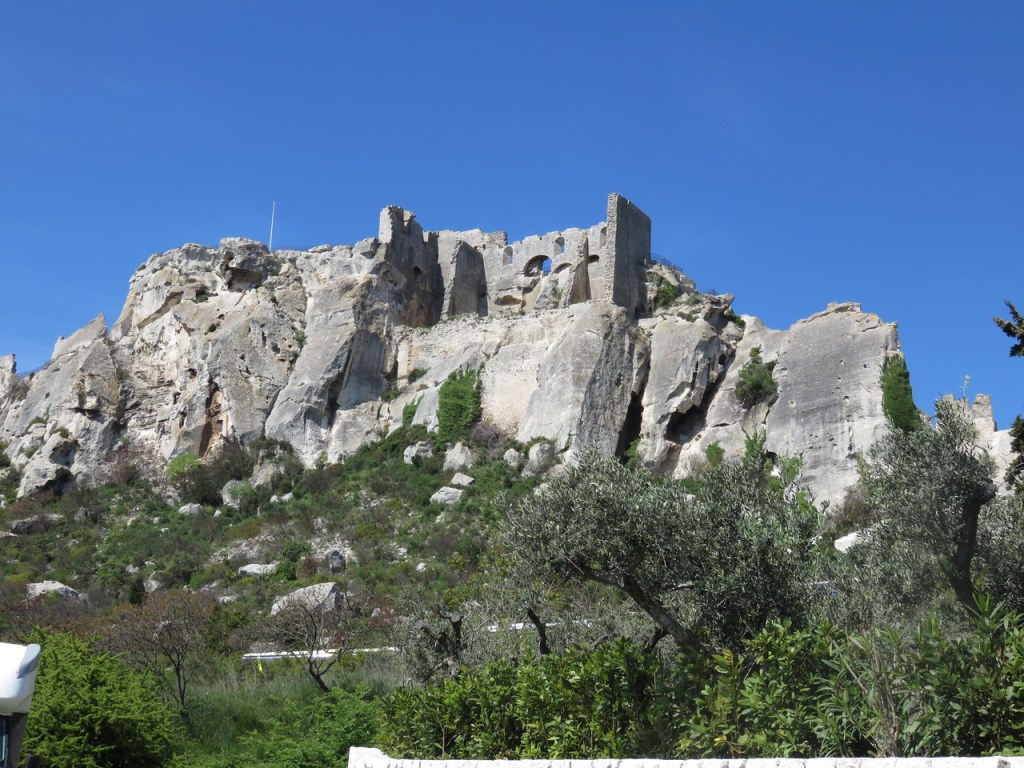
Another day and another drive, we were at the Des Baux de Provence, a craggy, ruined castle atop a rugged cliff. The views from the fortification were impressive over beautiful Provence countryside.  We climbed some very worn steps to the top after reading warnings to do this at our own risk.  From imagining ourselves in Roman times at Glanum we now were in the 16th Century being attacked by Louis XIII because we dared to become Protestants.  Huge catapults flung rocks against the stone walls of the castle until they crumbled and we were forced to surrender and flee to the marshy lands of the Camargue.

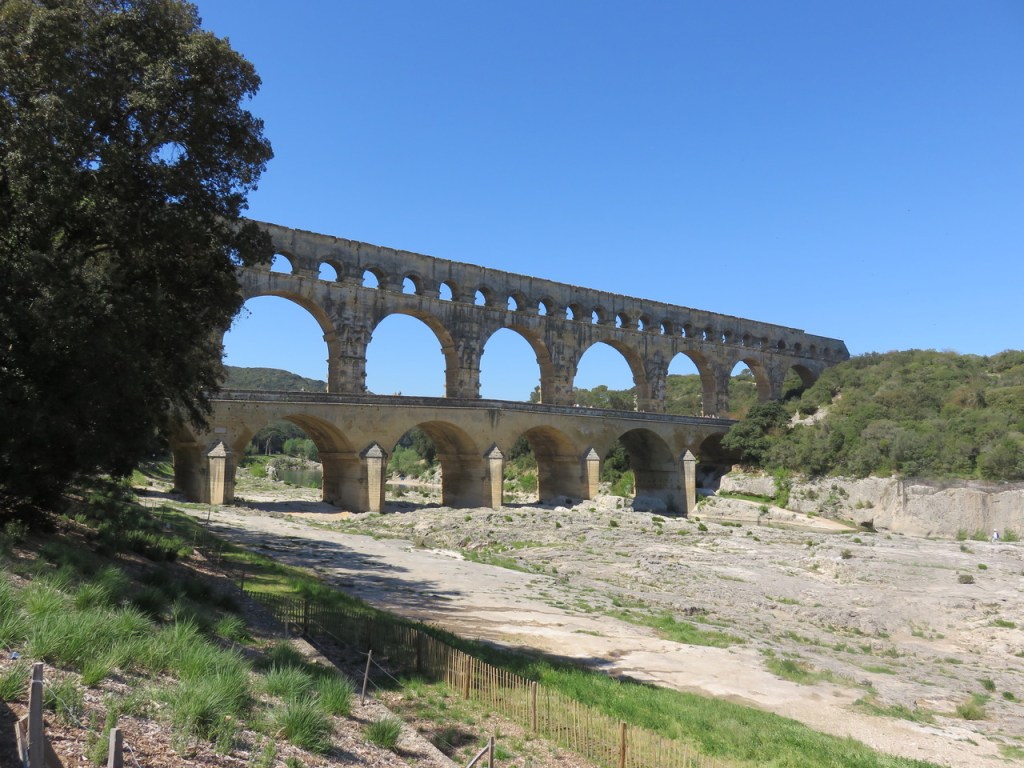
A longer drive to Longuedoc brought us to the 2000 year old UNESCO World Heritage Site of the Pont du Gard. It is surprisingly intact and even more surprisingly we were allowed to walk across it. Apparently by the 1990s it was full of tourist shops and rather tacky, but now it has been redeveloped, removing vehicular traffic and adding a museum.  It is a UNESCO World Heritage Site.

Our week was nearly at an end but we had one more thing to look forward to, dinner at Maison Drouot.  It was a ten minute walk from home out past the ring road.  The building is an 1887 flour mill which used to have a water wheel and still features a rushing stream.

We decided on the Degustation with matching wines.  We hadn’t eaten out in St Remy, choosing to cook in our rustic kitchen, so this was going to be a test of the best the town could offer.

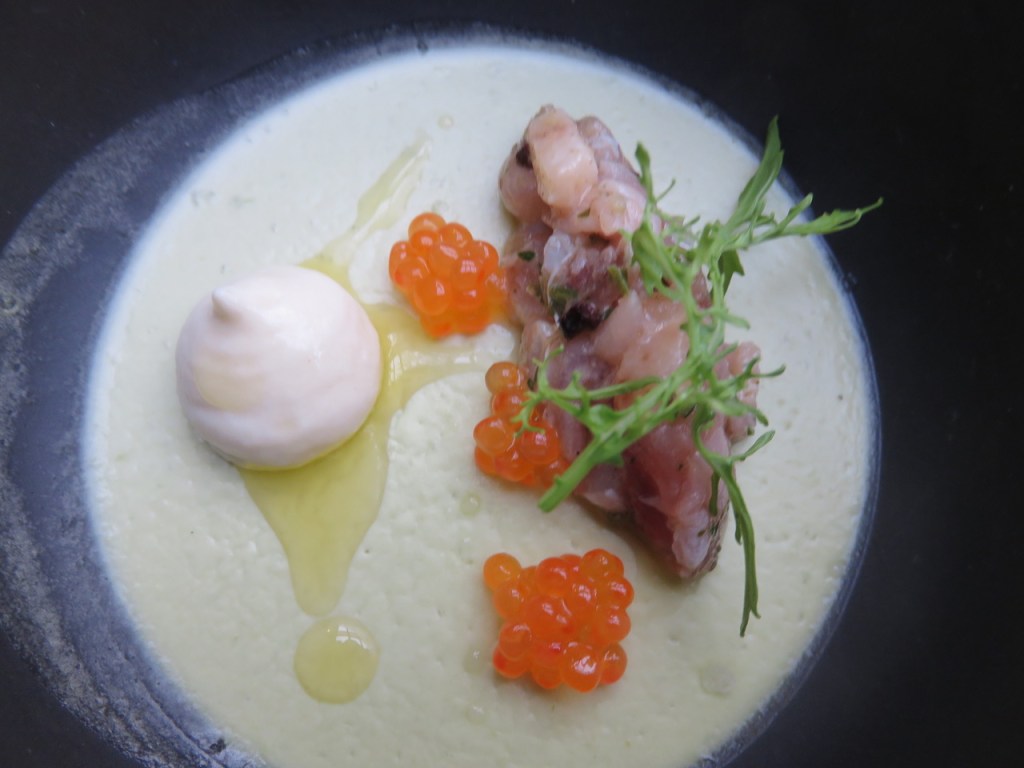
Immediately after our arrival we ordered the champagne and almond cocktail. Olives and little loaves of bread appeared. With the same solemnity as if it were wine we were shown a bottle of some local olive oil which was ceremoniously poured in small plates and accompanied by delicious bread. Then came the amuse-bouche.  On a bed of asparagus mousse lay raw fish, some roe and oyster flavoured mayonnaise.

Next a leek appeared, grilled to perfection with delicious little spots of sauce and a small pile of very strongly flavoured pasta. However,  my favourite dish was asparagus, sweetbreads, onions and almond flakes with a scrumptious sauce. This was followed by tasty fish (halibut I think) with little shellfish. Finally a piece of guinea fowl appeared, accompanied by asparagus, artichoke, artichoke mousse, a cheese wafer and some delicious indescribable sauce.

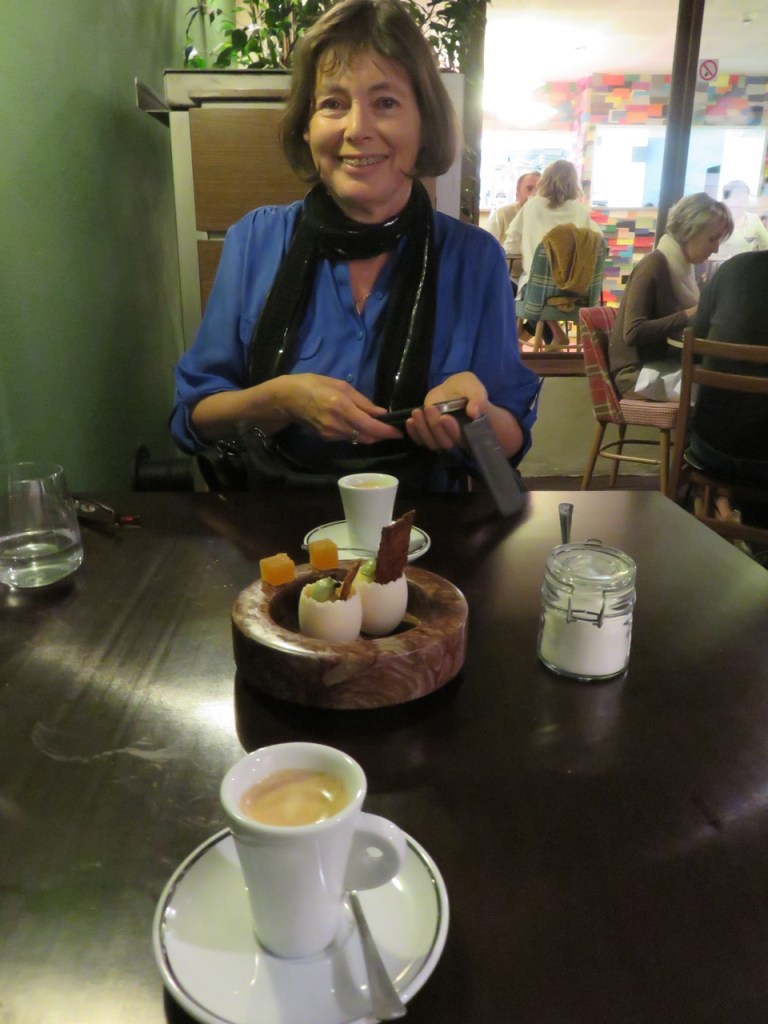
Dessert was less memorable but the espresso coffee came with little egg like creations which were very tasty.

I won’t tell you what it cost but it met all expectations and we decided we could eat baguettes, pate and cheese for the next week to compensate.

What was it about this restaurant that made it so different to any others we have visited? It was the little dog nearby, perched on its owner’s knees, delicately eating from its own plate at the dining table. Only in France!

H for the Holiday that Never Was

One of my favourite activities each year used to be planning an overseas holiday.  I say used to be because I no longer have the confidence to risk such an undertaking.  As “Novids” my husband and I expect any day to come down with the dreaded disease and can’t understand why we are in the 10% of the Australian population that hasn’t had it.

Not going overseas is definitely a First World problem.  When I think of people in countries where bombs are raining down, or earthquakes are burying loved ones under rubble I feel ashamed for complaining.  In my own country I look at people who have been flooded or burnt out in bushfires and think how lucky I am.  So I’m not too bitter about not going … but it would have been a great trip.

The year of 2020 was to include a visit to Sicily followed by a gulet cruise (traditional small cruise ship) among the picturesque Croatian coastal islands.

Our ship the Anna Marija

In October of 2019 I paid the deposit on our seven day voyage from Dubrovnik to Split.  The next step was to book a flight so I chose Qantas, with a two night stop in Dubai and a change of airline in Rome to fly to Catania in Sicily.

Once flights were booked I took out insurance in case the unthinkable happened and we couldn’t go.

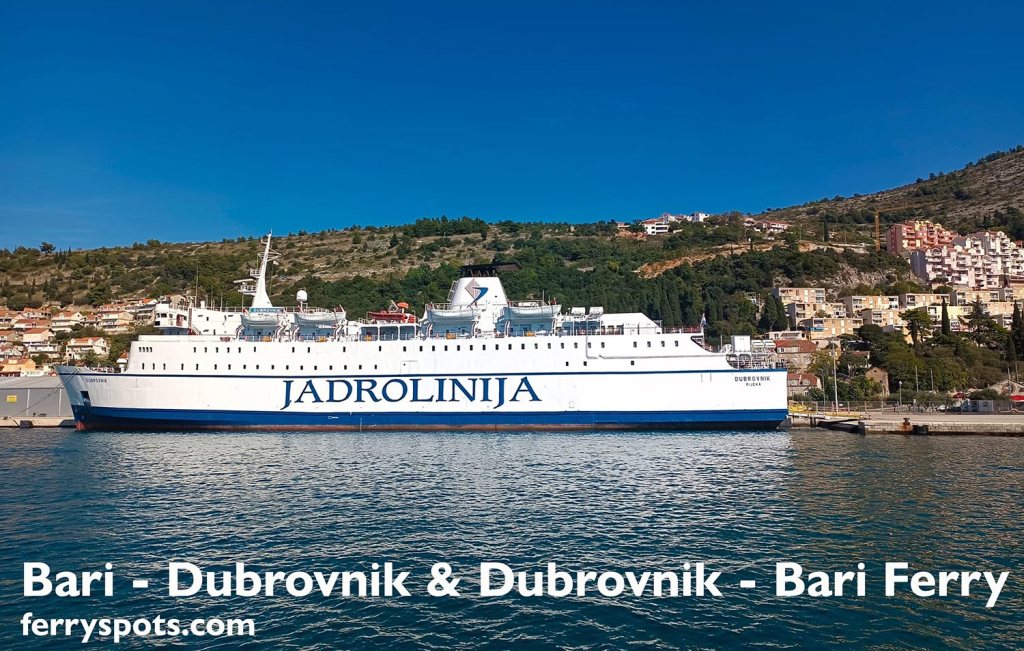
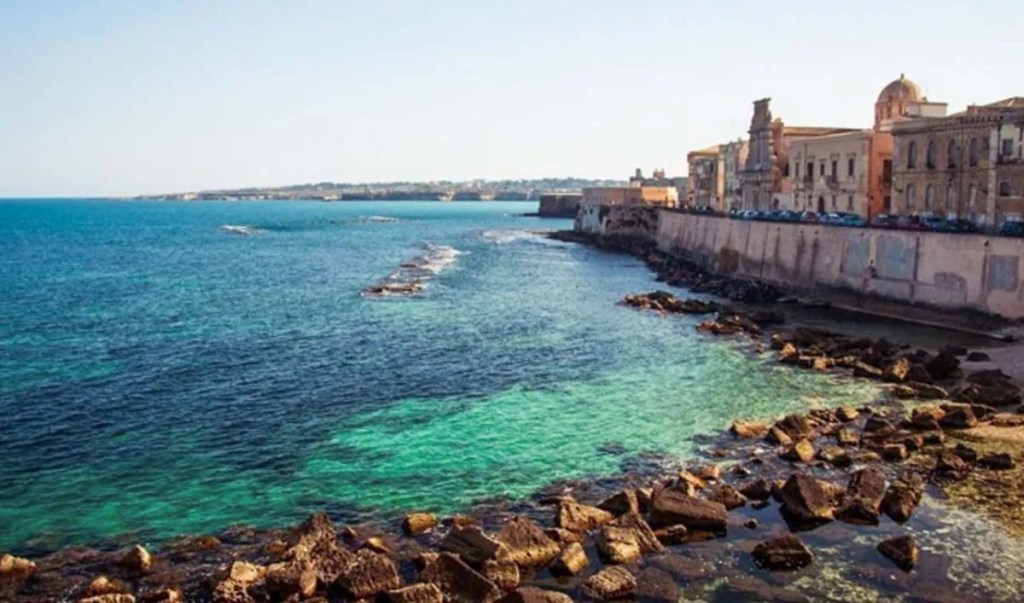
How to get from Sicily to Dubrovnic?  Further research found a bus we could take from Taorima to Bari on the mainland.  From here we could sleep on an overnight ferry to Croatia. Over the next weeks I booked two nights in Catania, a week in Ortigia, three nights in Taorima and individual nights in Agrigento and Piazza Amorina.  We would travel light and catch buses between the towns. By December I had booked two nights in Split for the end of our boat trip and two nights in Zagreb from where we would fly out to Dubai and finally back to Sydney.

A week in Ortigia was planned

Meanwhile the outside world had other plans. The 31 December 2019 was one of those days where the word “unprecedented” became part of the language. From across the Victorian border in Mallacoota all the way up the NSW coast bushfires destroyed people, towns, vegetation and wildlife.

Firefighters at work on the Currowan fire between Batemans Bay and Ulladulla (AAP Dean Lewins)

It seemed like it would never rain again.  The air was thick with smoke. 

Ovation of the Seas in New Zealand

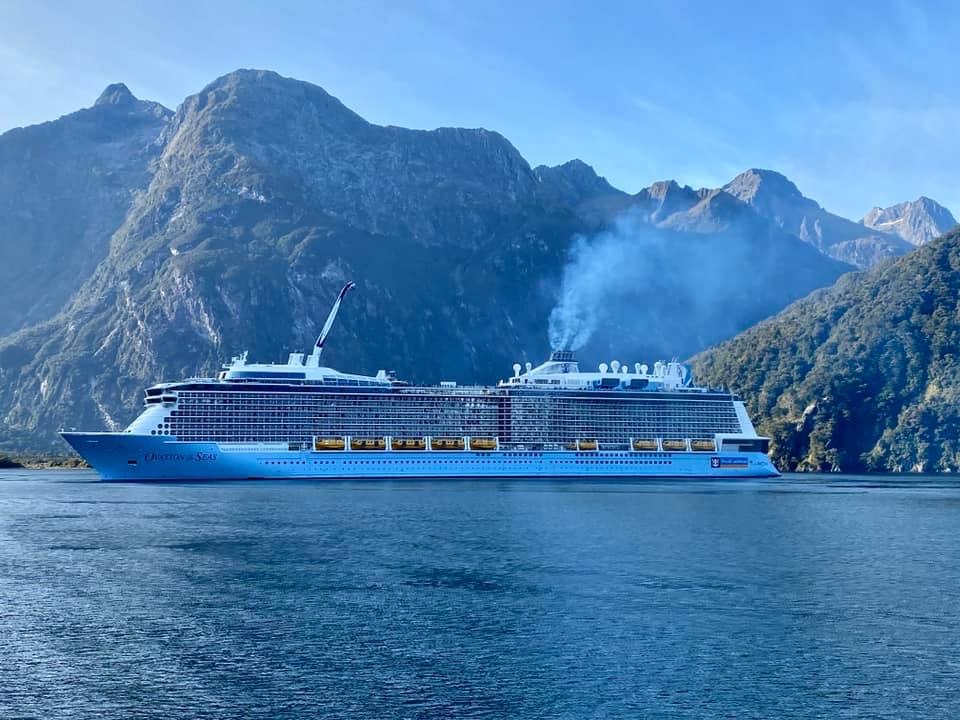
On the 16th January we left Sydney Harbour with our daughter, son-in-law and grandchildren on the ship Ovation of the Seas. We were glad to escape the smoky air of coastal NSW and explore a tiny bit of New Zealand from the ports of Dunedin, Picton and Wellington and view the Sounds. We returned to the still smoky Sydney on the 24th January. The next day the first confirmed case of Corona Virus in Australia was identified in Victoria in a man recently returned from Guandong, China

On Feb 5 I wrote the Corona Virus is spreading.  I hope it has settled down by June.  There are people stuck on a Princess ship off Japan as there is Corona Virus on board.  Imagine being trapped on a ship in a cabin, especially one without a porthole!

From the 7th February the word unprecedented no longer applied to bush fires.  Now it was floods and storms.  Dams were overflowing, people were being evacuated from flooded houses, powerlines were down.  The word catastrophic was used regularly.  At least the bushfires were well and truly out.

On 17th Feb we heard the people on the ship off Japan were being evacuated.  The Australians coming home would be in quarantine in Darwin for two weeks.  Our daughter was worried about her proposed trip to Thailand.  For the first time it occurred to us it could even affect our trip to Europe. Maybe it would be all over by June?

John’s brother and his wife were to fly to Africa in two weeks to begin a cruise through the Suez Canal and Mediterranean. On the 1st March John rang his brother to see if he was still going. We began to wonder if we would ever see them again as they were determined not to cancel.  The cruise was to finish in Venice which was by now a hotbed of Coronavirus.

A week later we made a decision. It looked like our plans were scuttled as Corona Virus spread far and wide.  I checked to see what could be cancelled and  found some accommodation was refundable.  I wasn’t sure about the flights.  They were bought on sale so I had my doubts.

On the 8th March I wrote I’m feeling sad about the European holiday but resigned as well.  Tomorrow I will ring Qantas. I will try to get a refund on the airfares.  Then I will do the accommodation.  There is also the flight from Rome and the ferry trip to Dubrovnik…

That same day the ship, Ruby Princess,  left Sydney for New Zealand. On the 19th March it returned, disgorging its 2,600 passengers into taxis, trains and airport buses. They were infected with Covid and spread it far and wide as some returned to homes interstate and overseas.

Italy imposed a lockdown March 9. On 11th March I wrote, Italy is now closed off to tourists because of the Virus.  It is estimated to hit Australia with a vengeance in a week.

My daughter and son-in-law celebrated their 40th birthdays at the Rose Hotel in Chippendale.  It was to be our last family gathering for many months.

The government announced on 15th March that everyone returning from overseas would have to do two weeks quarantine.  John’s brother and his wife had flown to Mauritius, decided against boarding the cruise ship and flown home again, just in time to avoid quarantine.  They decided to lie low at home for a couple of weeks as a precaution.

All school excursions have been cancelled as well as after school activities.  There is even talk that school might be cancelled too!

Then on 16th March something happened that was completely unexpected. John woke with numb fingers and was diagnosed with a transient ischemic attack (TIA). It was a mini stroke, in his case leaving no permanent damage.

The ## March was my daughter’s birthday.  It was also the day of her father’s carotid endarterectomy (removal of plaque from the carotid artery) and the first day of home schooling.  Just as well she had celebrated her 40th earlier in the month.

John recalls looking out the hospital window at the Ruby Princess tied up at Port Kembla.  It was just marking time with its 1400 strong crew stranded in limbo.

At the hospital the medical staff were busy preparing John’s ICU for the expected influx of Corona Virus patients.  They were stressed and distracted by the enormity of what lay ahead. He was glad to get out of there.

When we arrived home we heard our son (a computer programmer in Canberra) was in one half of the building that was sent home indefinitely. Presumably the other half were expected to spread out in the extra space.  The grandchildren had their last day at school as it was optional but highly recommended to stay home if possible.

That afternoon the Aqua Joggers linked up on Zoom in preparation for an 8 o’clock exercise class three times a week.  We all had fun talking to each other. It helped us survive several lockdowns and adjust to a limited lifestyle.

That all seems so long ago.  We were able to get refunds from some of our accommodation and the ferry trip.  Qantas eventually refunded most of our airfares.  Our insurance covered the rest except for the gulet. Every year Goolets Yacht Charters asks if we are ready to rebook our boat trip in Croatia. They wouldn’t refund us our deposit so it is still there waiting for us.  At first the thought of catching Covid while overseas was the biggest deterrent but now the long uncomfortable flights in economy class and the possibility of illness in a foreign country are enough to convince us “there’s no place like home”.  That’s not to say we won’t change our minds.  Never say never. 

G for Grey Nomads

When I was still teaching and my husband was retired, we referred to ourselves as “the Grey Nomad and the Brown Worker”.  A Grey Nomad is the term used to describe someone, usually with a caravan, camper or motorhome, who travels around Australia with the purpose of finding new places, meeting new people and generally leaving the worries and cares of home behind.  As a teacher, I was limited to school holidays, generous as they are, but towards the end was able to take advantage of that wonderful invention, Long Service Leave.

It was only with my retirement, however, that we could contemplate spending months at a time away from home.

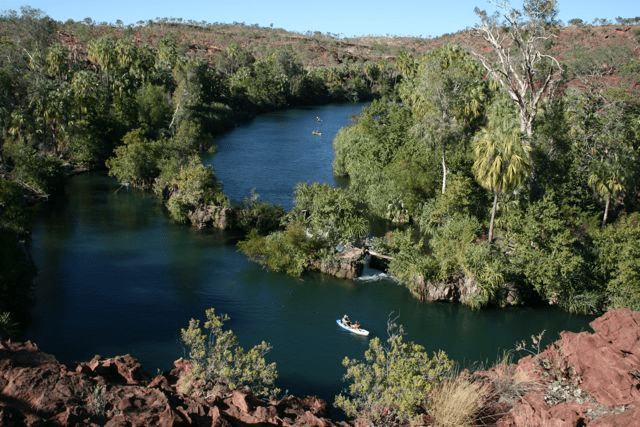
Lawn Hill, Queensland

In the USA there is a term “Snow Birds” describing the habit of people in the cold north descending on Florida during the winter.  We have something similar, with hordes of caravanners heading north from Victoria and NSW to the sunshine state of Queensland. They are sometimes known as “Mexicans” because they cross the border and stay for months at a time once they are warm enough.  Some occupy the same spot in the same caravan park year after year, meeting up with friends and warming their aging bones in the sun.

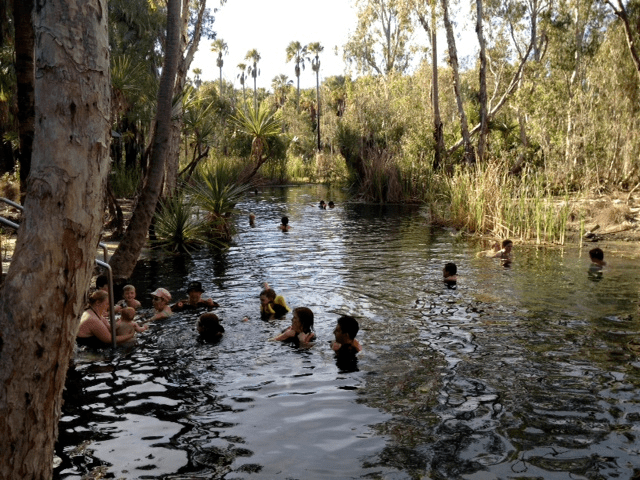
Bitter Springs, Northern Territory

Where we live in Wollongong is not cold compared to Britain, Northern Europe or North America but because of our in-between climate our older houses are not as well insulated or heated as our Northern Hemisphere counterparts.  The attraction of warmer weather calls us north every winter with the proviso that we want to experience something new every time.

That might mean doing “The Big Lap”, driving 15,000 kilometres around Australia and stopping to experience all that is interesting along the way.  This requires a bit of juggling to find the best time of the year for each part of the country.  No-one in their right mind would head to the “Top End” in the summer, but a winter start means waiting until spring before heading south down the West Australian coast, not only to see the wildflowers but to avoid the wintry weather in Perth and crossing the Nullarbor.  Since we experienced cold nights while free camping in the last part of our “Big Lap” we have installed a diesel heater.  Now we can go anywhere at any time, regardless of the weather.  Except where it’s too hot, of course!

Champagne Pools, K’gari, Queensland

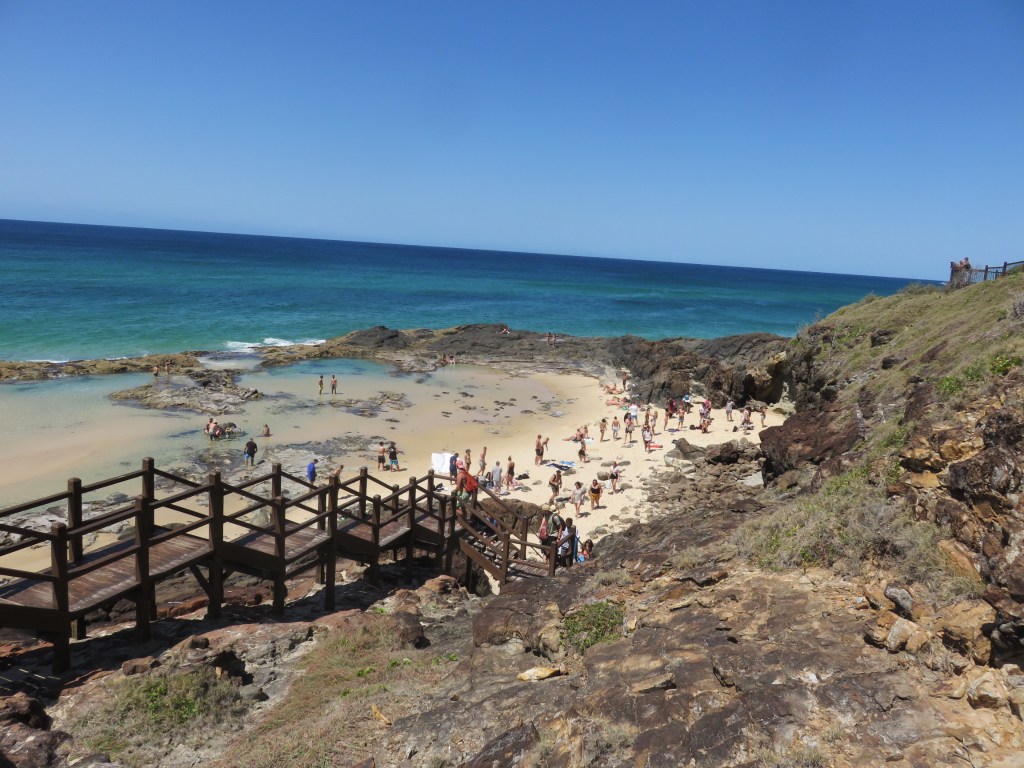
Even staying close to the Queensland Coast can be varied year by year.  I’ll never forget staying in Hervey Bay and taking a day trip to K’gari (also known as Fraser Island).  The four-wheel drive held six people and roared along the beaches, depositing us in the magical Champagne Pools and pristine perched lakes. Or there was the day trip we took last year to Lady Musgrave Island where we snorkelled with turtles and investigated the habitat of shearwaters and boobies. One year we stayed in Finch Hatton, driving into Eungella National Park and spotting a live platypus in the Broken River.  It was the first time I had seen one in the wild as they are notoriously hard to find.  Sometimes we have taken the kayak on the roof and explored the waterways at the Town of 1770 or paddled off Airlie Beach.

Maroochydore, Queensland

Turning in the other direction, to the south, we once crossed Bass Strait in the Spirit of Tasmania, boat and van snugly stowed below decks, to explore the small but fascinating island. 

“Only a month!” cried fellow vanners. “You need two or three to see it properly!”

Alas, our first grandchild was expected within weeks and we weren’t missing out on that!

Southern Tasmania

Travelling through the centre of Australia is the other extreme.  You can drive for hours and see very little change in the landscape.  To become excited at the sight of a service station or country pub shows how little there is to see.  But then you come across something wonderful.  It might be Uluru (Ayers Rock), Kata Tjuta, Kings Canyon or the West McDonnell Ranges. The majesty and beauty of these places has to be seen to be believed.

West McDonnell Ranges, Northern Territory

Travelling such long distances requires the right frame of mind.  Some people find it boring. We tried listening to audio books but find them hard to hear with all the road noise. I usually plan the day and night stops, the coffee and lunch breaks, and John decides just how far he can drive. I have only driven with the van in tow a few times. Dealing with fast travelling road trains and bad roads, with over two tonnes on the back, is a job I gladly hand over to my husband.  In the case of an emergency I would unhook the van and leave it for the insurance company to look after.

As we get older the driving becomes more tiring. Last year I planned a trip north with less than 200 kilometres a day of driving and stops of four or five days in each place.  Turning around after a week in Townsville my husband broke all distance records as he sensed home was within reach. So much for not being able to handle long distances!

Sir Leo Hielscher Bridge or Gateway Bridge, Brisbane, Queensland

Some Grey Nomads sell their home to fund their van or motorhome, expecting to live on the road for the rest of their lives.  This can be a problem if and when ill health arrives.  I would want some land, or maybe a small unit as a base for medical treatment if needed.  It could be making an income for you while travelling.

Owning a caravan is not necessarily the cheapest way to holiday.  Apart from the purchase price there is maintenance of car and van, registration, insurance and annual service and inspections.  As a van gets older there is usually something to repair, just as in a house. As for tyres, the car and van total 10!  Caravan Park fees are going up, especially in desirable beachside locations in peak season. The price of petrol and diesel has gone up enormously since we drove all the way around the country in 2015.  The number of vans on the road has increased since Covid kept people from flying overseas and consequently caravan parks are often booked out.  Free camping where one is completely self-contained and self-sufficient can be aided by the used of an online app called WikiCamps Australia and the free campers bible Camps 12 (each new version has a number).  This is an increasingly popular option but as people search for more out of the way places to camp they require off-road caravans, which in turn require sturdier suspension, weigh more and cost more.  The towing vehicle needs to be upgraded to a larger, heavier more expensive vehicle.

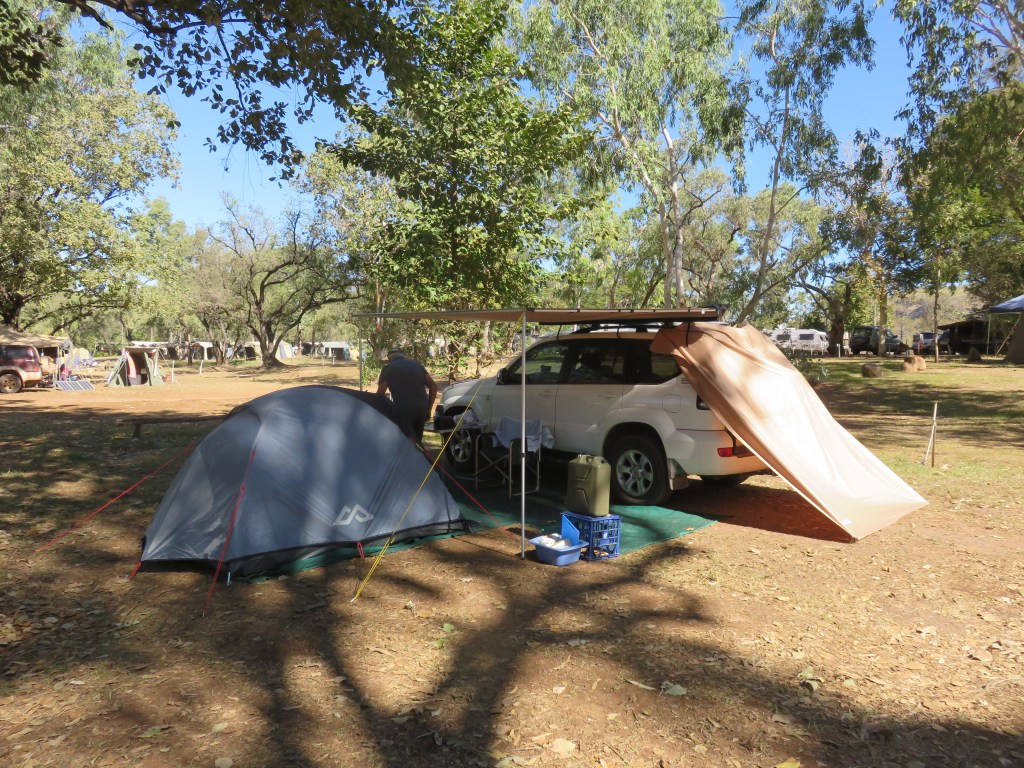
Or you could do what we did in the Kimberley, Western Australia.  Leaving the van in Kununurra at a caravan park we took our camping fridge and a two man tent to explore some of the Gibb River Road and camp at El Questro Station.  That was an experience! 

Camping at El Questro, Western Australia

Just writing about the nomad life makes me keen to work on our next trip.  So far we have booked some van parks on the Queensland coast but then we will head inland, go to places where we’ve never been and who knows what we will find?

F for Far from the Madding Crowd

On previous visits to England we visited the homes of Jane Austen, the Bronte Sisters and DH Lawrence. This time (2012) our plan was to explore the countryside made famous by Thomas Hardy’s novels. We decided to stay near Dorchester where the novel The Mayor of Casterbridge is based.

Just before our arrival in Dorchester we noticed the figure of a man carved on the hill in chalk.  He is known as the Cerne Abbas Giant and his origins are uncertain.  Some believe he represents the Roman god Hercules and is over 1500 years old. Others say it is a caricature of Oliver Cromwell and is only about 350 years old. It is one of three white figures cut into chalky hillsides, the others being the Long Man of Wilmington in East Sussex and the Uffington White Horse in Berkshire.

In Dorchester we found the building reputed to be the home of the Mayor of Casterbridge in Hardy’s story of the same name.

To reach Thomas Hardy’s birthplace we took a ten minute walk through woodland from the National Trust car park in Upper Bockhampton . Hardy’s father was a builder and stonemason and Hardy in his early years was an architect.  After five years working in London he returned to this house because of failing health.  This is where he wrote Under the Greenwood Tree and Far from the Madding Crowd.

Hardy’s birthplace

We then visited Max Gate, the house Hardy designed himself, built by his father and brother.  Here he wrote Tess of the D’Urbervilles and Jude the Obscure (known as Jude the Obscene at the time) as well as lots of poetry.  The National Trust have taken over both houses and it was only recently (before 2012) that tenants had moved out.  Max Gate is a huge contrast to the thatched cottage and is a very comfortable “town home”.

Max Gate

 On the recommendation of the B&B owners we drove to The Saxon Arms at Stratton for some tasty sailfish on a bed of green weeds.

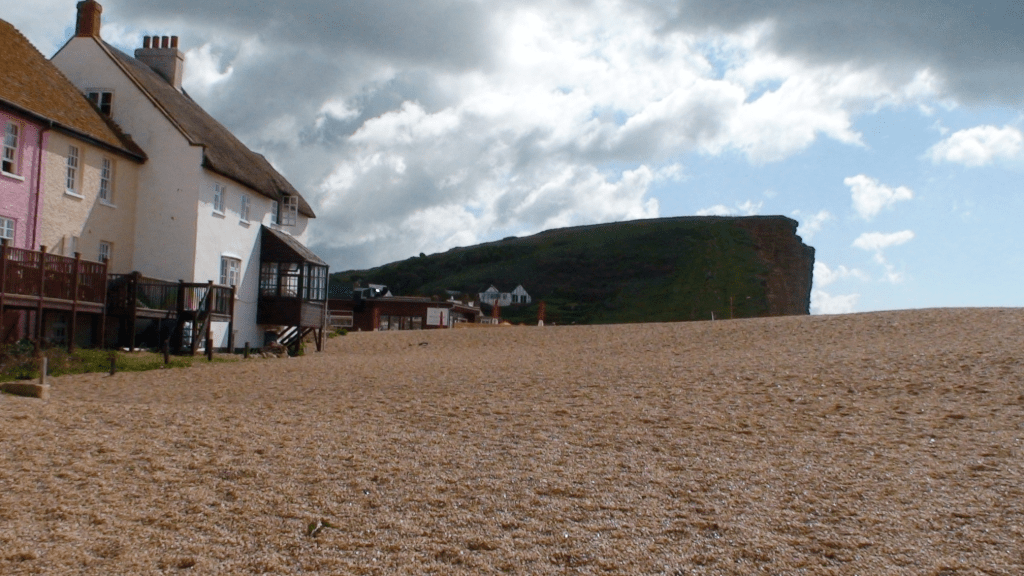
After another huge English breakfast where we chatted to a couple here for the trout fishing (or at least he was as she was about to hit the shops), we set off for Plymouth via the Jurassic Coast.  As we were driving we saw a sign to Chesil Beach so turned in along the three quarter mile track.  The size of the shingle varies from as big as oranges at the Portland end to the size of peas at the West Bay end.  It is said that in days of old smugglers could tell exactly where they were when they landed on the beach by the size of the pebbles. If you’ve ever read “On Chesil Beach” by Ian McEwen you might remember this was something the two main characters planned to investigate before fate stepped in. 

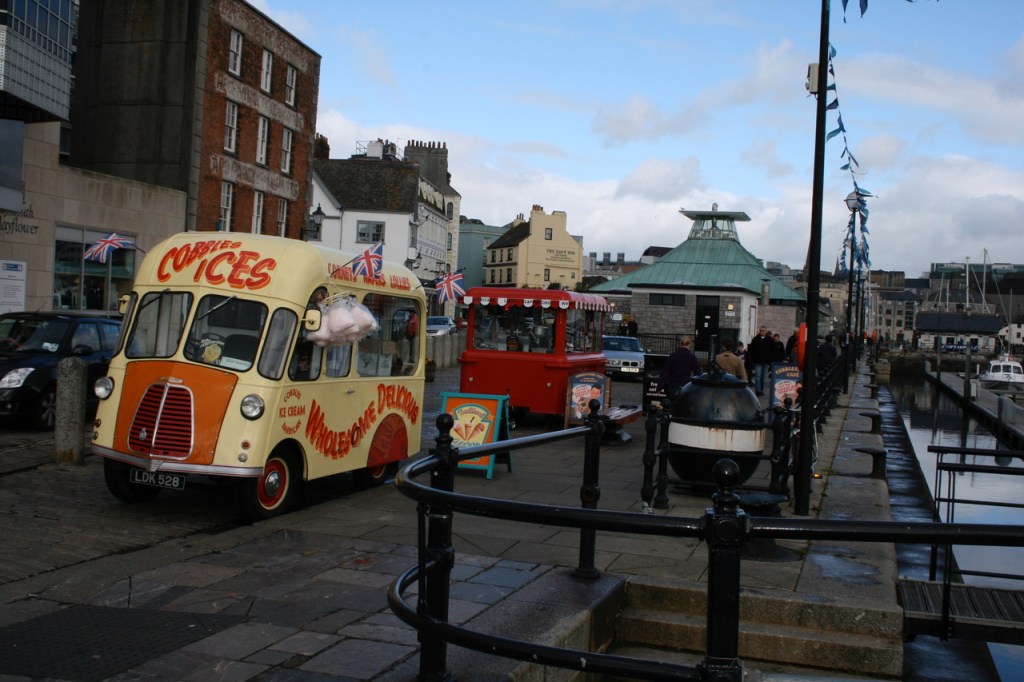
We bypassed Exeter and drove around the edge of Dartmoor Forest.  I couldn’t see any forest.  It was all rolling fields, hedges and stone walls.  Our Sat Nav brought us directly to the Premier Inn we had stayed in eight years ago.  It is right in the middle of Plymouth and across from the Barbican, accessed by a swing bridge.  The Barbican area consists of several streets which retain the character of the original fishing town as much of Plymouth was bombed to pieces in the Second World War.

After grabbing a quick lunch near our accommodation we dropped the car off at the Hertz depot.  John discovered he’d had a dodgy prawn so what should have been an enjoyable exploration of Plymouth became a rush to get back to the safety of our room.

We did manage to explore the waterfront and read the sad story of Raleigh’s Lost Colony, an early settlement in America which vanished between 1587 and 1590. Also saw the plaque to the Mayflower in 1620. So long ago!

I left him resting and went off to find dinner, avoiding the dodgy prawn place.  The Barbican was shaping up for a busy Saturday night with people dressed to kill disappearing up narrow laneways into interesting looking night spots.  I found what appeared to be a safe haven for a lone female at The Thai House and had a very tasty Pad Thai with a glass of white wine.

Fortunately John was well enough to sail across the Bay of Biscay to Spain the following day.

E for England’s Green and Pleasant Land

You might think that after living in England for twelve months in 2004 I might have seen enough to last me a lifetime but when an invitation arrived in 2011 for a Cotswold wedding in the following spring we didn’t have to think about it too long before accepting.

Leaving Sydney at 6.00 am we flew a total of 24 hours with a brief stop in Dubai. It was 10.35pm when we found our bed in a Premier Inn at Heathrow.  It had been a long day.

Of course we had to visit our former home in Chasetown, Staffordshire. It was good to catch up with Carol, the exchange teacher, admire her new kitchen and note the changes in the area.  It was also wonderful to meet up with her parents who had been so kind to us. Dinner had been booked by Carol at 1709 Brasserie in Lichfield. The building dated from the 1500s and had black beamed ceilings and lots of character. 

Next day we were on our way in our hired Ford Focus.  It was bliss to travel the countryside knowing I didn’t have to go back to work next week, next month or ever again. 

The first port of call was Whaddon where some of my ancestors had lived before emigrating to Australia in the 1860s.  I wanted to find the church where the family was married, christened and buried.  I couldn’t find any headstones with the names Ridgway or Colton but a local woman gave me the key to the church which was built in the 12th Century, so I stood in there and tried to imagine what life would have been like in this village one hundred and fifty years ago.  

Keys to the Whaddon Church

John was keen to see Bletchley Park where the breaking of the code for the German Enigma Machine took place.  

The tour begins at Bletchley Park

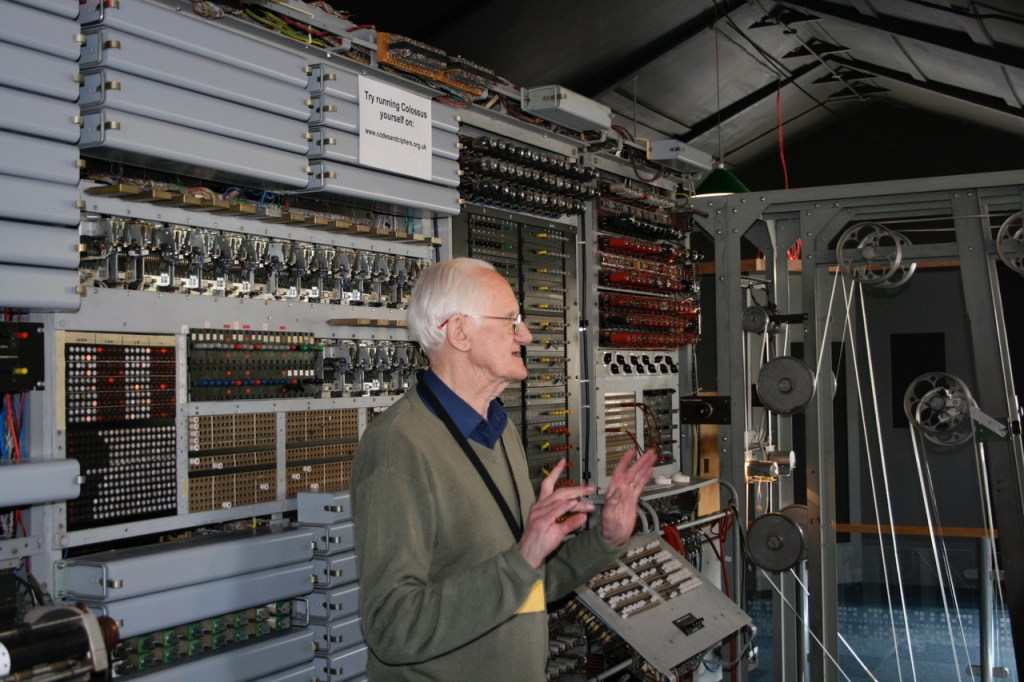
We joined a one-and-a-half-hour tour of the buildings which explained how the Enigma Code was cracked and showed us replicas of the machines which were able to do this – the Bombe and later The Colossus.  The latter was arguably the first ever computer.  Unfortunately the originals were scrapped at the end of the Second World War. 

A reconstruction of Colossus

Heading south we arrived at the Three Cups in Stockbridge around four o’clock and walked along the High Street. Tourists from London come here frequently for the fishing and the country air and the shops and cafes cater for them accordingly.  

The Three Cups, Stockbridge, Hampshire

Extract from diary

I am sitting on the bed in our 15th Century Coaching Inn called the Three Cups in Stockbridge, Hampshire.  The Cups are actually streams which run under the main street. The floor of our room veers in all directions.  The walls are white with black framework oak beams leaning at odd angles.  The ceiling is low on both our top floor and below so that the building looks quite squat.  Up until now I haven’t mentioned the food because there was nothing much to say but tonight it was worth talking about.  John had a pigeon on nettles entree with a red and a brown sauce.  I tasted some and it was very good.  We both had local trout with leeks and potatoes with a bowl of fresh vegetables – brilliant.  We shared a plate of three citrus desserts.  This was washed down with a French Cabernet Sauvignon.  

Our home for the next week was The Bakery Cottage at Ampney Crucis, near Cirencester. There was a very pretty stream flowing through the village (the Ampney), an old church and attractive gardens.  Every building was built from warm, brown stone, there was no graffiti, no rubbish and in every direction the scenery was idyllic. 

The Bakery Cottage (annexe to the main house)

The venue for the wedding (Cripps Barn) was perfect, nice and warm with heaters and a log fire.  The ceremony was held in the large stone barn.  Next to it was a new addition which had been sympathetically built to complement the original. This is where the tables were set for dinner.   We had drinks on the terrace in the one burst of sunshine. The ceremony was short, the bride looked radiant and elegant, the speeches were entertaining and the meal of smoked salmon, lamb with couscous and raspberry tart was tasty.  Guests danced away the evening in the stone barn, planning to regroup for lunch the next day.

Arlington Row

On Sunday morning we drove to Bibury, a picturesque village with a stream full of trout, a row of weaver’s homes called Arlington Row and the typical chocolate box houses of the Cotswolds.  We then parked at the Barnsley Pub in readiness for the after wedding lunch, taking a stroll around Barnsley House where the bride and groom stayed the previous night.  They happened to see Liz Hurley and Shane Warne walking out the door as this was a favourite watering hole of theirs.

Barnsley House

 Extract from diary

On this visit to the Cotswolds we have been able to differentiate between the villages as they all have their own individual character.  Nailsworth, on the way to our National Trust Mansion, Woodchester, is not one of the pretty towns although it is supposed to be “lively and artistic” and has the largest number of working water wheels per square mile in the country.  We were underwhelmed, especially as it was cold and wet.  The redeeming features was Hobbs Bakery. It was warm and cosy, the coffee was great and the hiker’s bar which we shared hit the spot.

 Fortified for what lay ahead we drove into Nympsfield where two walkers directed us to the Woodchester Mansion car park, about two kilometres further on.  Here we walked another mile (1.6km) 

“along a rutted track through the trees, at last to come upon the huge stone building hunched against the hill”. (Tourist brochure)

Woodchester Mansion

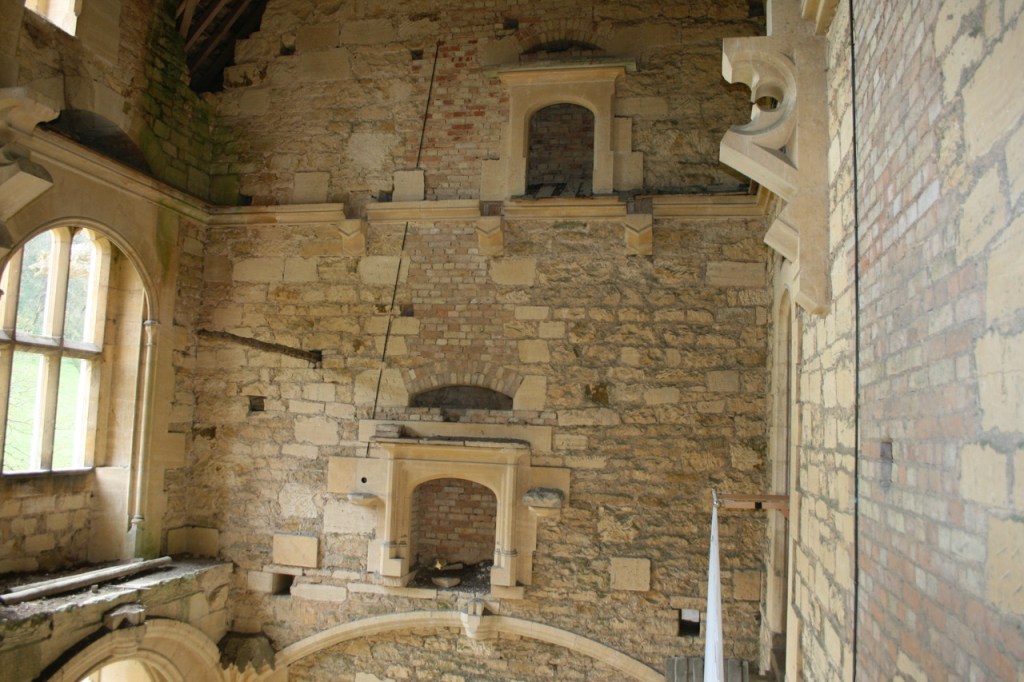
Woodchester Mansion was begun in the 1850s but never finished.  Because the interior walls were never lined the structure of the building can clearly be seen. There are no ceilings on the first or second floor and you can see fifty feet up to the roof. The owner ran out of money and died before he could complete the house.  It is one of the most amazing structures I have ever seen. 

Fireplaces in the mansion with no floors

We thought that as it was our last day in the Cotswolds we would revisit the Slaughters and Stow-in-the-Wold.  Driving into Lower Slaughter we parked opposite Lower Slaughter Manor.  At the front was a sign which advertised soup and sandwiches for two for 20 pounds.  As we walked in I decided on my next visit to the Cotswolds (after I win the lottery) I will stay here.  We were ushered into an elegant but comfortable sitting room with chess boards set up on tables and other games stacked on shelves. A seafood bisque with hot bread roll, a choice of salmon, tuna, chicken, cheese or ham sandwiches and coffee had me happy to stay there forever. Even the toilet was divine.

Lower Slaughter Manor

Tomorrow we move on to Thomas Hardy country!

D for Downsizing

I have often wondered why we are expected to downsize when the children have left and we no longer go to work.  I mean, we have spent our whole life working to achieve the ideal home subject to our financial limitations and then we are supposed to give that up, throw out half our belongings and move to something small and manageable.

It may have had something to do with the lockdowns during Covid, but two couples who are very good friends of ours made the move.  Both sold their large houses on quarter acre blocks and moved to quite different retirement situations.

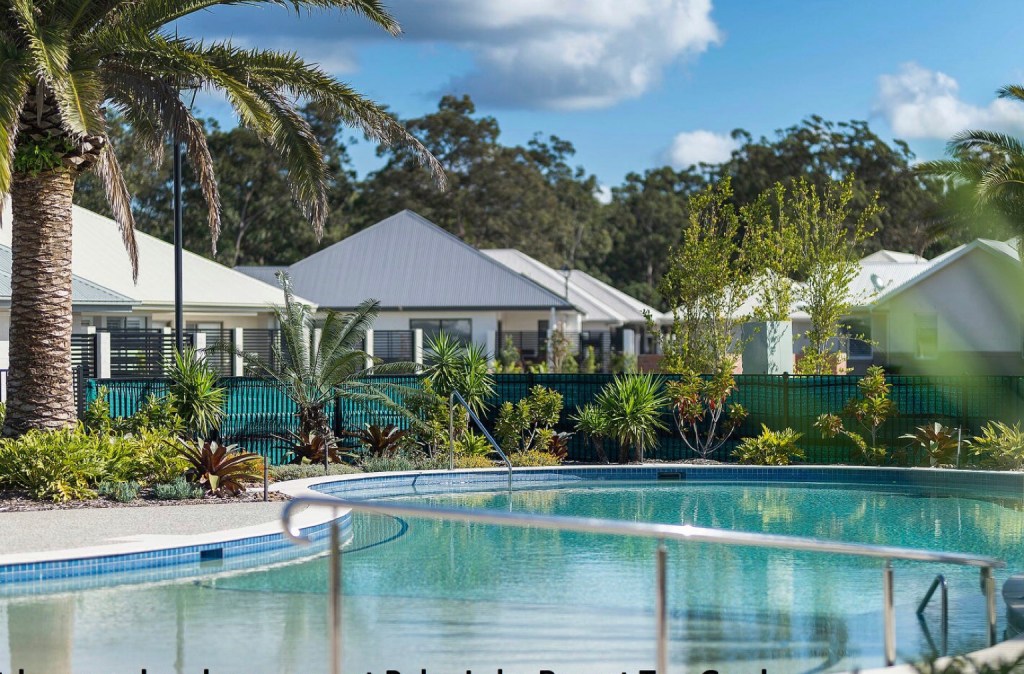
We visited Couple Number One in their new home.  It was two and a half hour’s drive north of Sydney and situated in a village with the dubious title of having the oldest population in Australia.  That said, it is situated in a beautiful area, with clean beaches, a large, protected bay and a river which leads to a series of lakes.  Their home was spacious and well designed, with an outdoor area situated to capture the winter sun, overlooking grassy paddocks dotted with kangaroos. The over 55s resort has many desirable features.  There is an indoor and outdoor swimming pool, gymnasium, bowling green, model yacht club with lake, library, theatre and as many group activities as the imagination would allow.  True, there were no water views but many people owned boats and caravans and stored them on the property. The beach was accessible by car or riding your bike along the designated bike path.

Courtesy of Palm Lakes Resort

Driving home we looked at the negatives.  Two things stood out in our minds.  One was access to health care. Maybe it’s not such a problem at first but the older one gets the need to be close to specialists increases. In an emergency a helicopter could arrive at a nearby heliport and transport the patient to hospital in forty minutes. Conversely, where we live we can drive to the hospital in five minutes.

The other consideration was access to family.  The extra time to visit the grandchildren would require planning.  They could no longer come visit for a day or even a weekend.  Our son’s travel time from Canberra would be doubled.

Then there were friends.  Yes, they could come and visit.  But how often would that happen?  There would be plenty of new friends to make but would we want to have them living all around us?

Still, it was definitely an attractive option.

Couple Number Two opted to move to an established “Over 55” village near to their old home in northern Sydney.  As a result they were able to keep all their existing contacts, friends and familiar places.  They completely gutted the two-bedroom unit so that it boasts all new kitchen, bathroom, carpet and curtains.  They also have a sunny courtyard with a small manageable garden area.  Surrounded by lush gardens they have a swimming pool, a gymnasium and meeting area for communal activities. However, they miss the space and privacy of their former home and not having their boat and van in close proximity.

Could we actually part from our home of 45 years?  We decided if we could find the right place for us we would do it.

Several Real Estate Agents were contacted and we agreed to go ahead with one who seemed to know the area well and was sure that the market was ready, with many Sydneysiders looking to move to the South Coast.

As we made a list of all our home’s assets we wondered if we could find anything to replace it. We discussed why we wanted to move.  The garden was a lot of work.  House maintenance was ongoing.  The neighbourhood had changed because of proximity to the university.  Many of the large older homes in our area were being rented to students so it had lost its sense of community.  Each weekend was spent visiting possible new homes but nothing spoke to us.  We were also cooling on the idea of an Over 55 Community with the financial implications and loss of freedom and space.

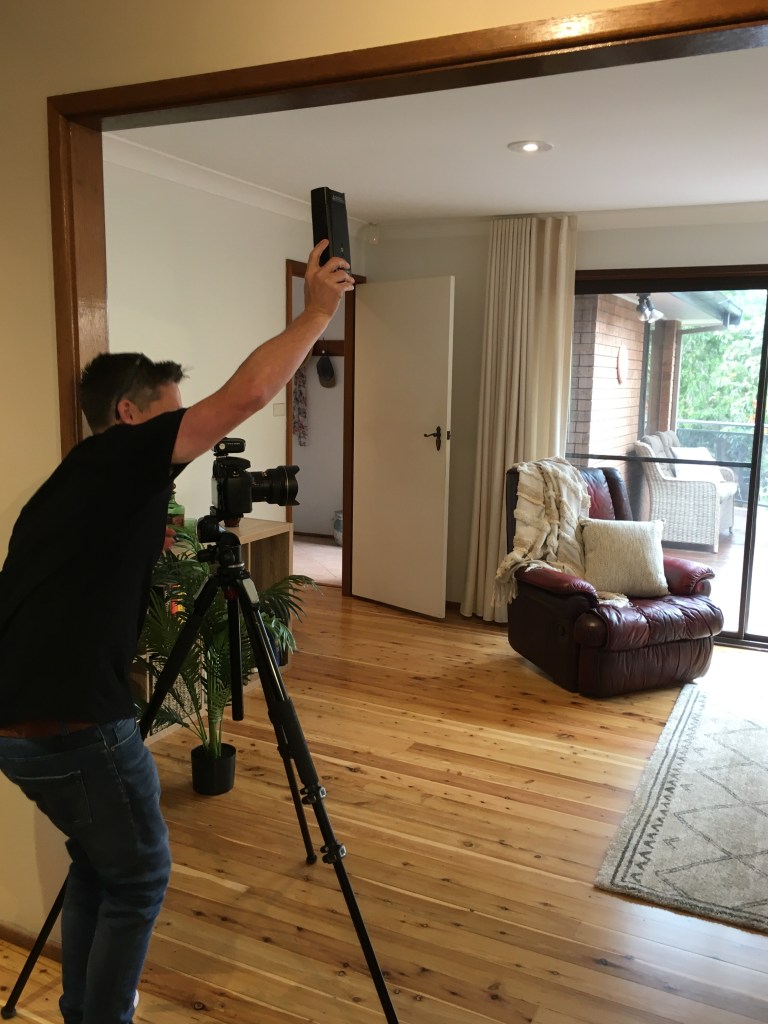
Relentlessly time marched on.  The cypress pine floors were repolished. I removed the ancient curtains from the family room. We borrowed and bought boxes, wrapped all but essential possessions in bubble plastic and stored them under the house.  We removed excess furniture and family pictures. A stylist visited with suggestions.  Photographs were taken.  

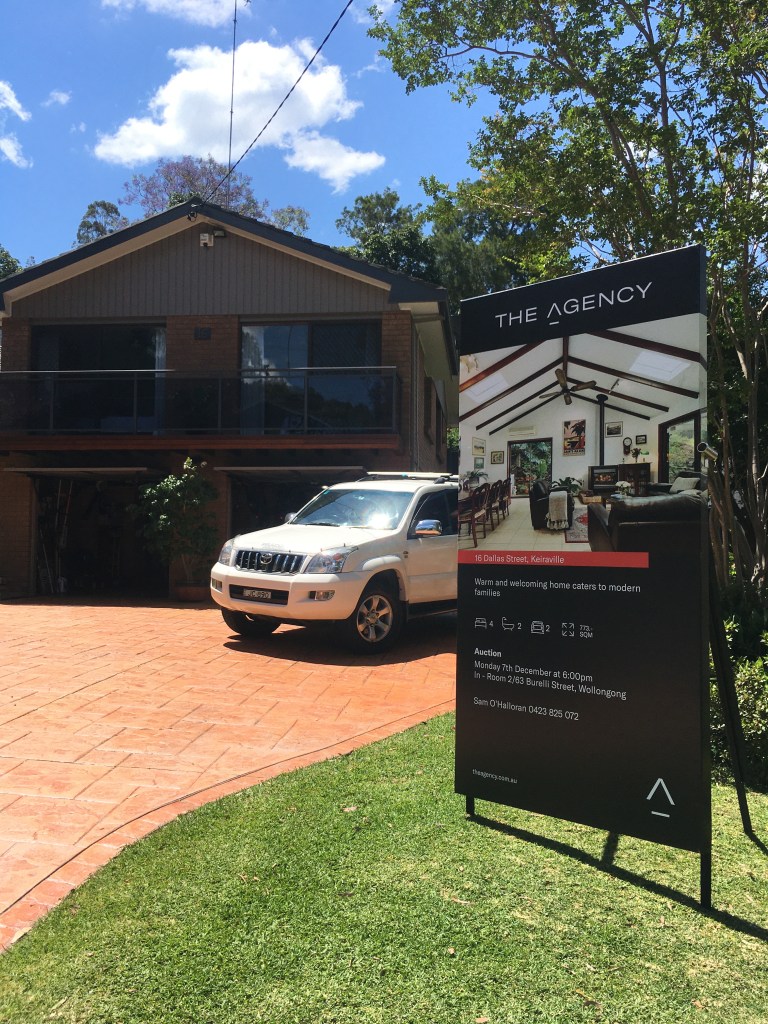
A large sign emerged on the front lawn.  It was one week to the first Open for Inspection!

The agent rang.  Someone wanted to visit immediately as they would only be in town one day.  All right, we said and raced around making last minute adjustments.

Suddenly it was pouring with rain.  Unbelievably, water  dripped from the skylight over the kitchen sink.  That skylight had been there for forty years and now it chose to leak!

The rain stopped and after a quick wipe to remove the evidence we exited the house and drove away for a well-earned coffee.

This was repeated every Saturday morning for the next few weeks without the torrential downpour, fortunately.  Offers were made but our agent said to wait as our house was worth more.  Then came the offer we couldn’t refuse. We decided we had come this far and felt ourselves irretrievably swept along a path of no return.

Alas, it was not to be. The buyer may have decided she might get it for a lower price if she waited for the auction so she rescinded her offer.  By this time we just wanted to call off the whole thing and go back to the nice little comfortable life we had before.  What were we thinking, selling our lovely home?

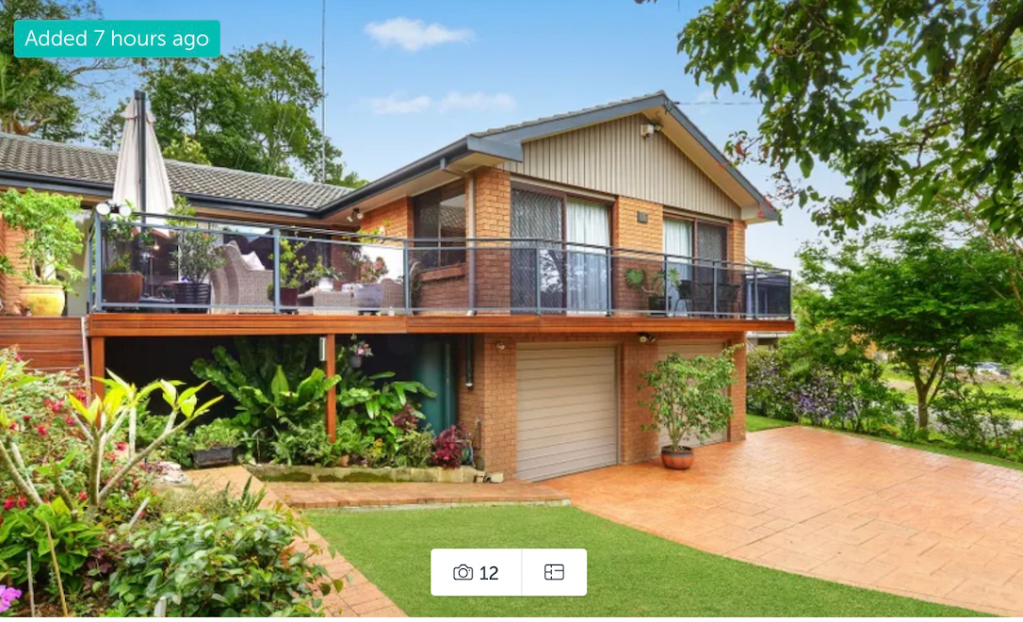
Seven hours on the market

On the night of the auction we were ushered into a little room with a closed circuit television so we could watch the proceedings in peace.  A few properties sold or were passed in before ours came up.  The auctioneer did a good job praising the street appeal, the proximity to university, Botanic Gardens, local village, the well-maintained house and gardens, but there was absolute silence.  A vendor’s bid was placed but still there was silence.

It was over!  John and I high-fived and drove home in a state of euphoria.  Despite the agent’s pleas next day to leave it on the market another few weeks we were adamant.  We were not selling.

It had taken the imminent loss of our home for us to realise how perfect it was for us.  So the garden gets too much for us, we will get a gardener.  While we have a boat and caravan, we will store them on our own land.  I know the theory is you downsize while you are fit enough to do so because if you leave it too long it will become an unpleasant job for someone else.  

On the other hand, why not continue living in a home you are pleased to come home to?  The costs of hiring help and maintaining an older house can be balanced by the not inconsiderable costs of moving.

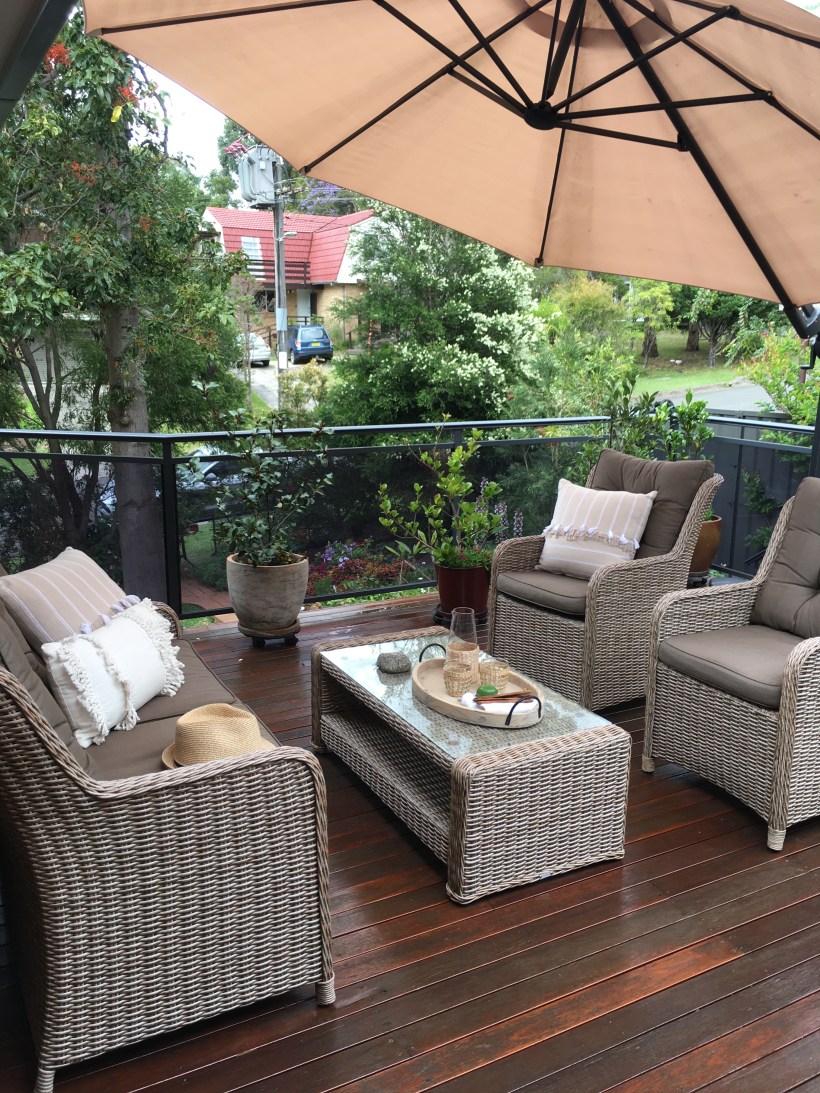
Life goes on.  We did replace that skylight and had the roof cleaned, repointed and painted. We have re-stained the deck twice since the For Sale that didn’t happen and do battle with the garden which grows while you look at it in this wet, sub-tropical summer.  

We have no plans to do anything different.  For now.

C for Cycling

I must admit I’m not a great cyclist.  Flat, straight bike tracks are my ideal.  I hate roads with cars, hills, narrow bridges, spirals, people walking in front of me and out of control children on bikes.  I can’t stand up on my pedals and I do fall off occasionally.  That said I still love to go for a bike ride.  There is a lovely bike track from Wollongong to Bulli which follows the beaches and the ocean baths, but it can be very crowded, especially on weekends.  We recently discovered a bike track which partly circumnavigates Lake Illawarra and ends at a delicious coffee shop.  Best of all it is usually deserted.

On the Wollongong to Bulli bike track

However we do most of our bike riding when travelling in the caravan.  In 2009 we bought two folding bicycles at Aldi and surprisingly they are still in good working order, fourteen years later.  

The folding bikes near Mon Repos, Queensland

Most of the towns where we camp have their own cycle tracks but when we stopped at Tumbarumba we decided to do something different.  There is a rail trail to Rosewood which is twenty-one kilometres long.  As there were some hills, especially at the start, we hired e-bikes for the first time. The temperature rose to 30 degrees Celsius so we were glad to have help from the batteries.  Finally reaching Rosewood we were gasping for a cold drink, a coffee and some cake but a blackout in the area meant that there was nothing open.  We had to make do with our bottles of luke-warm water, muesli bars and an apple. The twenty-one kilometres home again was a breeze on e-bikes and the scenery of cows, hills and farms was good for the soul.

Our bike rides when travelling overseas have added a new dimension to our experience. Turning left across traffic in Hue, Vietnam with heart in mouth, riding along the outer wall of Xian in China (and crashing into my husband’s bike), experiencing Berlin (and hitting a kerb where again, I fell off), exploring the grounds of the Palace of Versailles, riding through vineyards and pretty villages in the south of France (where I found myself locked in the toilet at our lunch stop), and exploring the rice fields of rural Japan, were all memorable experiences.

Cycling in Japan

The closest I have felt to sheer terror had to be the 46 km (28 mile) bike ride down Mt Haleakala, a dormant volcano of 3,048 metres (10,056 feet) on the island of Maui in Hawaii.  It was mostly downhill which sounds a piece of cake, but it is a very windy, twisty road as you might imagine. They put the inexperienced riders like me towards the front and the bigger, more experienced men like John at the back.  The pressure was on to keep up the pace of 29 to 40 kph (18 to 25 mph)  when my instinct was to brake, brake, brake! If we crossed over the centre line of the road we were told we would be put in the back of the truck.  At the halfway point the front person gave up and retreated to the vehicle. We posed for some silly photographs which made it look like I was enjoying myself!  

Posing for the camera in Hawaii

I was ignominiously placed at the front to be “coached” down the mountain. We arrived at the sea at Pa’ia and sat on the beach to calm down. It was one of those experiences that is better viewed in retrospect. I’m so glad I did it!

Cycling is something adults can do with their children and their grandchildren. From tiny bikes with training wheels ours all graduated to full sized adult bikes. When they were small the grandchildren would pedal short distances from one children’s play area to the next. Now we can’t keep up.

Off on a bike ride with a grandchild