V for Vernazza, Corniglia, Manarola, Riomaggiore and Monterosso al Mare

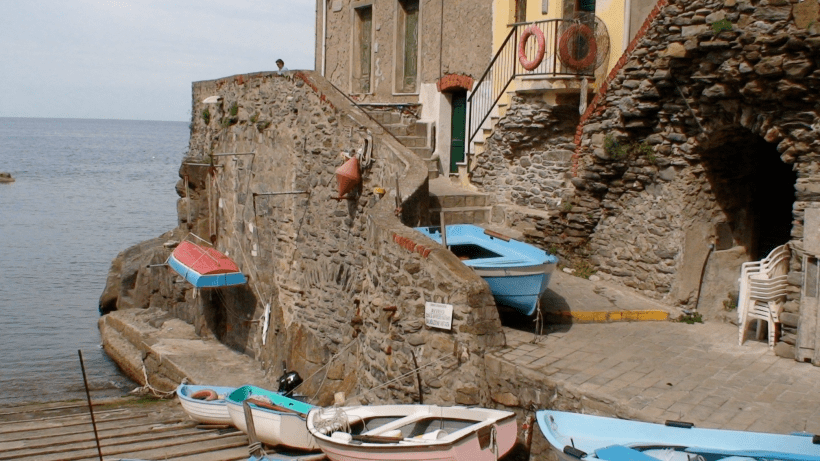
Of all the places I have visited the Cinque Terre stands out for its multiple attractions.  Five villages, all exquisitely beautiful and yet different.  Three ways of seeing the villages without a car: walking, catching a train, catching a ferry. Plenty of places to eat delicious locally produced food.  In May, 2011 it wasn’t too crowded.  This was before massive floods in October of that year washed away many houses in Vernazza. Three residents were killed and the town was buried under four metres of mud and debris. There was over one hundred million euro worth of damage. Below are extracts from the diary I kept on the five days we spent in this beautiful area.
We are in the train to Torino following the coast up as far as La Spezia.  It is 1.15pm and we were one and a half hours late leaving Roma as the train didn’t arrive on time.    There are people in all the seats so its rather squeezy.  We also have a rabbit in the compartment and a dog in the corridor. The scenery is interesting with coastal views and productive farmland.  One of our stops was Civitavecchia where we will travel in a week’s time to board the ship.  The train gets close to the water’s edge in some places and then veers inland again.

I’m going to read my information on things to do in Cinque Terre.  We still have about one and a half hours to go and of course no internet.  John has reported that the toilet is blocked so I plan to hang on until I get to the destination.

 We arrived eventually after some confusion at La Spezia.  There was no sign to say where to catch the train and people were wandering around looking confused.  Eventually we were on what we hoped was the right train and after waiting for a while it eventually moved.  The eight-minute trip, mainly through tunnels, stopped at Riomaggiore to let us off.  We walked up a steep hill for 300 metres and rang the doorbell but no-one appeared. A passing woman stopped to help and rang someone on her mobile.  Then Emiliano turned up with two other guests who must have arrived when we did.  He showed us to our room which is small but pleasantly airy with blue and white curtains and white walls.  The bathroom is new looking and clean although it had one of those annoying semicircular showers where the door is hard to shut.  There is a brand-new TV which should keep John happy.  The balcony looks across at the village and the grape vine covered hillside but at one end it gets larger and you can see the sea.

The view from our balcony

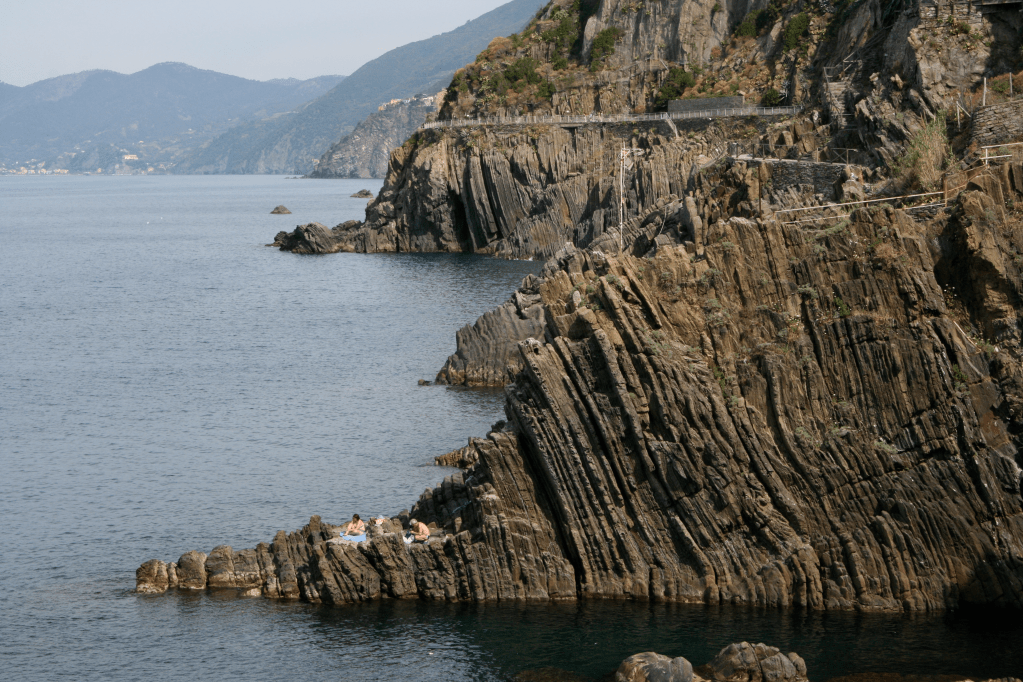
We had had lunch on the train but decided to buy some food and wine for happy hour.  Emiliano suggested we walk along the Via dell’Amore to Manarola and have dinner at one of three restaurants he recommended.  After a shower and a drink on the balcony we walked along the Via dell’Amore, translated to “The Way of Love.”  which follows the edge of the ocean, through tunnels, finally emerging at Manarola. 

The Via dell’Amore

Then it was a steep climb up a series of steps and roads to Billy’s, a restaurant recommended by both Emiliano and Trip Adviser.  We had to wait twenty minutes to get a table but they gave us some Prosecco to keep us going and we sat on the steps looking out to sea.  Our table was beside the kitchen on the outside, with a view of the setting sun over the ocean.  The food was good.  I had mussels in garlic and tomato followed by a grilled fish and John had butterflied raw anchovies soaked in lemon juice followed by stuffed mussels.  We shared two half bottles of white and red and were given complimentary glasses of lemoncino and a purplish liqueur that tasted like cough medicine.  It must have had some kick because I walked home, fell into bed and was asleep within minutes.

 Tuesday, May 31, 2011

 I felt below par today.  I don’t know if it was jet lag, the limoncino or what but I felt decidedly queasy as we walked to the harbour this morning.  We had a latte and John had a croissant but, in the end, decided to have an easy day and do the boat trip tomorrow.

 We bought some tasty food to keep us going and had lunch on our balcony overlooking the town and the sea.  We had fresh bread, delicious tomatoes, olives, cheese, salad mix and the remains of some Balsamic vinegar and olive oil.  No wine but healthy juice with orange, carrot and apple.  I wrote six postcards.  The PO was closed when we walked past so will have to try and post them tomorrow.

 We booked dinner at La Laterna for 8 but decided to have the first course at home on the balcony.  Ricotta cheese, olives, tomatoes, bread dipped in olive oil and balsamic vinegar and the local dry white wine.  What a way to start the evening!  At La Laterna we had a main each and a glass of house red.  I had spaghetti with seafood in foil and John had a fried fritto misto.  We shared a tiramasu.  

 Wednesday, June 1, 2011

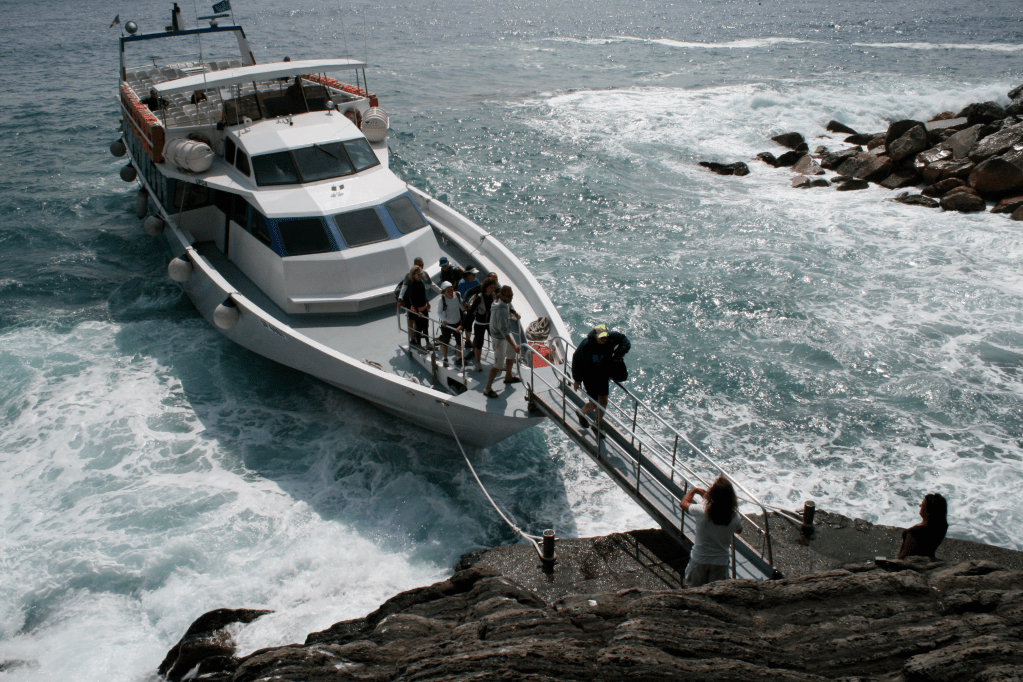
 First day of winter at home and here didn’t look much better.  It was cloudy and windy and rained through the night.  We wondered if the ferries would still be running.  I felt much better than yesterday and think I am finally recovering from jet lag.  We had breakfast in the room before heading off down to the jetty.  At nine o’clock the ticket office was still shut but it opened just before the ferry arrived.   I bought two E20 all day tickets even though the ticket seller gloomily forecast the ferries might not run because of the swell.  We saw what she meant as the ferry came in.  The landing spot was just a piece of rock and people had to run along a gangplank over the bow that swung around in the waves.

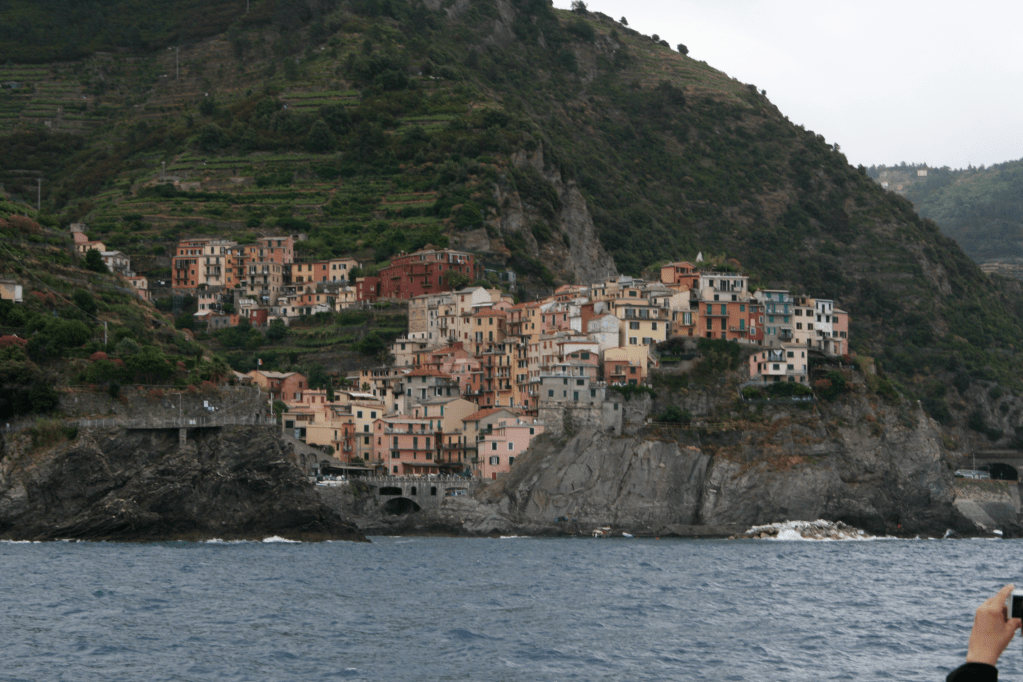
 The boat set off in the swell and we filmed and photographed the scenic villages under a cloudy sky. First we passed Manarola, the most spectacular from the sea I think. 

Manarola

The next town is Corniglia which has no jetty and is perched on a hilltop. 

Corniglia

Vernazza was next but our ferry went straight to Monterosso al Mare.  Here we were able to get off fairly easily as it was a large jetty.  The town seems much bigger than Riomaggiore and has an interesting medieval centre.  We stopped for capucchino and cake in a bar which was very busy.  We were astonished at pictures on the wall of the bar of huge waves roaring up Monterosso’s main street.

Monterosso al Mare

 As we passed a Post Office I thought I would go in and buy some stamps for the post cards.  The man behind the counter waved me away and said “Go to the shop at the back” or so I thought.  I went outside and looked around but could see no shop at the back.  I went in and this time he said, “Go to the tobacco shop”.  We walked down the road and into the tobacco shop but they said they don’t sell stamps anymore and to go to the Post Office.  One more try at the PO and I were sent angrily away, I suppose because there was a huge queue waiting and only one man serving.  I don’t know when I’ll be able to send those post cards.

 At 11.30 we caught a ferry to Vernazza.  It was smaller than Riomaggiore and seemed more touristy if that is possible.  We only had 40 minutes there but wandered around the streets.  It has a stream running through the middle of the town.  Small bridges cross the river from the road to the houses. There were lots of people waiting for the train.  Maybe they were tired after doing the first 90 minute walk from Monterosso.

Vernazza

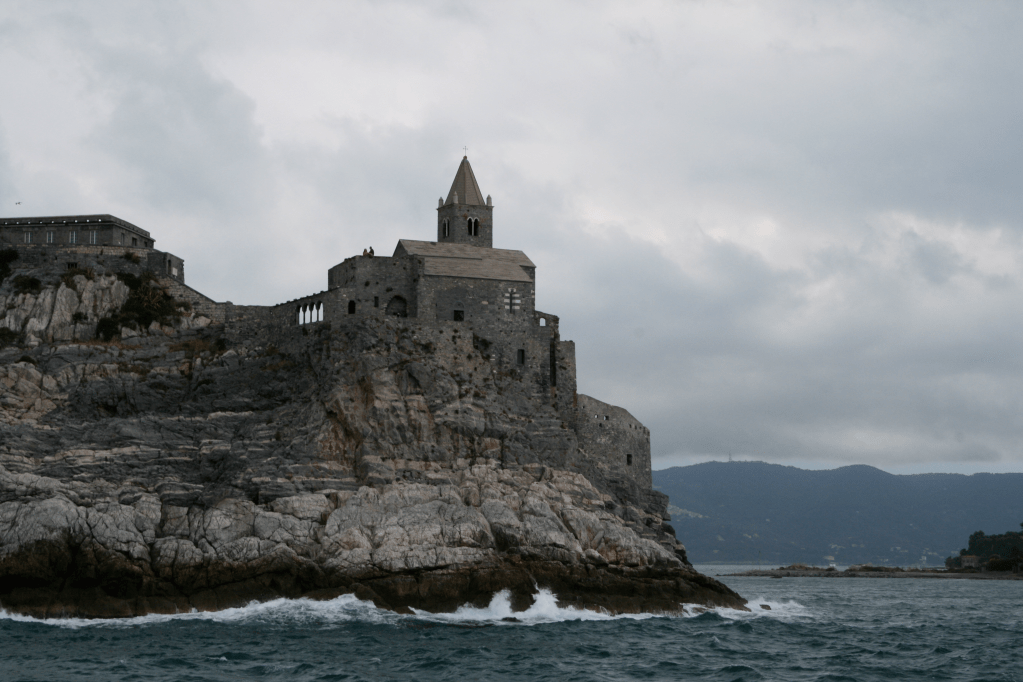
 The next ferry at 12.20pm was supposed to stop at Manarola but they must have decided it was too rough and kept on going.  It did stop at Riomaggiore but we stayed on because we were going to Portovenere.  We kept saying we could see a patch of blue or the sky was getting lighter and I think that was actually the case.  There were a few clusters of houses on impossibly steep hillsides but from Riomaggiore to Portovenere was mainly unpopulated.  As we approached Portovenere we saw a pointed rock with a cross on it, a massive castle on the left hand side of the entrance to the harbour and a church on top of a rock, also at the entrance.  Once inside the heads it was calm and peaceful so getting ashore was no chore this time.  We walked off the ship on the side, not over the bow.

 Portovenere was such a pretty town with its castle and row of pastel houses along the waterfront.  We spotted Tri Torri right away at the back of a square near the marina.  John was hungry so we headed there first.  The ferry captain told us the 3.00pm ferry would be the last one as the last two were cancelled.  The restaurant was lovely.  It was all beige and white with a view of the water and the castle.  We both ordered a E25 main course of mixed grilled seafood plus a salad and two small carafes of house white and red plus a bottle of water.  The food was delicious.  We had scampi, prawns (huge), calamari (tender, grilled on charcoal) and fish.  The waiter cleaned up the fish for us, removing bones and fins and opening it up to make it easier to eat.  

Portovenere

 We had time to buy a gelato each and eat it before our ferry came in.  The trip home was rough but the sun had come out and everything looked bright and clean.  I filmed the arrival of our boat at the landing spot in Riomaggiore and people getting off and on.  It was quite scary at times as the boat swung around.

 We bought some food for dinner, bread, tomatoes, cheese, salad, onion, prosciutto and a cake.  John made coffee when we got back to our room and now we are resting on the bed with the windows open, the cool breeze blowing in and the sound of birds and children’s voices coming from outside.

 Thursday, June 2, 2011

 We have completed all we could do of the Cinque Terre walks as the track from Corniglia to Manarola is closed.  When we arrived at the station this morning we saw that we had a 40 minute wait for a train so we purchased our train/walk pass and started the walk to Manarola.  Once there we had cappucchinos and waited for the train.  Funnily enough the train we would have caught at Riomaggiore went straight past but there was another one soon after.  Today is a public holiday so there were plenty of people out and about.  We took the train all the way to Monterosso al Mare and felt as if we were in a different town to yesterday.  The sun was shining, the umbrellas were up and people sunbaked or swam in the sea.  What confused us most was where the train station is situated is in a part of town we hadn’t seen yesterday when we got off the boat.  It was very impressive and had a lovely resort feel about it.  I was tempted to pay for a little change room and sunbed on the beach with its own umbrella.  The umbrellas all looked brand new for the new season.

After buying a gelato we started the walk.  It was only three kilometers but took an hour and a half.  There were a lot of steep steps going up out of the town and the sun was shining hotly.  We were very pleased to reach Vernazza and sat down in a pleasant little café called Trattoria del Sandro.  I had vegetable pie, a local specialty while John had octopus and potato salad.  He said it was very tender.  We had a can of lemon squash and a salad.  It came to E35.50 so John says no eating out tonight.

Vernazza

We were amazed at the throngs of people flowing through the village, from trains, ferries and walking tracks.

 We headed off again on the Vernazza to Corniglia track.  This was supposed to be longer at 4 kilometres but the time was the same – one and a half hours.  It started to rain at one stage but was a welcome relief from the heat.  We sheltered under a tree until the big drops stopped.  Corniglia had cars, motorbikes and buses parked in a square when we arrived.  The square led to a narrow street where we bought a lemon gelato with honey drizzled over it. The narrow street wound its way to another square where a number of cafes had large umbrellas covering most of the area.  At the back was an ancient church with a paved area beside it where children played a noisy soccer game.  The road continued to a look out over the sea where telescopes could be used to view the other villages in the distance.  This wasn’t the way to the train station so we walked back all the way to the square with cars and bikes and continued to a set of 378 steps which wound all the way down to the train station.  We were glad we were going downhill and that this was almost the end of the journey.  We had a 20 minute wait for our train, eating our rather squashed nectarine, our juice and a mandarin.  We chatted to two Americans from New Jersey until the train arrived.  Back at Riomaggiore we walked up our 300 metre hill and decided it wasn’t so bad.  We have both had showers and are resting our extremely weary bones.  Our clothes were saturated with sweat so we washed them and hung them out.  A heavy downpour of rain has just wet them all again but no matter as they weren’t dry anyway.

 I will have to take this laptop down to the main street to send my emails when we go to get some dinner.  I think we’ll take the long road past the church as the steep way (down the steps) would be too slippery.

 Later:  I couldn’t get the internet to work tonight so will have to send it in Roma.  Tonight we ate at Le Grotto.  Our main course was spaghetti with fresh anchovies and herbs (delicious).  For dessert we had strawberries, something like homemade icecream and cranberry sauce (with a bit of chocolate).  A bottle of red and some sparkling aqua and the bill E50 with tip.  On the way back we passed a brass band warming up outside a church (or was it an oratory?)  We didn’t stop to hear them play but as we lay in bed later we could faintly hear it.  People talked loudly until late in the night and as our room was right beside the footpath it felt like they were in the room with us.

Our apartment in Riomaggiore

 Friday, June 3, 2010

 We are on the train to Roma so this is a good time to write.  I have just started a spreadsheet of expenditure so I can keep track of the cost of this holiday.

 We were awake early and by the time the 7.00am bell started pealing we had packed and eaten our remaining yoghurt and fruit for breakfast.  We said goodbye to La Baia del Rio, leaving the key on the table.  After checking our train times and remembering this time to date stamp our tickets from the yellow machine we had coffee at the little shop near the station.  The train left Riomaggiore at 8.37am which would get us to La Spezia early but we intended to buy some lunch for the journey.  All went according to plan and we arrived at La Spezia with our next train departing at 10.06 am.  This gave us time to walk down to the main square, check out a market and buy some rolls with ham and salad.  We also bought some little cakes for dessert.  Back to Platform 3 and we had a 20 minute wait for the train.  We are now stationary at Pisa Station but can’t see any Leaning Tower from here.  I’d be frustrated if I hadn’t seen it before.

 Later:  We arrived in Roma and carried our backpacks to the Welrome Hotel where we were taken to our new room by Mary.  It is called Colosseo and is larger than the Trevi and has a small balcony at the back on which we hung some clothes to dry.

U for Understanding Sandakan

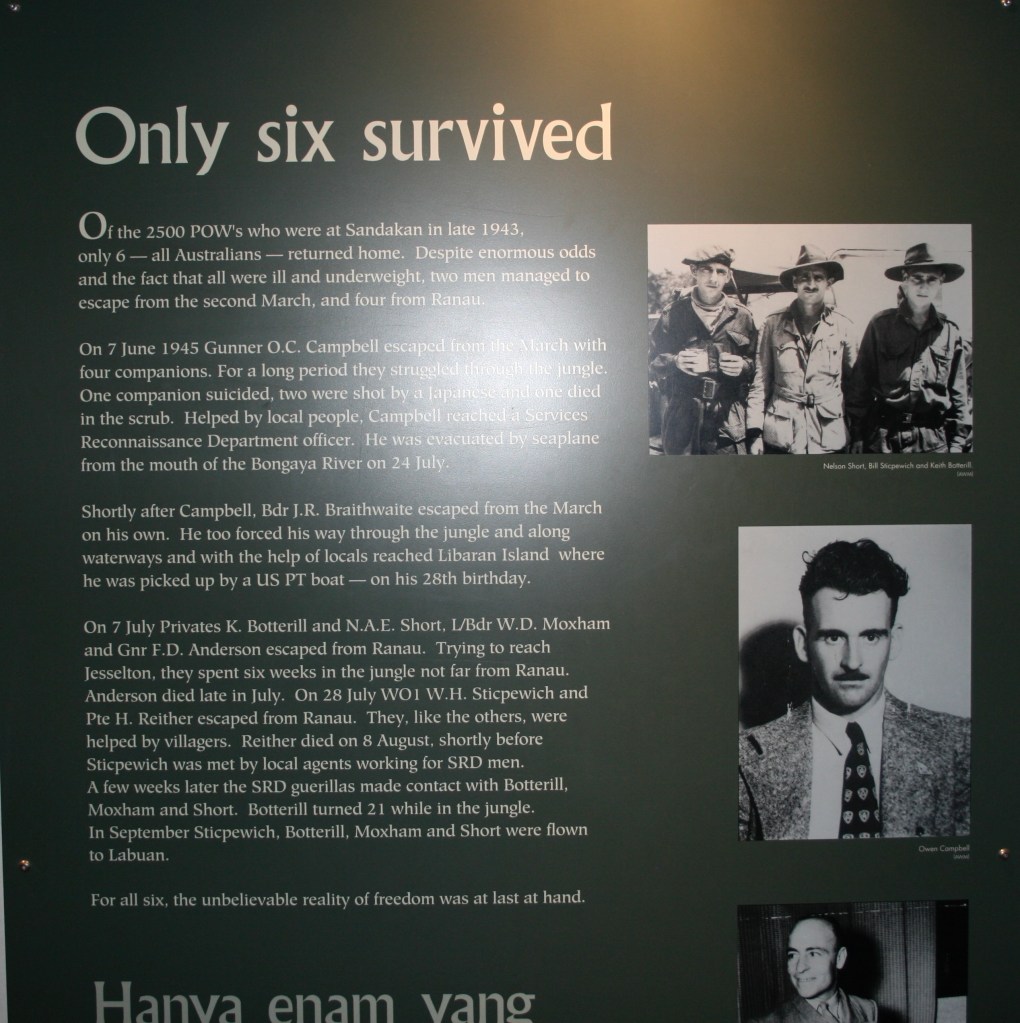
When we booked our trip to Sabah, I knew that there had been a Prisoner of War camp in Sandakan and had heard of the Death Marches but knew very little more. What we learnt on our visit about the enormity of the crimes committed by human beings on fellow humans was hard to comprehend.

Since then my husband has read The Story of Billy Young by Anthony Hill and Sandakan: A Conspiracy of Silence by Lynette Ramsay Silver.  I have not attempted either as the thought of revisiting that period of history is just too confronting.

However today is ANZAC Day when we remember those who didn’t make it back home so I thought it was a good opportunity to bite the bullet and try to answer a few questions.  Why were the guards so brutal?  Were there any survivors? How did so many die? I’m not attempting to read Silver’s outstanding book in one day so am using the ANZAC Portal from the Department of Veteran’s Affairs, specifically Sandakan 1942-45 as my main source.

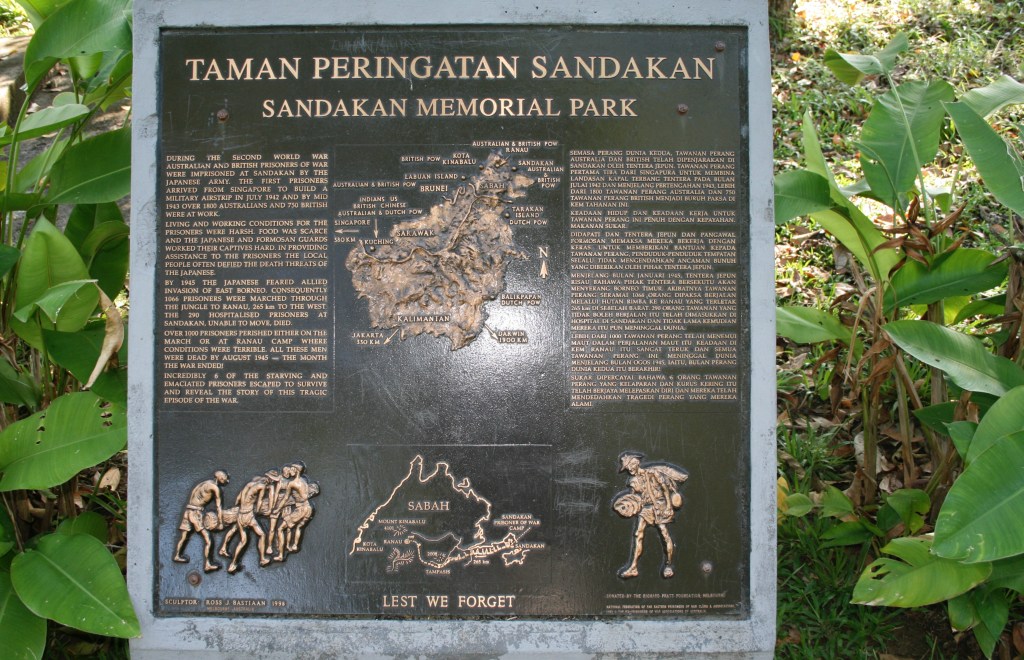
In 1945 Borneo was still occupied by the Japanese, and at the end of the Pacific war in August, Australian units arrived in the Sandakan area to accept the surrender of the Japanese garrison. Just 16 kilometres out of Sandakan, in a north-westerly direction, was the Sandakan POW Camp. Here, between 1942 and 1945, the Japanese had at different times held over 2700 Australian and British prisoners. The POWs were brought from Singapore to Borneo to construct a military airfield close to the camp. By 15 August 1945, however, there were no POWs left at Sandakan Camp.

So what had happened to 2700 men? For the next two years, between 1945 and 1947 the area from Sandakan to Ranau, 260 kilometres to the west, was searched, and the remains of 2163 Australian and British POWs were uncovered. Hundreds of bodies were found at the burnt-out ruins of the POW camp.

Research has indicated that some 2428 Allied servicemen—1787 Australians and 641 British—held in the Sandakan Camp in January 1945 died between January and August 1945 in Japanese captivity. 

They were so close to being freed as the war was nearly over.  How is it that so few (only six) made it home?

Until April 1943 the soldiers were worked hard but had enough to eat and kept their spirits up with concerts. Then the new guards arrived, from Formosa, under Japanese leadership. They were considered the lowest of the low by the Japanese, not even good enough to fight, so brutalised and resentful, they took out their anger on the prisoners. In July an intelligence ring run by some officers with local people was discovered, resulted in severe punishments.  There must have been some hope when in September 1944 Allied planes began bombing Sandakan and the airfield.  This was seen by the captors as a reason to reduce rations as the prisoners were no longer needed to work on the bombed-out airfield. The plan was made to move the prisoners to Ranau in the mountains where they could be used as supply carriers. The first group of 455 Australians and British set off with only four day’s rations, no boots, in rain, suffering from malnutrition and numerous other illnesses.  If they fell they were dragged into the bushes and bayoneted or shot. By June, five months later, there were six left.

Back at the camp in Sandakan, things were no better.

Hundreds of Australian and British POWs between January and August 1945 expired at Sandakan camp from ill-treatment in a situation where their captors possessed locally enough medical and food supplies to adequately care for them.

At the end of May another 530 prisoners were moved out with about 270 left behind, too incapacitated to move. Twenty-six days later 183 men reached Renau; it had indeed been a Death March. Of those left at the camp they all either died of illness or starvation or were killed by the guards.

Remains from the burnt out POW camp

Reading about the conditions under which these men lived and the hard work they were expected to do until they dropped is gut wrenching so I will move on to one bright note.  Six men survived.  Yes, out of 2,700 men Six survived.  This is their story.

Gunner Owen Campbell, 2/10th Field Regiment

On the second Death March, Campbell and four others decided to use the first opportunity to escape. Out of sight of guards during an air attack, they slid down a 61-metre bank, hid in some bracken and rubbish, and lay quietly until the column had moved on. For four days they fought their way, sometimes on hands and knees, through the jungle in what they assumed was the general direction of the coast. The four other men all lost their lives but Campbell eventually spied a canoe.  The canoeists, Lap and Galunting, took him to Kampong Muanad where Kulang, a local anti-Japanese guerrilla leader, was headman. The local people hid and cared for the sick man.  Eventually, Kulang took Campbell down river to where an Australian SRD (Service Reconnaissance Department) unit was camped.

Bombardier Richard ‘Dick’ Braithwaite, 2/15th Australian Field Regiment.

During the early stages of the second march Dick Braithwaite was so ill with malaria that his mates had to hold him up at roll call. For him it was a question of escape or die. Taking advantage of a gap in the column, he slipped behind a fallen tree until everyone had gone by. Eventually he reached the Lubok River where an elderly local man called Abing helped him. Abing took Braithwaite in his canoe down river to his village, where he was looked after. Hidden under banana leaves, Braithwaite was paddled for 20 hours downstream to Liberan Island where  he was rescued by an American PT boat and taken to nearby Tawi Tawi Island. A week later, after he had told his story, an Australian colonel came to see him in his hospital bed to tell him they were going in to rescue his friends:

I can remember this so vividly. I just rolled on my side in the bunk, faced the wall, and cried like a baby. And said ‘You’ll be too late’.

Private Keith Botterill, 2/19th Battalion, 

Lance Bombardier William Moxham, 2/15th Australian Field Regiment, 

Private Nelson Short, 2/18th Battalion

Botterill, Moxham, Short and another man, Gunner Andy Anderson, escaped from Ranau on 7 July and for some days hid in a cave on the slopes of Mount Kinabalu. They ran into a local man, Bariga, and had little option but to trust him with their story. Throughout the remainder of July, Bariga hid them and brought food. Anderson died of chronic dysentery and they buried him in the jungle. At this point, Bariga learnt that there was an Australian unit operating behind the lines in the area, and after the Japanese surrender on 15 August the three POWs were told to head out of the area and meet up with this unit. Nelson Short recalled as they lay exhausted in the jungle:

We said, ‘Hello, what’s this? Is this Japs coming to get us? They’ve taken us to the Japs or what?’ But sure enough it was our blokes. We look up and there are these big six footers. Z Force. Boy oh boy. All in greens.

Warrant Officer ‘Bill’ Sticpewich, Australian Army Service Corps;

The final escape from Ranau was that of Sticpewich and Private Herman Reither. Towards the end of July a friendly Japanese guard warned Sticpewich that all remaining POWs at Ranau would be killed. On the 28th he and Reither managed to slip out of the camp and hid in the jungle until the hunt for them died down. They moved on and were eventually taken in by a local Christian, Dihil bin Ambilid. Hearing of the presence of Allied soldiers, Dihil took a message to them from Sticpewich. Back came medicines and food but unfortunately Reither had already died from dysentery and malnutrition. There is a dark side to this story which you may wish to read in the following article by Lynette Silver.

These six survivors were alive to testify in court against their tormentors and to ensure that the world received eyewitness accounts of the crimes and atrocities committed at Sandakan, on the death marches and at Ranau.  As a result of these trials, eight Japanese, including the Sandakan camp commandant, Captain Hoshijima Susumi, were hanged as war criminals. A further 55 were sentenced to various terms of imprisonment.

It is hard to explain the treatment of prisoners at Sandikan by their captors.  The Imperial Japanese Army indoctrinated its soldiers to believe that surrender was dishonourable.  POWs were therefore thought to be unworthy of respect. The IJA relied on physical punishment to discipline its own troops and allied prisoners formed the bottom rung of the military hierarchy.  The fear of an uprising by the prisoners may have been behind the decision to make them weak through sickness and malnutrition.  The fear of reprisal at the end of the war would have fuelled the decision to remove every trace of the 2,500 prisoners sent to Sandakan. 

T for Tiger Leaping Gorge

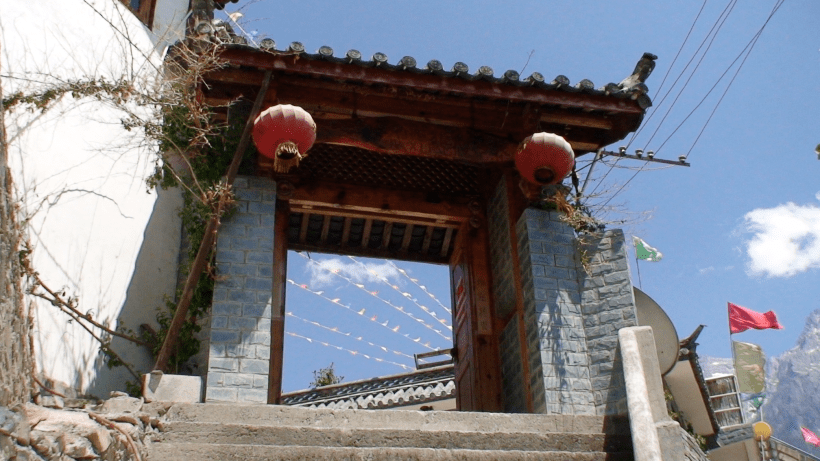
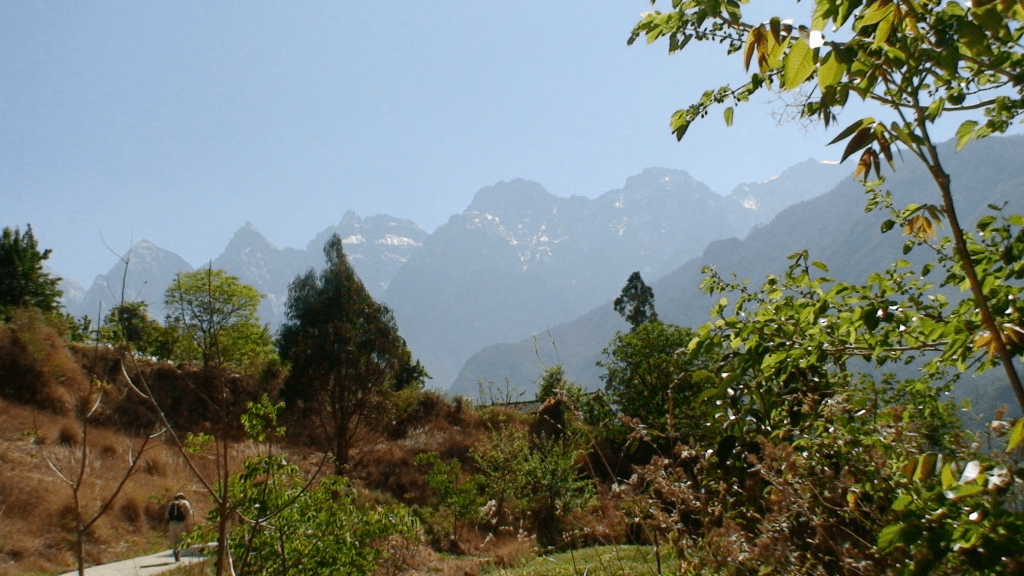
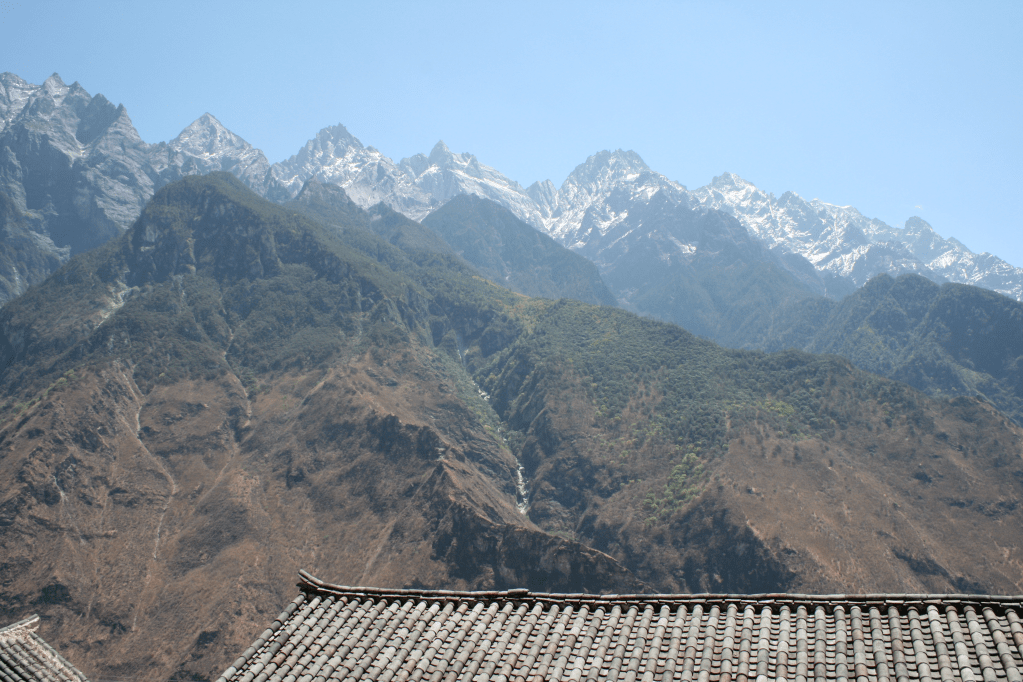
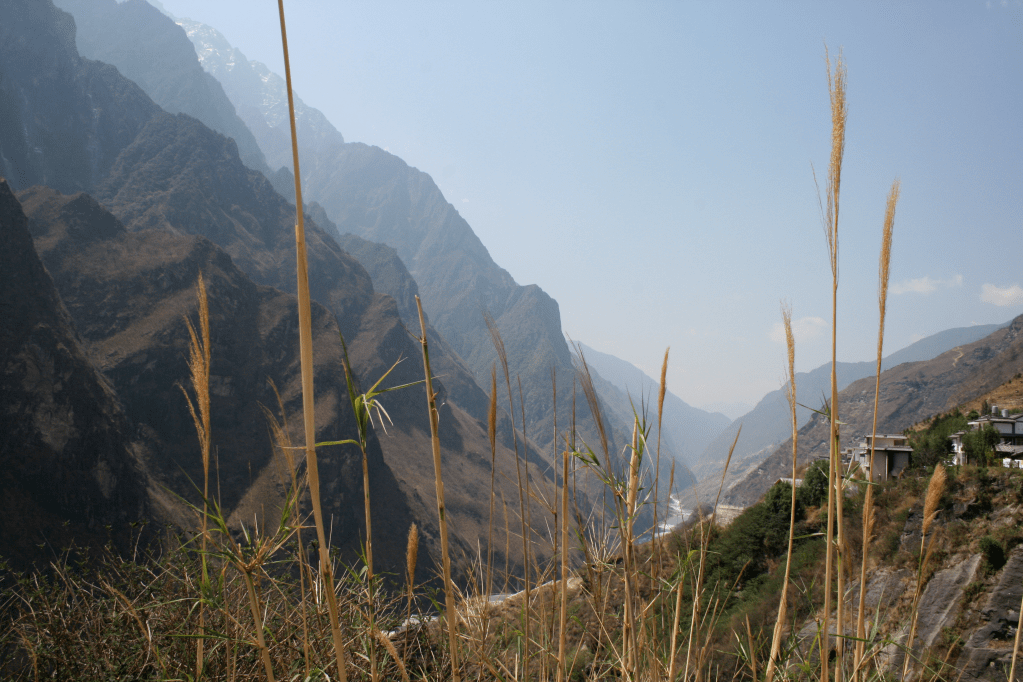
Ever since China opened up to overseas tourists in the late 1970s we had wanted to visit this enigmatic country. It wasn’t until April, 2014 that we embarked on a tour with Peregrine Adventures.  What I liked about the tour company was that it mainly used public transport, involved a lot of physical activity and the group would be no larger than fifteen people. Reading the Lonely Planet guide I was entranced by the picture of Tiger Leaping Gorge and imagined myself climbing narrow tracks beside rushing rivers and below jagged snow-capped mountains.

Photo by Linda Curry

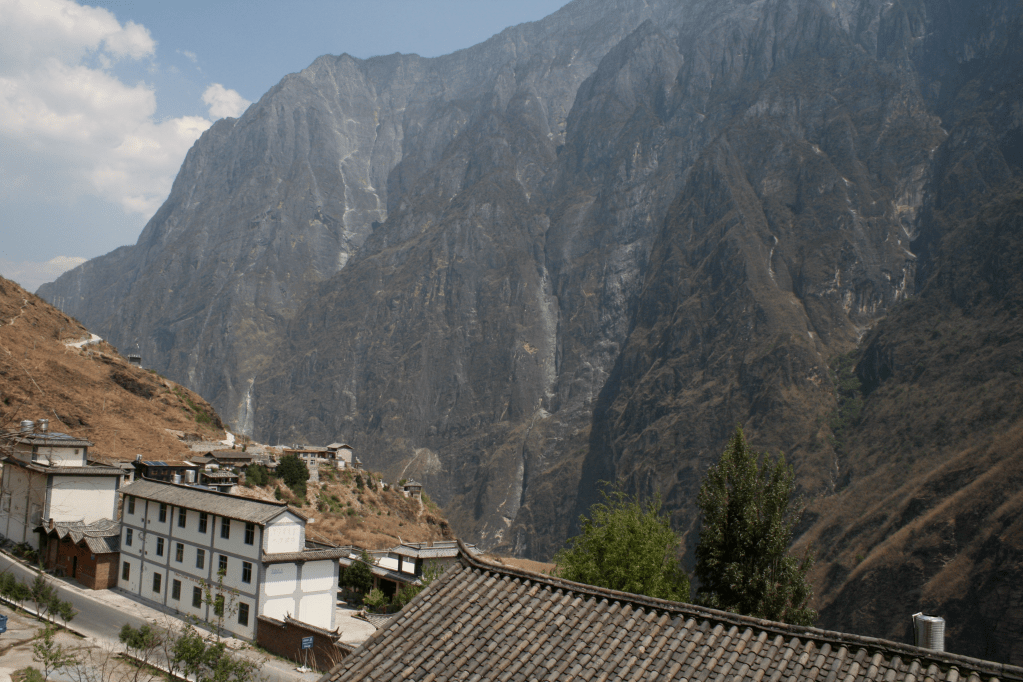
Where is Tiger Leaping Gorge? It is 60 kilometres (37 miles) north of Lijiang City, Yunnan, in southwestern China. Around fifteen kilometres in length the gorge is located where the Jinsha river passes between Jade Dragon Snow Mountain and Haba Snow Mountain in a series of rapids under steep two hundred metre cliffs.

Although the gorge is not considered navigable, four rafters attempted to go down the rapids in the early 1980s and were never seen again.  Subsequent attempts using boats were more successful.  The area was first officially opened to overseas tourists in 1993.

We had had an inauspicious start to our tour. On the second day I was violently ill so I spent the day in bed. 

Two others in our group starting feeling queasy. We decided it must be a combination of altitude (2052 m) although altitude sickness should not really kick in until 2500 m and strange food, water, jet lag, tiredness etc. Our guide Jane wants us to eat like the locals and serve ourselves with our own chopsticks but we rebelled and said that it would be too easy to spread germs so she relented and we now use serving spoons although continue to eat with chopsticks.

Personally I blame the birthday cake for John, loaded with cream and delivered to our table in Dali Old Town.

Was the birthday cake to blame?

Would we all be well enough to tackle Tiger Leaping Gorge?

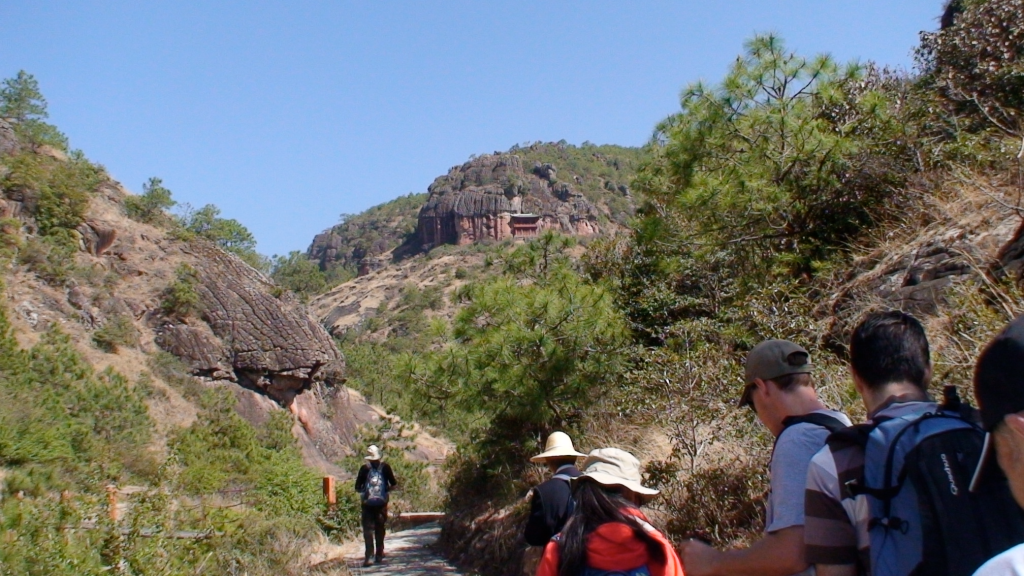
Saturday was the test before the big one. To climb Shibaishan Mountain was our aim. To get there from Shaxi, we walked 1.5km north, turned left at the sign (pointing to Shadeng Qing) and walked another one kilometre to the foot of the mountain. The path up the mountain consisted of hundreds, maybe thousands of stone steps.

The first temple is up on the hillside

Along the way were several temples, grottoes and stone carvings. At the first temple we thought we had reached our destination but onward and upward we continued. Three had stayed behind owing to illness and some of the group were either coming down with or recovering from bouts of diarrhoea. It was sunny and hot and we needed frequent rests. As I felt I had recovered I really enjoyed the fresh air and the surrounding hills covered with cypress forest and the view of paddy fields way below.  I felt I was ready for whatever tomorrow would bring.

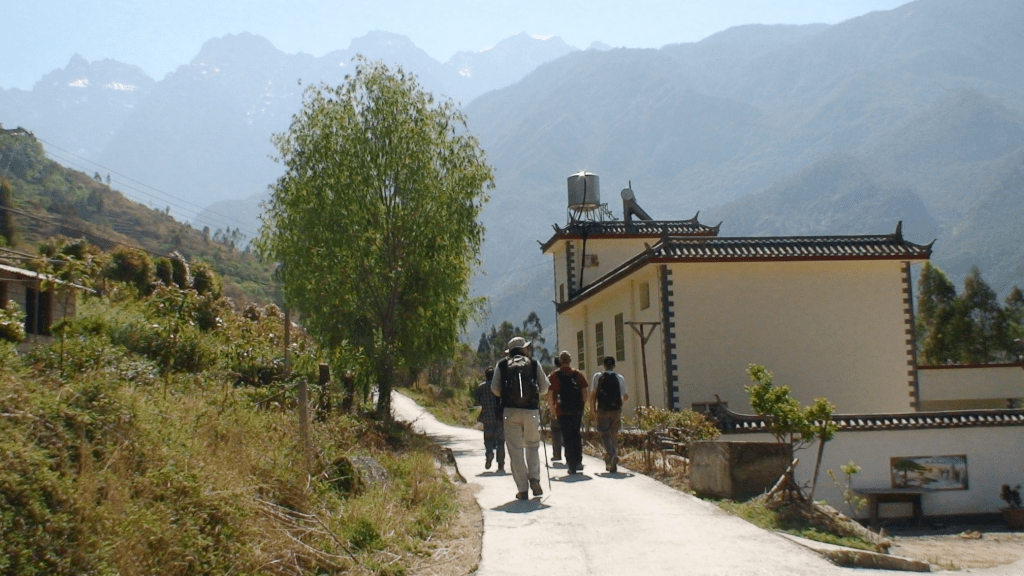
On Sunday, 13th April, 2014 we left at 7.30am on the three hour trip to Tiger Leaping Gorge.  This was at times a harrowing experience but we finally arrived at Qiaotou and armed only with backpacks and bamboo walking sticks set off on the trail.  

Leaving Qiaotou

The first part of the walk was easy and pleasant as it was not too hot and the track rose gradually. We admired the river below and the snow speckled mountains above until we reached the Naxi Family Guest House where we had a long lunch.  

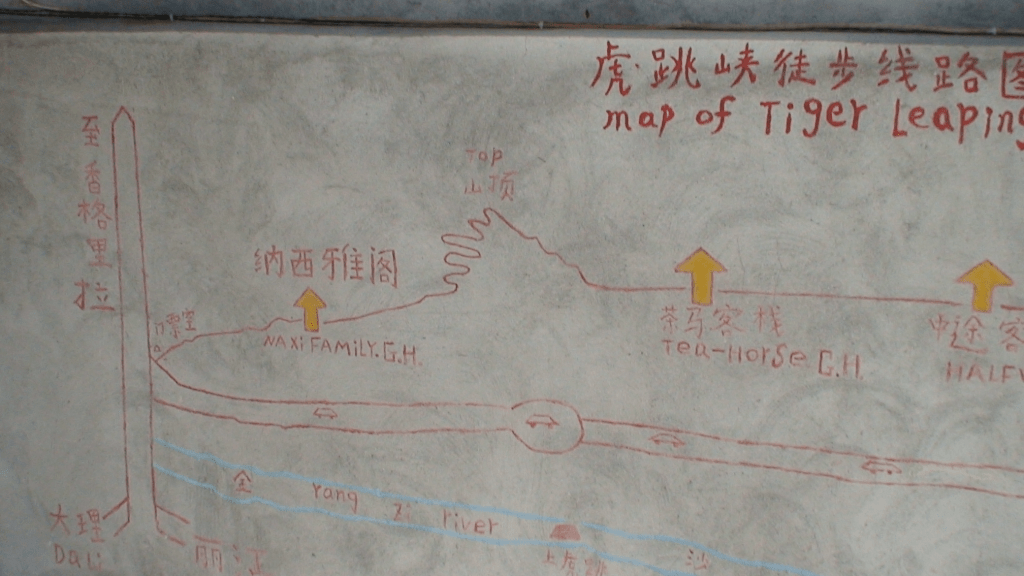
Map at the Naxi Guest House. See the 28 bends?

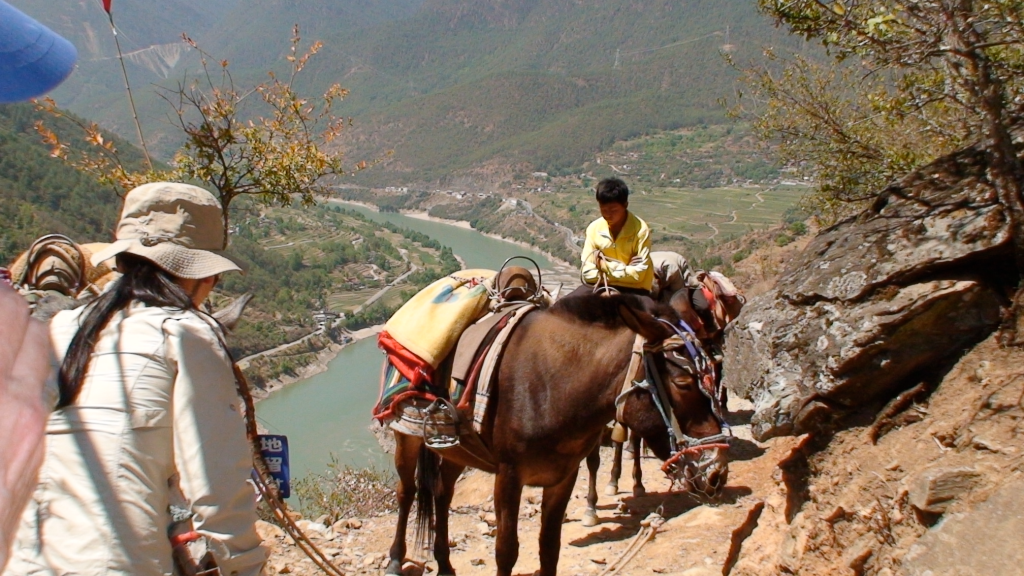
The plan was to rest before tackling the notorious 28 bends in the late afternoon, but the tactic did not work.  I found I was becoming more and more exhausted and had to rest frequently.  There was no shade and sitting on a hot rock was not very pleasant.  All the while the mules tinkled behind us and their owners eyed us hopefully, waiting for a sign of weakness.  When I felt dizzy from hyperventilating I decided a mule was the only way to go.  As if waiting for someone else to crack, three others also paid the 200 yuan ($40) for a mule. 

I give in

The ride was actually quite enjoyable.  It was such a relief not to be climbing any more and my mule and I became very good friends.  He was very sure-footed and I had complete faith that he would not topple off the narrow track.  I had visions of riding into Tea Horse Inn on my steed but just short of the highest point of the track I had to dismount and continue on foot for an hour.  From then on it was easy walking and we were met on the track by the four who were unable to do the walk.  Of the eight who walked today, four did the whole trip under their own steam, without the help of mules – the youngest, aged 23 and the oldest aged 77.

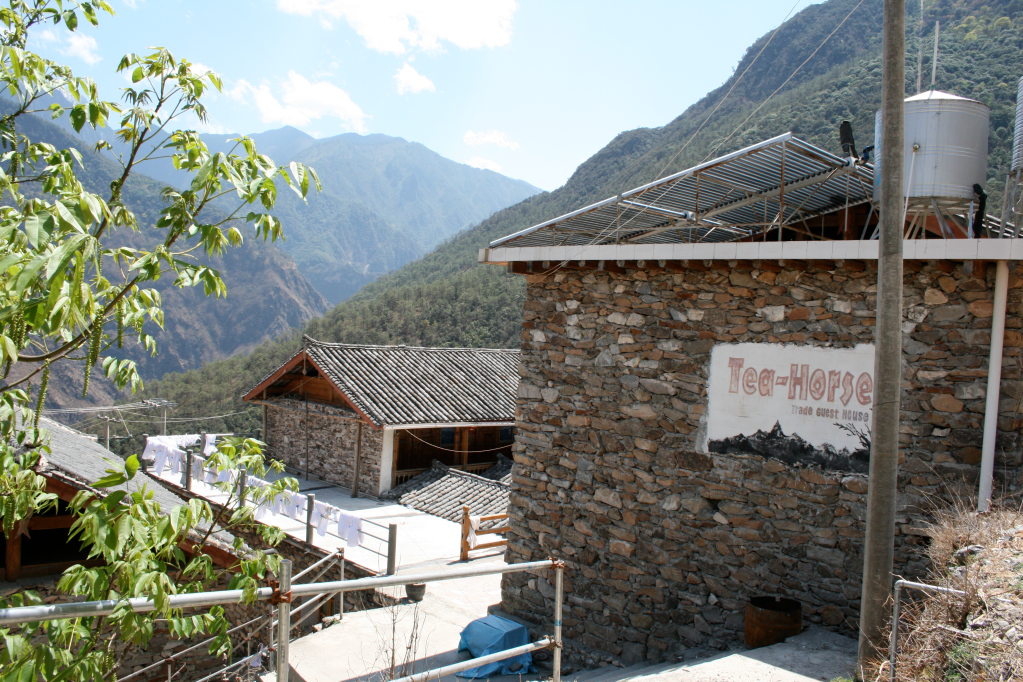
Glad to make it to Tea Horse Inn

Tea Horse Inn was picturesque and the beds were comfortable. The showers were hot and there were pedestal toilets in the bathroom, something we did not have in Shaxi.  Those who were too sick to walk had been entertained by watching the instalment of a new kitchen and dining room which we got to experience that evening.   With our diet of rice, vegetables, little meat, no alcohol and plenty of exercise I felt like I was in a health resort.  There was beer but I went off it after Dali.

 Watching the sun move across the peaks of the mountains next morning was spoiled only by the fact that some were still too sick to do anything but travel by vehicle to the next night’s accommodation.  We found the walk much easier on day two and enjoyed the magnificent scenery.  We came across a waterfall of cloudy white water beside what looked like a primitive factory and found it was part of a tungsten mine.  In fact there was only one unpolluted waterfall in Tiger Leaping Gorge and that was used as the water supply for the area.  Plastic and metal pipes followed the track, detracting from the natural scenery for much of the walk but we were glad to make use of them at the end.  Somehow we forgot to eat lunch as no one was hungry when we rested at the Half Way Guest House.  We got to visit the famous toilets with the best view in the world.  The whole back of the cubicle was open to the sky and the mountains.                           

On the roof of the Half Way Guest House

The only steep part of the track caused problems for a Canadian trekker in our group who fainted and fell, cutting her head.  The guide and the woman’s husband helped her down and fortunately she made a good recovery that evening.  It was very stressful for Jane (our tour leader) as she was keeping an eye on us in front and also the injured member behind.  The descent to Tina’s was gravelly and one slip could be disastrous.  We had a walk across the bridge, looked below at some ant like people on the rock and returned to sit in the dining room eating freshly roasted peanuts and drinking coke. 

Tina’s Guest House

 We left Tiger Leaping Gorge the next morning at 9.30 am, following the river in our bus which had driven the three hours from Lijiang to get us.  It was difficult to squeeze through in parts because of rockfalls.  

Is this where the tiger leapt?

Some of our group planned to visit the hospital  as soon as we arrived at our Naxi style hotel.  I accompanied Jane and two group members who had been sick for an extended period of time, walking through the old town and into the new town for medical help in the form of antiemetic drugs.  

Lijiang had an earthquake in 1996 which killed 300 people, including many schoolchildren when the roof collapsed in a school.  Many of the town’s buildings date from that time. The old town was carefully reconstructed with UNESCO funding and is a maze of cobbled streets and wooden buildings. 

Lijiang Old Town from a hilltop

Fortunately most people in the group recovered in the next few days but for the rest of the trip no-one was willing to admit they had a birthday and risk being presented with a microbiologically suspect cream cake.

S for Sandakan

The name Sandakan has a wonderfully exotic sound.  When our travel agent gave us someone else’s  itinerary which included Sabah, now part of Malaysia, on the traditional island of Borneo, we couldn’t wait to make it ours. Things didn’t quite work out as planned which made me decide to be my own travel agent in future but I have to tell you about the Gomantong  Edible Birds’ Nest Cave, the Sukau River Lodge, the trip up the Kinabatangan River watching for proboscis monkeys and orangutans, the Sepolik Orangutan Centre with the orphaned orangutans, the English Tea House high on a hill in Sandakan, the Memorial Park to the soldiers of the Sandakan  Death March and the Agnes Keith saga of “Land Below the Wind”. 

Are you ready?

 Wednesday, 22nd July, 2009 Kota Kinabalu, Sabah

 We were awake before alarms started going off around 4.30am.  By 5.30 we were anxiously looking for our pick-up vehicle.  5.45am and we were very anxious.  We gave up and took a taxi. The 45 minute flight itself was interesting, over mountains and rivers.  We were astonished at the extensive plantations of oil palm trees (Elaeis guineensis) which had replaced the traditional rainforest. When I say extensive you’ve got to believe it.

At Sandakan Airport we were met by M who was very well spoken but looked seriously unfit.  He seemed to have difficulty moving and the sweat poured off him in the intense heat.  First stop was the Sepolik Orangutan Centre where we were to transfer to our minibus.  M did not inspire us with confidence as he disappeared, leaving us alone in front of a small café.  Close to us a charismatic guide was surrounded by adoring tourists pressing notes into his hands and farewelling him with genuine remorse.  However, our fate was to be with M who waved us in the direction of the minivan and explained there would be two vans travelling together as there were eleven of us in the group.  The other bus left but ours would not start.  After a while John and any other male around who thought he knew about cars had a go at starting it.  The key went in the ignition but would not turn.  About half an hour later the driver finally realised he was using the wrong key.  Finally on our way we encountered our next problem in the small town of Kota Kinabatangan. M indicated that we could stop for a coffee break but we found the real reason for the interruption soon enough.  One of the passengers on the other van had come to realise that he was travelling inland and not to the jetty where the boat left for Turtle Island.  This was especially galling for us as we had wanted Turtle Island in out itinerary but the travel agent had “stuffed up”.  Oh well!  The other passengers had to wait an hour on the side of the road in a hot minivan while a taxi came for the errant tourist.  At least we had cold tea and iceblocks to while away the time.

Finally on our way we turned off to the Gomantong Caves where swiflets construct edible nests from a glutinous secretion, produced from salivary glands under the tongue.  The Cave Swiflets that live here in the thousands make two types of nest, commonly referred to as white nests and black nests.  Both are edible and they are used to make the Chinese delicacy birds nest soup.

Gomantong Caves

A slippery wooden walkway followed the inside edge of the cave.  Above us were the valuable birds’ nests and a few swifts darting around.  The bats were mainly sleeping so were few in number.  Below and inside the walkway was guano (the excrement of birds and bats).  A handrail divided the walkway from the stinking mess below but I grabbed it only to let go in horror as it was covered not only in guano but cockroaches, dead and alive.  Where there were missing wooden slats on the walkway I was forced to grab the handrail again, gingerly, with the tips of my fingers.  I noticed M had stayed outside.  On our way around the cave we found one tiny bat on a rock and a baby swiftlet that had fallen from a nest.  We were all pleased to see the sunlight again and voted unanimously on the bus afterwards that the climbing of slippery rope ladders in those smelly caves to gather  birds’ nests, would be one of the worst ten jobs in the world.

Here is a newspaper extract concerning the current value of birds’ nests. (2009)

By Niluksi Koswanage and James Pomfret

SABAH, Malaysia (Reuters Life!)

The nests are woven by the saliva of the Asian male swift, and when prices went as high as $2,500 a kg (2 lbs) last year, teams would work round-the-clock to prise them off the walls of the 25-storey high Goamantong cave in eastern Sabah state.

Now, as the global economic recession reduces the appetite for luxury items in China and beyond, Asri and other harvesters spend most of their time outside the cave, smoking and keeping an eye out for thieves eager to make off with the nests despite the drop in market prices and demand.

“We are stuck. There are many birds’ nests to collect but we have been told by our bosses to take less because prices are falling and people from China are losing interest,” Asri said.

Consumers in China and Taiwan prize swifts’ nests as a health tonic, aphrodisiac and status symbol, earning the delicacy its “caviar of the east” nickname. Goamantong nests are among the most exquisite in the world as there are less impurities like feathers and grit, traders say.

So the other job we considered on a par with the nest gatherer was the job of nest guard, high up inside the cave on a platform, in the dark, with the smells and the insects, bats and bird droppings.

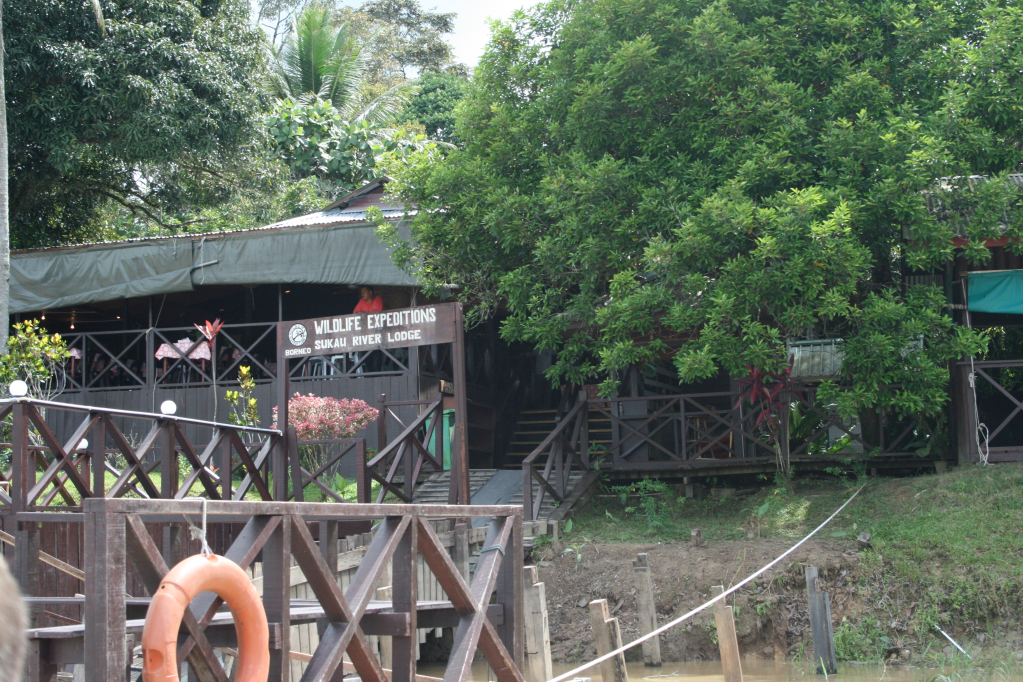
Wildlife Adventure Tours Lodge

A short walk along a jungle track brought us back to the minivan.  In less than an hour we had reached the wide, brown Kinabatangan River.  Here we boarded a launch and crossed the river to the Wildlife Adventure Tour’s own lodge.  At first sight it looked run-down and ramshackle but we were immediately served a lunch of rice, chicken, fish and vegetables.  I especially liked the stir-fried eggplant and jackfruit.  Our rooms were quaint little dark green lodges on stilts which looked authentically Malay.  Although spartan they contained necessities such as an air conditioner and a shower.  There were twin beds, each with a mosquito net over it.  The windows also had screens but it was comforting to have double protection.  Showered and refreshed we walked back to the jetty for our river trip in search of monkeys and other wildlife. 

Proboscis monkey

This is where the best memories and the worst experiences blur together.  I became so hot I nearly passed out as there was no cover over the boat.  Only when the sun slipped behind the trees could I enjoy the scenery around me.  We spotted numerous macaques, proboscis monkeys, a striped snake and at the very end of the cruise, a pair of orangutans. They looked like kings of the jungle as they balanced easily on branches at the tops of the tallest trees.

Looking for wildlife on the Kinabatangan river

 Back at the lodge we showered again before dinner.  There was freshly made fried rice and some tasty barbecued meat.  John bought us each a can of beer which we consumed while chatting to some of the other people on other tours. The proposed slide shows and insect walks did not eventuate, and although annoyed that M couldn’t be bothered, we weren’t sorry to retire to our stilt house and sleep under our mosquito nets.

Macaque monkey

 Thursday, 23rd July, 2009, Sukau River Lodge

 The alarm woke me in the middle of a dream but on the whole I slept well.  M had promised to be there in the morning to hand us over to our new guide as he was staying another day so I decided to give him a few RM in appreciation for his efforts.  However he wasn’t there so he missed out.

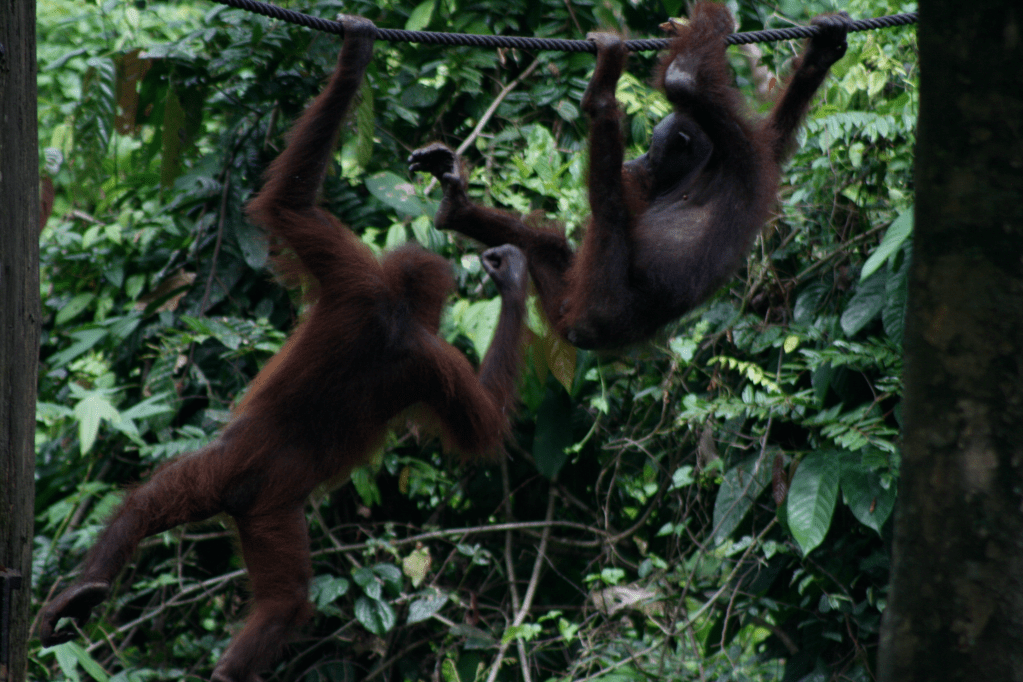
 We were quite happy to leave, said goodbye to our two Danish friends and had an uneventful journey to Sepolik Orangutan Park.   At the Sepolik Orangutan Centre there were hundreds of people, many tour guides and very little direction.  We were told by our guide to “wait here for Mr G” after which hundreds of people poured past us into a small theatre, all escorted by their efficient and capable guides.  Where was Mr G?  Finally we saw our former guide and asked after our new escort.  Mr G had been lounging around having a cigarette and enjoying himself, unaware, or so it seemed, of our existence. The two guides argued over whether we should see the film now or after the orangutan feeding.  Mr G lost so we squashed in on top of the other 250 people in the theatre to hear the end of an explanation of what the Orangutan Centre was all about.  The film was very informative, explaining how people try to raise orphan orangutans in their homes.  The orangutans become too big and too strong to handle and the owners don’t know what to do with them.  The orangutan centre prepares them to re-enter the wild.  At the feeding table we saw about five orangutans.  We stood on a seat at the back and watched over the heads of the other two to three hundred people.

Orangutans at the Centre

 Back on the bus we arrived at the Sandakan Hotel.  It is about a three star standard but is in a very good central position.  We had a brief rest before organising a taxi to take us to the Death March Memorial.  It cost RM60 return, with the taxi driver waiting for us, having a siesta under the trees.  As he said, “How else would you get back to the hotel?”

THIS MEMORIAL MARKS THE SITE OF A PRISON CAMP OF SURVIVORS OF THE FIRST DEATH MARCH FROM SANDAKAN TO RANAU FROM JANUARY TO APRIL 1945.

OF THE 2,000 AUSTRALIAN SOLDIERS OF THE 2ND A.I.F. AND 750 BRITISH SOLDIERS OF THE BRITISH ARMY WHO LEFT SANDAKAN ONLY 6 AUSTRALIAN SOLDIERS SURVIVED.

ON THIS ACTUAL SPOT VX52128 GUNNER ALBERT NEIL CLEARY 2/15TH FIELD REGIMENT, ROYAL AUSTRALIAN ARTILLERY WAS CHAINED TO A STAKE AND BEATEN AND STARVED FOR 11 DAYS UNTIL HE FINALLY DIED ON 20 MARCH 1945. AGED 22 YEARS.

THIS MEMORIAL ALSO COMMEMORATES THE COURAGE AND BRAVERY OF THE LOCAL PEOPLE OF SABAH, WHO SO GALLANTLY ASSISTED THE PRISONERS-OF-WAR AGAINST OVERWHELMING ODDS.

Sandakan Prison Camp

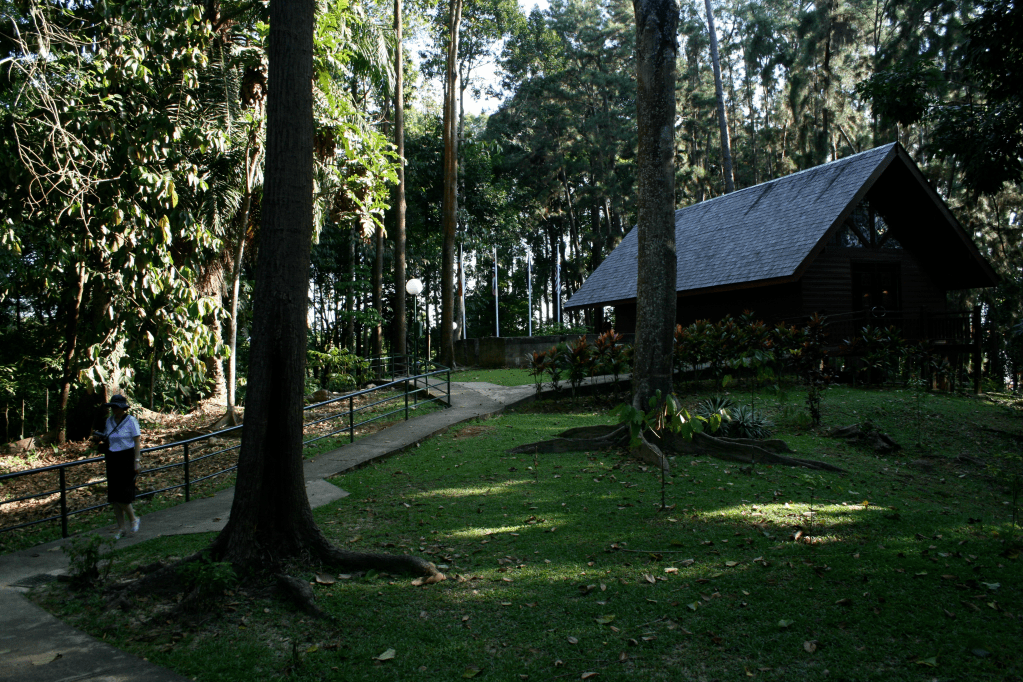
I could write a hundred pages or more about the Prison Camp but will leave it until U for Understanding Sandakan.  It was a very peaceful place with trees and lakes and birds.  It was hard to imagine what took place here on this spot 64 years ago.  The remains of some of the machinery, water tanks and pipes of the prison camp were scattered around the park and a chapel-like building with a scale model of the camp as it was stood at the crest of a hill.

On the way back we asked the taxi driver if the Agnes Keith House would be open.  We had read it was near the English Tea House so when he said “Yes, you want English Tea House?” we decided to take a risk at getting home afterwards and go there.  The Agnes Keith House was closed but we decided we needed cheering up after the Death March Memorial and headed off for an English tea.  Our table was overlooking the sea but because I indicated I liked the gazebo it was immediately cleared and made ready for us.  John was chatting to some people on the croquet lawn when he discovered I’d moved.  We enjoyed our coffee with scones and cream so much that we decided to come back for dinner. 

An English tea with coffee

Instead of getting a taxi back we walked the “hundred steps” to the bottom.  The road and steps were covered in moss with gaps and holes in numerous places so we thought it might be dangerous in the dark.  That night we went  back up in a taxi but we walked down the main road to come back to the hotel which didn’t take very long.

 Dinner in our gazebo was very pleasant overlooking the Sulu Sea in a perfect temperature.  We shared a papaya and scallop entrée, had red bream with rice and snow peas for mains and bread and butter pudding (me) and mango pie(John).

The gazebo

 The music was from the war years and the atmosphere was magical.  It was a truly memorable evening.

Friday, 24th July, 2009, Sandakan, Sabah

After breakfast, we walked up the hundred steps to the Agnes Keith House.  This is how Lonely Planet describes it.

This atmospheric two-storey colonial villa, Newlands, tells the story of American writer Agnes Keith and her British husband Harry, the Conservator of Forests in North Borneo. They lived in Sandakan from 1934 to 1952 and spent three years in Japanese internment camps during WWII.

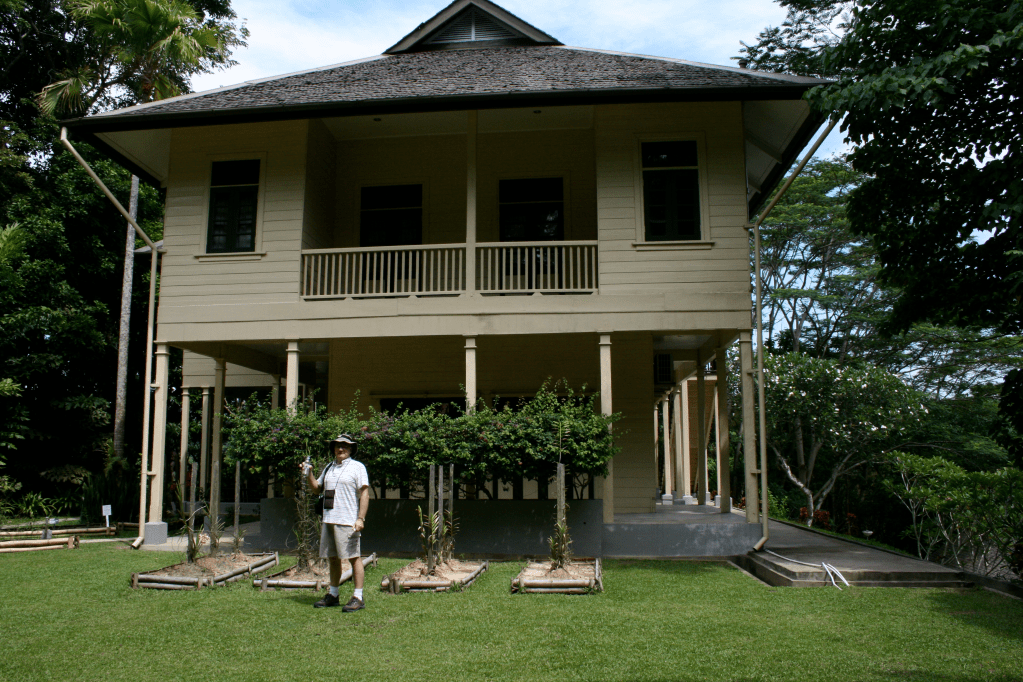
As the day had not become too hot (it was only about 28 degrees Celsius) the walk was quite pleasant.  We fell in love with the house as soon as we entered.  The ground floor has high ceilings and polished floors.  It consists of two large rooms with a broad staircase in the middle.  I noted there was a dining room with a refrigerator and a lounge room.  The absence of a kitchen was explained by a room across a breezeway where the cooking would have been performed by the servants. 

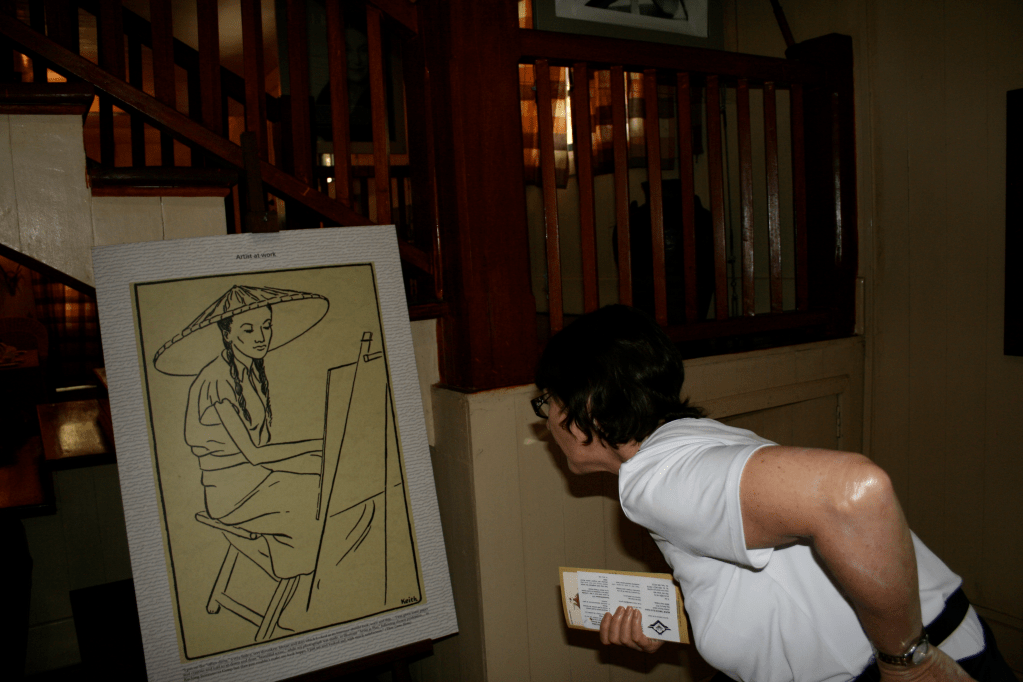
Agnes was a good artist

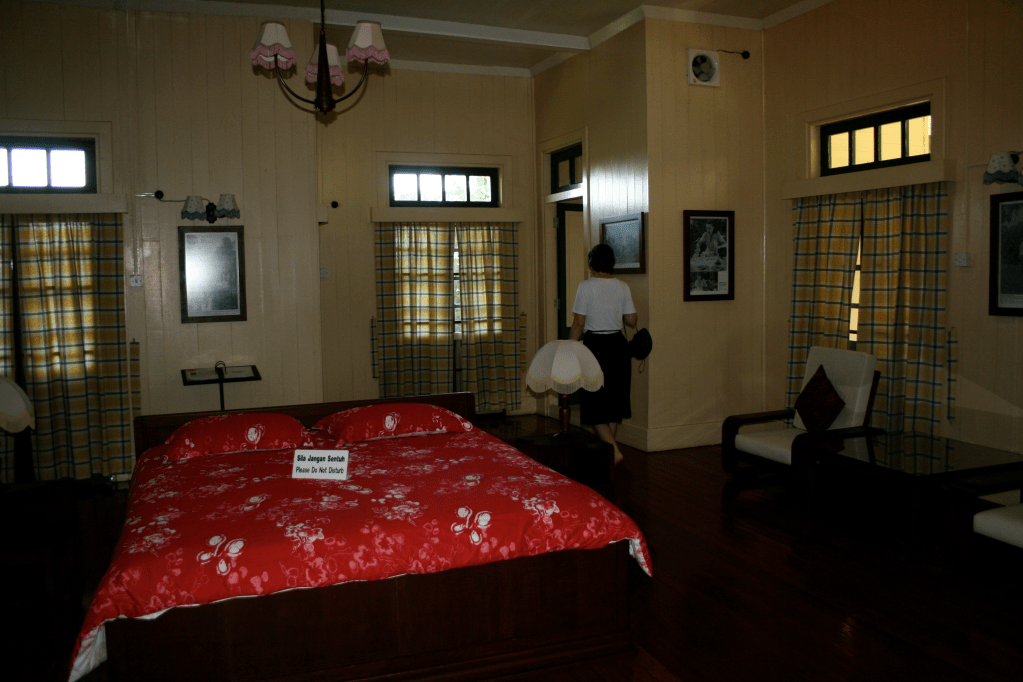
Upstairs were two huge bedrooms and a study. Each bedroom had a spacious ensuite off one end.  In the master bedroom the queen sized bed was in the centre of the room “to catch the breezes” with all the other furniture against the walls. 

Bed in middle of room for coolness

We read about the life of Agnes, her husband Harry and their son and daughter.  I intend to buy or borrow her books – “Beneath the Wind, Three Come Home and White Man Returns”.  They are about pre-war Sandakan, being captured by the Japanese and returning after the war.

The Agnes Keith House

Reading the books afterwards I learnt how Agnes, Harry and their son were imprisoned during the war but survived.  Coming back to their home they found it burnt to the ground. It was rebuilt as an almost exact replica of their former home.  However, Borneo after the war would never be the same and when “White Man Returns” they find their days in Sandakan are numbered.

R for Reading and Recording

When I retired I relished being able to read a book when I felt like it, without the pressure of work obligations keeping me from one of my favourite activities.

For several years I hoped to find a Book Club and eventually rang the local library to see what they suggested.  They gave me the name of a group who met once a month on a Tuesday at 5.30 pm.  The leader was a librarian who worked there but the meetings were held at the Golf Club. I spoke to Ruth, the leader, on the phone, and she told me the next book was Inhaling the Mahatma by Christopher Kremmer and the meeting would be on the 19th January, 2010.

I found the book hard going but completed it by the day of the meeting.  I was a bit apprehensive about the intellectual rigour of the group but I needn’t have worried.

There were seven or eight all together.  Most people didn’t like the book as a whole, although some liked part of it.  Two had only read two chapters, one had returned it to the library unfinished, two hadn’t read any of it and the leader had almost finished it.     

It was one of those Book Clubs where you turned up whether you had read the book or not.  It was as much about socialising as an in-depth book study. I felt at ease with this group although I was determined to read every book nominated before the meeting.

Thirteen years have passed and still our group consists of the same people plus or minus one or two. When the librarian, Ruth, retired from the library, we all wondered briefly what would become of us.  Ruth decided to just keep on as before, so we still meet every month in the same place to discuss a book, sometimes briefly, sometimes in great depth.  Now we have a FB group so we can communicate with members more easily.  We have tried other venues but keep returning to the Golf Club where we can usually find a quiet corner and we can enjoy the spectacular view out to sea.  Towards the end of every year we all contribute one or two suggestions to make up a list for the following year.  The icing on the cake is not having to cook a meal because we all order at the club restaurant after the meeting.

How I read books has changed a lot in the last seventeen years.  By this I mean it used to be either library books or books I bought from local bookstores.  Now it is mainly library books read on my iPad, downloaded from Borrowbox.  Sometimes I will buy and download a book from iBooks or Kindle. Christmas and birthdays are the main times I buy books unless it is something unavailable in other formats. I love reading on my iPad because I can eat at the same time!

Some books borrowed on Borrowbox

I also belong to another Book Club associated with our Aqua jogging group.  It meets up infrequently and only once since Covid restrictions ended. I wasn’t adequately prepared for the last one as I had read Lessons in Chemistry by Bonnie Garmus six months before. Alas I had even forgotten some of the characters and felt unable to contribute anything sensible.  Everyone else had read the book and seemed to know it inside out. I’ll be better prepared next time.

As well as Reading my other R is for Recording.  Every major holiday I used to take my Sony HandyCam with me and record every interesting and fascinating moment.  I would then relive my holiday by playing it back on my computer and using the software iMovie, to edit, add music, transitions and titles.

This would then be burnt onto a DVD and an appropriate picture would be printed on the white blank of the disk as well as the jewel case cover.  Friends and family would then be subjected to this modern take on a slide night which would see most of them falling asleep.  To prevent this happening I then made ten minute DVDs with the edited highlights.

Holidays captured on DVD

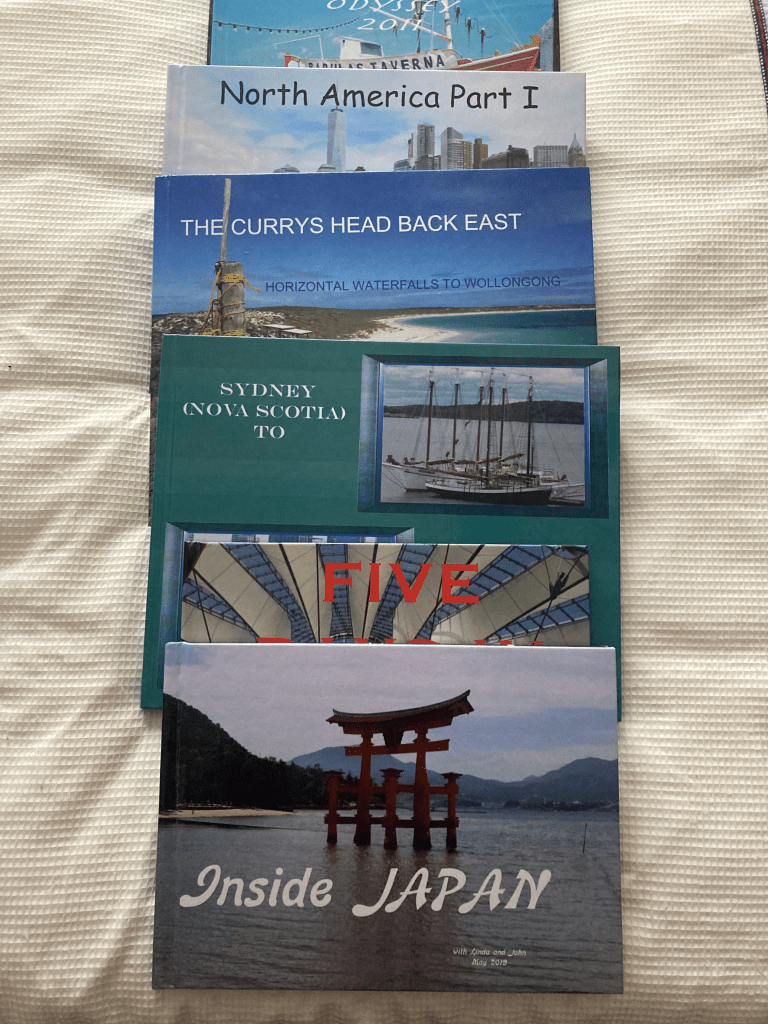
Possibly everyone heaved a sigh of relief when I found technology changing around me, rendering my video camera obsolete and my beloved iMovie 6 replaced by a newer version I didn’t like. Some of my aqua and book club friends were showing off their newly made photo books.  All you have to do is download the software from Photobookclub, insert your favourite photos and get it made up into a beautifully bound photo book.  The quality is not quite as good as a printed photo but it is fun to play around with different backgrounds, borders and arrangements. An added bonus is a guest can flick through it in ten seconds and is not held captive by a lengthy video.

Holidays captured in Photo Books

I even made a photo book based on my 1918  “A for Ancestry” but named it “The A to Z of my DNA”.

An A to Z in a Photo Book

Printing six copies I was able to keep one, give one to each of my children and three to new DNA relatives.  Even though it is nearly 50% text it still came up well as a photobook.

Inside the A to Z of my DNA

Putting together photos of the first five years of my grandson’s life I made another simple story/photo book which he still loves to read.  He keeps asking for me to make one of the next five years but that is a project still on the back burner.

When I was small my father would tell me stories of “Step and Tear”.  They were two orphans who had all sorts of dreadful experiences but things turned out well for them in the end.  I started telling these stories to my grandchildren but had to make up many new adventures as I honestly couldn’t remember much.  Now I have all these stories on my computer and am looking for a way to make them into a self-published book for the children before they get too old. That is my next project after the A to Z is over.

Think how much photography has changed in the last 17 years!  From having rolls of film printed and waiting a week for the finished result we now have instant access to our photos which as a result have multiplied exponentially. On the computer are slides converted to digital, photos in older software, scans of printed photos, photos not yet put in folders.  Finding photos for this and other A to Zs had been time consuming because they are all over the place. That is another job for the future, organising all the photos into one place on my computer.

Don’t get me started on all those printed photos in boxes, and the ones in photo albums.  I really should go through them and discard at least 50%. 

I just have to get in the mood.

Q for Quarantine Station

You might ask what Q Station stands for?  It is short for Quarantine Station but is not where people were isolated with Covid.  Instead it is a comfortable, quirky and different type of accommodation in a stunning setting on North Head, Sydney Harbour.

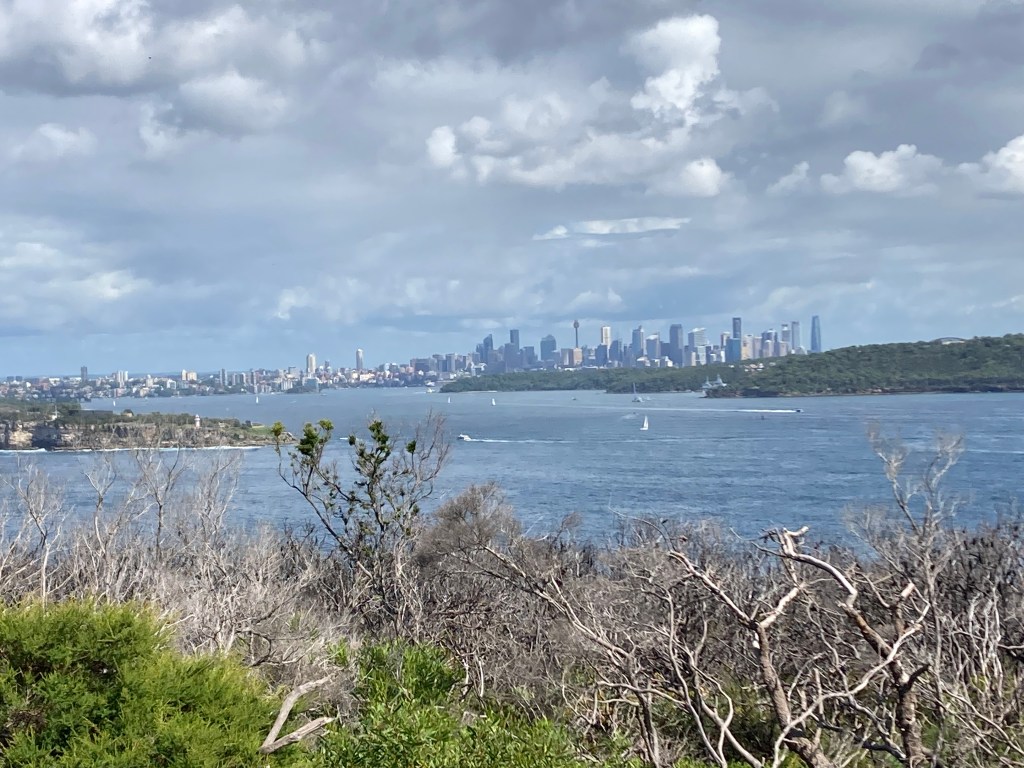
We decided to give ourselves one night there for our birthdays which are not too far apart.  To get there we caught a train to Sydney, changed at Central for Circular Quay, then took a ferry to Manly and a bus to the Q Station.  The bus driver insisted we stay on the bus so he could drive us up to the lookout to see what he thought was the best view in Sydney.  He even stopped to let me off for a quick photo before dropping us back at the Q Station.

View of Sydney from North Head

We arrived two hours before check-in, thinking we could leave our small bags somewhere and have lunch in the café at the beach.  Reception rang the room and it was ready so we hopped on a minibus and were driven down a steep hill to our accommodation.  It wasn’t luxurious but it was clean, had an ensuite and a verandah with two chairs and a table.  

Entry to our room

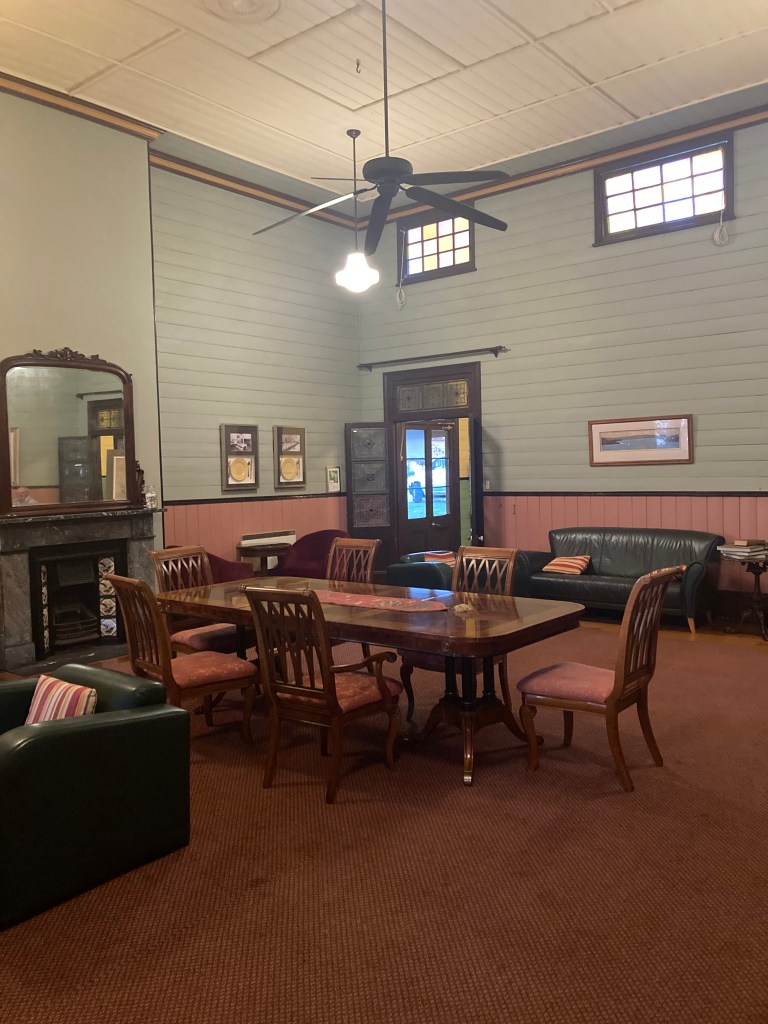
Our view was of the buildings opposite, but some exploration brought us to the First Class dining room next door which opened onto a deck overlooking the water.  It is no longer a dining room but where we were staying was for the First Class passengers arriving by ship years ago. We decided to keep that spot in mind for a pre-dinner drink later in the evening.

The First Class Dining Room

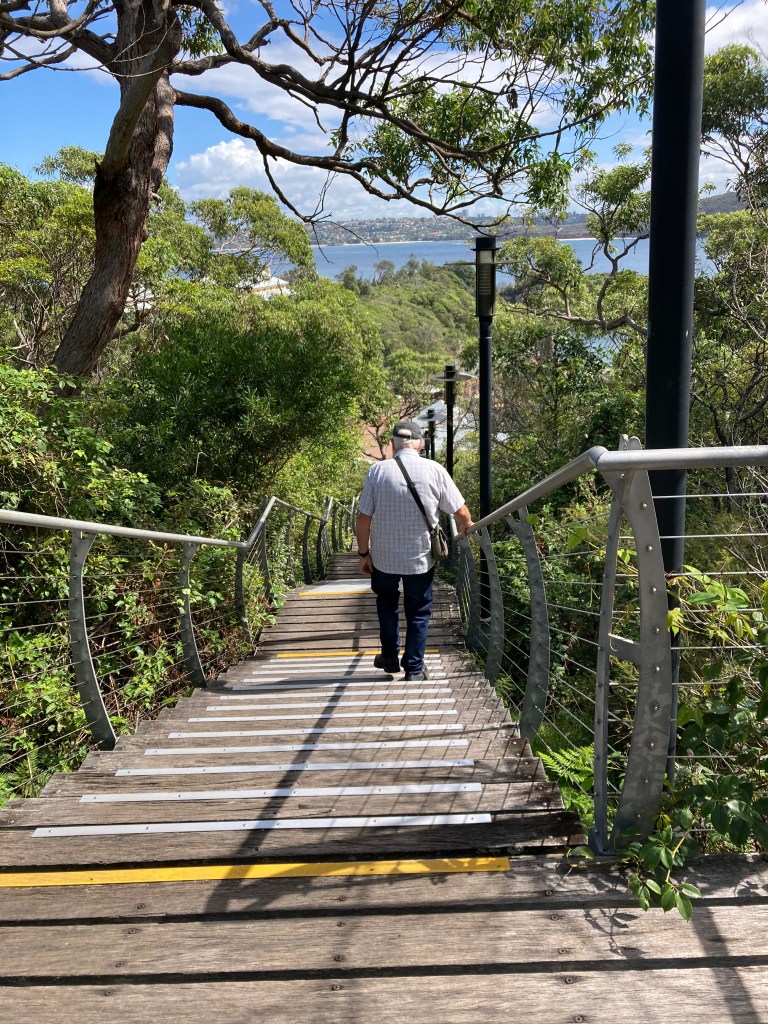
There used to be a funicular railway to the beach but that has been removed and instead we walked down 230 steps.  We could have called for the minibus to take us but decided we needed the exercise.  Next to the café is a small museum which tells the story of the Quarantine Station.  We ate bagels filled with ham and pickles and watched school children on an excursion, glad that we were not the teachers.

A long way down

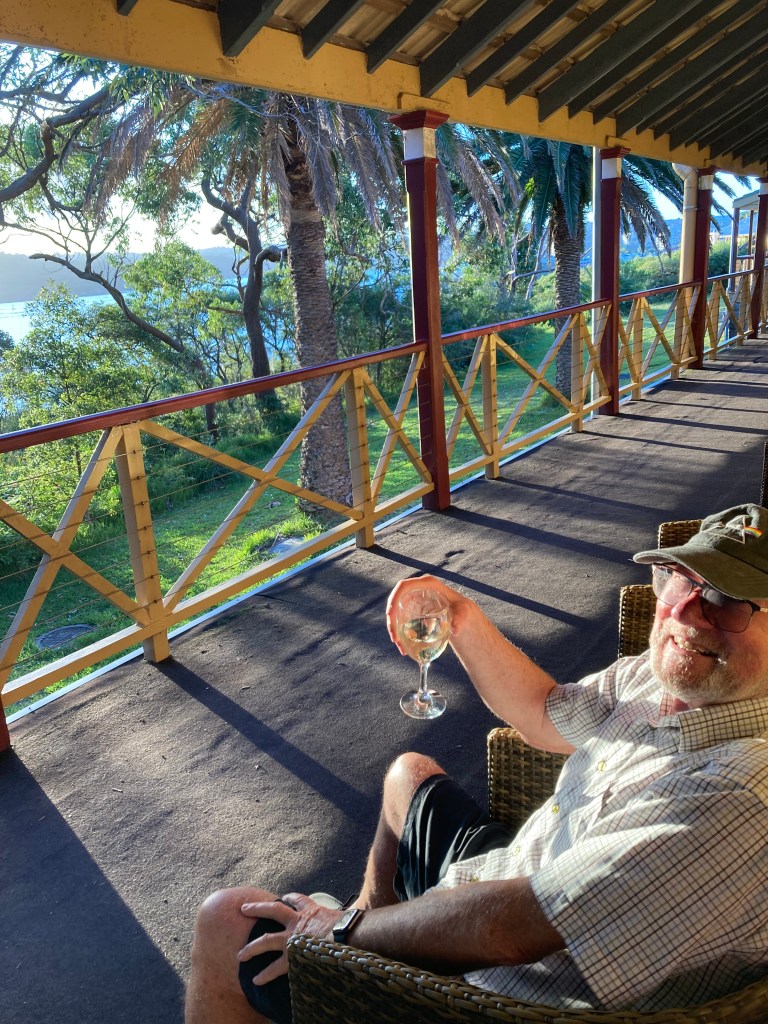
After exploring the museum we walked back up the 230 steps and spent the afternoon poking around the extensive buildings spread across the hillside.  A brief rest in our room was followed by a shower and a glass of white wine on the First Class Dining Room verandah.  We thought we were observing a dramatic life and death rescue by helicopter out on the water but fortunately it turned out to be a drill.

Drinks outside the First Class Dining Room

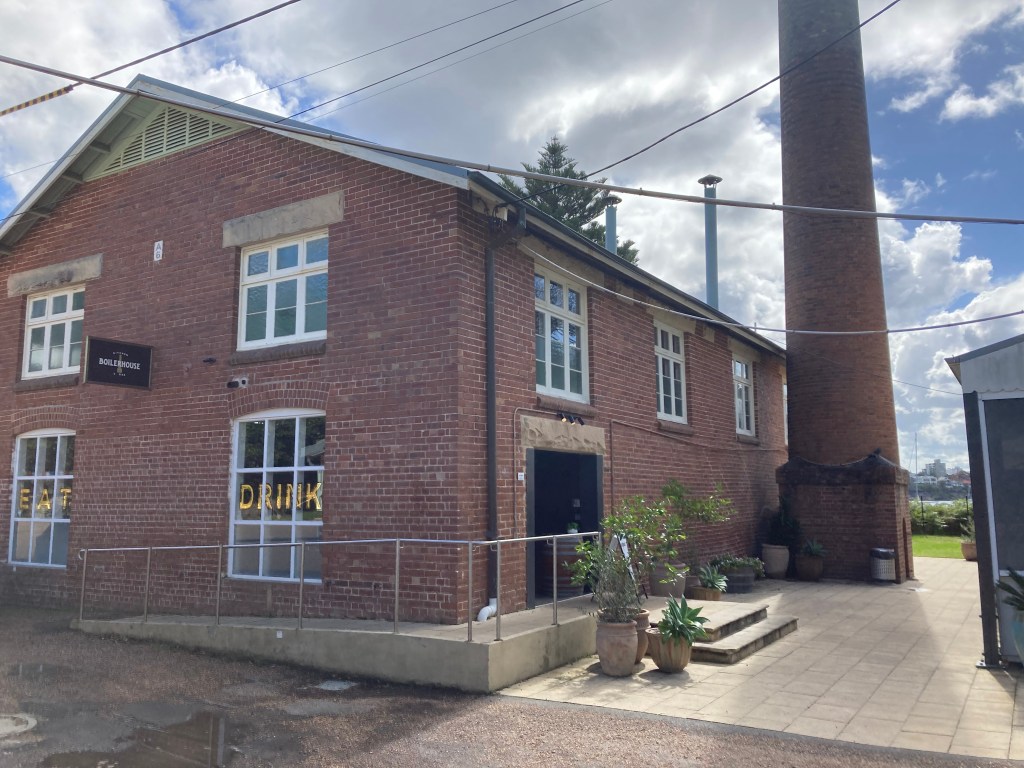
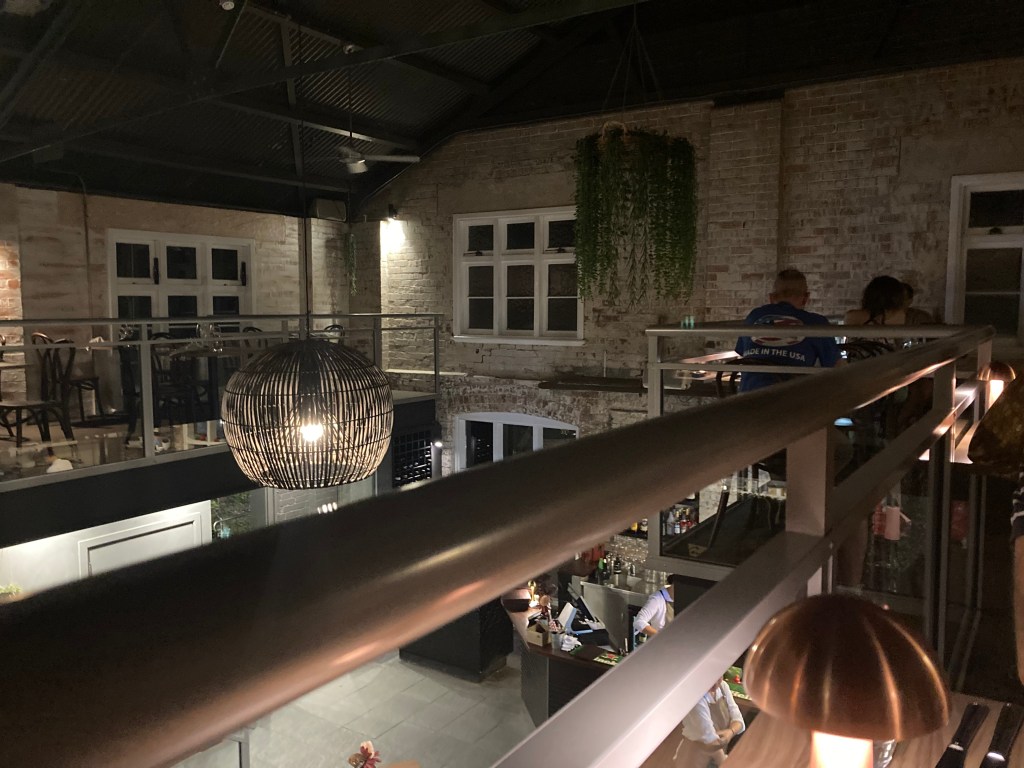
It was time to walk back down the 230 steps for dinner at the Boiler House. There were corporate groups outside under pavilions but we were escorted up more steps to a mezzanine level built inside the old building.

The Boiler House by day

Our two-course meal with a glass of wine was excellent and was followed by a stroll around the jetty and beach before climbing the 230 steps to our room.  It was time to do some research on the history of the Q Station.

Dining room in the Boiler House

In 1836 the immigrant ship Lady Macnaghton left Cork, Ireland.  Of the 444 passengers on board, 56 had died from typhus and scarlett fever by the time it reached Sydney.  The sick were left on board and the rest were housed in tents on the site of the Quarantine Station at North Head for two months. Seventeen more people died on shore owing to the exposed living conditions, lack of warm clothing and unpredictable weather.  An inquiry was held into conditions on emigrant ships which resulted in considerable improvements and stricter rules.  It was also the catalyst for the establishment of permanent buildings for the purpose of quarantine.

Quarantine Beach. The hospital is on the hill.

From the 1830s until 1984, migrant ships arriving in Sydney with suspected contagious disease stopped inside North Head and offloaded passengers and crew to protect the residents of Sydney.

Quarters for First Class passengers

As Australia’s longest continuously operating quarantine station, it has changed considerably over time.  The heritage buildings reflect the typecasting of people by gender, race and class. 

After its closure on 16th March 1984, ownership of the Quarantine Station was transferred from the Commonwealth to the State Government. The National Parks & Wildlife Service (NPWS) established guided tours and a conference and functions centre.

Largely owing to lack of funding many of the buildings fell into disrepair.

In 2006, Mawland Group signed a lease with NPWS and repaired and improved the facilities to their current standard. In 2022 the site above Quarantine Beach was sold to a successful northern beaches hotelier.

We studied the map and found a myriad of uses for the structures around us.

The shower block was the first stop for quarantine arrivals, where they were forced to strip for carbolic acid showers. This was to erase fleas and body lice which could host infectious diseases. What a traumatic introduction to Australia for would be residents!

Shower block

One building, which contains a single, windowless room, was used as a gas-inhalation chamber, under the misguided belief a good dose of zinc sulfate would kill a virus in the lungs.

Another building contains large-vaulted chambers that were used to fumigate passengers’ luggage on arrival with the aim of killing vermin.

Chamber to fumigate luggage

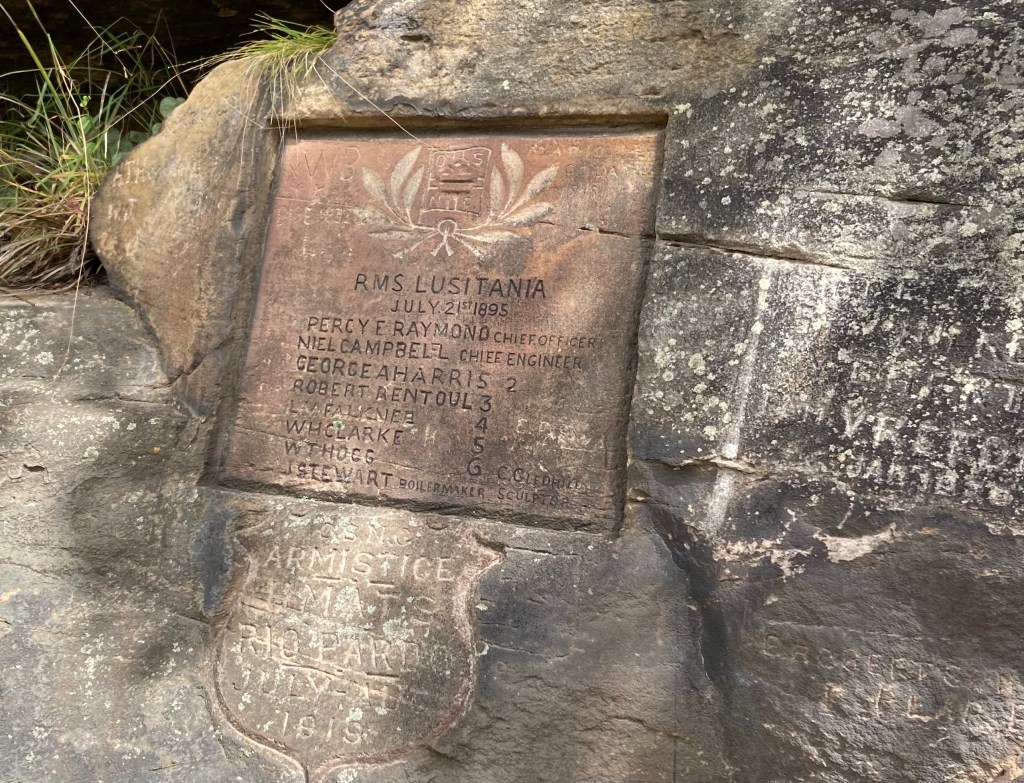
More than 800 carvings and inscriptions by inmates have been discovered around the property.  There is a large sandstone rock face that’s covered with painted, carved and scratched inscriptions from many of the 12,000 people incarcerated at the quarantine station during its time in operation.

Some are initials, others are drawings, and many describe the misery of life in quarantine, written in many languages. 

One inscription from 1917 by Xie Ping De from He County, China: 

Sky … Ocean,

I am very frightened of having the disease.

Moreover the doctor is helpless to control the sickness.

Feeling pessimistic and despondent.

I am not used to maintaining hygiene yet.

If you asked me the feeling about the voyage.

I shall persuade you never come here for pleasure.

Wish you good health and a long life.

(Translated from Chinese)

It wasn’t all misery for the detainees.  The Sydney Morning Herald in 1913 described some of the leisure pursuits that passengers had available to them.

Those who are merely detained as contacts have about 500 acres of ground to ramble over.  In good weather the days pass like a picnic.  There are retired paths and retreats and open well-grassed plots.  Cricket has been played and though the inclines are steep football has been attempted.  Fishing is open to all, and those who like swimming have opportunities in abundance.

The Migration Act of 1958 legalised the detention of “illegal immigrants”, a term referring to anyone without a valid visa. What was originally built as a staff dining room became a detention area for people awaiting deportation.  An inscription in this building (translated from Turkish) goes like this.

The Cruelty

Where did you come from Adam or Noah

My wrists! Where did you get this chain?

The cruel capitalists can exploit and kill

The poor people and enslave them

I’m not strong enough!

The cruel and the cruelty

My wrists! How did I get this chain?

In the final stages of the Vietnam war, the Quarantine Station provided refuge for children hastily evacuated from Vietnam as it fell. Many of the 200 children brought to Australia were cared for by staff there as they waited to meet their new adoptive families.

I wondered what happened at the Q Station during the Covid lockdowns. Apparently you could stay in a cottage (at a slightly reduced rate) for weeks at a time, with your groceries delivered, and live in complete isolation from the rest of the world, ensuring your safety and good health.  It wouldn’t be a bad spot to retreat from the world.

A quiet retreat from Covid

All photos by John and Linda Curry

P for Patter of Tiny Feet

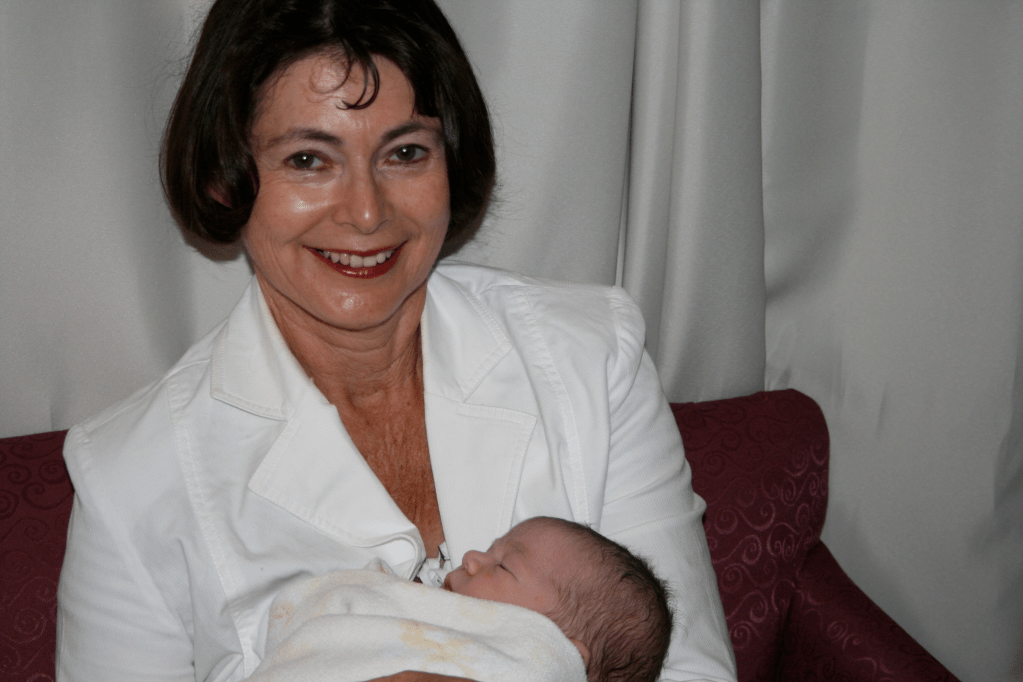
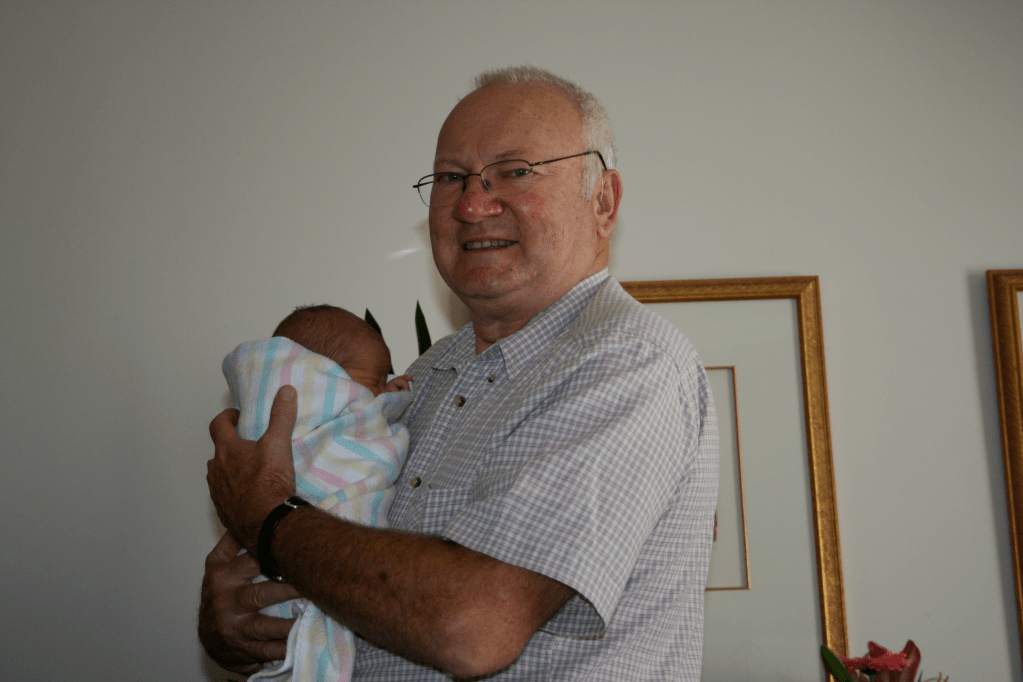
I am indeed fortunate to have two grandchildren. The first one arrived in 2010. We were at the hospital when she was born and I held her in my arms shortly after delivery.  What an exciting time! Not so much for her mother, left alone in recovery.

Grandchild number one

After twelve months my daughter went back to work.  We agreed to babysit one day a fortnight while the other grandparents did one day in the other week.  The rest of the time she went to a long day childcare centre.

Babysitting this one kept us busy

It was an early start for us, getting up in the dark, driving to Sydney to arrive by 7.30am so the parents could head off to work. Memories of my own children came back as we settled into the routine of bathing, changing, feeding, sleeping and going for walks.  We would drive back home around six o’clock at night and collapse exhausted from the effort.  How do parents do that every day?

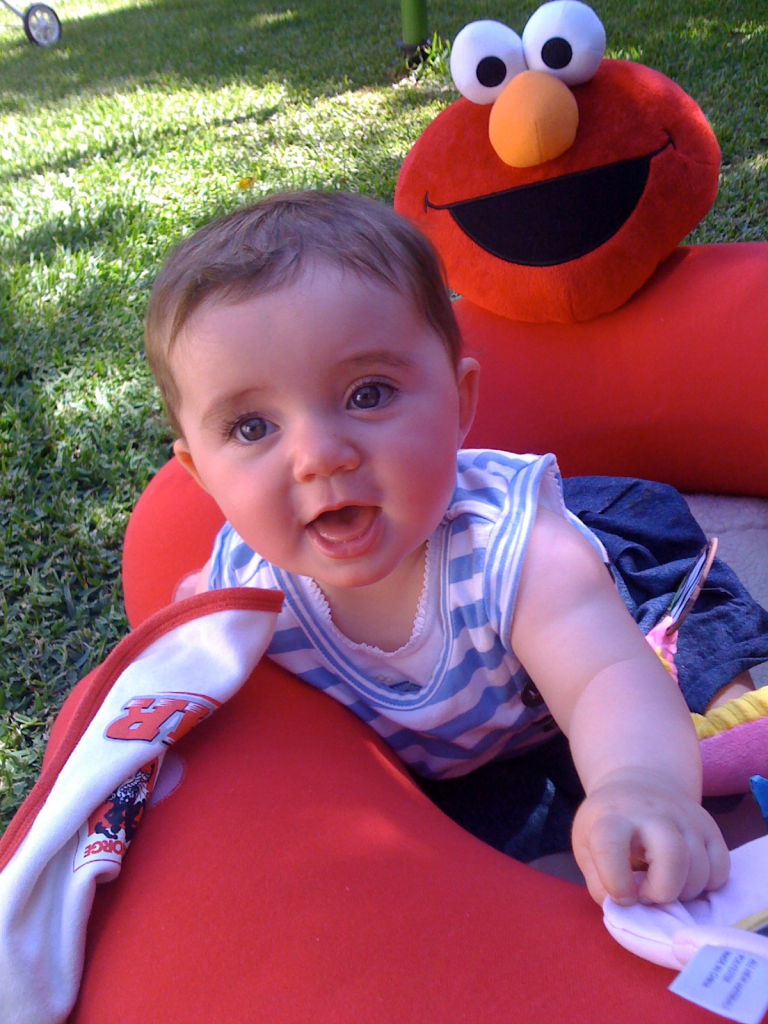
Two years after the birth of our granddaughter a baby boy arrived. Now our visits were to help our daughter where we could as she was at home for another year. She moved houses several times and I recall my husband saying more than once “this is the last move where I’m helping.” 

Grandchild number 2

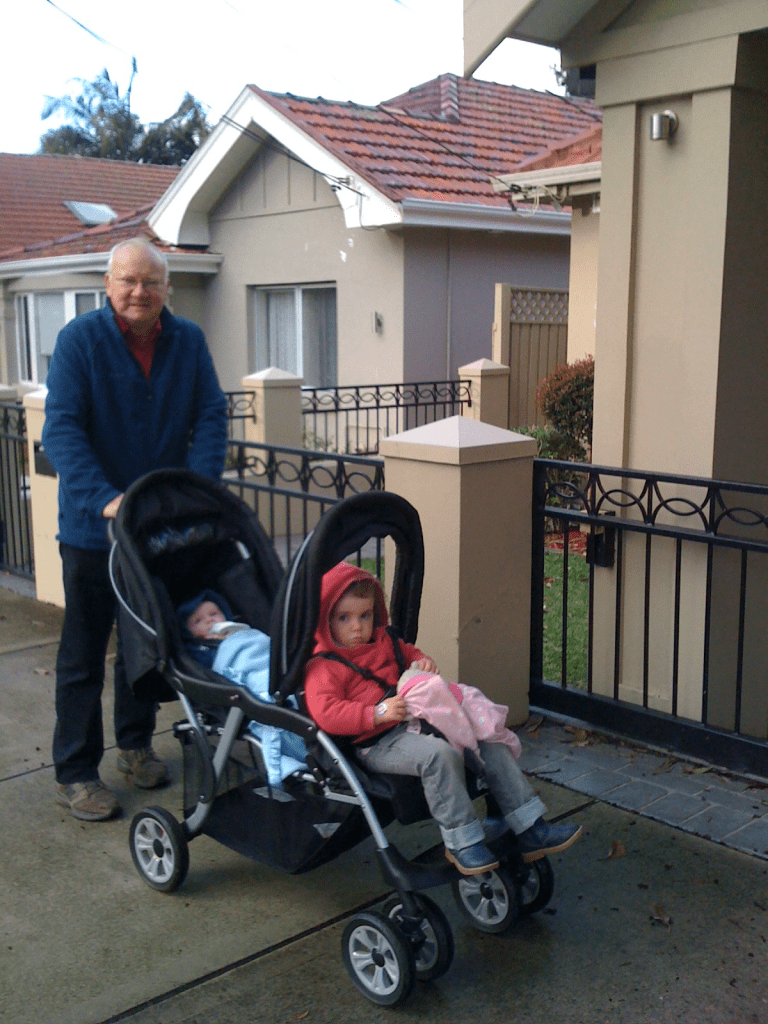
Then she was back at work and we were babysitting two little ones once a fortnight. I remember the double pram she bought so we could explore the streets of her suburb.  

Taking two for a walk

Eventually the eldest was at school and after seven years they both were.  The early morning trek to Sydney was no more although we still visited.  Seeing the children regularly in their first five years was a privilege that many grandparents don’t have for various reasons.

Now that the children were older they came to visit us in the school holidays while their parents worked. The younger one especially, missed his parents and had trouble sleeping.  I would end up in his bed or he would be in ours and we would all be walking around, eyes propped open with matchsticks the next day.

It was extremely fortunate that the Early Start Centre was constructed at the University of Wollongong just when we needed it.  It was a magical place to take the children so I bought an annual membership for us all for several years.

Drama at an early age. Performing at the Early Start Centre

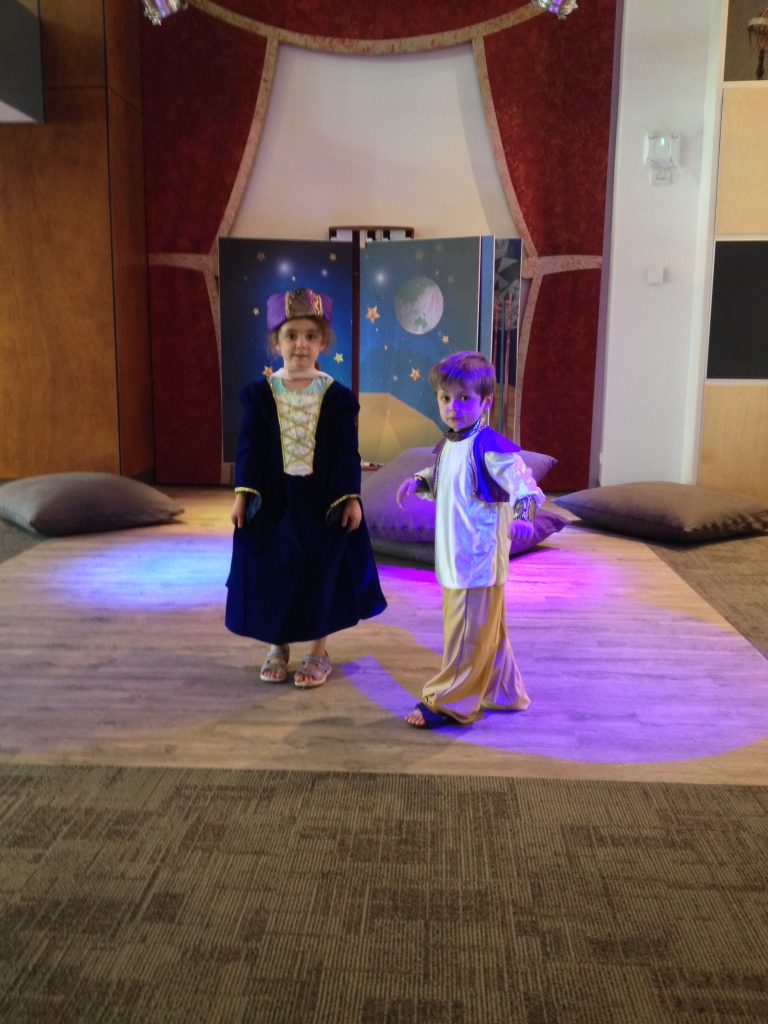
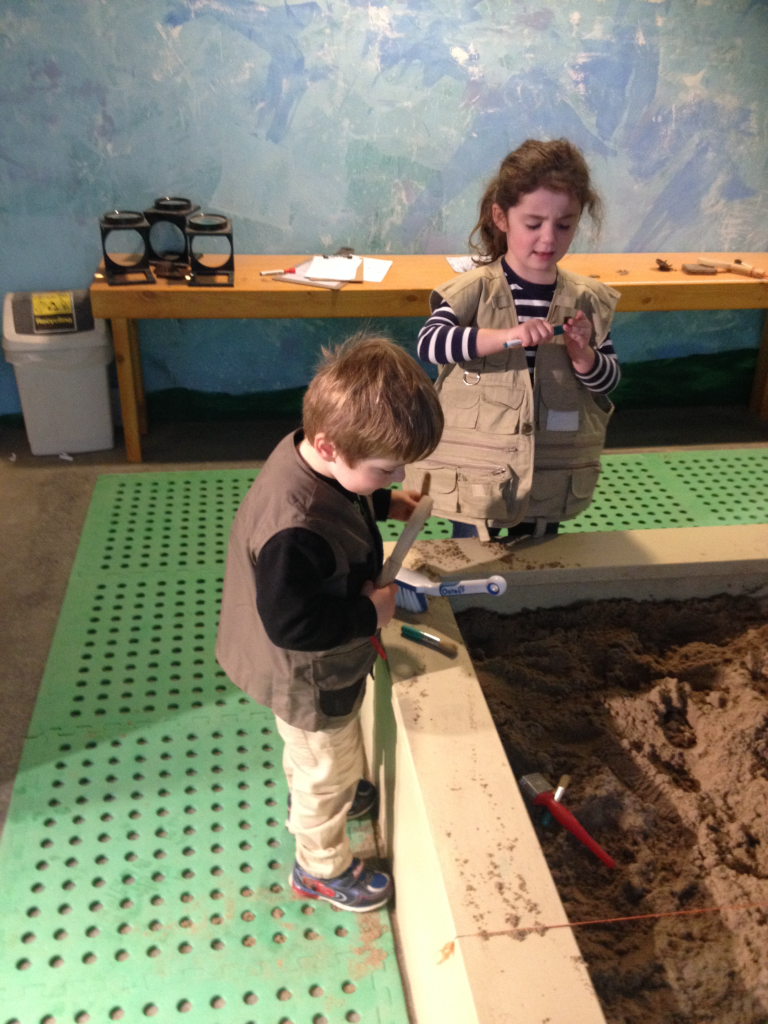
There was a pirate ship where they could climb the rigging, a grocery store where they could shop, a café where they could make pretend food and coffee for their grandparents, a craft area, a reading room, a Lego room, an outdoor play area, a construction site with bricks and tiles, an archaeological dig, a dress up area with lights and backdrops, a puppet show stage and most challenging of all, a digestive system where children climbed in the mouth and came out the other end. My grandson took a few visits to pluck up the courage to try that one!

Dressed up as archaeologists, UOW Early Start Centre

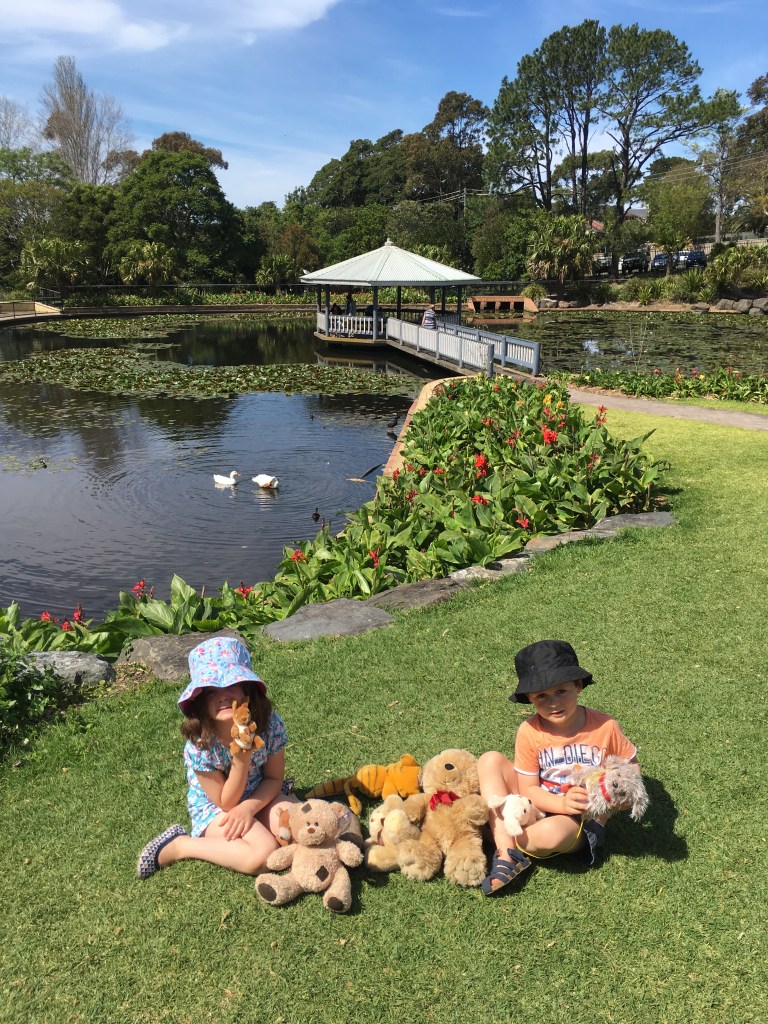
As I type I am looking at a photo on the wall of the grandchildren at the Botanic Gardens near our home.  They are surrounded by teddy bears.  We used to take a picnic lunch and have a Teddy Bears’ Picnic.  I would hide the bears in the bushes and they would spend ages trying to find them.  I don’t think we ever left one behind.

Teddy Bears’ Picnic at the Botanic Gardens

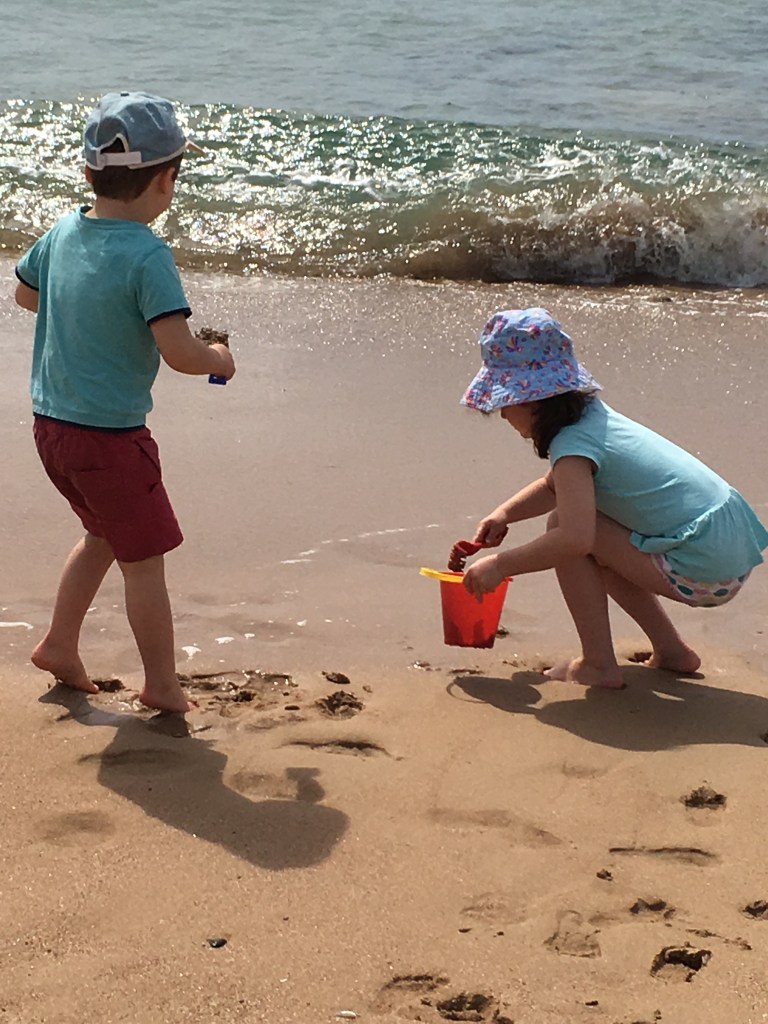
The other picture on the wall is of the two of them playing in shallow water at the beach. Whenever the weather was fine we would take them down to the rockpools and sheltered sandy spots to splash in the water and build sand castles.

Playing at the beach

Now the eldest is a teenager.  This week the three girls (my daughter, my granddaughter and I) are going to see Julia, a play about the first woman Prime Minister of Australia.  An ardent feminist, my granddaughter is looking forward to hearing the famous misogyny speech. She loves drama in all its forms, enjoys debating and performing. 

My grandson is also a great lover of drama, watching and performing.  He sings in the State Public School choir.  Like his sister before him, he is school captain and relishes getting up on stage to make speeches. Such self-confidence is amazing in one so young but a lot of it has to do with the constant support of his parents. I’m looking forward to seeing how these young people develop and grow over the next few years. I hope that life treats them well and they are happy in whatever they choose to do.

O for Origins

I may have given the impression we are always travelling, camping or boating.  That is far from the truth as we spend a lot of time at home.  I have always been interested in family history and being retired has given me time to pursue that hobby with renewed vigour.

Most Australians come from somewhere else a few generations back.  Because the first British settlement in Sydney Cove was in 1788 it is fairly easy for people to find where they came from, especially with modern DNA technology to help .

As an only child with two grandmothers, I absorbed their stories of life in the outback and of the ancestors who came before them to Australia in the 19th Century. Both my parents were only children so there were no aunts, uncles or cousins to talk to.  After my father died when I was 10, from a heart attack, it was just my mother and me, two grandmothers and a great uncle.  I worshipped my mother as she turned my father’s failing business around and succeeded in a man’s world of steel and piping. To me she seemed invincible.

I did ask her how I came to be born fifteen years after she was married but she calmly told me she had used contraception until the time was right.

My parents had a difficult life with one failing business after another, so I accepted what she told me.  In Mildura, where I was born, they had a successful business selling irrigation equipment to soldier settlers after WW2.  My mother was happy there, she said, so that when I came along, she was in a position to enjoy having a child.

I was so involved in family history research that I based some of my A to Z’s on it. In 2017 I wrote “Fact or Fiction-Family Stories”, investigating all those tales I had been told, to see if they stood up to proper genealogical research. During that time I found out considerably more about my father’s paternal side of the family, hailing from Fermanagh in Ireland.  All were involved in the railways and a shocking number of them died early from heart disease.

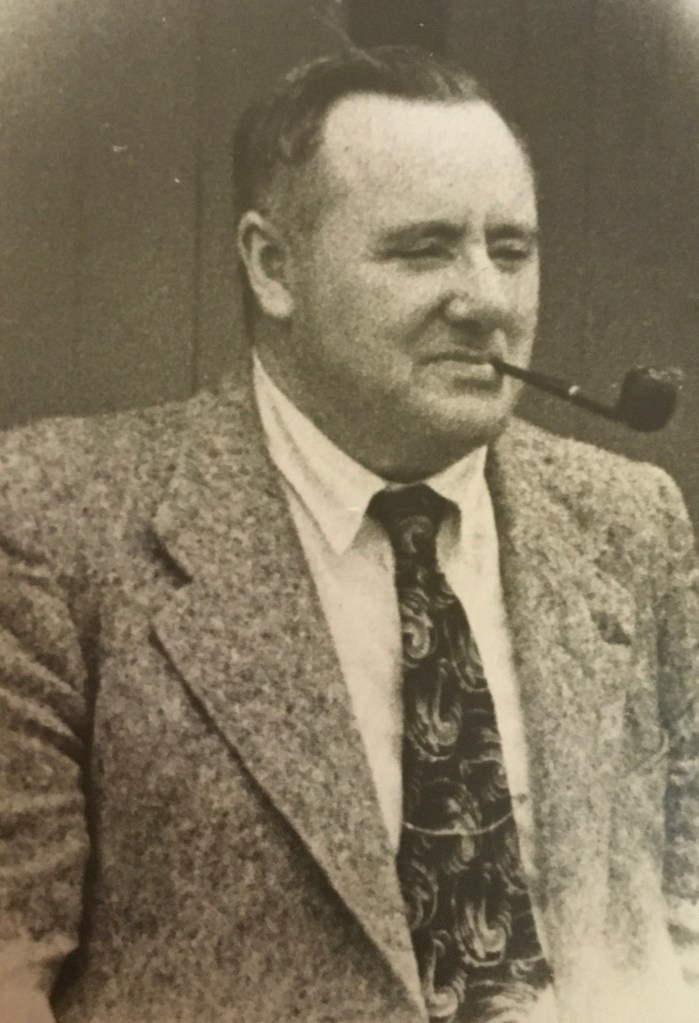
The father I grew up with (a rare photo)

Late in 2017 my husband and I decided to do Ancestry DNA tests to help with our research.  When John received a match to his cousin we marvelled at the accuracy of the test.  When I received a very close match to an unknown person alarm bells rang.  Funnily enough, I knew straight away that my father wasn’t my father.

Not that he had ever indicated I wasn’t his.  In fact he spent a lot of time with me so that I missed a considerable amount of school travelling around the country as his “Shiralee”.

The person who matched as a possible cousin came from Mildura, the town where I was born.  Her mother’s maiden name was familiar. I had a faded brown newspaper cutting  from my deceased mother’s possessions.  It was an obituary for someone with that name, written in 1952, the year after I was born.

At first I thought this man could not be my father. He would have been 60 when I was born. My mother was 33. You can imagine my brain has been very active ever since my discovery, vainly trying to piece together what happened. I wrote a whole A to Z based on my search in 2018. It is called “A is for Ancestry” and tells the whole story in detail. My “cousin” and I were very excited about our discovery, of course. She refused to believe that her grandfather could be my father as she wasn’t that much younger than I was. (At the time I was 66). Maybe it was his son or one of his younger brothers.

Could this man be my father?

I was so keen to meet a living relative we drove a thousand kilometres to meet up at her place. Her cousin was a genetic scientist working in the United States so she sent all the information to him.  He replied shortly after with the conclusion that her grandfather was without doubt my father!  That made her my half-niece.

That also made her mother my half-sister.  My newfound father Bert had married and had four children before I appeared.  Now they were all in their nineties, except one who had died in her eighties. The family wanted to keep it a secret from the remaining sisters, so I had to meet them without telling them of our relationship.

The young Bert around 1915

I did meet my half-brother who was told of the discovery because his son was the genetic scientist in America.  He remembered meeting my mother in 1952 after coming back from a trip to Europe.  He even bounced me on his knee, not knowing our relationship! His father at that time was very sick and died shortly after.  He could not tell me much about my BCF (Birth Certificate Father) that I grew up with, but I sensed he hadn’t liked him and he felt my mother was “under his thrall” which maybe means he bullied her or did not allow her to participate in decision making.  I certainly saw plenty of evidence of that in my childhood.

I’ll never know what really happened.  My mother always came across as a devoted, dutiful wife but she really blossomed after my father’s death.  Free to make her own decisions at last, she built up a very successful business, retired and lived in relative comfort in a seaside suburb in Sydney.

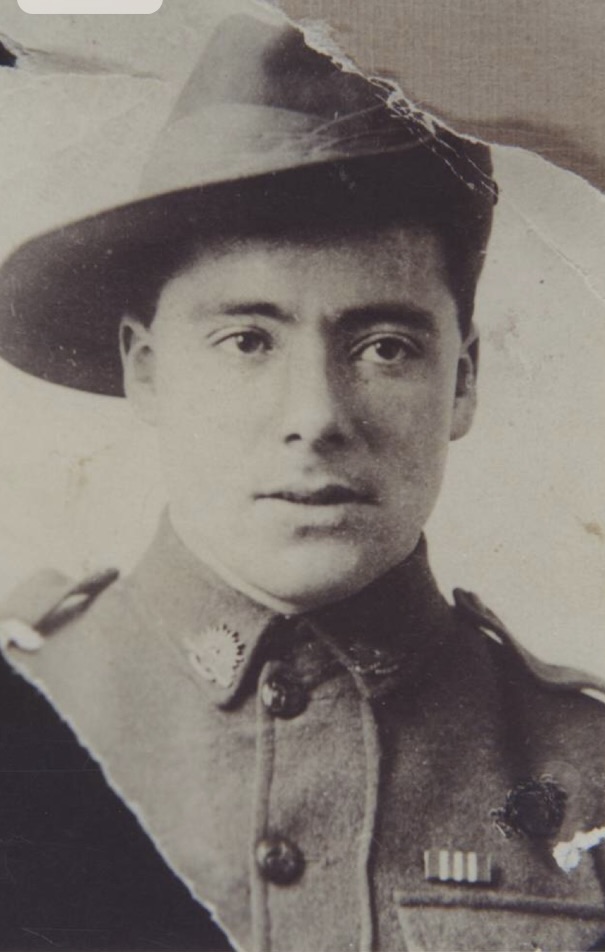
From what I have read, Bert was a very charismatic man.  He had been lucky, surviving Gallipoli with a shoulder wound and returning from Europe after WW1 to take up land in Mildura under the Soldier Settlers Scheme.  Finding that grape growing was never going to provide more than subsistence on a small block he organised a packing shed and devised marketing strategies for distribution of the grapes.  This led to a career as a real estate agent and auctioneer and a stint as a recruiting officer for the Air Force in WW2.  In the post-war years he suffered from a mystery illness and was semi-retired which is when he somehow became involved with my father in the irrigation equipment business venture.

Bert heading off to WW1

This is where I just can’t decide what happened.  I assume my father was unable to have children because after fifteen years of marriage nothing had happened. Note that my mother didn’t have any more children after I was born. Maybe the doctor organised a sperm donation.  Maybe Bert and my mother had a relationship. Whatever happened, she did it to bring me into the world, and for that I will always be grateful.

It was a relief I no longer carried the genetic heart disease of my BCF and it seemed I had inherited some long-life genes if my sisters and brother were anything to go by. However, my biological father died at 61 and I’m still not sure of the whole story.  The family said he died from cancer caused by a war wound in WW1.  At the end of WW2 he had to retire early as he was diagnosed with cancer and given only a few years to live. His death certificate from 1952 says he died from a fibrosarcoma of the left axilla, diagnosed only 18 months earlier.  His WW1 war wound was to the right upper arm and shrapnel had remained in his body.  Maybe someone got the arms mixed up when transcribing the information.

Sadly my half-brother and two half-sisters have all passed on.  One sister celebrated her 100th birthday last year.  I was lucky to meet them all before it was too late.  I also met a cousin (daughter of my new father’s sister) who was very much into family research and died two years ago.  I keep in contact with my half nieces and nephews, some of whom are about my age.  They are a very friendly bunch and have included me in a family reunion and the memorial service for my half-brother. I have been able to watch the other funerals online.

As for origins, I have English and Scottish heritage but have lost my Irish connection.  On Bert’s side, his paternal grandparents came from London and Essex in England.  His maternal grandparents came from London and Hampshire.  They all emigrated to Victoria in the 1860s.  On my mother’s side, her paternal grandparents came from Warwickshire and Sussex and on her maternal side they came from Norfolk, England and Aberdeen, Scotland. They too, all arrived in Victoria in the 1850s and 1860s.   

So much for my origins. That I exist at all is a quirk of fate.  That I grew up in a home full of love I am extremely thankful. I have indeed had a fortunate life and owe much of my happiness to my mother Elsa who devoted her life to my upbringing.

N for Nakasendo Way

In Joanna Lumley’s series “Japan” she travels to the Kiso Valley to walk part of the Nakasendo Way.  When I watched this on television I dreamed of doing the same. It is an old travellers’ road from the Edo period (which lasted from 1603 to 1868).  Nakasendo literally means “Central Mountain Road” or “Inner Mountain Path” and is a trail that once connected a string of villages that provided lodging and sustenance for shoguns, retainers, samurai and daimyo (feudal lords).

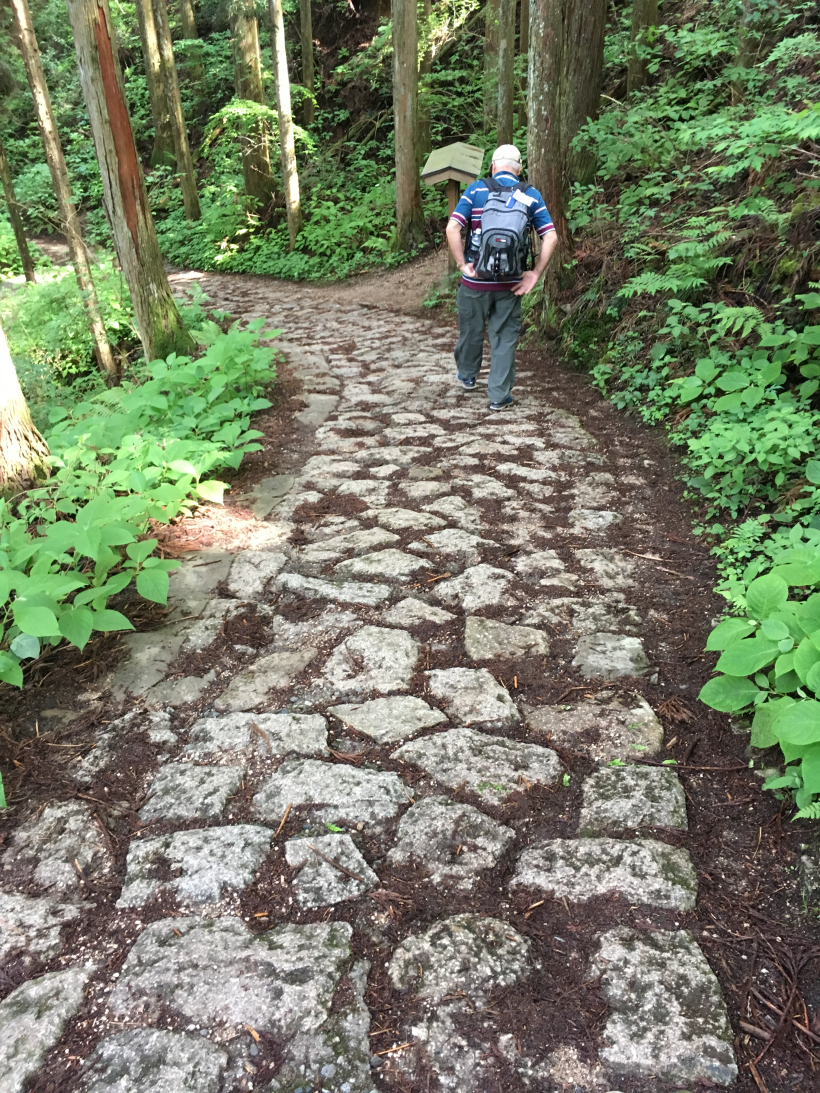
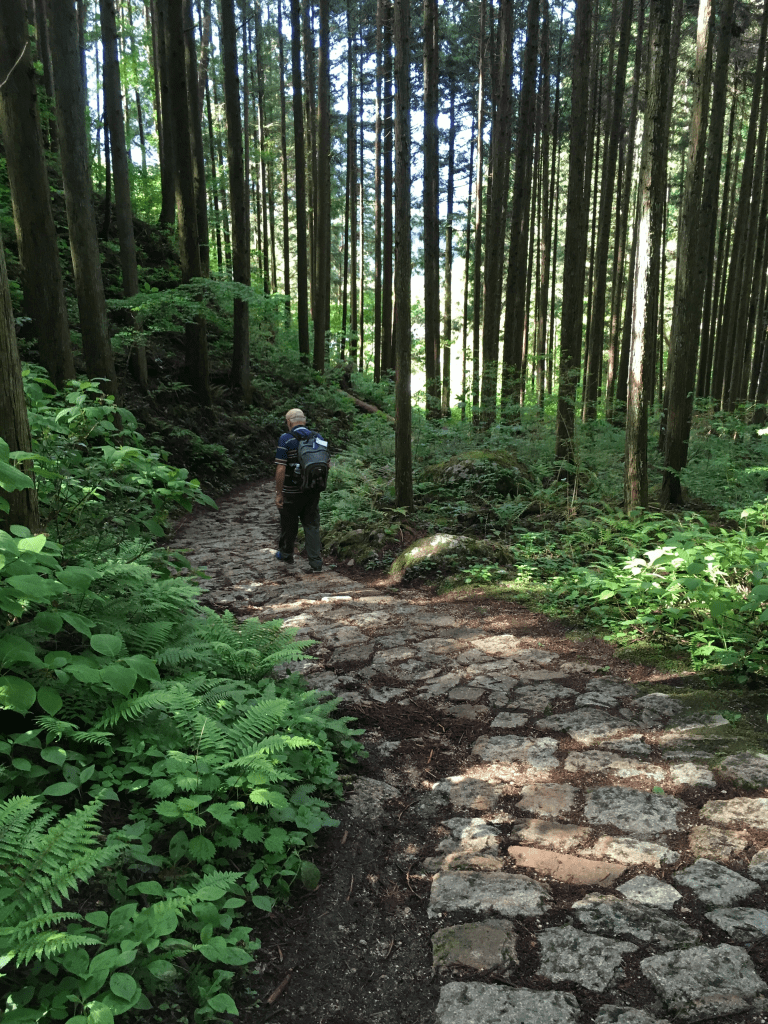
Walking the Nakasendo Way

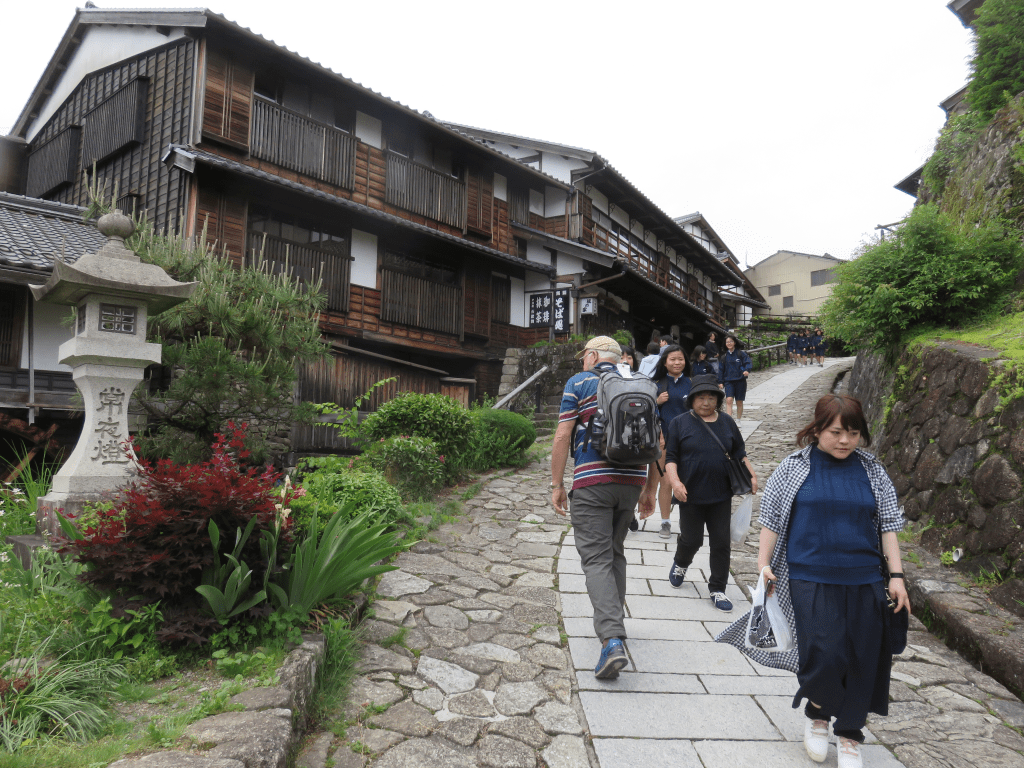
The trail and its villages were largely abandoned in the 19th Century but fortunately a campaign to remove all the modern buildings and restore those left from the Edo period began in the 1960s.  Streets were repaved with original stone and period-correct food and shelter was once again available to walkers.

Traditional village on the Nakasendo Way

We felt a bit overwhelmed at the idea of finding our own way around Japan so utilised the services of “Inside Japan”.  We looked at their suggested itineraries, picked out the parts that appealed to us and added a bit of our own (a visit to the Toyota factory for John). They booked the hotels, organised transport (trains and buses) and gave us a daily outline of where to go and when.

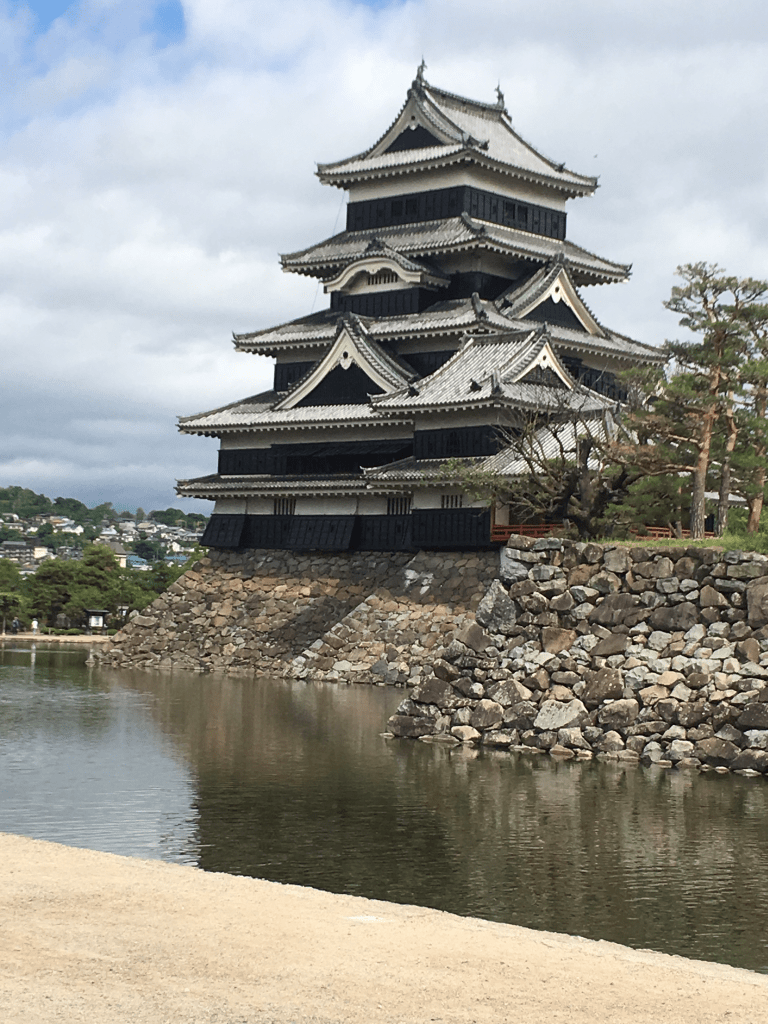
Matsumoto Castle

From Matsumoto we were to catch the train to Nagiso and then hop on a bus  to Magobe.  There was a brief period of time in the morning to see Matsumoto Castle.  I left John at the hotel and promised to be back in time to catch the train.  It was quite exhilarating to be on my own.  I paid the entrance fee and climbed to the top of the castle, each floor accessed by steep steps until I breathlessly reached the top.  Back in the grounds I posed with some Samurai warriors before finding my way back to the hotel.  John was relieved to see me as it was time to head down to the railway station. It took one and a quarter hours to reach Nakatsugawa by train and then another 20 minutes by bus along a winding road to reach Magobe.

We walked uphill to the tourist information office and on through the ancient village to a vantage point overlooking the town. The trail starts in Magome at an altitude of 600 metres, rises up to 801 metres and then descends to 420 metres in Tsumago. 

Climbing the hill in Magome

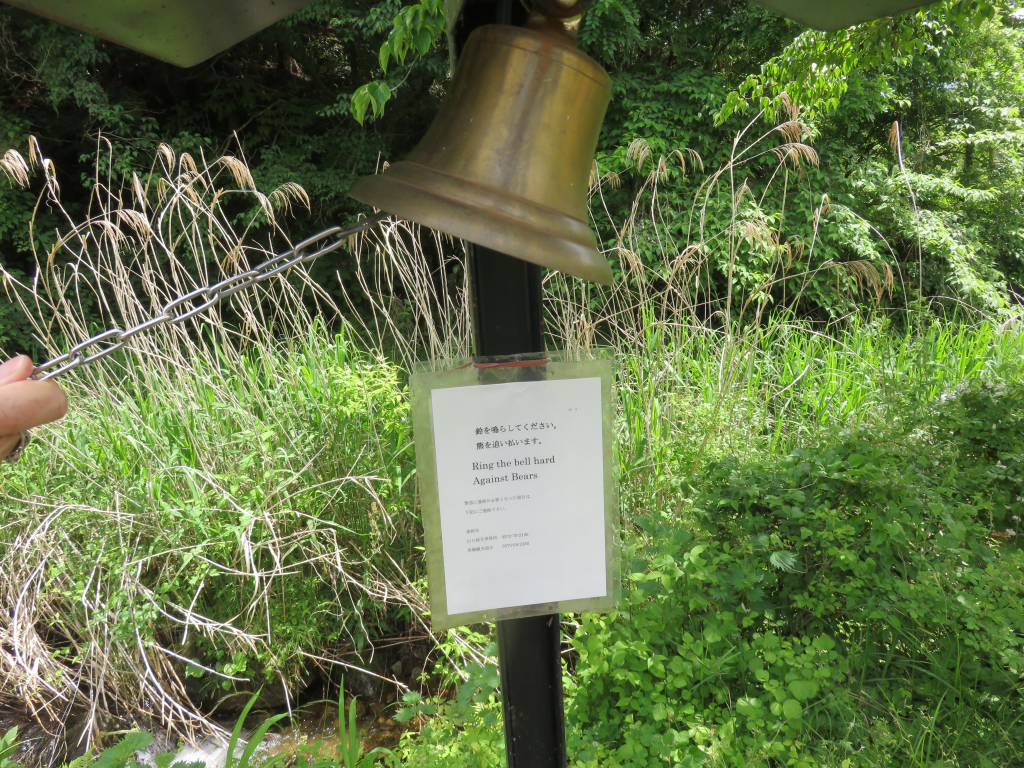
We headed off downhill again, skirting through a small wood to cross the road which appears regularly along the way. It is a very quiet road, but a reminder that a modern world exists outside of our ancient path. At the entrance to the wood is a static bear bell.  Our information told us to give it a good yank and scare off the bears. We didn’t see any, but found a bell in each wooded area. I think the bears left the area long ago.

Beware of bears

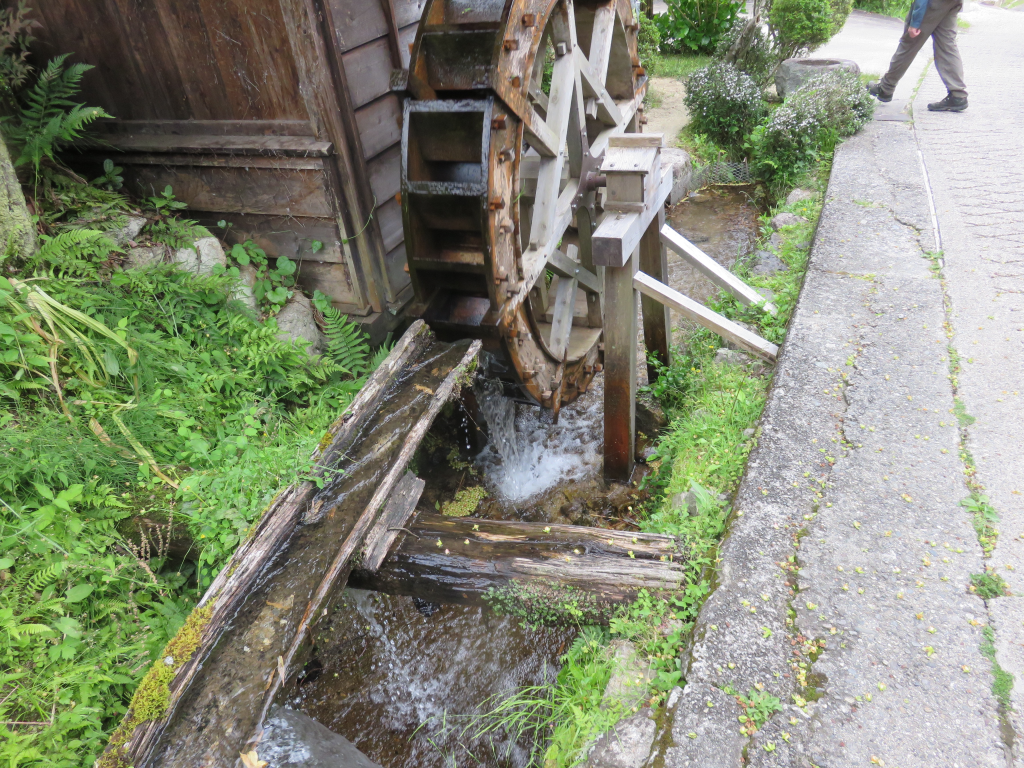
We walked past waterfalls, bamboo groves, terraced rice paddies and a working water wheel.

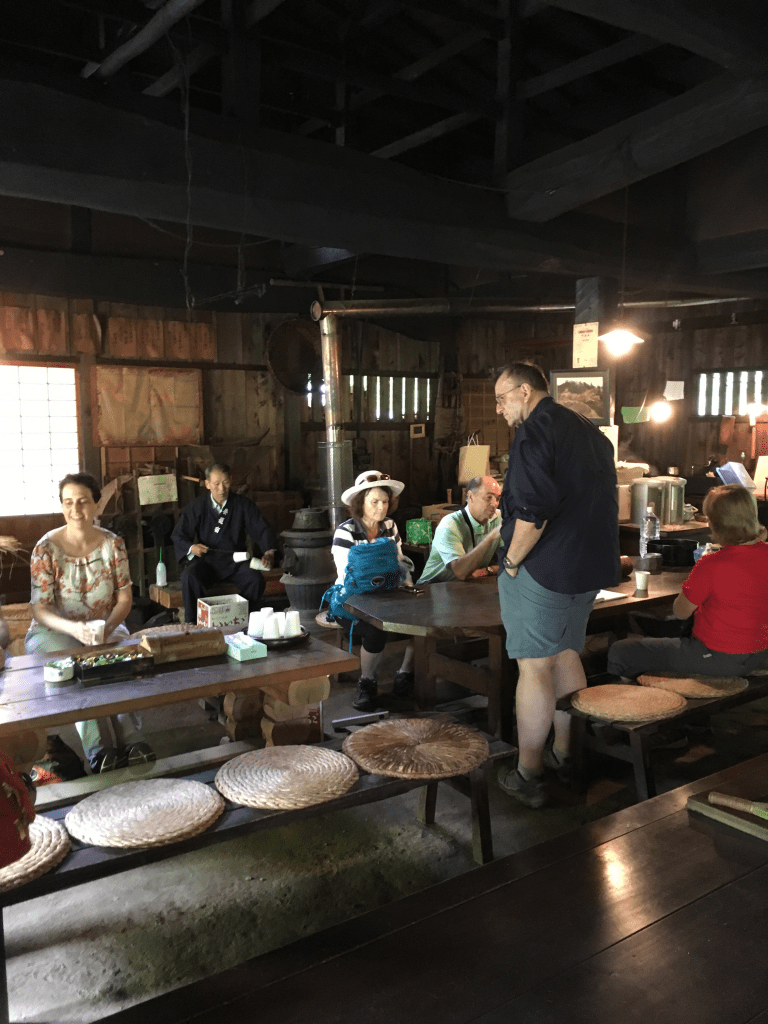
At around the halfway point there was a rest stop within a traditional-style tea house. Inside the old building is a traditional Japanese irori fire pit, and we had snacks and Japanese tea served by a local man in traditional costume.

Traditional tea house on the Nakasendo Way

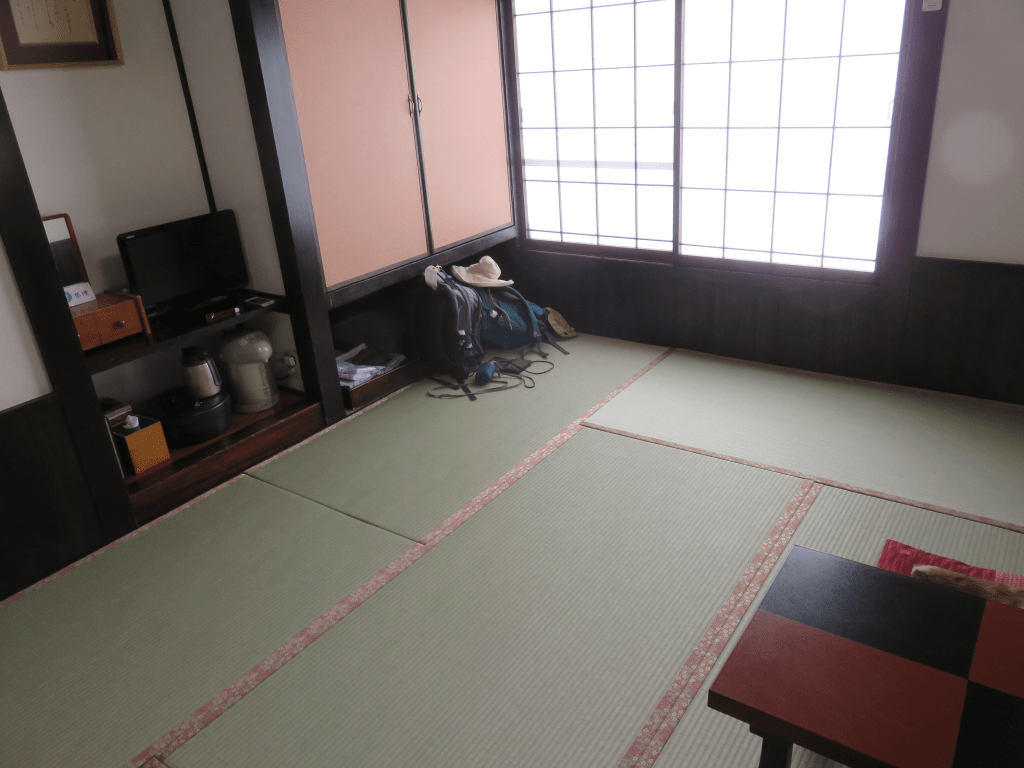
All up it was 7.7 kilometres to Tsumago, so we were pleased to arrive at our minshuku and view our room.  It was almost totally bare but we were shown our beds and yukatas so we set about preparing for the evening. A minshuku differs from a ryokan in that it is a smaller family run operation. The rooms have basic amenities and beds often have to be prepared by the guests.

Our bedroom in the minshuku

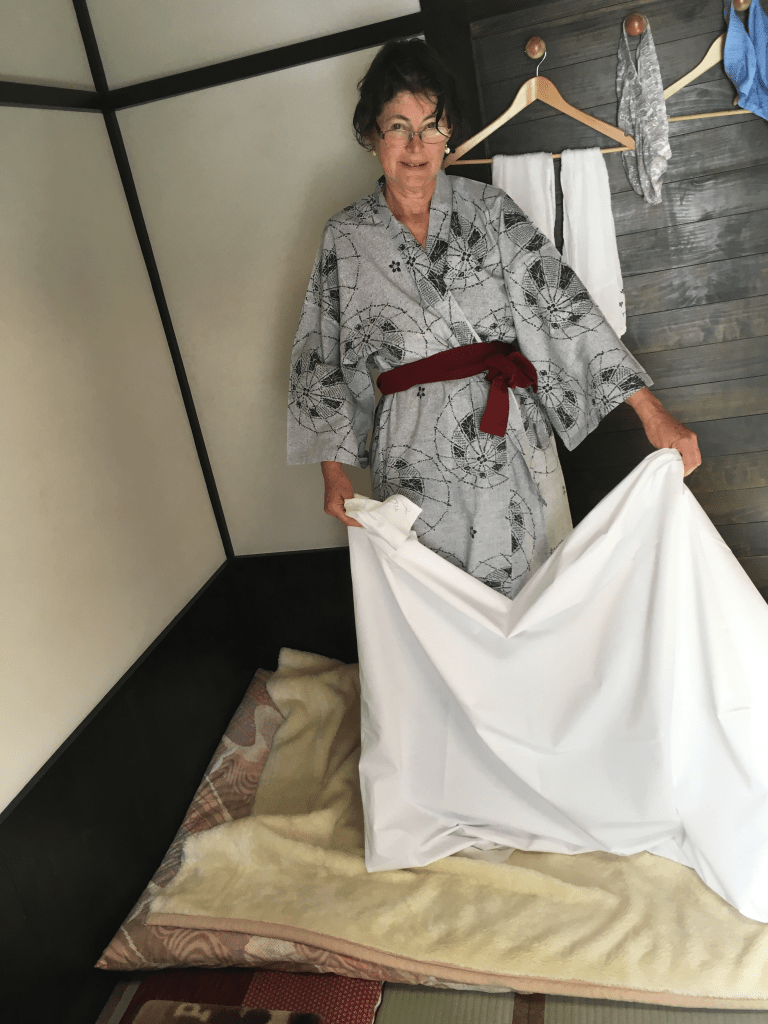
 The correct way to wear a yukata is to place the left side against your body, then fold the right side over it. Then, take the belt (called an obi), wrap it around your waist one or two times and tie it in a bow knot. Finally, twist the obi around so the bow goes in the back. We removed the futons from the cupboard and laid them out.

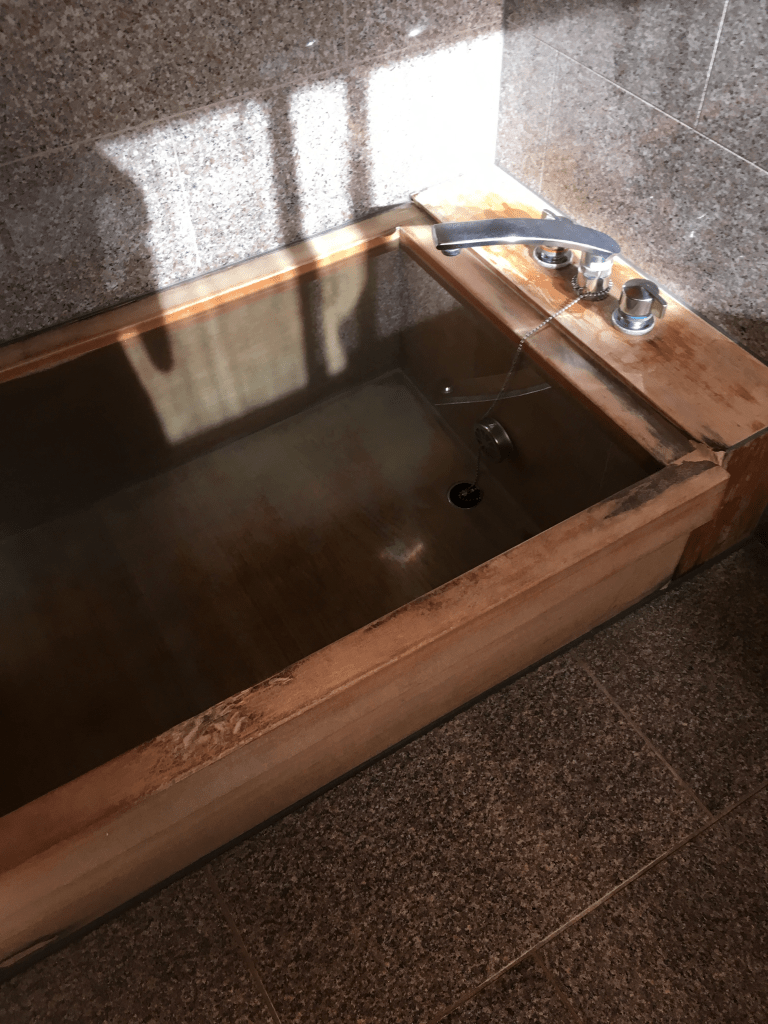
Once we were dressed we checked out our wooden bath.  The local Hinoki cypress is turned into tubs for bathing and is fragrant when it heats up. Although it was at the end of the corridor we were told if we locked the door we would have it to ourselves.  First we had to wash our bodies with a bucket of warm water and soap.  When we were clean we stepped into the hot spring water and soothed away all the aches and pains resulting from our walk.  

Our tub is ready

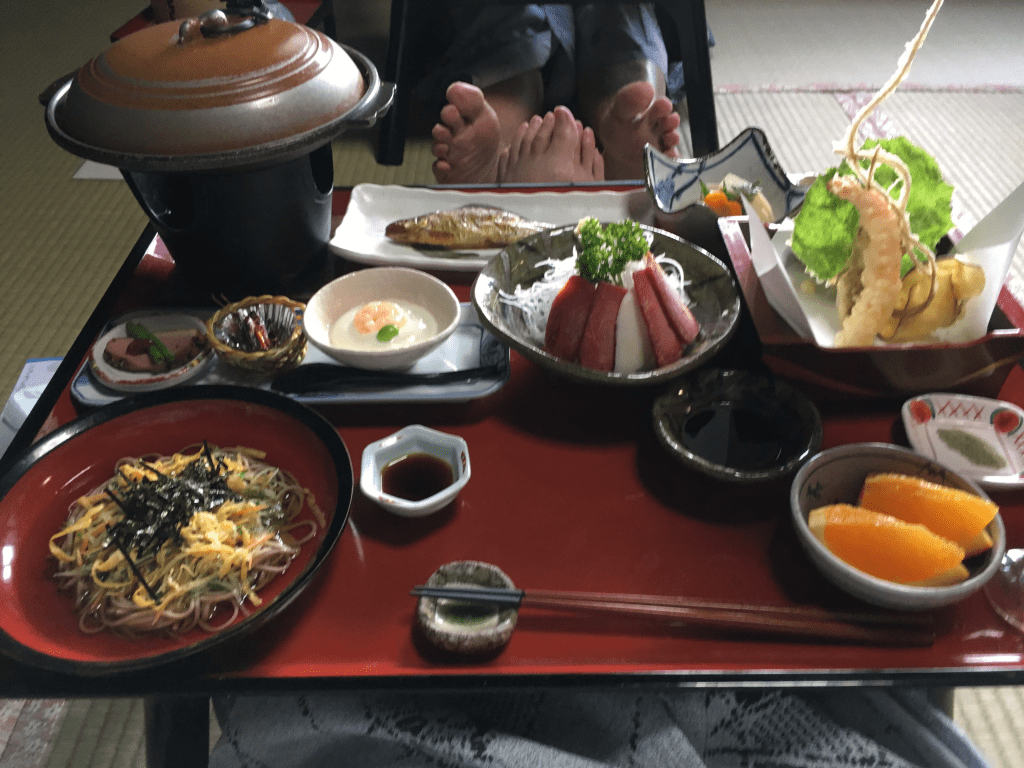
At 6 o’clock dinner was served in the dining room at low tables.  Everything was delicious but most memorable were the grasshoppers and raw horse meat sashimi. I can tick that off my list and never need to eat either again.

Amazing meal at our Minshuku

We retired early after a strenuous and exciting day. The beds were comfortable but I did record in my diary that they were the hardest pillows I had ever experienced.

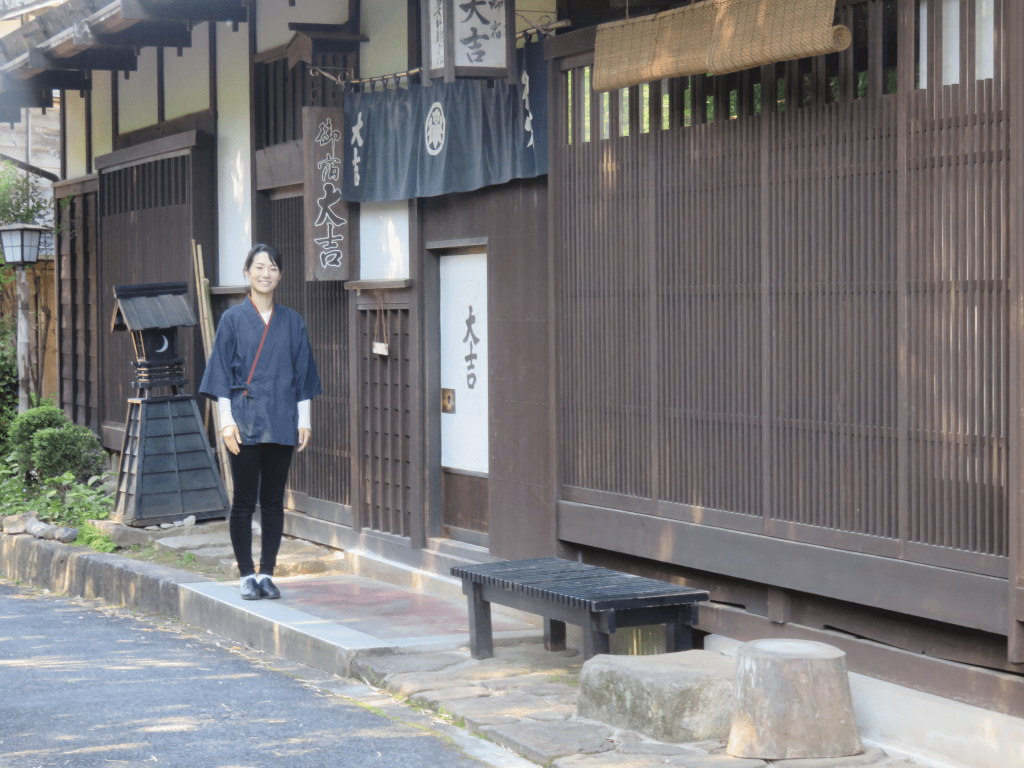
Breakfast was another hearty meal, farewells were made to the friendly family and we were on our way to Nagiso Station, another 3.5 kilometres.

Leaving our minshuku

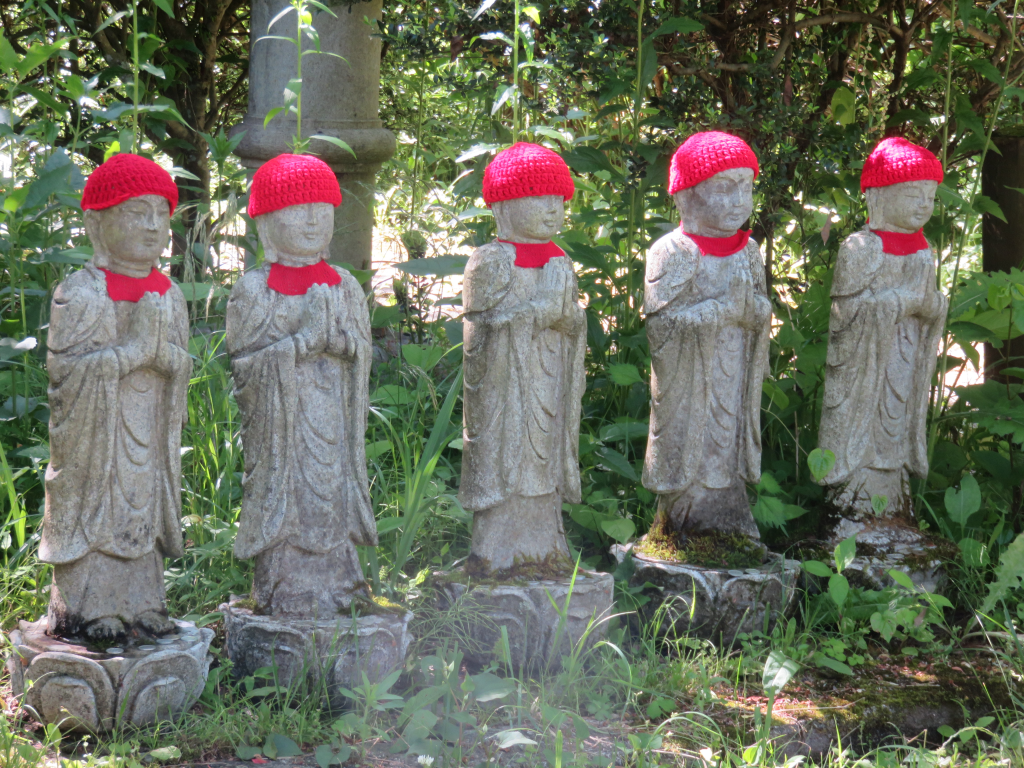
 This section leads through more populated areas and does not feature any preserved pavements, but it still offers a pleasant, rural atmosphere and a shorter walk than the day before. We came across some intriguing statues with red knitted bonnets on their heads.

Jizo statues, guardian deity of children and travellers, made out of stone, which is said to have a spiritual power for protection and longevity that predates Buddhist beliefs.

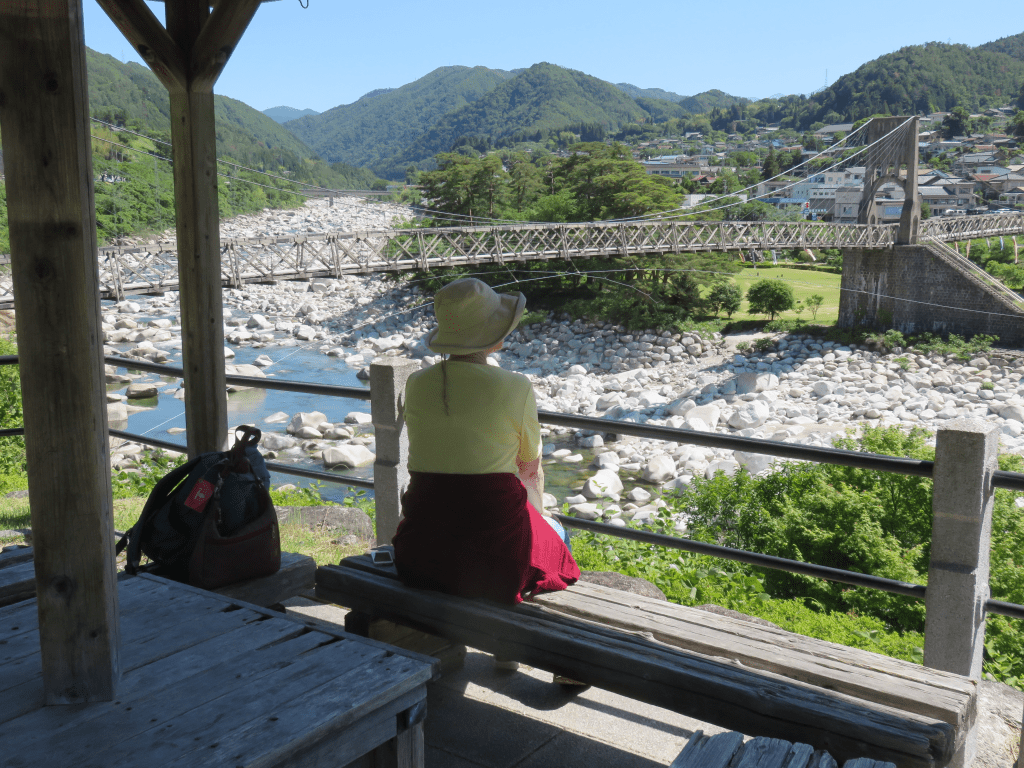
We had some time to fill before our train arrived so walked over the  Momosuke Bridge, a wooden suspension bridge crossing the Kiso River.  The bridge was built in 1922 to facilitate the construction of the nearby Yomikaki hydroelectric plant. The bridge is one of the longest of its kind in Japan.

A park beside the Momosuke Bridge

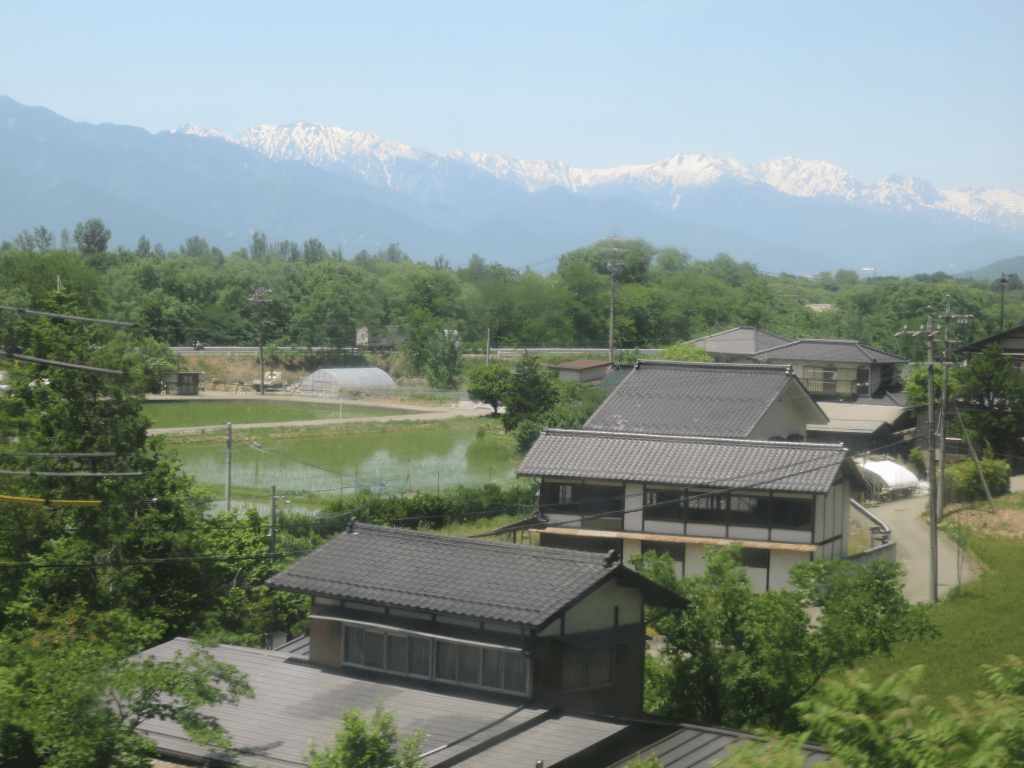
Our holiday was drawing to a close as our train raced towards Tokyo. Snow capped mountains could be seen from our window. One moment in time we were in ancient Japan and now we were speeding headlong to the modern capital.

M for Mediterranean Cruise

Back in a time when taking a cruise was not a guaranteed way to contract Covid, we booked a dream holiday on the Celebrity Equinox. We had enjoyed our experience on the Pride of America around Hawaii so much we thought we would try cruising again.  My theory is if you can get off the ship most days it is nice to have a cabin and a meal to come home to.  We left from Rome (Civitavecchia) and returned ten days later.

Here are some highlights (and lowlights) of our 2011 cruise.

Santorini

The first port of call was Santorini. After studying Trip Adviser and the Cruise Forum we decided to catch a bus from Fira to Eai and explore some of the island. We were still confident even after receiving a warning.

We sat at a table with a couple from Colorado called Rick and Sue.  They are taking an organized tour on Santorini and wished us luck on our self-guided tour.  The biggest obstacle will be getting a bus from Fira as there could be nine ships in port. 

That morning I picked up our tender boat passes which had number 9 on them meaning Groups 1-8 would leave before us. Of course all the people on organized tours were leaving first.

We waited until 2.00 pm when we expected to go ashore, then it became 2.30, then 3.00. A Latin American musician kept people entertained but by 3.00 we were wondering if we would ever get off. About 3.10 our group was called and we climbed into our tender. The ship’s lifeboats were not used as there is an agreement to use the boats from Santorini. Once ashore we had the option of a one and a half hour wait for the cable car, a ride on a mule or a walk up 600 steps. Thinking we were in good shape we opted for the walk but didn’t count on sharing it with 600 mules, or the overpowering smell of their dung and urine in 30+ degrees Celsius heat.

About halfway up we watched horrified as we spied a large man walking down the hill with two riderless mules coming down behind him.  We yelled but it was too late.  He was pushed forward and as a result was running faster and faster.  John heroically grabbed him by the arm and swung him to the side of the path.  I had an image of them both rolling down the steep steps.  He was very thankful, but I don’t think he realized how bad the situation could have been.  I think we were conned by the 600 steps as each step was three paces deep.

 Once at the top we found a café with a beautiful view but I headed straight to the bathroom and splashed cold water on my face until I felt human again.  We drank cold sparkling water and beer and at last took in the view.  Fira is on the edge of a caldera.  The crater is now filled with water and is reputed to have once been the site of the lost city of Atlantis.  The houses and buildings are nearly all white with occasional splashes of pink and cream. 

We could see four large ships and two smaller ones in the harbour. That could mean 8000 visitors ashore at one time which is an awful lot for a small village. We had planned to catch a bus to Eai but with the late arrival on the island and the heat we opted to look around Fira instead. Once away from the crowds in the town we had a pleasant walk along the cliff edge admiring the views of white-washed houses and blue domed churches. I vowed I wasn’t going down the track with all the mules but the line for the cable car was snaking along the street and into the distance so we reluctantly started downhill. The trip back wasn’t so bad once we squeezed past all the mules who were patiently waiting at the top. I went for a slide when I stepped on a patch of mule dung so walked very carefully from then on. John beat me but saved a place in the line for the return tender. We were so glad to get back to our cabin and a hot shower.

Athens

At breakfast we sat next to some sisters from Glasgow who were heading off on an organized tour of Athens. I was a bit apprehensive about our “do it yourself” tour in an unknown city and briefly wished we were on a tour as well. Not for long. Back in the room the safe refused to open. Imagine if we were supposed to get on a tour bus and couldn’t access our money or IDs! We spoke to Joel who rang the person in charge of opening safes. Two frantic phone calls from John and a man arrived, plugged a contraption like a large mobile phone into the safe and was able to open it. We hurried off the ship, jumped onto a transfer bus from Terminal B to Terminal A and then began walking to the train station. There were lines of taxis, all trying to get our business. One driver said E20? so John said OK and soon we were sitting in air conditioning with a cheerful driver telling us about the things we should see. For E85 he was prepared to be our tour guide for the day but although tempted we bid goodbye at the foot of the Acropolis.

The first glimpse of the Acropolis, so close to the city, was awe inspiring.  Ever since reading my Primary School Social Studies textbooks I had wanted to see the Parthenon and now at 60 I had finally made it!

 We used our Rick Steve audio guides as we wandered around the Propylaea, the Erechtheion and of course the Parthenon.  John was amazed at the amount of restoration since he was there in 1969.  It is partly funded by the EU and will take forever to restore.  We enjoyed hearing a couple of stories about the site include the man who was asked to raise the Nazi flag on the hilltop, but as he lowered the Greek flag he wrapped himself in it and threw himself off the cliff, and the two Greek boys who scaled the wall and removed the Nazi flag.  What happened to them I don’t know.

 After leaving the Acropolis we started looking for the Plaka where we had cold drinks in a shady bar.  We still wanted to see the smaller Parthenon like building we had spotted from the Acropolis on the plain below.  It looked to be in excellent repair and was surrounded by trees and gardens.  With John’s good map reading skills we arrived at the Temple of Thesseion, entry to which was included on our Acropolis ticket.  We also walked between the columns of the Stoa of Attalos which I identified as Ionic and Doric.  It has been fully restored and is now a museum.

Outside Parliament House there were many protesters demonstrating against the spending cuts being voted on in Parliament.  There was some doubt as to whether the trains would be running because of the strike but to our relief there was a train to Piraeus and then a shuttle to the ship.

Istanbul

I woke up just before seven feeling as though I had the flu but the view as we came into port at Istanbul was enough to get me out of bed. We saw a row of famous buildings visible from the waterfront. The Blue Mosque, the Hagia Sophia and the Tekpaki Palace. At 8.30 precisely we walked down to our shuttle bus and were on our way to the Bazaar in Istanbul. First stop for us was the Underground Cistern (Yerebatan). Apparently it was used in a scene from “From Russia with Love”, a James Bond movie. We were lucky to be there before the crowds and we enjoyed the strange music playing as we walked along the boardwalks. It was used as a water storage facility from 532 AD until the 16th Century and restored in the mid 20th Century. The columns come from different Roman structures. There are two Medusa heads used as column bases, one upside down and the other sideways. Whether this has any significance or was just a useful bit of stone is unclear.

Across the road was the Hagia Sophia. I learnt about this building in art history at high school and to actually see it was exciting. It was constructed in 537 AD and was a Christian church for 916 years. When the Ottomans conquered Constantinople, the church became a Muslim mosque for 481 years. Now it is a museum, opened in 1935 after extensive restoration ordered by the enlightened leader Mustafa Attaturk. The lime covering on the Christian mosaics was removed so once again they could be viewed. (Note: Since 2020 it is once again a mosque.)

While waiting in line we were approached by a carpet seller.  This was a common occurrence throughout the day.  They were invariably cheerful and all seemed to have an Australian wife and a cousin in Wollongong. In the Hagia Sophia we walked up to the top gallery and looked down below.  This area was reserved for women during services as a Muslim Mosque and maybe when it was a Roman Christian church as well.

The Blue Mosque, although free, took a while to access because of the long queue.  I had taken the scarf off John’s suitcase so I could wear it over my head but found the majority of people had no scarf or if they did just draped it around their shoulders.  I got that wrong (or did they?).  The ceiling was amazing but the crowd was dense so we didn’t stay long.  The mosque was constructed in 1609-1616.  It has 21,042 blue, green and white tiles in the interior and six minarets.

The Topkapi Palace was last on our list and I was really looking forward to it. Begun in 1475 it was extended and extended until it was abandoned in the 19th Century. It is twice the area of the Vatican but has been constructed around large squares and gardens so has a lot of open space. The Imperial Treasury houses consist of four rooms in all with a decorated throne at the entrance to each one. Some of the exhibits included the Topkapi Dagger and the Spoon Maker’s Diamond.

Next Day

With half a day to see more of Istanbul we opted to walk around the port area and explore.  We saw a sign which said “Tunnel’ but as it had trains we didn’t go in.  John was keen to see the fishermen on the Galata Bridge so we watched them pulling in heaps of tiny fish which they put in jars and containers.  There were also some larger mullet.  There would have been 200 people fishing on the bridge with a gap in the middle to let boats through.  The Galata Tower was my object as it was visible from most vantage points.  We walked up steps and down hills and up more hills until finally we found it.  Had we taken the Tunnel we would have been there in minutes.  It connects the district of Galata with the district of Beyoglu.  The subway is the shortest in the world and is only 750 metres long.

 The Galata Tower is 61 metres tall but is also on top of a hill.  There are supposed to be 143 steps or a lift but we used the lift and I counted 60 steps on top of that.  At the top we had quite a good view of the Bosphorus, the Golden Horn and the Sea of Marmara.  Its claim to fame was when a scientist named Celebi jumped from the top and flew to the other side of the Bosphorus Strait, using the wings he had invented.

After an expensive coffee outside the tower we continued to walk until we reached Istiklal Street.  We came to this via the Jewish Quarter which had security guards at each end and made us a little nervous.  The Tunnel came out here and was met by an old-fashioned tram which was full of people so we didn’t get on.  The street was lined with embassies, Russian, Swedish and Danish, a number of Christian churches and luxury hotels.

Ephesus

We woke up today feeling confident as we had a pre-booked tour with Ephesis Shuttle. Our guide Melissa was holding a sign that read “John Curry”. It was certainly nice to get into our air conditioned Mercedes Benz van and be whisked off to Ephesis in comfort. Once there Melissa stayed with us and talked about the various sites as we walked. The highlight for us was the Terrace Houses which are now under permanent cover and have been unearthed from the hillside. The walls are covered with frescoes which were being revealed as we watched. It was quite thrilling to see people in action working on the walls.

On the way back we visited the Temple of Artemis which is only a column but was once one of the Seven Wonders of the Ancient World.

 Behind it is a monastery which used the Temple of Artemis as a source of building materials.  I was excited to see it because I had read about it as a child.  This is what it once looked like. It was more than twice the size of the Parthenon.

Attribution: Zee Prime at cs.wikipedia.  

Mikonos

 Today was a beautiful blue and white day.  Blue sky, blue sea and white buildings.  A blast from the past for John.  From the time we pulled into the pier which did not exist in ’69 John was comparing and noting changes.  He didn’t recognize anything until the shuttle bus took us around to the drop off point, a five-minutes walk from the town.  He was pleased to see the toilet block over the water was still there although now it has flush toilets which no longer empty into the sea and the little old lady no longer stands there collecting money from the visitors.

After a walk through the maze of streets we passed through to the other side of the town where we saw a row of windmills. Now no longer in use as windmills, some are private residences and shops. John was surprised at all the shops and cafes. They were all private homes with families when he was here last. In the past some had rooms to rent but the ubiquitous display of postcards, souvenirs and T-shirts showed how much the island had changed.

Past the windmills we finally came to John’s beach where he slept on the sand in his sleeping bag in 1969.  The taverna where he ate was still there although the staff were new and young.  We had two capucchinos and two enormous pieces of baklava.The beach had a few pebbles but the water looked inviting so we took turns to have a swim. We were able to change in the Taverna and use their day beds and umbrellas.

Herculaneum

This morning we spent packing as we did not have to leave the ship until 12.45.  The ship was very quiet as most people had gone ashore on the long trips to Sorrento and Capri.  We finally gathered in the Equinox theatre before going ashore on one of the ship’s life boats.  Then it was into a bus and off to shock, horror, a cameo factory. Once back on the bus we were held up for another half hour!!!!  There were three American ladies who must have been buying out the shop.  They finally appeared looking quite unperturbed.  A few people were muttering that they had spent an hour and a half seeing nothing but finally we were on our way and pulled into a carpark shortly after, at the foot of Mt Vesuvius.  

As the day progressed the mountain became clearer and the huge crater in the middle of it became apparent.  We looked down on Herculaneum from ground level.  The city was covered with molten pyroclastic rock to an average thickness of 16 metres.  Unlike Pompeii, wooden and other organic based materials were carbonized and preserved. There are a number of two-storey buildings and vivid mosaics.  Much of it is still buried below the modern town of Ercolano.

As Vesuvius erupted people rushed to the shoreline on the edge of the city to escape in boats but they were killed by the high temperature of the blazing clouds exploding from the volcano.  Their remains have been found in the boathouses along what was the water’s edge, now about a kilometre from the sea.

Having visited Pompeii in 1998 I enjoyed seeing Herculaneum even more, but then I am absolutely fascinated by the whole story of the eruption of Mt Vesuvius in 79 AD.

Our voyage had come to an end and lived up to all expectations. We would definitely go on another cruise.