Although I had no Aunts or Uncles my grandmother Kay had a younger brother called Claude, who lived in Victoria. He had been a sickly child, missing large amounts of school and slow to achieve the milestones expected of him. As a result he grew up unable to read or write. Sometime in the late 1950s Kay must have had news from her relatives that he was living in reduced circumstances so she dispatched my father to Victoria to find him and bring him back.
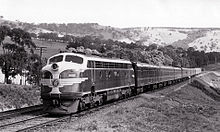
Victorian Railways Publicity Photo of B Class diesel-hauled Spirit of Progress 1953
This was a big adventure because I was going too and we were to catch the Melbourne Limited Express and travel in a Sleeping Car. Inside the compartment were two fixed sleeping bunks, one above the other. A pull down handbasin with brass face plate, a mirror and varnished timber walls added an element of luxury .
A 1950s sleeper compartment Wikiwand E type carriages
After a night’s sleep we were up early for we had arrived at Albury Station on the NSW/Victorian border. Because NSW and Victoria had different sized railway gauges our train was unable to travel any further. Breakfast at the station cafeteria was eaten before we climbed aboard the famous Spirit of Progress to continue our journey to Melbourne.
A warm welcome at The Waterhole
The next day saw us on the train to Terang where my great uncle worked on a dairy farm. His room was small and dark and he worked long hours milking and carrying out farm chores. What the farmer thought when my father arrived and demanded that Claude leave with him I will leave to your imagination. I can’t remember if we had a sleeper on the way back but do remember his first night at our home where he must have felt very strange.
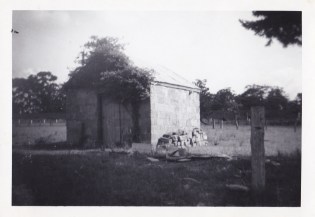
The Stone Room
Uncle Claude lived with us for many years, first in The Stone Room built from convict brick and then in the Long Room (a converted shed). Eventually Kay bought him a tiny house across the road, hired a builder to add a kitchen and called it Lock Cottage.
Uncle Claude at Lock Cottage
Claude did odd jobs around the property, fed the animals when we were away and rode his motorbike for recreation. He was kind and gentle, with a slow drawl and a love of animals, motorbikes and roll-your-own cigarettes.
Water was always a scarce commodity and was carefully conserved. Although we had the waterhole across the road to fill our dam we relied on tanks for drinking water. They were a breeding ground for mosquitoes so we usually had their larvae at various stages of development swimming around in our glass. I fished them out with a spoon although most adults drank them regardless.
A chip heater like ours
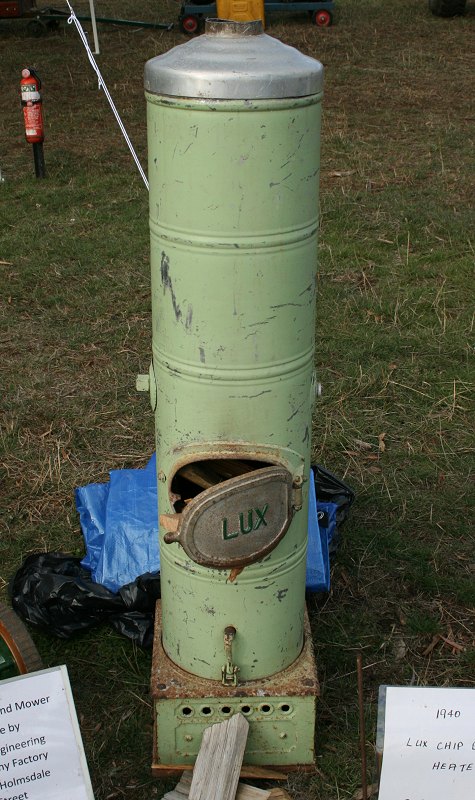
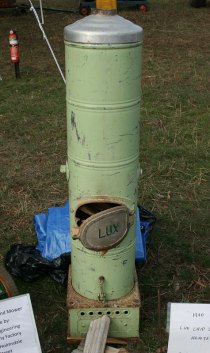
Our small bathroom boasted a chip heater with a shower over the bath but it became unusable after my father experimented with using coal instead of small pieces of wood. From then on we had to light a fire under the copper in the laundry and carry the water in buckets up the back steps to the bathroom. Consequently baths were not taken more than once a week and were shared by the family. The rest of the week I was given a bowl of hot water, soap and a washer with instructions to “wash up as far as possible, down as far as possible, and then wash possible”.
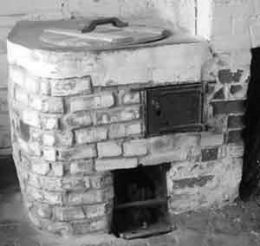
This is a bit like our copper bricked in over a fireplace
Washing clothes was also a complex task. The fire under the copper was lit and the clothes dropped in the boiling water with Sunlight soap. They were swirled around with a stick before being dragged into one of the tubs full of cold water. From here they were pushed through a mangle, which consisted of two rollers connected by cogs and powered by a hand crank. The sheets went in the first wash and were accompanied by a “blue bag” which kept them white. The washing water, when cold, was thrown over the lemon tree as it was supposed to deter bugs.
Wickson Plums
Our property was known at “The Waterhole” because of the gravel pit across the highway. At the front of the property was a small fibro shed with The Waterhole written in large letters across the gable. It had been used for selling fruit to passing travellers so it became my job to sell our Wickson plums at the weekend. They ripened around February when we were inundated with thousands of plums. I have never seen them anywhere since and cannot attest to their flavour as I was heartily sick of them.
When I first compiled my list of A to Z topics I immediately thought of the booklet that gave me a huge amount of pleasure in my primary school years. It was the Commonwealth Trades Alphabet and like the A to Z Challenge, each page was devoted to a different letter, in this case representing an Australian Industry. It may sound rather dry and boring – a booklet where the only splash of colour was on the front and back cover, but it was interactive in the best sense of the word. Great was the excitement when, once a year, Mr Scott would unwrap a parcel containing enough copies for every child in the school.
I recently started Googling “Trades Alphabet” and didn’t find much information, except a for few copies available on eBay. It was then I knew I had to buy one. Now I have it. My very own copy in pristine condition! Inside I found an article on the origin of the “Alphabet” by Robert Westfield, who founded it in New Zealand in 1913. By 1959 it was issued in seven countries and four and a half million copies were printed a year. I don’t know when it stopped publication but I do know that it fulfilled its aim “to bring to children…a knowledge of their own and other countries’ industrial and cultural development.”
The key to its success, apart from the simple stories in pictures told by the advertisers was that every product supplied an address to write away for extra information. That meant that we received mail in a continuous flow for weeks or even months. Colourful booklets, charts, maps, sets of cards, projects and best of all, free samples would arrive at the local General Store cum Post Office to be collected on the way home from school. Here’s where our teacher’s letter writing fetish bore fruit as we all happily wrote our “Dear Sir” and “Yours Faithfully”. The most popular advertiser was Actil. The project material they sent considted of little samples of cotton at each stage of production, from fluffy balls to yarn to sheets and terry squares.
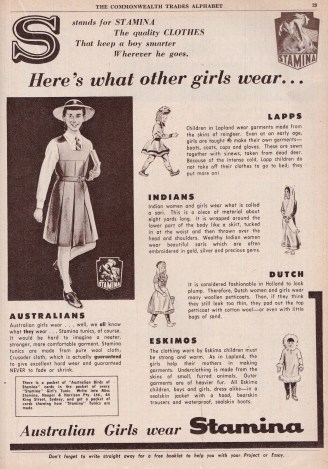
Australian primary and secondary industries, many no longer in existence, were well represented, along with imported products. CSR Sugar, Balm Paints, Crusader Cloth, Davis Gelatine, Exacto Cotton, Eta Peanut Butter, Commonwealth Savings Bank, Stamina Clothes, Wrigleys Gum, Pelaco Shirts and Rinso were some of the advertisers.
As today is the day for the letter “T” I will end with the Trades Alphabet contribution for that letter.
Just in case you think this is all too male oriented here is their page for girls.
Did you realise, as I just did, that they had their headings mixed up?
Who’ll stow his white collar and put down his pen.
We’ll blow down a mountain and build you a dam
Much bigger and better than Old Uncle Sam.
By William Lovelock
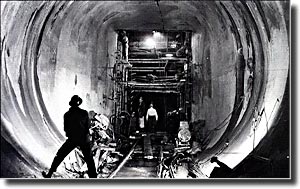
Construction of the Eucumbene-Tumut tunnel, 1958 multiculturalaustralia.edu.au
The Snowy Mountains Scheme was the largest engineering project ever undertaken in Australia. Begun in 1949 it employed men from thirty countries and is an integrated water and hydro-electric power scheme diverting the snow fuelled waters of the Snowy River to the Murray/Darling Basin.
Oh what fun, Oh what fuss, in our Pioneer bus, on the road to Eucumbene! busaustralia.com
On one of his business trips to Cooma my father had a few days to kill. He booked a three day Pioneer Bus Tour of the Snowy Mountains for us both and so at the age of eight I was able to see tunnels, dams and power stations of this great post war enterprise. It was not yet complete and so the huts used by the workers were still on site. We visited Cabramurra, the highest town in Australia, and Khancoban, another town constructed especially for the scheme. What captured my imagination were the towns inundated by the rising dam waters, Jindabyne and Adaminaby. Some buildings, mainly churches, were moved brick by numbered brick to the new town sites. Others like the hotels, sank below the waters and could be glimpsed from above at times of low water.
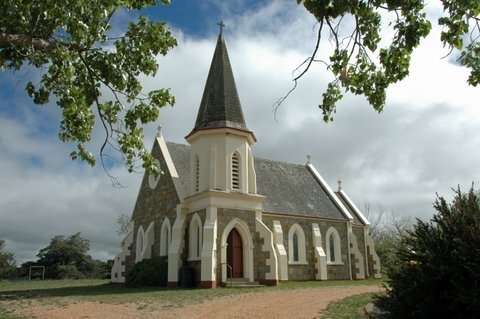
St Johns, Adaminaby, moved in 1956/57 homenetspeed.com.au
Our driver taught us all four verses of Snowy River Roll as well as The Pioneer Bus Song which followed the tune of The Road to Gundagai. Instead it was the “Road to Eucumbene”.
The most exciting thing about the tour, however, was the presence of another girl on board. She was a couple of years older than me and we sat together on the bus talking non-stop. I think my father was a little jealous as he commented that I wasn’t observing the surrounding scenery as closely as I should.
I kept in touch with Jennifer by mail until she finished university, married and moved to America.
In the northern hemisphere Easter heralds the coming of Spring, but in Australia it occurs in Autumn and what better time to showcase the produce of the previous summer than over the Easter break.If Empire Day was the most exciting day of the year then the visit to the Royal Easter Show in Sydney came a close second.
Even getting there was exciting. The first stage was catching the train to Central. Then we would join the queues waiting for the buses to the showground at Moore Park. Entering the gates there was the thrill of expectation. Rides, showbags and displays were anticipated with great enthusiasm.
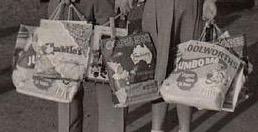
1960s showbags Maria Stufano Daily Telegraph, April 12, 2014
The dilemma was whether to buy the showbags early and avoid the crowds or leave them until last and so avoid carrying them around all day. The showbag was the proof you had been there and was something to look forward to once you arrived home. Examining the trashy, rubbishy items within and nibbling on the cornucopia of normally banned sweets was a rare treat indeed. One year my father decided that showbags were a waste of money and bad for my teeth so we didn’t buy any. My disappointment and outrage was prodigious but to no avail.
Jimmy Sharman’s Boxing Troupe Royal Easter Show 1956-1962 By Morris, Raymond. Contributed by National Museum of Australia.
S John Ross TTaylor Wikipedia
There were other attractions of course. The sideshows and rides were exciting. As a small child I was content with the merry-go-round, the ferris wheel and the ghost train. We saw and occasionally went into tents showcasing Jimmy Sharman’s Boxing Troupe, Smoky Dawson and a variety of illusions, magic acts and death defying feats. A man called S John Ross made a silhouette of my childish profile with great skill. He worked quickly with a pair of small scissors, cutting a portrait from thin matt black card. He then mounted the portrait on white card.
The Daily Telegraph April 10, 2014
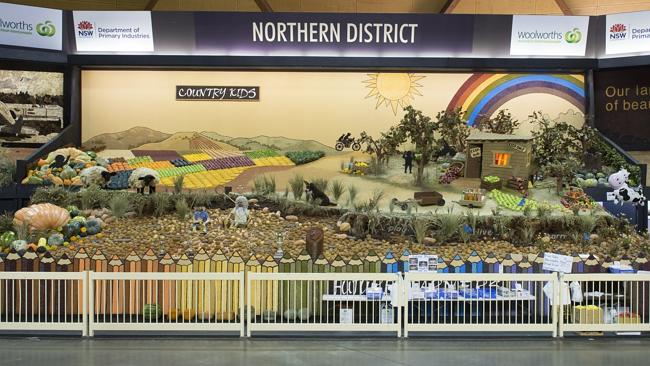
The prime purpose of the show was to showcase the best of the state’s primary and to a lesser extent secondary industries. The District Exhibits competition consisted of displays from four NSW areas and also South East Queensland. Large diaramas using wool, wheat, fruit, vegetables, sugar cane, cotton and preserves were judged on their originality, quality and aesthetic appeal. This was compulsory early viewing as well as the Arts and Crafts section, the cooking and preserves, the crochet, smocking and knitting. Then it was on to the animal displays where we saw prize winning cats, dogs, birds, fowls and even rats and mice.
Main ring at the Moore Park Showground showing the Grand Parade, 1950 (:Len Stone/Vic Solomons Collection:203)
The men in the wood chopping arena swung their axes, show jumping horses cleared hurdles in the main arena and neverending lines of horses, cows,sheep and dogs participated in the Grand Parade. I loved the show at night when all the lights came on, culminating in fireworks after which I sleepily headed for home.
The Easter Show has now moved to Homebush but still continues the traditions of its 193 year history.
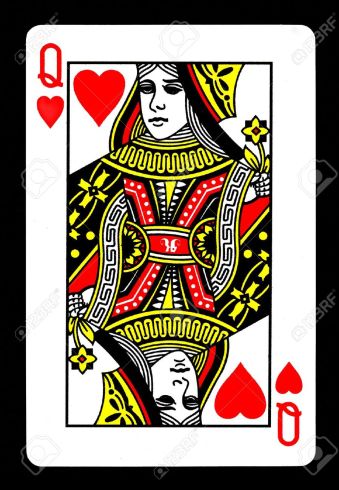
My father was a gambling man. Whether it was on the racecourse or in Thommo’s Two-Up School in Sydney he was always looking for that lucky break. He taught me to play poker almost as soon as I could read and passed the time that way on many a train journey. His most ingenious invention was not intended to make money but reflected his love of cards. For every card in the pack we had a secret code. Linden would pull up at a country hotel on one of his business trips, order a beer for himself and a raspberry and lemonade for me and then proceed to amuse the locals. He would produce a pack of cards, ask someone to choose one and then ask me to name it. Only once did I make a mistake and that was when he fed me the wrong information.
It worked like this. The code word for the suite of hearts was “mummy” or “mother”. It would not seem unusual to mention my mother in general conversation. As it was eight miles to Mittagong from our home my father might say, “Linda’s mother will be shopping in Mittagong today”. I would know that the card was the eight of hearts. Unfortunately I can’t recall all the codes nowadays as it is fifty five years since I last performed these tricks but the card numbers reflected how many dogs, cats, sheep or hens we had, the distances to various places and some aspects of our garden and home.
Staying in country or city hotels was a regular way of life for us. My father called me his “Shiralee”* and insisted I was getting a far better education travelling with him than attending school. In fifth class I missed fifty eight days of school. I learnt how to calculate the winnings on a bet in a horse race and discussed the possibility of life after death. My father didn’t believe in it but said if it was true he would get in touch with me after he passed on.
Boorowa Hotel
We sang songs, recited poetry, discussed how Harry Houdini escaped, examined the meanings of proverbs and talked about Henry Lawson’s short stories as the truck rattled and bumped its way through Boorowa to Cowra. I didn’t believe it at the time but I think he was right. My education with my father complemented and enriched what was learnt at school. I am so lucky to have spent time with him, especially as that time was so short.
The Shiralee, by D’Arcy Niland is a novel about a swagman who tramped the towns of Western NSW with his four year old daughter.
Freedom to choose where to go and what to do was the essence of play in the 1950s. Beyond the township of Yerrinbool was the Bargo State Conservation Area leading down to a tributary of the Bargo River. It was a magical place, with sandy beaches, overhanging caves carved out of the sandstone and large rocky areas leading to small waterfalls and deep pools. When I was younger I would be accompanied by older children from the local farms as we explored the untamed bushland. Later I would explore it on my own or take a friend to show them the secret places.
Our property had a large grove of Scots pine trees about thirty year’s old. They were excellent for climbing and from the top I could see across all our paddocks to the busy Hume Highway and the Sydney to Melbourne train line. I placed a “memory box” at the top of one of those trees. It is probably still there.
At night we would listen to serials on the wireless including Smoky Dawson, with his horse Flash and his sidekick Jingles. In conjuction with Kellogg’s Cornflakes we all joined the Smoky Dawson Wild West Club and received our Deputy Sheriff badge in the mail.
Influenced by the Famous Five books my friends and I would always be looking for adventures, often snooping on some of the lonely characters living in their huts on outlying farms. One day an older boy from school arrived with his home made bow and arrow and suggested we go hunting rabbits. We were unsuccessful, although we saw a few as we scouted the paddocks. My father nearly exploded when he found that the “arrow” actually had a nail embedded in the end. Poor Jimmy was sent home after an earbashing.
Friends, dogs, dolls and teddy
As well as tomboy activities I also adored dressing up. Pre-loved dresses, hats and gloves discarded by my mother and grandmothers were great adjuncts to journeys of the imagination. My playground was a yard full of strange objects, such as the enclosed back of a truck which made a great cubby house and wooden shelves under the trees for storing pipe fittings which acted as a boarding school for my dolls and teddy bears. Pets were roped in as pretend dolls and suffered being dressed up and wheeled around in prams.
Is this where my interest in building houses began?
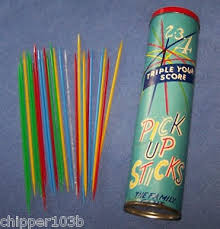
There were a few toys like the Bilda-brix set of red and white bricks for making houses and the Pick-Up Sticks where the black one had to be retrieved without moving the others.
.
Zorro was very popular for make believe as a black cape, sword and mask could easily be made. I loved my Zorro jigsaw which was something like this one.
My greatest desire was a real doll’s house with proper wooden furniture so I didn’t properly appreciate the home made version with matchbox furniture made by some unknown friend of the family.
Pogo sticks were all the rage. I tried to make one with a spring and a piece of timber but it didn’t work. I didn’t get a bicycle until my teens but bought an old scooter for 15 shillings from a girl at primary school. I then proceeded to wear out the sole of my left shoe as I rode it along the gravel road to school each day.
As an only child I was never bored. If I had no friends to play with I invented them. The imaginary ones were usually much more accommodating than real life people which probably accounts for some difficulties I had relating to others in my High School years.
After leaving Auburn South Infants School and relocating to Yerrinbool I was given the choice of attending Mittagong Primary School eight miles away from our home or the local one teacher school. Although I preferred the idea of the larger school the hour long bus journey each way was enough to convince my parents otherwise.
Sadly there are no photos of Yerrinbool School. This is the closest I could find.
Yerrinbool Public School was a cream coloured weatherboard box on brick piers, first opened in 1922. It had a corrugated iron roof, a closed in verandah and a cloak room where we left our bags and washed our hands.
Inside the classroom there were rows of wooden desks, upper division on the left and lower division on the right. As we moved up a grade, we moved one row closer to the front. The desks held inkwells that were filled by ink monitors when the need arose. Two blackboards on easels stood at the front of the room, each side of a fireplace and the teacher’s desk. Mr Scott would have all the work for the morning written up on the two boards. At the time of my arrival in First Class there were about thirty students. They were the children of apple orchardists and poultry farmers, itinerent railway workers and a few business people working in the bigger towns.
I soon settled into life at the new school. Playtime and lunchtime were periods of great freedom as Mr Scott stayed inside to eat his lunch and listen to Blue Hills, (a long running serial) on the wireless. There were cubbies built in the scrub and destroyed by opposing gangs, there were episodes of marbles and hoops and once a year Redback Town would come to life. This was a hard clay depression in the ground which for a few short weeks sported houses and shops made from bark and leaves, joined by dusty roads on which we placed our toy cars. Then as quickly as it started it would vanish. We played Simmonds and Newcombe, the names of two Long Bay Gaol escapees and told jokes about them.
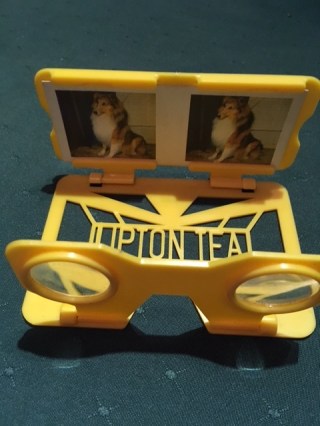
Collecting cards was the craze when I first arrived. Beautiful bird cards from Lipton Tea became a most desirable possession and swapping took place every playtime. Over the years we collected 3-D cards from Weet-Bix and Lipton Tea, Birds, Beetles and Sea creatures from Shell Service Stations, plastic cars, trains and boats from Kellogg’s Cornflakes. They were all free but we had to consume large quantities of the product to complete our collections.
Sport consisted of rounders every Friday afternoon. This was quite exciting because Sir would come out to bowl. He was, as the local mothers put it, “past retiring age” so as my years at Yerrinbool progressed he became increasingly less active. Even our annual “Bird Walk”, the only excursion we ever had, was indefinitely postponed in our final year.
The wireless was our main source of entertainment and diversion at school. “Tales of Many Lands”, “Health and Hygiene”, “Let’s Sing Together” were some of the programs. They must have been a great help to a teacher trying to manage seven classes, but we ended up all learning the same things as we couldn’t help but listen. Our visitors were few, but a Bowral Real Estate Agent drove out once a week to give us our Scripture lesson.
As we had no homework I would memorise songs from my Broadcast Book or learn poems. The long dreamy afternoons were spent reciting, drawing and painting, weaving baskets and singing or listening to Mr Scott reading extracts from Perseus and Medusa. There seemed to be little money spent on the school but I remember Mr Scott purchasing a set of illustrated Social Studies books on early Australian explorers. Adding pictures to the words made them slightly more interesting as we followed the often disastrous journeys of these driven men. The only time I was motivated by my drab Social Studies book was the description of the voyage by ship from Sydney to London via the Suez Canal. The exotic ports of Singapore, Colombo, Aden and Port Said, the mysterious pyramids of Egypt and ancient treasures of Greece and Rome eventually led to England, the country of my ancestors, so familiar and yet so distant.
We went from this
To my annoyance my teacher insisted we write business letters or letters to friends for Composition every second week. The other week we were allowed to use our imagination. He said we would write far more letters than stories when we were adults. Handwriting changed significantly over the years.
to this
Not long after we progressed from printing in pencil to copperplate with pen and ink, a new handwriting syllabus appeared. The new writing was called Modified Cursive which meant we had to relearn our letters. No longer were we encouraged to use thin upstrokes and thick downstrokes. Capital letters became simpler and loops were removed. To help us the Department provided us with new pens with small reservoirs which meant less dipping in the ink. Ball point pens and fountain pens were unknown until I reached High School. Every week we would do Mapping with a special fine mapping pen, choosing a country from an atlas where many of the countries were coloured red, drawing in freehand, trying not to smudge the ink.
The World in 1957
Arithmetic was my father’s specialty. He had been caned at school for making one mistake in an important exam. The pressure was on to get a perfect score which I rarely did. We were still using Pounds, Shillings and Pence, often multiplying these amounts by three figures. Strange and useless tables were learnt like “pounds in a bushel of wheat, oats, barley” (they were all different). Rods, poles and perches, chains, yards and feet all became obsolete a few years later when the metric system was introduced.
The only other change in the school over the six years was a square slab of cement poured onto the hard baked clay at the front of the building. Mr Scott would clap his hands at the top of the step and we would line up on the new surface, say good morning and march into school. We even had Folk Dancing on the cement broadcast from the wireless but that stopped when the numbers became too low. By the time I reached sixth class there were four children in my year and two in Kindergarten. Once we four went to High School the school was permanently closed and Mr Scott retired.
I left Primary School determined to do two things. One was to become a teacher and the other was to travel the world.
“Nice? It’s the only thing,” said the Water Rat solemnly as he leant forward for his stroke. “Believe me, my young friend, there is nothing—absolutely nothing—half so much worth doing as simply messing about in boats.”
from The Wind in the Willows by Kenneth Grahame
One of my happiest memories of the few years I had with my father was our fishing trip to Sussex Inlet. Waving goodbye to my long suffering mother we drove down Macquarie Pass in the truck, singing “Gone Fishin’” all the way.
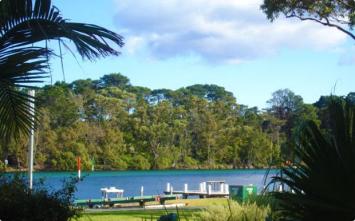
The view from the current RSL Club
Our accommodation was a cut above the basic hotels where we usually stayed. It was a guest house called Heimdall spread out along the waterfront on beautiful Sussex Inlet. The gardens were filled with exotic trees and the octagonal dining room looked out across the water to another famous guest house, Christian’s Minde.
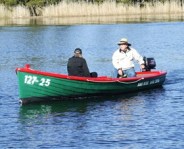
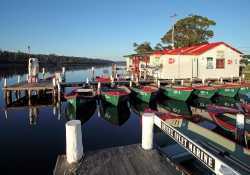
The boats haven’t changed in 60 years
My father hired a motor boat and fishing equipment. We motored towards the sea past magnificent sandhills which I loved to climb and roll down. Then we turned around and headed towards the entrance of St George’s Basin. The colour of the water was unbelievable with the clean yellow sand below the clear water. I caught the first fish of my life, a leatherjacket and learned how to take it off the hook.
Ready to go fishing
So began my love of boats and Sussex Inlet. As an adult I have returned many times. Alas, the guest house had gone and has been replaced by an RSL Club. Development has changed the town but not too much. It is still a great place to launch your boat and go fishing, swimming, sailing, paddling or pedalling.
I was interested to discover that Heimdall belonged to the same family as Christian’s Minde so I have written a very abbreviated history of the family based on information provided by the Sussex Inlet Computer Club.
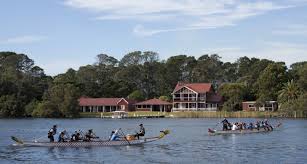
Christian’s Minde as it is today
The oldest existing building in the Sussex Inlet district is the Christian’s Minde complex located on the north shore of the Inlet.In 1880 Jacob Ellmoos, a seaman from Denmark, was granted a selection of 1200 acres in an unspoilt fisherman’s paradise. He enthusiastically invited his parents and siblings in Denmark to join him. Despite hardship and family tragedies, a guest house was opened in 1890, the only one between Port Hacking and Twofold Bay. The home was given the Danish name of Christian’s Minde meaning “To the memory of Christian”, the name of both Jacob’s father and his late brother, during a traditional Danish wreath-laying ceremony.
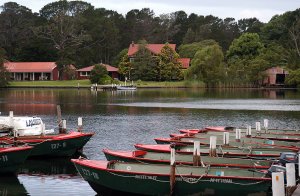
Wooden boats for hire
In 1915 the Commonwealth took over the Inlet and part of the land bordering St Georges Basin as a part of the Australian Capital Territory (ACT).Jacob was compensated by the government and bought land on the southern bank.On a part of this site, he established another famous guest house Heimdall which he and his family controlled until the site was purchased by the Sussex Inlet RSL Club.
Christian’s Minde is currently being renovated but a small house in the complex can be rented for a short holiday break.
I am standing with my children in front of the house where Elsa was born
Walter and Myrtle, Elsa’s parents
Life was never easy for my mother. Born in Williamstown, Victoria in 1917, she attended Williamstown North Public School between the ages of 6 and 8 until her mother took her away from her home and father and resettled in Glebe Point. There she attended Forest Lodge Public School. At the age of 11 she moved again to Charleville in Queensland. Kay arranged for Elsa to board with a family and attend the local high school in Roma, Queensland. My mother felt she was being exploited as she was asked to do increasing amounts of housework and ironing so when she turned 15 she begged to leave school and the family she lived with.
She must have a trade, of course, so like her mother she became a dressmaker. After six months as an apprentice in Charleville she was able to obtain a position with Lucy Seekers in Melbourne and boarded with her Aunt Harriet and Uncle Ed in Williamstown. She told me how she would spend weeks perfecting one skill, such as collars, before moving onto another, like buttonholes. This way all the machinists worked together to make garments.
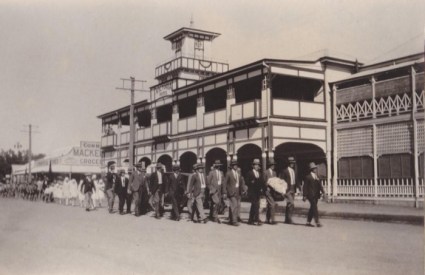
The Victoria Hotel in Goondiwindi in 1934
Why she was working at the Victoria Hotel in Goondiwindi at the age of 17 I don’t know, but that was where she met my father. She insisted she wasn’t a barmaid. She would have been too prim and proper for that. Her job was at reception where one of the guests she checked into the hotel was Linden Price.
Six months later they were married. It must have been a much more exciting life than she had experienced. Linden drove fancy cars, went to the races and ate out at the best restaurants. Life with Linden was a roller coaster but it wasn’t boring.
Elsa with Mr Munro before I was bornElsa looking very smart
I used to think my mother was the most beautiful, courageous and capable woman in the world. When my father died she had a lot of decisions to make. The business was running at a loss and the bank was owed a large amount of money. One option was to sell the property and move to Sydney near her mother in Mortdale. She contemplated getting a job in a hardware store as she jokingly said her knowledge of crosses, tees and elbows, male and female threads, nipples, couplings and unions was second to none. Then again, she had spent years running a steel and piping business, as my father was often away so why not stay on at The Waterhole?
My mother with a piece of piping
Within a year she had repaid the overdraft. No-one was allowed to buy on credit. She travelled widely through NSW and bought second hand piping whenever it became available. Because she was a widow and a woman she was afforded unexpected respect from her male counterparts. The men who worked for my father were asked to leave and she outsourced jobs such as welding for making gates. She employed a house cleaner so she could devote herself to the business. She had a large bedroom built on the back of our house so she keep a watchful eye on her mother-in-law and Mr Munro who were by now living with us.
Life was not easy. Ella was devastated by the loss of her only son, Linden, and eventually became bedridden. Every night she rang a bell three or four times asking for my mother. Elsa was sleep deprived and exhausted. Finally Ella moved to a convalescent home in Oatley, near my other grandmother so we visit her every school holidays. My mother had a new kitchen built to replace its dark and dingy predecessor and redecorated the lounge room.Mr Munro relocated to a renovated building on the property.
Despite the loss of my father I had a secure childhood and felt loved and wanted by my mother. Our relationship had a closeness that she had never experienced with her own mother.





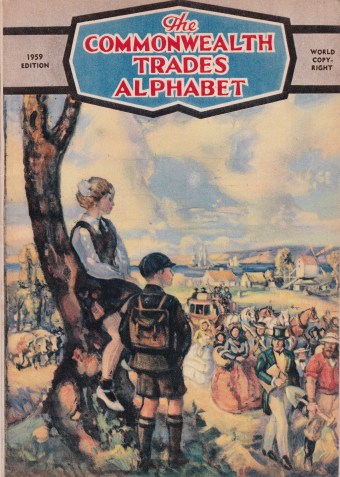 When I first compiled my list of A to Z topics I immediately thought of the booklet that gave me a huge amount of pleasure in my primary school years. It was the Commonwealth Trades Alphabet and like the A to Z Challenge, each page was devoted to a different letter, in this case representing an Australian Industry. It may sound rather dry and boring – a booklet where the only splash of colour was on the front and back cover, but it was interactive in the best sense of the word. Great was the excitement when, once a year, Mr Scott would unwrap a parcel containing enough copies for every child in the school.
 The key to its success, apart from the simple stories in pictures told by the advertisers was that every product supplied an address to write away for extra information. That meant that we received mail in a continuous flow for weeks or even months. Colourful booklets, charts, maps, sets of cards, projects and best of all, free samples would arrive at the local General Store cum Post Office to be collected on the way home from school. Here’s where our teacher’s letter writing fetish bore fruit as we all happily wrote our “Dear Sir” and “Yours Faithfully”. The most popular advertiser was Actil. The project material they sent considted of little samples of cotton at each stage of production, from fluffy balls to yarn to sheets and terry squares.




 My father was a gambling man. Whether it was on the racecourse or in Thommo’s Two-Up School in Sydney he was always looking for that lucky break. He taught me to play poker almost as soon as I could read and passed the time that way on many a train journey. His most ingenious invention was not intended to make money but reflected his love of cards. For every card in the pack we had a secret code. Linden would pull up at a country hotel on one of his business trips, order a beer for himself and a raspberry and lemonade for me and then proceed to amuse the locals. He would produce a pack of cards, ask someone to choose one and then ask me to name it. Only once did I make a mistake and that was when he fed me the wrong information.
 At night we would listen to serials on the wireless including Smoky Dawson, with his horse Flash and his sidekick Jingles. In conjuction with Kellogg’s Cornflakes we all joined the Smoky Dawson Wild West Club and received our Deputy Sheriff badge in the mail.

 Zorro was very popular for make believe as a black cape, sword and mask could easily be made. I loved my Zorro jigsaw which was something like this one.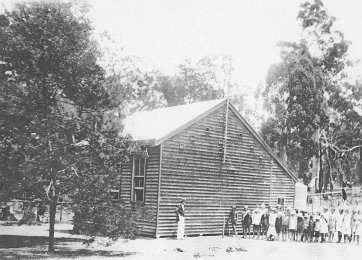
 Collecting cards was the craze when I first arrived. Beautiful bird cards from Lipton Tea became a most desirable possession and swapping took place every playtime. Over the years we collected 3-D cards from Weet-Bix and Lipton Tea, Birds, Beetles and Sea creatures from Shell Service Stations, plastic cars, trains and boats from Kellogg’s Cornflakes. They were all free but we had to consume large quantities of the product to complete our collections.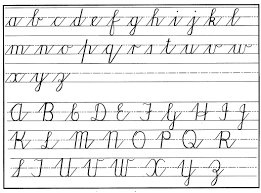






 Life was not easy. Ella was devastated by the loss of her only son, Linden, and eventually became bedridden. Every night she rang a bell three or four times asking for my mother. Elsa was sleep deprived and exhausted. Finally Ella moved to a convalescent home in Oatley, near my other grandmother so we visit her every school holidays. My mother had a new kitchen built to replace its dark and dingy predecessor and redecorated the lounge room.
 The Curry Apple Orchard