In 1862 Emma Moore was alone, 17 years old, sailing to the opposite side of the world. She would never see England or her family again.
My grandmother said. ” My father’s parents were both English. They were sweethearts in England. He came to Australia first, she followed later. They were married at Warrnambool and reared their family there”.
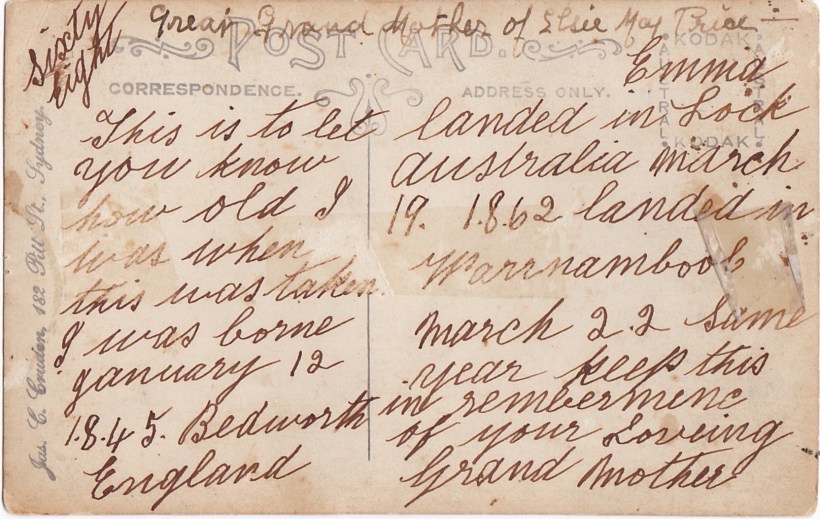
I even have a postcard written by Emma who states her date of birth and her birthplace as Bedworth, Warwickshire, England.
Unfortunately I can’t find a record of her birth that fits the dates she supplied. Either the dates are wrong, or the birthplace is wrong. Maybe some people just didn’t have their births recorded or it isn’t on the internet. I do have two records of her travelling on the Shackamaxon to Australia. One says she is 17. The other that she is 18 and can read but not write. She is to work for a Mrs Dooley of Warrnambool as a servant for 20 shillings and sixpence a week. The passengers of the Shackamaxon were mostly single females, optimistically seeking a new life and a husband in the Colonies.
SHIPPING INTELLIGENCE
The Ship Shackamaxon, with her Government Immigrants on board, was towed alongside the Government Railway Pier, Williamtown, yesterday morning. Her passengers were forwarded to Melbourne by special train.
The Argus (Melbourne, Vic. : 1848 – 1957) Thu 20 Mar 1862 Page 4
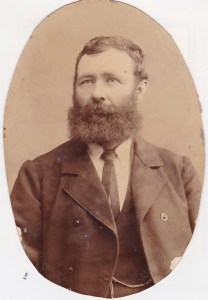
Henry Lock
I can find a Henry Locke on the Anglesey in 1861 but his age is recorded as 30 and he is a “Trader”. Our Henry Lock was only 22 but maybe he put up his age.
They married in 1865 in Warrnambool so it makes sense that Emma would work as a servant until Henry was able to establish himself. By 1868 they were in Port Fairy (known as Belfast), in 1870 in Warracknabeal and by 1878 back in Warrnambool. They had six children with my great grandfather, Reuben Benjamin Lock, arriving last but one in 1872.
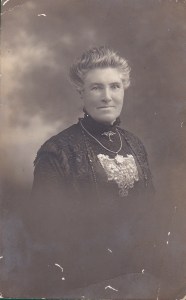
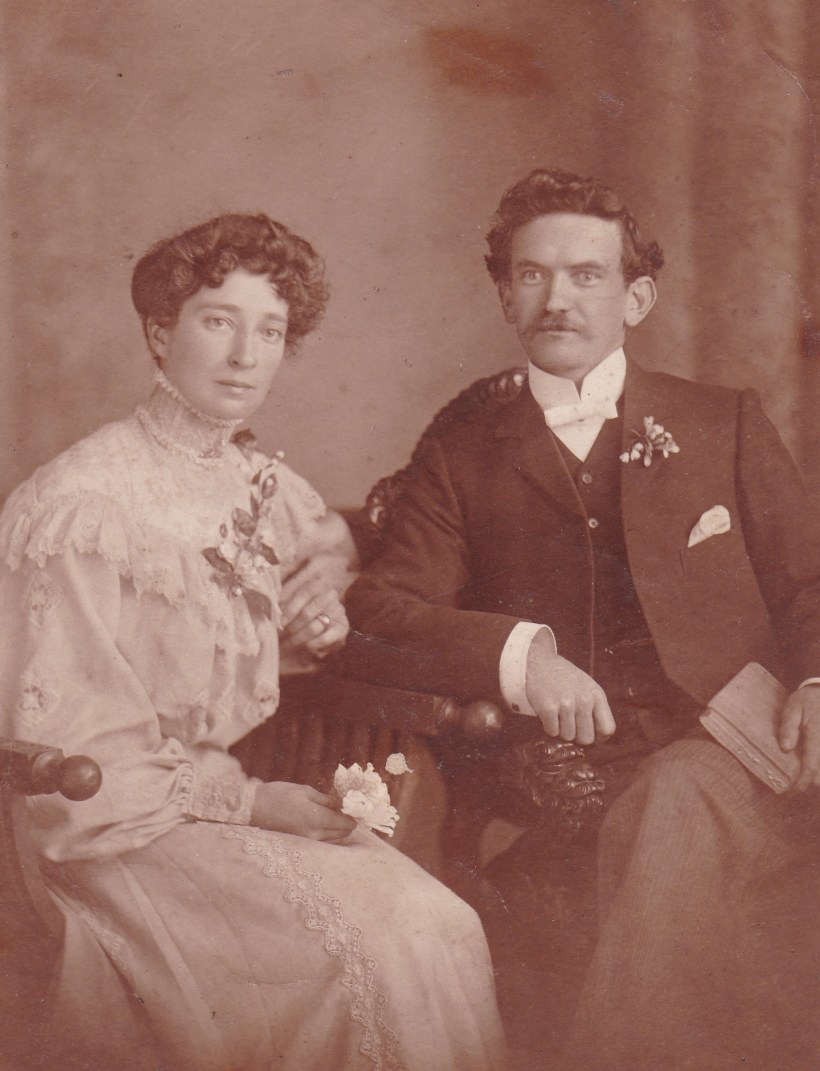
Emma Moore
My grandmother said they had a boat called “The Rookie” which ran between Warrnambool and Melbourne but I can’t find anything about it. Henry later worked on the railways which would have been hard work for an ageing man.
This photo was taken when Emma was 68. This was the year (1913) that her husband Henry died at the age of 74. She lived to be 81.
When I was a child I was told my grandfather Walter Sydney Hall died when my mother
Myrtle aged 25
was eight. This wasn’t true as my grandmother left Walter and took her only child with her to Sydney. Interestingly this event coincides with the death of Myrtle’s mother Christina. I am unable at this stage to find any records of a divorce although I was later told this took place.
Myrtle with her first husband and my grandfather Walter Sydney Hall
As a trained dressmaker Myrtle was able to support herself and her daughter but I am guessing when the Depression arrived around 1928 the demand for bespoke gowns declined considerably. Myrtle next appears in Queensland at my mother’s wedding in 1936 but now her name is Dighton. Walter Hall died in 1933 so whether she married after she became a widow is unknown. Like my other grandmother she worked on properties as a housekeeper so probably met her second husband in that capacity.
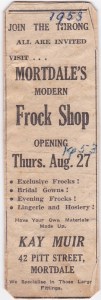
Frederick George Dighton was an overseer and in 1943 they were living at Gidyea Plains, Charleville. The rare times his name was mentioned he was not remembered fondly. Sometime between 1946 and 1953 Myrtle married George Muir in Sydney, NSW, changed her name to Kay and opened a “Frock Shop”. I remember the apartment upstairs with its modern kitchen and bathroom, the dress shop below and the large workroom behind with long cutting tables and sewing machines.
The love of Kay’s life was also called George but she never married him.
George, the man Kay should have married
She used to frequent fortune tellers and was told by one she would marry a man called George. She happily replied that she was planning to marry a George. The fortune teller warned that the man she was to marry she hadn’t yet met. Did she marry George Muir for the prospect of being able to build and open her own dress shop? It was an unhappy marriage. As a small child I remember the tension in the air when I visited. When Kay Muir Frocks was sold in 1963 my grandmother left her last marriage and men behind forever.
She avoided her last husband by living quietly at Bonnie Vale Beach near Bundeena, south of Sydney and later bought a unit on the beach at Cronulla.
I can’t find any records of the divorces. I would like to know why she left the men she married. She had such a charming, outgoing personality but seemed unable to find and keep a soul mate.
John Curry (my husband) knew that the Currys had come to Australia by sailing ship, arriving in Melbourne in 1870 before heading off to the Gold Fields of Victoria. John Currie (wrong spelling), Miner, is listed on the shipping records of the Percy with his wife Margaret, son John aged 9 and then on another page is 17 year old Andrew (John’s Great Grandfather) also a Miner and his brother James aged 12.
Andrew Curry later in life
Andrew didn’t keep a diary as far as we know but we have the next best thing.
A 20 year old quarryman called Thomas Pierce kept a journal of the voyage. He may have even swung his hammock near to Andrew and John. I have summarised the highlights of the trip.
Thomas boarded the Percy on Christmas Eve but the ship didn’t sail until January 2nd. In the meantime it snowed and the younger passengers had a great time throwing snowballs across the deck. Sadly one infant died before the ship left shore.
As they tacked across the Channel many of the passengers were “shooting the cat” or to put it simply, vomiting over the side. When they approached Gibraltar the passengers enjoyed dancing on the fo’c’s’le accompanied by a concertina, fiddle and tambourine. Nearing the Canary Islands they all suffered from the intense heat, lying about the deck trying to catch a breath of air.
Crossing the Equator was fun, with some acting as barbers and shaving the men. Rockets were let off and a man scared the girls by dressing up in a sheep’s skin.
After many days they sighted Pernambuco (South America) where they traded with the natives and were able to send letters home.
Every few days another child died of fever. Church services were held by lay and religious people on various parts of the ship and rousing sermons formed part of the entertainment.
By March the weather was as cold as it had been in England. On April 16 the ship hove to off Port Phillip Bay near Melbourne. All on board were examined by a shore doctor and on the 18th they were sent ashore to the Quarantine Station for a week.
To those from the ship it must have seemed like paradise. It resembled a magnificent park fringed on one side by a beautiful beach. Andrew and his brothers would have enjoyed bathing at the beach, fishing, rambling in the woods, chasing kangaroos and sleeping in the large barrack style rooms.
Boonal (pronounced B’nall as in shawl), Bogan Gate, Boggabilla, Berrigagama, Bogan River, Barcoo, Boggabri, Budgery… These are names that swirled around my impressionable ears as the adults talked. Hundreds of unlabelled, sepia photographs of horses, cows, lambs, droughts, farmhouses, buggies and early model cars show tantalising hints of my paternal grandmother’s life as a widow.
Ella and John Price on their wedding day
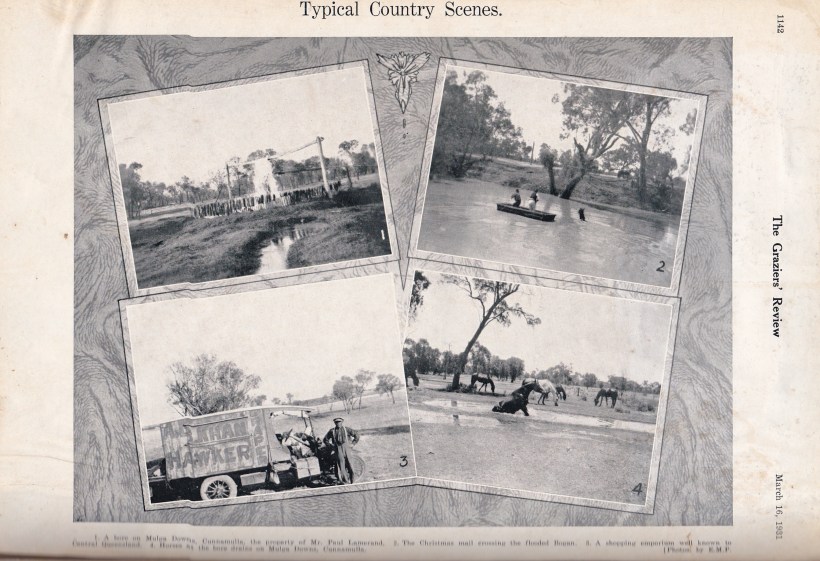
When my grandfather, the stationmaster, died suddenly, my father was only six years old. Ella was 38 and had to make ends meet. Her photos published in the Grazier’s Review give a Rose Bay, Sydney, address but they indicate she had travelled widely to stations all over NSW and Queensland. She worked as housekeeper and station cook. Her published stories describe “The Station Woodhead” and “Drought in the Outback”. She called herself Ixia and Ilex in various publications and wrote rather strict, moralistic articles on modern trends as well as descriptions of life in the bush.
So what happened between 1913 (when John Henry Price died in Bogan Gate) and 1930 when she appears at Boonal working for Mr Munro? I recently found a document in the NSW Will Book 1800-1952. It seems that Ella and Linden moved to Marrickville, Sydney after the sudden death of her husband. She may have been staying with relatives as her mother-in-law lived there. It seems John Price didn’t make a will but she ended up with £504-4-6. I wonder did she put aside this money for Linden’s education and then answer an advertisement for a job as housekeeper and cook for Mr Munro? She may have worked for other people first but I am pretty sure when my father started Newington in 1918 she was in Mr Munro’s employ.
An article I found on the internet entitled THE MUNRO’S OF WEEBOLLABOLLA by Judy, Jac, Jen, Sandy, Treen and Kirst, descendants of the pastoral family, mention my grandmother’s employer Alfred Munro, once:
Alfred (the second son) received 3,865 acres of Boonal on which he lived, unmarried until he died in 1974 at 100 years of age.
This is incorrect because Alfred died in a Bundanoon Nursing Home at the age of 99. I know because I visited him every second Sunday with my mother. Also of interest in the article
Charles Alexander, a popular and capable man and the third of Alec’s sons, received 3,064 acres of Boonal. He established a Poll Shorthorn stud at Kondar, Goondiwindi with poll cows from the Goodar herd which he selected as part of his entitlement.
This might infer that Alfred was neither capable or popular. In spite of this (or maybe because) Alfred seems to have moved about a lot, managing various stations, with my grandmother in tow. Although she denied it, I wonder if he paid for my father to go to Newington? My father told me that a position was found for him as a trainee wool classer when he left school and Mr Munro offered to pay for him to attend university in Scotland. He turned down the university offer and left wool classing after deciding he wanted to be his own boss. When my father met my mother her life became inextricably linked to Alfred Munro as well.
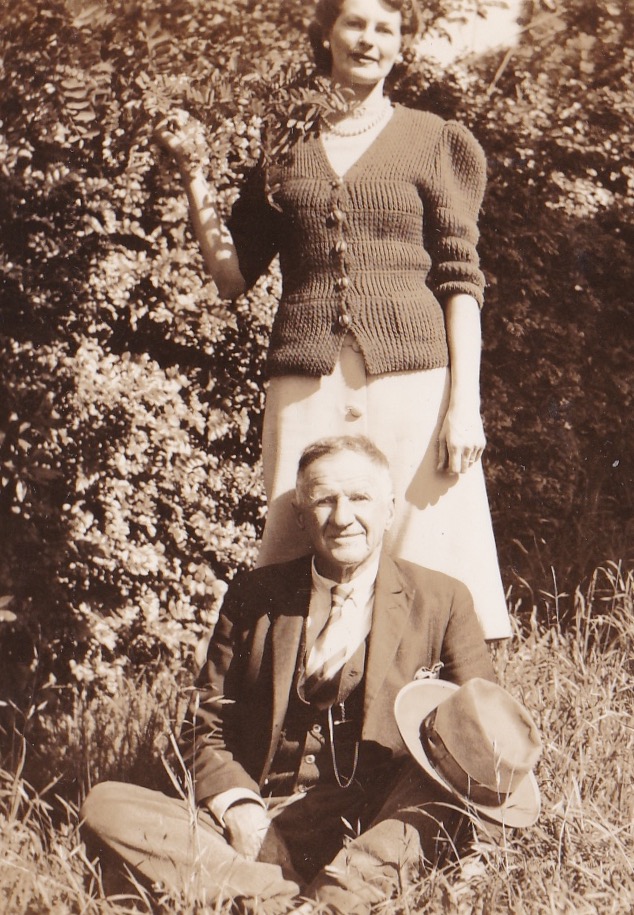
My mother Elsa (standing) and Alfred Munro (seated)
In 2013 an article appeared which showed Boonal was still a station although somewhat changed from the ‘20s and ‘30s.
Fifth-generation farmer Sandy Munro is taking advantage of renewed corporate interest in large rural operations, putting his family’s $30 million-plus Boonal station in northern NSW up for sale. The 9800-hectare Boonal station is in the Moree-Goondiwindi district, one of the wealthiest agricultural regions in Australia.
In order to find where my grandmother Ella lived between 1913 and 1930 I traced Alfred Munro’s whereabouts. As a station manager his name appeared more often than my grandmother’s.
In 1913 he resided at Lignum Station, Yetman. In Wikipedia it states, “The thick rabbit and prickly-pear-ridden scrub of the Brigalow and Belah country was reclaimed from expiring leases in the 1920s and the back-breaking work of rendering it fit for agriculture did not bear fruit until the 1950s when wheat-growing became and remains a highly successful enterprise”.
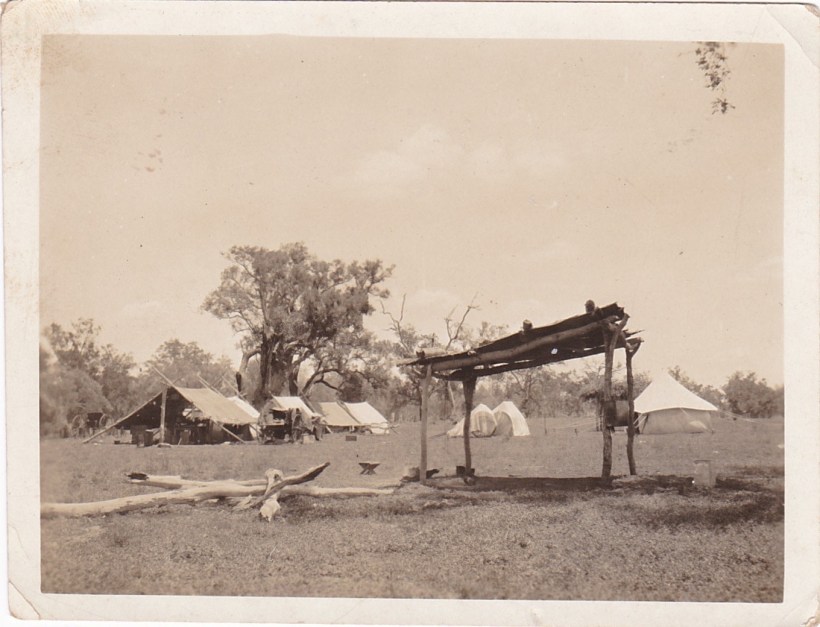
Rabbiter’s Camp on the Gwyder, Warialda
It doesn’t sound like a desirable location at the time but Alfred was there in 1913-1914, back to Boonal in 1915 and then in Lignum from 1916 to 1920.
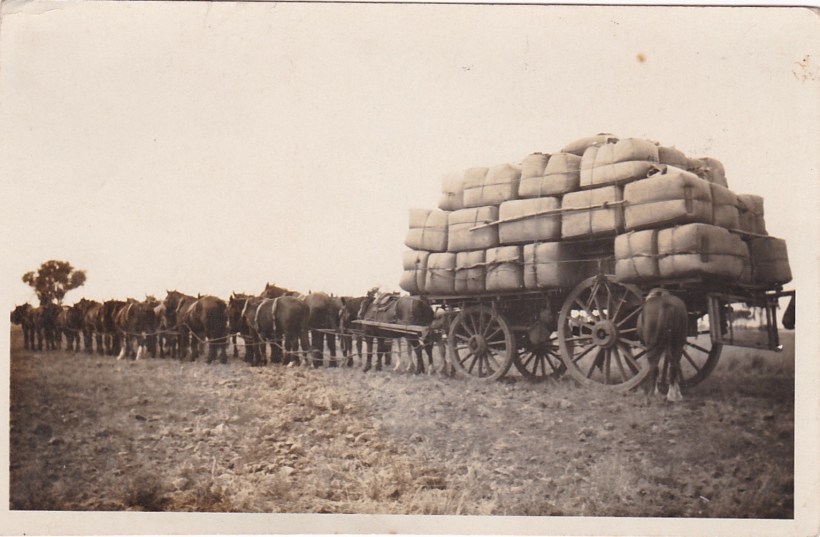
Wool Teams at Lignum, Boggabilla
In her published photographs Ella shows scenes from Mulga Downs, Cunnamulla in South West Queensland, the property of Mr Paul Lamerand. In one of the pictures is the Christmas mail crossing the flooded Bogan. I think it is the same square boat where my father and his “little friend” are photographed on the Bogan River in June 1914.
The right hand photo at the top is the Christmas mail crossing the flooded Bogan River.My father and a friend on the Bogan River
Meanwhile I found my grandmother as a housekeeper in 1922 at Dirranbandi, which is in south west Queensland also. After searching through thousands of records this is where I am. I know Ella and Alfred went to Norfolk Island during World War 2 and have hundreds of photos to prove it, but that is another story.
Shortly after I first met John he took me to the Argyle Cut in The Rocks, Sydney, to show me the plaque honouring his Great, Great, Great Grandfather John Sutton. It stated simply that he was Mayor of Sydney in 1866. Three or four times since we have looked for the plaque but it seemed to have disappeared. Only a few days ago we tried again and to our astonishment it had returned. It looks as though it may have been hidden by a spreading, espaliered fig tree all these years and now that the tree has been chopped back it has been restored to us.
The Rocks has the flavour of old Sydney. It is an historic area which nearly disappeared under the demolisher’s hammer but was saved in 1973 by Jack Mundey’s Green Ban. The Argyle Cut was begun with convict labour in 1843 to provide direct easy access between Millers Point and The Rocks but was not completed until 1859, with the use of explosives and council labour.
John Sutton arrived with his wife Ann and two children, James aged 8 and George aged 6 in 1842 on the Marchioness of Bute. It may say something about his character to read in his journal that he wrote:
Not satisfied with Manchester my Dutie called me to Emigrate and so set sail for Sydney, NSW from Liverpool by the ship Marchionefs of Bute 850 tons on Sunday morning, 12th September 1841 20 minutes before 5 pm and after a long voyage cast ankor at Brown’s Wharfe, Darling Harbour, Port Jackson, Sydney, NSW on Friday morning, January 7th, 1842 five minits past 7 o’clock being 117 days out at that time. 3000 emigrants just arrived, one empty room 14/- shillings per week, rump stakes 1 penny per lb, Tea 1/- per lb, sugar 2 pence per lb, butter 3/6 per lb. Wages 10/- per day for tradesman every one soon got work.
He set himself up as a builder and slater with premises in Palmer Street. His obituary states he built many of Sydney’s public buildings. John Sutton was Alderman for Fitzroy Ward from 1 December 1858 to 30 November 1866. He was Mayor of Sydney in 1866.
Now here is the mystery. We have in our possession a Grandmother chair. With it is a photo of the chair from earlier times. Written on the back it says it was owned by John Sutton and was a wedding present from Mark Foy.
After doing some research on Mark Foy, it appears he and his brother opened a store in Sydney in 1885. It wasn’t until 1908 that they opened their grand department store based on the Parisian Bon Marche´. John’s wife Ann died in 1876, and the following year he married Melissa Dorcas (Dolly) Stone. Even if Mark Foy had given John Sutton the chair on the event of his second wedding this would not make sense, as Mark was only 12.
John Sutton’s granddaughter, Grace Elizabeth Sutton was married to William Thomas King in 1887 so maybe that is when the chair was gifted from Mark Foy. Looks like some further research is needed.
Here is the chair after a makeover in the 1940s and as it looks now after another makeover in the 1970s. It was actually part of a suite of grandmother and grandfather chairs with a chaise lounge.
I was fortunate to have two wonderful grandmothers who told me lots of family stories which, as the only grandchild, I accepted without question. Somehow these stories and whether or not they can be verified, will be the topic of this year’s A to Z (2017). As well, I have in my hands the stories from my husband’s family so will include some of those as well. There is still much to be discovered in our family history although we have both been doing bits and pieces for many years.
It is a little unusual, I think, that all my ancestors and those of my husband came to Australia between 1850 and 1870 from England, Northern Ireland and Scotland. Of course this was a time of massive immigration to Australia, but to have every one of them set sail from Great Britain within a twenty year period is rather remarkable.
It must have been easy to make up stories about one’s past when in a new country. My grandmothers may have elaborated on the truth or maybe they simply passed on exaggerated and tall tales from their parents. Hopefully by the end of April the truth will out and future generations of my family will have a clearer idea of where they came from.
In one hour we will be in Sydney.It has not been a bad flight although it was delayed by two hours and we walked from one end of LAX to the other when our departure lounge was altered.We both bought soft neck pillow which made sleeping a lot more comfortable.We also managed to score three seats between us which gave us more room to move.
Leanne and Gary picked us up at 10.00am and drove us to the Getty Center.It is high on a hill and is surrounded by stunning gardens and views over Los Angeles.
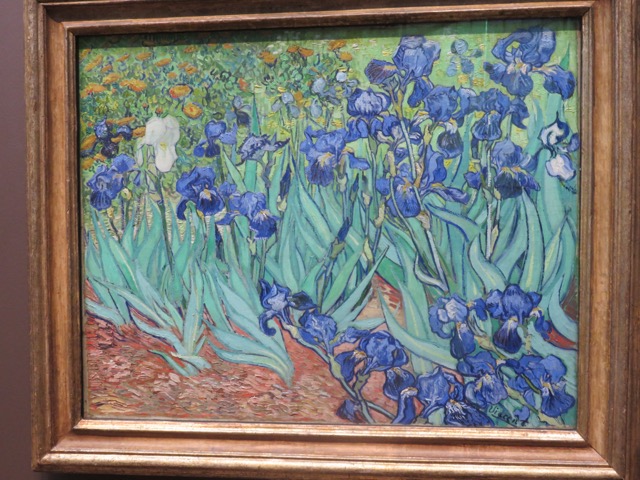
We decided to do a guided tour of the highlights of the museum.We were given headsets so we could hear the group leader easily.By asking lots of questions she made us think about various aspects of the art work we were observing.The first painting we saw was Van Gogh’s Irises which is a permanent exhibit which never goes on tour.Painted in the sanitarium in St Remy it brought back memories of our holiday last year.It had belonged to Alan Bond but he lost it when he was made bankrupt.
Leanne and Gary were keen to see a photographic exhibition gifted to the Getty by Robert Mapplethorpe and Samuel Wagstaff.Mapplethorpe was a visual artist who influenced his wealthy lover and art collector to develop an interest in photographs. His photographs of male and female nudes are impressive and confronting.
One picture in the Wagstaff collection depicting three cats flying, water thrown from a bucket, an easel, a footstool and Salvadore Dalí all seemingly suspended in mid-air had me wondering if any cats had come to harm in the making of the photograph.
Dali Atomicus (Phillipe Halsman) no copyright . Library of Congress Prints and Photographs Division Washington DC 20540 USA
The garden itself is a sculpture but because of the drought the fountains and water features are not operating.The views over Los Angeles, expressways, a vineyard (only one in LA and belonging to Rupert Murdoch) on this very hot day were interesting.
Another exhibit we visited was the cave temples of Dunhuang from Western China on the Silk Road.We were given 3-D glasses and took a virtual reality tour of an actual cave filled with life sized sculptures of Buddha and his entourage.
We all ate healthy salads for lunch before heading back for more viewing. In order to avoid the worst of the traffic we drove soon after to Leanne and Gary’s house in Manhattan Beach.It is an interesting house on three levels with a deck on top.It was a short walk to the beach so we took the dog and ourselves for some exercise.The beach is wide with a bike path running along the edge and some fascinating houses overlooking the water including the house from Beverley Hills 90210 (if anyone can remember back that far).There was also the house used in Tequila Sunrise with Mel Gibson.
Finally we said farewell as we were dropped off at the airport. Five weeks in North America has come to an end.To use a quote from Henry David Thoreau.
It’s not what you look at that matters.It’s what you see.
We saw a lot, most definitely missed a lot, but had a great time exploring North America and relating to the people who live there.Maybe in the next couple of years we will come back to see some more.
Summer is upon us and what a wonderful day it was. However I must go back to Boston and our leisurely breakfast at the Hampton Inn followed by our shuttle to Logan Airport. All went smoothly until our departure time changed from 1.15pm to 2.30pm. We were a little concerned but then it changed to 2.45pm. If it kept getting later we would miss our connecting flight from New York to Los Angeles! Finally we took off and we were looking out the window at the amazing coastline south of Boston.
Fortunately we made it to JFK but then had to change from terminal 8 to 7. Would you believe that no one mentioned we had to take the air train when we asked for directions. It took a while to discover that important information. The five hour flight to LA was just about right. I watched Jaws just to see if Martha’s Vineyard looked the same. It was great to see it again with the new knowledge of where it was set.
People complain about airline food but I can tell you I really enjoyed the salmon with mashed potato and beans, accompanied by a sparkling white. We had two seats on their own three rows from the back of the plane but it was actually quite roomy and we had good views of America down below. The mountains below us as we approached Los Angeles were spectacular and we could also see the canyons in the Grand Canyon vicinity.
We were instructed to use a guide at the airport to find our luggage. Only thirty of us were staying in LA as the rest were flying on to Brisbane, Sydney or Melbourne. As we were the last of the plane the guide had gone but good old Qantas found us another one who escorted us an incredibly long distance to a lift where we joined the flight crew. We had a chat with the pilot about the flight and we all agreed a five hours was perfect. Time for a meal, a drink and a movie and you were there.
It was after 9.00 pm by now. We found a taxi and set off in LA traffic. $53 later we arrived at the Channel Road Inn, a 1910 grand house with sea glimpses on the edge of Santa Monica. Our room (the economy one) was on the third floor and though small it had a large bathroom and was nicely decorated.
Next morning we had a scrumptious breakfast. There was not a huge variety but it was all fresh and tasty. We were asked by Heather what we wanted to do for the day so I enquired about the bikes. They are beach bikes with wide handlebars, no gears and back pedal brakes. However they were fine for the flat bike path which runs along the Palisades, Santa Monica And Venice Beach. Getting out early was a good idea as there were few people on the track and it was cooler. We passed the Santa Monica Pier but were content to look from afar. As expected there were a number of homeless people camped in makeshift tents between Santa Monica and Venice. We locked the bikes and walked out on the Venice Pier which gave us good views back along the beach. People were fishing but there were warning signs that certain fish were contaminated and not to eat them.
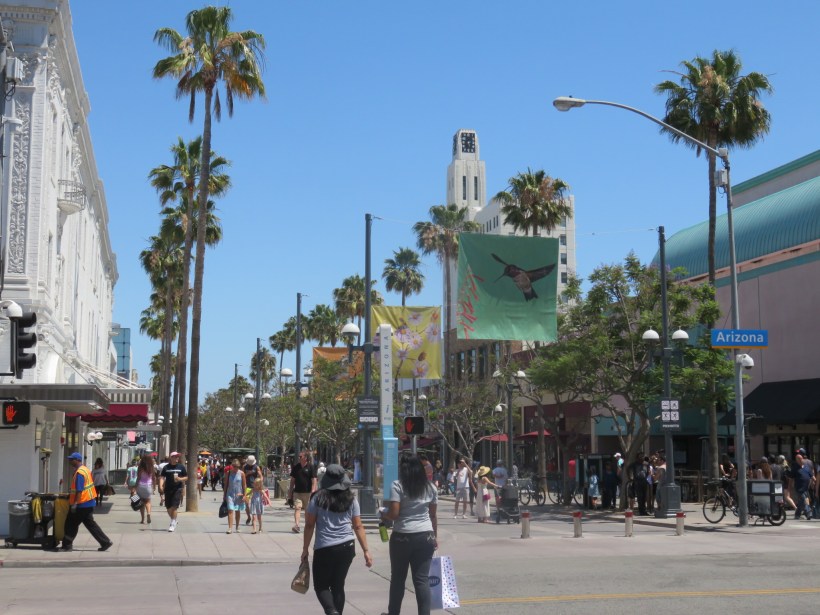
It was midday when we finally returned the bikes. The Inn is a long walk from downtown so we caught a Big Blue Bus. A mall runs through several blocks so I took pictures for Wollongong Council to give them ideas.
We returned around 5 o’clock, just in time for Happy Hour. There was Chardonnay, cheesecake, meat, dips, biscuits, vegetables. If you really wanted to you could make it dinner!!!! We decided on a nearby Mexican where we tried their margaritas and genuine Mexican food. We thought it should be the real thing in Santa Monica. It was fine until I bit into some hidden chilli and consumed two glasses of iced water afterwards.
Tomorrow we are being picked up by friends of Bob and Nancy around 10 o’clock and dropped off at the airport in the evening. When I post the next blog we will probably be home.
There is a feeling in the air of “home” as we start the long journey back. Yesterday we drove to Hyannis after a visit to the local laundrette. The laundrette was near a boatyard so John could wander and dream while the clothes washed and dried. The road to Hyannis was crowded and not particularly scenic. The town itself made us pleased we were staying in Falmouth and after a very ordinary coffee we drove back towards home looking for a rest stop with a view of the water to eat our picnic lunch.
The Centreville Country Store gave you the option of letting the world know your political leanings.
The road through Centreville to Craigville Beach looked promising but there was nowhere to park. Every street was no parking except for a $20 parking lot. Why pay $20 when we are staying near a perfectly good beach in a beautiful, character filled house? So we went back to the Beach Breeze Inn and had our picnic lunch by the pool with a view of the sea.
It was back to our favourite eating place, the Quarterdeck, for dinner. The town was warming up for the weekend, with live music and dancing in the marquees. We watched the experts for a while before walking home in the moonlight.
Another knock on the door from the manager at 10.30 pm had us handing over the keys to the car as the horn was going off again. Walter promised to stop it if it recurred so we could sleep in peace. What a nice man. We considered contacting Avis but what could they do? Most of the time there was no problem.
This morning we farewelled Walter, who assured us he will never forget us or our car. Before heading back to Boston we explored Woods Hole where the car ferry leaves for Martha’s Vineyard. It is a very picturesque little town surrounded by water. We tried a double shot latte in Coffee Obsession which was drinkable. Just.
The run to Logan airport was trouble free, with our Tom Tom finding its way through the new tunnel system easily. We decided to drop off the luggage at the Hampton Inn, get some fuel and then drive to the Avis drop off area. The signposting was excellent and American drivers are very courteous, at least in this part of the world. They stop and let you pull out and no one blasts their horn or gets angry.
Things just got better and better as we solved tomorrow’s major problem. At the American Airlines desk John asked if we could fly to JFK on a later flight. No problems. We are now leaving at 1.30 pm which means we won’t have to kill seven hours at the airport in New York. What a relief. We could use the gym or the heated pool at our hotel instead of hanging around an airport.
The Hampton Inn is situated in Revere, an industrial area about three miles from the airport. When we asked about somewhere to eat, a menu for an Italian restaurant was thrust in our hands and we were told to jump on the shuttle. Some time later, after a tour of the airport, we arrived at Jeveli’s, a very traditional restaurant which produced very good, authentic food. We shared an antipasti plate and had mussels (John) and chicken and artichoke with penne pasta (me). There was far too much food but we were combining lunch and dinner. The shuttle picked us up outside the door and took us back to our hotel.
I’m sitting in the courtyard of 15 Monument Street with a selection of snacks and an orange juice. John is bringing a glass of wine as soon as he catches up on the latest news on TV. It is warm with a light breeze at the end of a mainly successful day. We had a bit of a slow start because our trolley bus failed to appear at the Constitution Museum. Other buses, red, orange and green, green and yellow turned up but not our silver one. So we walked across the bridge. This was an eye opener as the walking path actually zig zags across the locks and through a park. We waited another 15 minutes at the next stop but still no trolley so we set off on the Freedom Trail looking at graveyards, churches and Paul Revere’s house. (Didn’t go in because John said he already knew what it would look like). Paul Revere was a very talented man who was a silversmith, artist, false teeth maker, spy and producer of 18 children with two wives. What he did not do was complete the ride he is famous for. He was captured by the British and one of his companions, a Dr Prescott went on to warn the militia in Concord.
Our aim was to find the perfect flat white in Boston. I had read a review of Pavement in Newbury Street which featured photos of their flat whites so thought that a worthy object for our endeavours today. We finally picked up a silver trolley which took us to the Boston Common. Here we watched people in paddle boats with a huge swan in the front, inspired by the opera Lohengrin in 1877. We were amused by the preschoolers all tied together walking around the park.
On to Newbury Street and the Back Bay area. The street is lined with tall brownstone buildings, the lower levels used for coffee shops, restaurants, art galleries and all sorts of interesting clothing and related shops.
Just as we were about to give up we found Pavement and the coffee and muffin lived up to the recommendations. Back we walked past Trinity Church and the Boston Public Library where Chinese women were protesting over prisoners being used for organ donations (against their will). We stopped for a chat.
We decided to buy lunch in Quincy Market and chose lobster rolls from the Boston and Maine Fish Company. The lobster was very good. Maybe the rolls could have been better.
Our two day pass on the trolley also entitled us to a harbour cruise so we opted to take this as the weather was perfect and John’s foot needed a rest. It was very interesting as it followed the shoreline closely on the starboard side and gave us a new perspective.
We bought some food to cook for dinner and enjoyed the sun in the courtyard until John reminded me about the seating on the flight home. I had tried to prebook seats for the LA to Sydney leg on the Qantas site but ended up with seats in two different rows. I could do nothing to change them so had to ring an 1800 number. Now it’s all sorted and we can spend the 15 hour flight in misery together.
Wednesday, 15th June
Some days everything goes right … until the end. The taxi took us to the airport car hire centre Avis was very efficient and soon John was driving south in our red Ford Focus through the tunnel out of Boston. Our sat nav worked beautifully but I didn’t put it on until we were out of the tunnels as it is over three years old and could have caused confusion. The weather was glorious and it was lovely to be out in the countryside again.
Falmouth was larger than expected. It is full of picture postcard Cape Cod houses. It is unusual to see an ugly one. We were expecting a sleepy seaside village but the traffic is thick. Our Beach Breeze Inn is a short walk from the beach. It is not like a Wollongong beach but then few places in the world are. The manager raised the Australian flag (to half mast) shortly after we arrived. We have been made to feel very welcome.
I almost matched John’s passport fiasco but losing my Qantas prepaid card. I found out eventually that I had left it in the ATM when I took out the balance so it was not a disaster to lose it. The bank is considering whether to cut it up or give it back to me. Hopefully I will get it back tomorrow.
Dinner tonight was at the Quarterdeck. We had a carafe of red wine and a seafood pie (John) and prawns and scallops with linguine (me). There was no room for dessert but back at the inn the s’mores were being cooked by the pool. Having not tried them before I found I had to toast a marshmallow on the fire and place it between two graham crackers with a piece of chocolate. I don’t think I will have it again but we had a pleasant conversation with some families at the fireside.
We were both asleep when we heard knocking on our door. One of the managers told us our car horn was going off for no reason. After a lot of messing around the problem was still not solved.
Thursday, 16th June
John fixed the car problem this morning. Apparently the hood was not completely shut so that set off the horn at irregular intervals. 10.30 saw us on the Island Queen heading for Martha’s Vineyard.
We found that the island is famous for a number of things. It is the setting for the movie “Jaws” and on our bus trip we saw the lagoon where Jaws came under the bridge and “had a snack”. It is also where Edward Kennedy drove off the bridge in Chappaquiddick resulting in the death of Mary Jo Kopechne. We watched the car ferry travel across to Chappaquiddick from Edgartown. Now that was a discovery. After wandering around Oak Bluffs where the boat docked, having coffee and brunch, we debated whether to hire bikes, catch a local bus or catch a ferry back to Falmouth. We decided on a day ticket on the local bus which led us to Edgartown. It is supposed to be the most beautiful town in New England and I can quite well believe it. If only I could take one of those houses home! Everything is picture postcard perfect, from the retired captain’s houses to the grand churches and festive post office, all built from weatherboard.
Back at the Inn John went for a swim in the pool and I discovered that my swimmers were missing. I must have left them on the ship. I am not doing very well today. I drank a glass of wine by the pool before we drove up the street to La Cucina. John had prawns and scallops with angel hair pasta. I had lobster filled ravioli with a scallop sauce. Before the main course we shared a salad. It was so huge we had half put in a doggy bag for tomorrow’s lunch. When we went to take the remains of the wine home we were told that to do that it must be recorked, wrapped in brown paper and have the bill attached. I suppose that is to stop us taking a swig as we walk down the street.