There were all sorts of reasons to say no. In two years Joanne could proceed with her plan to travel to London, teach and travel. On the other hand, if she married she might never have the chance to fulfill her dreams.
However, might it not be more fun to travel the world with a soulmate? She envisaged the two of them teaching somewhere in the snowy Canadian mountains, using their holidays to explore the continent of North America. Of more immediate importance, Will said they could paint the flat under his parents’ house in bright sunny colours with only $10 a week rent.
Suddenly Joanne wanted it all to happen straight away but Will thought they should wait until the following year. After all they had to plan a wedding!
The first task was to buy an engagement ring. They looked in the window of Angus and Coote for a few minutes before stepping inside. As soon as they mentioned ‘engagement’, they were ushered to comfortable chairs and presented with trays of glittering rings. Joanne liked a flat gold ring with a small diamond flanked by triangular metal buttresses.
Joanne had never been to a wedding. All she knew was that she didn’t want the flouncy white dress, the father walking her down the aisle (there was no father) and a minister officiating.
In 1972 the options were a church wedding or the registry office. Marriage celebrants did not exist although some outdoor weddings took place with a person of the cloth in charge. They heard stories of people who visited their priest or minister several times for counselling before the wedding and of some who had been refused a wedding because they were not regular church goers.
Joanne’s mother Annie was horrified at their plans for a registry office.
‘People will think it’s a shotgun wedding!’ she said. ‘I’m not allowing it!’
But Joanne would be 21 the month before her wedding so she could legally do what she wanted. Fortunately, Annie came around in the end although she did tell enquiring friends that her daughter was getting married at the Anglican Church in Wollongong.
The wedding took place at the Wollongong Courthouse, just across the road from Wollongong’s Anglican Pro-Cathedral. Will decided to wear white trousers, a black and white paisley shirt, white tie and a black and white tweed jacket. At first Joanne planned to wear a long blue dress with a black yoke but relented when she saw the perfect unconventional wedding dress. It was made of figure hugging white crepe, the hood and bodice trimmed with a tapestry of mauve and yellow flowers surrounded by green leaves on a cream background. She could wear the hood until she said ‘I do’ and then pull it back off her head.
The registry office was small. Joanne sat beside Will, his brother on one side and her flatmate on the other. Joanne’s mother and Will’s parents stood behind them. The District Registrar made a short statement about marriage and then proceeded with the vows. When Joanne’s name was spoken with the word ‘spinster’ attached, the flatmate gave a loud snort. The laughter was infectious, and Joanne tried grimly to stifle any sound by holding her breath and biting her tongue. They signed the register, followed by Will’s brother and the flatmate, who were ‘best witnesses’. It was with great relief that Joanne walked out onto the courthouse steps to pose for a photo taken by the flatmate’s boyfriend.
In the months preceding the wedding Will and Joanne discovered a new reception centre in Atchison Street only a block away from her old flat. It was called The Barclay and had three themed rooms for small, medium and large receptions. They chose the smallest, the Moroccan Room. Joanne, in her naivety, told Will’s parents that her mother was paying for the food and that they would be paying for the drinks. As it turned out they also paid for the band which continued to play late into the night because no one would go home.
The best wedding ever
They had invited a few friends and lots of relatives. Joanne didn’t have any relatives to speak of, just her mother and grandmother. Her flatmates from Teachers College had not arrived and she looked anxiously at the empty seats. Where were they? The main course had arrived when they walked in looking somewhat dishevelled. It seems they had ridden down from Sydney with their current boyfriends on the back of motorbikes and had a number of problems on the way.
Soon they were all in a circle dancing ‘Zorba the Greek’. The dessert arrived, a flaming Bombe Nesselrode and the drinks flowed. Joanne agreed with everyone that this was the best wedding ever.
Back at Will’s parent’s house his mother tentatively brought out a wedding cake she had secretly made. Will and Joanne had been adamant they didn’t want ‘tradition’ but Joanne could see how worried she was and gave her a big thank you hug.
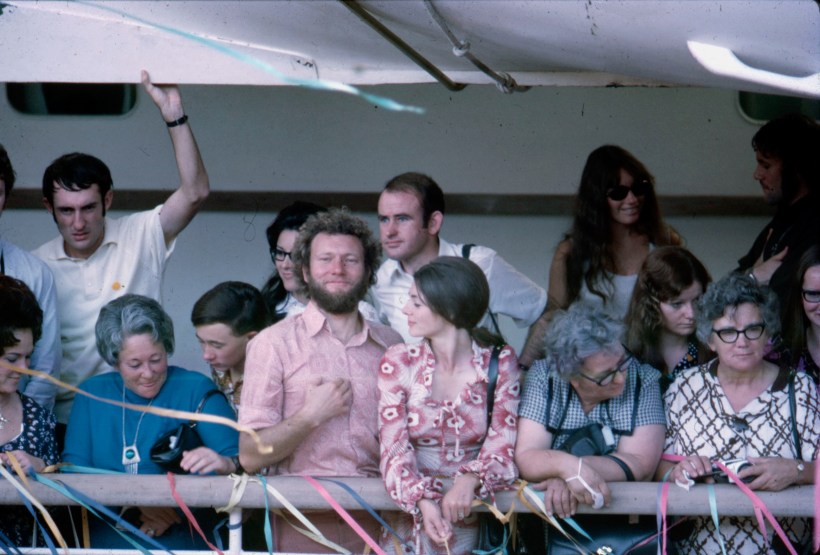
Downstairs at last in their own little flat still there was no peace. A friend of Will’s challenged Joanne to a chess game and to her surprise she found she was winning. Then it was time for everyone to leave because tomorrow the newly married couple were off on their honeymoon, a cruise on the Oriana.
When Joanne heard about the Centre Trip she was desperate to go. Camping in tents, they would travel through four states, visit Cooper Pedy, Woomera, Alice Springs, Ayers Rock, Karumba on the Gulf of Carpentaria, Cairns and Brisbane. The cost was $120. Joanne didn’t have that sort of money but she borrowed it from her mother, Annie, promising to pay it back when she started teaching.
Oh the places she would go!
When the time came for her to leave, she wasn’t quite so keen. Surprisingly none of her friends had shown any interest in going, so she knew no-one on the trip. Also she had been seeing Will for only a short time and didn’t want to spend the next three weeks apart from him. Who knows, he might have found someone else by the time she returned?
He turned up on the day she was to leave, helped her pack by reading out her list and then took her to a Chinese Restaurant for lunch.
Sitting alone in the bus full of chattering students she was relieved when, just before they left, a girl asked if she could sit beside her. She looked French, with her dark bob and her slight accent. Her name was Michelle and she proved to be an excellent travelling companion for the next three weeks.
They didn’t camp in tents the first night. Arriving at 9.20pm in the decidedly frosty air of Bathurst, they slept in a scout hall and had cold showers that warmed up just as they finished. The next day they drove through Orange and Dubbo, stopping for lunch on the side of the road near Narromine where they made their own sandwiches from an array of fillings, vegemite, peanut butter, tuna, baked beans, tomato, apricot jam.
As they rumbled through Nyngan and then Cobar, Joanne considered each town as a possible location for her teaching position the next year. Twenty miles past Cobar they set up camp at Springfield Tank where the soil was red and soft and small trees dotted the landscape. Michelle and Joanne pitched their tent, pumped up their lilos and arranged their sleeping bags. A short game of wood cricket was followed by a meal of chops, veggies, rice-cream and peaches, prepared by the group on duty. Joanne practised her trumpet in the bus and then joined the others singing songs around the campfire.
The night was cold, making sleep difficult. In the morning the tent dripped water wherever it was touched. Joanne dressed rapidly and rushed off to help prepare the breakfast of onion and tomato on toast.
The bus drove over to the water supply which was as cold as the morning air. About two thirds of the students were from the Physical Education faculty. They were noticeably more athletic than the Primary group and wasted no time dumping one of their own in the water tank.
The sighting of three emus and a kangaroo caused great excitement. Every ten or twelve miles they crossed a cattle grid with fences stretching out each side as far as the eye could see. Arriving at the caravan park in Broken Hill (population 30,000) the students enjoyed hot showers in the amenities block which put everyone in a good mood. After the meal Joanne and Michelle decided to wander down to the main street but found a determined gathering of lecturers at the gate. They were told was too dangerous for them to be let loose on the sinful city of Broken Hill. Furious, but unable to do anything about it, they settled for a sing song around the campfire with a group of other travellers.
Their first excursion was to the North Broken Hill Zinc-Lead-Silver Mine where they observed basic elements being extracted from a muddy conglomerate. Amid the noise and smell, a guide described in great detail the process, which remained a mystery as no-one could hear a word. A similar scenario occurred at the South Broken Hill Mine. The highlight of the day was the free lunch and finally crossing into South Australia.
Bound for South Australia – from the journal of Joanne Walsh
Here they encountered fifty miles of dirt road, with sheep, rabbits and kangaroos slowing their progress. Their camp was set amidst saltbush with a few stunted small trees so finding a “restroom” was difficult. It was a case of girls to the right and boys to the left. This was the first night they decided to risk sleeping in the open without the tents and found they were still comfortably dry in the morning.
Driving through Horrick’s Pass in the Flinder’s Ranges they learnt that an explorer, John Henry Horricks, lost his camels and found the pass. They descended into the city of Port Augusta (Population 11,000) and happily explored the shopping centre, free of the lecturers at last. At the Town Hall they found a wash room where they freshened up before buying some genuine artifacts at the Department of Aboriginal Affairs including a boomerang and a woomera.
After filling their water bottles the intrepid group set off for the Centre Track. Joanne dozed until she woke scarcely able to breathe for the heat and the dust, only relieved by a stop at 4.00 pm to set up camp. After the sun set Joanne wandered into the bush and looked back at the camp. She saw the glow of the fire, heard the muted voices and then there was nothing in any direction for hundreds of miles but desert and stars. She contemplated the passage of time, the people who lived here long ago and stood mesmerised for a while. Reality hit when she found someone (one of the boys) had let down everyone’s lilo so there was no sleep until they were pumped up again.
Rain woke them all at 3.00am so there was a sudden rush to the bus carrying damp sleeping bags and packs.
Caught in the rain – from the journal of Joanne Walsh
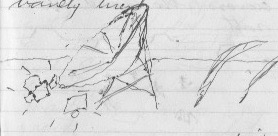
Out in the middle of all this vastness was Island Lagoon Tracking Station. Inside were enormous computers filling whole walls. The saucer was eighty-five feet in diameter and was currently tracking Pioneer 8 and relaying information to America. One of the workers told the story of a Landrover parked under the telescope. When the dish swung down that was the end of the Landrover.
The demise of the Landrover – from the journal of Joanne Walsh
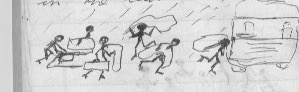
Driving into Woomera was no simple deal. There was a considerable amount of discussion between the authorities, the lecturers and the bus driver. Joanne and others were told to put away their cameras although they couldn’t imagine what harm there would be in snapping photos of the small shopping centre, swimming pool, cinema and neat houses. The bus stopped at Lake Hart and the students ran half a mile across the dried up salt as if released from prison.
Running across Lake Hart – from the journal of Joanne Walsh
At Cooper Pedy a guide named Helena, who originally hailed from Germany, jumped on board. She regaled them with funny stories which had them all laughing. They were impressed with the underground dugout scooped out of the rock, the only room above ground featuring a swimming pool. It was a show house in the winter while its owner lived in a double decker bus but as soon as the weather warmed up she moved into her underground home. Joanne felt she could have lived in that house while digging for opals but from Helena’s stories gathered that Cooper Pedy could be quite a wild place.
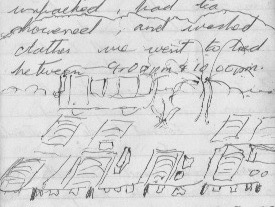
Over the border into the Northern Territory they passed a perfect mesa called Mount Conner. Everyone was straining to catch their first glimpse of Ayers Rock. It was 5.00pm when they finally arrived and set up camp at the base of the rock. Again they decided against putting up the tents but it was still 10.00pm before the camp was quiet.
Camped at the base of Ayers Rock – from the journal of Joanne Walsh
The lecturers informed them that the first objective next day was to climb Ayers Rock. There was only one climbable section with some posts and chains to help the climber. Further on there were only broken white lines to follow. At the top a visitors’ book was found which everyone signed as well as posing for photographs.
Ready to climb the rock – from the journal of Joanne Walsh
One of the female lecturers and the girl who was dumped in the Springfield Tank had a mock wedding on top of the rock with confetti sprinkled for the occasion. After a rapid descent the students travelled in the bus to the Olgas where they only had time for a short walk. Joanne hoped to come back one day to explore the area further as the tracks disappearing into the red rocks looked enticing. Michelle, Joanne and a few others chose to walk the five and a half miles around the base of the rock until they reached their campsite. That night Joanne and Michelle visited the local establishment, the Log Cabin, spent 52 cents each on a vodka and orange drink and listened to an Aboriginal man playing a guitar and then later a didgeridoo.
A long dusty drive deposited the students into Alice Springs. Here they erected their tents and enjoyed hot showers. Joanne thought it was a beautiful area, especially after visiting Stanley Chasm as the sun slanted onto the rocks at midday. She and Michelle explored the main street and slipped into an art shop where they saw paintings for sale by Oscar Namatjira, Albert’s son. Enjoying their first taste of a big town the group were treated to dinner at the Oasis Motel and some even ordered wine. Joanne was running out of money fast so had to stick to water.
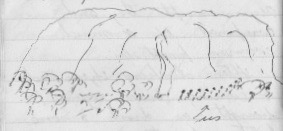
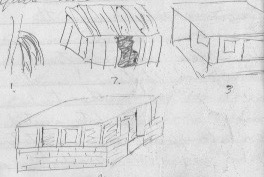
Moving north they saw a mobile school at Ti Tree which moved with Aboriginal families. The next stop was a mission where an experiment was underway concerning Aboriginal housing. As the bus drove along they passed very basic humpies, then one roomed houses with verandahs all around, then the same in brick and finally three bedroom fibro houses.
Different styles of Aboriginal housing – from the journal of Joanne Walsh
The guide from the mission explained that when families showed they could look after their house they were promoted to a better one. Joanne and the other students thought this seemed a good idea at the time. In hindsight it could be perceived as protectionism and ignoring Indigenous rights and freedom. While I won’t go into the history of the treatment of Aboriginal Australians in this story (Joanne had very little idea as she only knew what she read in the newspapers) suffice it to say that the ‘60s and ‘70s saw massive changes in the status of Australia’s First Nations people.
At Banka Banka Station the students took photos of the Aboriginal children of the stockmen and their wives. When the students climbed back aboard the bus they were stunned when one of the lecturers told them off for their thoughtless actions. It hadn’t occurred to anyone that they needed to ask permission or that they were being disrespectful.
Stopping at the Devil’s Marbles they climbed over the strange, round rocks. Previous visitors had painted their initials in large brush strokes on a few of the rocks which Joanne thought was a terrible thing to do to such remarkable formations.
The strange sight of the Devil’s Marbles – from the journal of Joanne Walsh
Still the bus roared onwards until it arrived in the dark at a Mount Isa caravan park. The hot showers were greeted with moans of delight. The next day (temperature 65 degrees F) they were driven out to Lake Moondarra where Joanne joined the others in the chilly water, swimming out to a platform with a slide and enjoying herself immensely.
Heading steadily north they drove through Normanton with their proposed night stop four miles further on. Suddenly they heard a loud bang. Close inspection confirmed their fears. They had a flat tyre. The driver continued to the campsite with the tyre making a huge racket. The next morning the bus was driven into Normanton to get the tyre fixed before they headed off along a sandy track to Karumba, on the Gulf of Carpentaria.
House in Normanton – from the journal of Joanne Walsh
There was great excitement when the students learned they could earn $80 a week working on the prawn conveyor belt if they came up here in the summer. As the ribbon of seafood passed by Joanne had a turn at picking out anything that wasn’t a prawn and throwing it to one side. Initial excitement subsided when they considered the heat, the wet, the insects and the monotony of the job. The pool at the Karumba Lodge was a highlight as the temperature had increased considerably since Mount Isa.
In Georgetown they met a couple of young school teachers in the only pub in town. The men, originally from Cairns, were friendly and obviously starved of female company. They said Georgetown had never seen so many girls at once in its history. The girls told them they would be camping about an hour up the road so they promised to follow. Camped by the banks of Routh Creek they did see some headlights slowly going past but the lecturers must have scared them off because that was the last they saw of them.
Camped by Routh Creek – from the journal of Joanne Walsh
The bus made its way through the Atherton Tablelands to Cairns, where they set up their tents in a caravan park. Joanne and Michelle thought they were very daring to hitch a ride into town but they were picked up by a taxi and given a free ride. They met some young men in the pub and were shouted cans of XXXX. Joanne hated beer but felt she had to finish it in case she offended the buyer. Their reward for travelling 3,580 miles through deserts and tropical regions was a boat trip to Green Island. The island was small and could be circumnavigated in less than an hour. They swam in the warm clear water, wishing they could check in to the resort and stay for a week.
One of the friends Joanne had made flew home from Cairns as she was missing her boyfriend too much. The PE students couldn’t believe anyone would let a romance upset a good holiday and thought she was the worst kind of wuss. Travelling the 1500 miles from Cairns to Wollongong was a bit of a blur as they covered long distances with few stops. They planted sugar cane from a tractor, slept in a motel storeroom in Surfers Paradise as the rain poured down, and dropped off several students at their hometowns as they travelled down the NSW coast.
Home at last, Joanne was met by Will, who was limping and had a cast on his leg.
‘Hockey accident,’ he said cheerfully. ‘Broke my foot.’
Joanne had never been so pleased to see anyone in her life.
I think I love you Isn’t that what life is made of? Though it worries me to say I never felt this way
I Think I Love You – The Partidge Family 1970
There was a feeling of uncertainty in the air, of not knowing one’s future. The Department of Education, in its wisdom, would decide Joanne’s fate and send her a telegram towards the end of January. In it would be the name of one of the 1500 Primary Schools in NSW where she would be appointed.
In the meantime the long summer holidays stretched ahead and Will, also at a loose end, suggested they pack the tent and drive to Queensland.
‘I’d love to go,’ she said doubtfully, ‘but my mother…. I don’t think she would approve.’
‘We’ll call in on my uncle and aunt in Newcastle,’ he said cheerfully. ‘Tell her we are staying with my relatives up there.’
Uncle Jack owned a corner store. He greeted Will and Joanne with enthusiasm.
‘We’ll get takeaway Chinese tonight. We always do on a Friday night. Gives Martha a bit of a break.’
Joanne found the food stuck in her throat. She was feeling very unwell and slipped off to bed early, complaining of a sore throat.
The next day they farewelled their genial hosts and drove as far as Coffs Harbour. Will pitched the tent, which was a primitive affair, just a triangle with no floor. Joanne lay curled up on her sleeping bag in misery, her body aching, her throat increasingly painful. After a restless night where she burned up with fever Will decided to take her to the hospital. She lay face down on a bed while the doctor injected her in the bottom with a large syringe.
‘Where are you staying?’ asked the doctor.
‘At the caravan park in a tent,’ said Will, looking worried.
‘She is too sick to go back to a tent. If you can get her into a motel with air conditioning and a proper bed she should recover quite rapidly. I’ve just given her an injection of penicillin for her Strep throat.’
Joanne couldn’t remember much of that day. She slept in the cool air conditioning and woke to the sound of Will lighting a small gas camping stove on the floor of the motel room. He opened a packet of soup and added water, stirring the contents rapidly. Then he removed the saucepan and carefully balanced a piece of bread on a folding toaster contraption.
‘Here you are!’ he said, passing her a bowl of soup with bits of toast floating around the top. ‘Would you like me to feed you?’
She tentatively swallowed the hot soup and found her throat was already improving. Hopefully they could continue travelling north tomorrow.
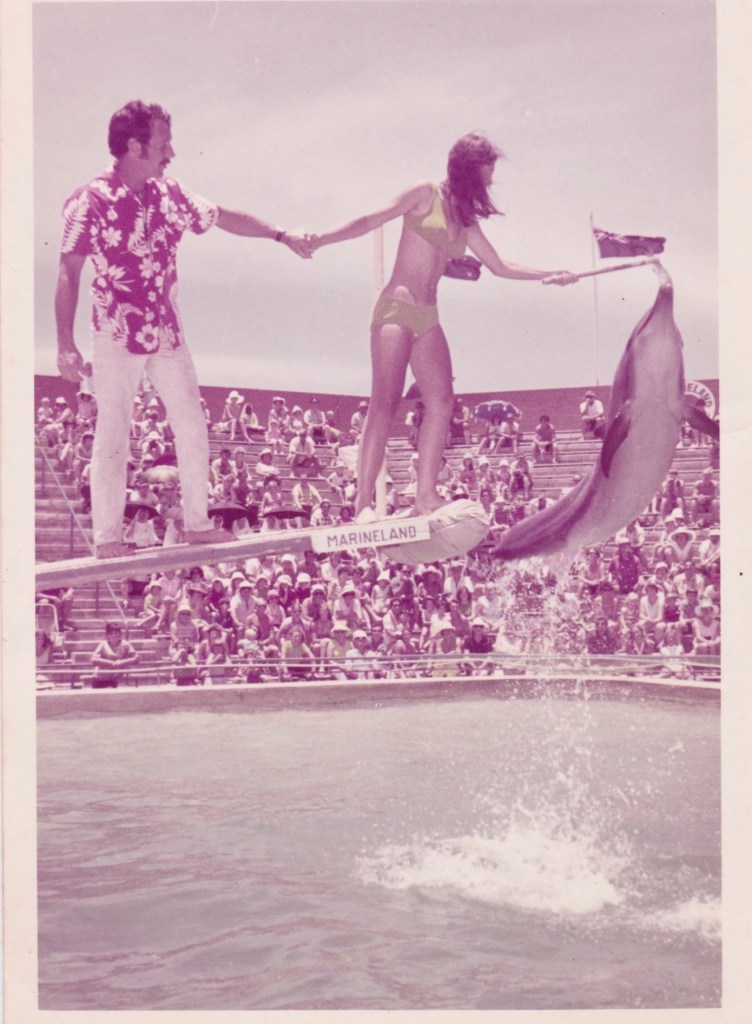
The big attraction on the Gold Coast was Marineland. Joanne, feeling almost fully recovered, sat next to Will in her orange bikini, letting the hot summer sun caress her skin. They were watching dolphins leap from the water as the keeper held a fish above their noses on the end of a stick. They were asking for volunteers to feed the dolphins from the end of a long diving board. A man came up to Joanne and asked if she would like to do it. There would be rewards for her participation.
Marineland, Gold Coast. 1970
She stepped gingerly onto the diving board and hung the fish out over the end. The dolphin leapt, grabbed and then a hand pushed her from behind. As she fell into the water all she could think of was her contact lenses. She swam, eyes closed, to the edge of the pool and was relieved that the world around her was still in focus. They gave her tickets to shows and bars and restaurants but Will would have to pay his share so they didn’t use most of them because money was short.
They set the tent up in Noosa. The caravan park was on the edge of a creek. Across the road and over a small grassy knoll was the beach, where long haired youths rode surfboards on the perfect waves. A few shops straggled along the road but they left them alone, preferring to cook on their camp stove and drink instant coffee.
On the way home they splashed out on another motel in Grafton as Joanne was still not fully recovered from her illness.
One thing she had learned from their rather disastrous holiday was that Will was there for her ‘in sickness and in health’. However they were both careful not to appear too committed and their favourite travelling road song was:
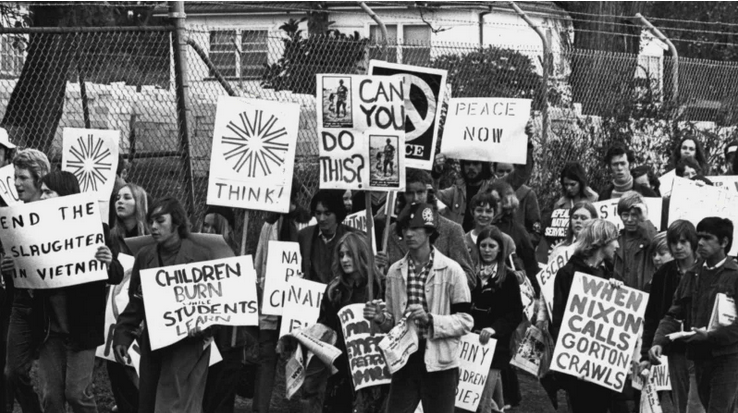
Starting in 1962, the war in Vietnam was considered by most Australians to be necessary to stem the spread of Communism. Conscription was introduced in 1964 and by 1970 many Australians wanted all troops withdrawn. This was especially so as the number of casualties grew. Young people marched in demonstrations, carrying banners and chanting anti-war slogans.
Joanne was fairly immune to all the controversy until her second year at college and her introduction to Shauna’s passionate views.
‘Last year the moratorium marches in America showed that more and more people oppose the war,’ said Shauna. ‘This year they are going to be held all over Australia. We are going to march against conscription and bring about the end of the Vietnam War!’
Joanne helped Shauna and Margo paint a few posters but declined to participate any further. She had to go home for the weekend. She was amazed at the strangers invading their share house, all preparing for the march. Margo and Shauna told her that a new friend of theirs had been called up in the draft and was refusing to go. ‘He’ll get prison if he’s caught,’ whispered Margo.
Arlo Guthrie sang on the record player.
You can get anything that you want at Alice’s Restaurant.
Vietnam War protestors Sydney, May 1970 (Sydney Morning Herald)
Meanwhile Will had a dilemma. His American cousin was coming to Sydney on R&R from Vietnam. He was planning a day trip to entertain him and thought a visit to Canberra might be a good thing to do. He asked Joanne if she would ask a girlfriend to come with them on a double date.
Joanne asked several girls but they were not available. She wondered about Margo, who was preparing to march with Shauna.
‘You want me to go out with an American soldier?’ Margo looked at her in disbelief.
“Well, he was drafted, so he can’t really help it if he’s in the war,’ said Joanne. ‘ He needs a bit of normality after what he’s been through.’
Margo agreed to go. Will’s cousin seemed happy to have some female company. Joanne was not so happy. Just days before their planned trip the phone had rung at Mrs Kruger’s house. It was her mother, Annie.
‘Look, I don’t know what you want to do, but I’ve just had a phone call from the American chap who stayed with us in the Christmas holidays. He’s back in Australia and wants to see you.’
Joanne had received several communications from the American. He had returned to the United States but was now fearful of being drafted in the Vietnam war. He thought if he moved to Australia he might avoid conscription but was doubtful how long he could stay. Now he was coming to Yerrinbool on Sunday to have a talk about the future.
She felt she had to tell him face to face that she had moved on, but how?
Finally she arranged with Will to stop at her home and leave her on the way back from Canberra. She would catch the rail motor to Wollongong the next morning.
They had an interesting day in Canberra, viewing the embassies, visiting Parliament House and exploring the Australian War Memorial. Margo was stressed by the graphic depiction of war and announced she was going to throw up. What the cousin thought we’ll never know but Will and Joanne sang all the way back and it was with some sadness that Joanne bid the others farewell when they left her at her childhood home.
The American was there, keen to tell her of his plans to move to Australia. She told him about Will and he said that was wonderful and that he had high hopes that there was a future for him with his other penpal.
Time passed and the American had to go home, was drafted and served in Vietnam. Joanne often wondered what happened to him but she was sure she saw him on an American reality TV show late one night.
Will’s cousin finally was demobbed and returned to his home.
Conscription ended in Australia in December 1972. 63,735 national servicemen served in the Army, of whom 15,381 were deployed to Vietnam. Approximately 200 of those conscripted men were killed but the mental and physical aftermath of the ‘American War’ will never be fully realised. As for servicemen from the United States and the Vietnamese people themselves, the scale of death and destruction cannot be put into numbers or words.
When Joanne arrived at Teachers College she still thought of herself as a Christian. After being leader of the ISCF (Inter School Christian Fellowship) in High School she, along with Margo, began attending the college equivalent, TCCF. However it was not without some reservations. For a start, some of the people there were just too inflexible and unbending.
Having a father who challenged her to think about what she was taught in Sunday School opened her mind to alternate ways of thinking. Even at the age of ten she wondered why her religion was the only right one in a world of different beliefs.
In her small township of Yerrinbool the Baha’is held their annual summer school. With nothing else to do she enjoyed the company of other teenagers at the camp. As well as hiking to the creek for a swim or playing games, she sat in on some lectures explaining the philosophy of the Baha’is. It seemed Jesus was one of many prophets sent by God, the last being Baháʼu’lláh. She liked their belief that all religions have the same spiritual foundation, despite their apparent differences. She also thought they were on the right track when they said no one can describe God because they don’t have the mental ability and everyone’s view of him was coloured by their own experiences and cultures. They didn’t believe in the use of alcohol or drugs unless prescribed by a doctor, as it destroyed reason and led people astray. However they did believe in dancing, singing and enjoying themselves as she found one New Years Eve.
Her best friend at school was a Seventh Day Adventist so she spent time at their holiday camps, listening to their beliefs and experiencing a vegetarian diet long before it was fashionable. When her friend married a Methodist, Joanne and Will wondered which religion would win out. The ceremony was held in the Methodist Church but then they moved on to a Seventh Day Adventist Reception Centre. Will wished vehemently that the reverse had been the case as he ate his gluten steak, bemoaned the lack of wine, stared around at the unadorned women and worst of all, spat out his decaffeinated coffee!
Joanne was disturbed and puzzled at the examples of hypocrisy where people she had respected refused to participate in events run by other religious denominations. She had the time of her life as a model in a mannequin parade organised by two local Catholic Colleges. All the local Secondary Schools were asked to volunteer two models but her equally tall, third best friend refused to participate on religious grounds. One afternoon a week she would catch a bus to a grand house in Burradoo where the group of girls would meet, trying on clothes and walking the improvised catwalk. Joanne felt a stab of envy as the students from Dominican Convent took her up to their Science Lab to check on their mice. They seemed to be having so much fun at boarding school, reminiscent of Enid Blyton’s ‘Malory Towers.’
When Joanne started dating Will they would drive to a scenic lookout and watch the moon over the Tasman Sea. Talk invariably moved to religion and they had long discussions about the nature and existence of God. Will was enthusiastic about science being the basis of all knowledge. Charles Darwin was his hero and to him, his theory of evolution made absolute sense. While they didn’t agree on absolutely everything they both decided that organised religion was not for them.
Joanne reasoned that if all the religions of the world were the same and only altered by their environment and way of thinking, then maybe they were man’s way of explaining the creation of the universe, life and death. She decided that if there was a God, he had created them and left them to it. It was up to them to do the best they could with the world they lived in.
Will had already decided he was an atheist but Joanne was hedging her bets, just in case.
Of course, Joanne still told her mother everything. They had been so close since her father died that they used to think as one. Leaving home was changing their relationship as Joanne insisted on discussing religion and the pros and cons of sex before marriage, oblivious of her mother’s increasing concern.
Annie had walked out with thousands of others to rededicate her life to Christ at the Billy Graham Crusade in Sydney (1968) and now her once religious daughter had turned against God, all because of the new boyfriend.
Dr Billy Graham arriving in Sydney 15 April 1968 [picture] / John Mulligan
Several years later, when she found her Dutch husband, Annie faced her own religious dilemma. Lars was a Catholic so they agreed to marry in a Catholic Church. Joanne had to laugh when the priest read from the service that the couple were to bring up any children they might have in the Catholic religion. After all they were in their sixties!
It wasn’t long before her newly married mother converted to the Catholic faith. Joanne wondered what her atheist father would think about it all. Before he died he told her he would try to contact her from the afterlife if it was at all possible, but he didn’t think there was anything after death but a long sleep. She had never heard from him in the nine years since his death so she could only conclude that he was right.
It amazed Joanne that some people never thought about religion at all, while others found that faith was enough to sustain them without question. She was careful not to offend and avoided the topic except when Mormons and Jehovah’s Witnesses knocked on her door. This was the only time she could discuss religion in depth with someone who actually wanted to listen and debate.
Towards the end of the year with Mrs Kruger, Margo asked Joanne what she thought about renting a flat. They looked at a high rise block near the beach and imagined having a quick surf before lectures. Another girl called Shauna was also interested. She wore John Lennon glasses, was into Folk Music and protested against the Vietnam War.
At first Joanne’s mother opposed it. She could see that without the watchful eye of Mrs Kruger the girls could easily be led astray but she relented as she realised she could do little to stop them. All she could do was help them find a place to live.
The Real Estate Agent was doubtful. ‘There’s not much available. Anywhere near the beach is out of the question. However there is an old house in Atchison Street which might suit. It’s only a short walk to the bus stop and not far from the shops in the CBD. Also the rent is $66 a fortnight which is quite reasonable for a house in the city.’
The girls’ first flat
Margo and Shauna looked at the house with dismay. It was what was known as a ‘Federation’ house, built in the early 1900s, timber clad, with a covered verandah around two sides. Images of neat little apartments with sea views were cast aside and Shauna remembered her manners and thanked Joanne’s mother for the effort she had made.
At first Joanne and Margo shared the large front room with the bow window. Shauna had the other bedroom because growing up in a large family, she had never had a room to herself. Also at the front of the house was a small lounge room with an open fire-place and stained glass windows. Margo later used this as a bedroom. The kitchen at the rear was large and homely. A fuel stove promised warmth on cold nights and was kept running with wood off cuts ‘liberated’ from a nearby timber yard. The most interesting feature of the kitchen was a walk-in pantry lit by one small window. With their meagre allowances the girls were never able to fill the pantry shelves but it did add a certain grandeur to their new home. Out through the back door a covered area led to the bathroom and laundry. Over the free-standing bath, the shower only produced boiling hot or cold water, necessitating the use of the bath instead. In the same room a washing machine had lost its ability to spin. A manual wringer was attached to the cement sink. The girls thought it was fun to insert the washed clothes in between two rollers and turn the handle to squeeze out all the water.
Joanne missed the meals served each evening by Mrs Kruger. The girls decided to take turns preparing the evening meal but towards the end of each fortnight their money and enthusiasm had dwindled and they resorted to fish and chips or even just chips. Joanne brought cooked chickens and fruit cake down the mountain each Sunday night to supplement their food supplies but when Will started calling around, he would often find Joanne hadn’t eaten and would take her to the Adriatic Coffee Lounge and watch her eat schnitzel.
At the end of the year the girls completed their two years of teacher training and returned to their homes, ending their lease. All that was left was to wait for notification of their teaching post, somewhere in New South Wales.
Joanne was idly reading The Daily Mirror at home one weekend when something caught her attention. In a wanted column she saw that an American stationed on the Marshall Islands was looking for a penfriend. She had penfriends all over the world but they were all girls. Maybe this one would be fun to write to and she might even get an answer.
The reply arrived a week later. The American said his friends had placed the ad as a prank but he would be happy to write to her. The letters led to an exchange of photos and cassette tapes, even Christmas presents. He was from Alamogordo in New Mexico but instead of going home for his vacation he was coming to Australia.
It was then Joanne found she wasn’t the only penfriend. She had offered him accommodation on their twelve-acre farm when she found he was staying with another girl as well. ‘I’ll meet you at the airport,’ she wrote excitedly. ‘You can visit your other friend and then come and stay with us.’
Joanne had never had a sleepless night in her life but this was an exception. She was up at dawn to catch the diesel train to Sydney. Alighting from her taxi at the airport she saw a huge run in her stocking. Nothing could be done about it now so she pushed on regardless looking for a likeness to the photo in her hand.
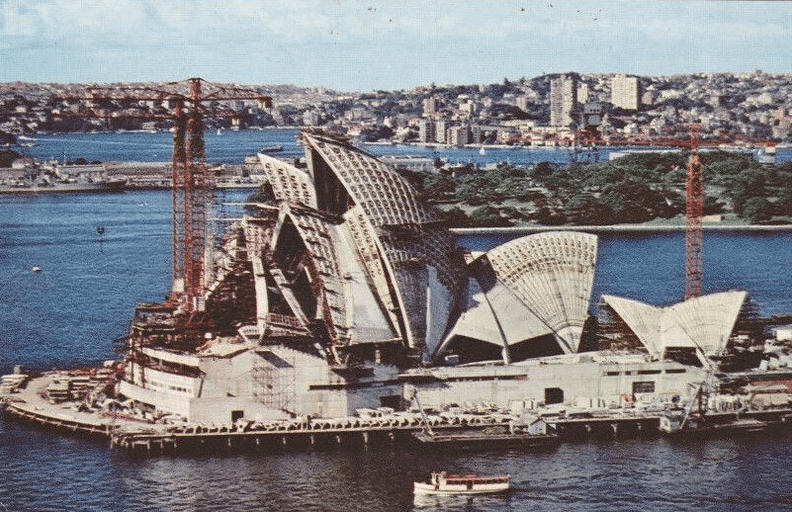
He seemed nice and asked if she would like to travel with him to Kings Cross where he had booked a room. He dumped his bags and they made their way to Circular Quay where they caught a ferry to Manly. The Opera House drew their attention, with its tall cranes and unfinished sails.
The Sydney Opera House in 1970
‘It’s supposed to represent the sails of the yachts in the harbour but it’s quite different to the original design by Jorn Utzon, the architect,’ said Joanne. ‘It’s certainly not like any other buildings in Sydney, I’ll give you that.’
They ate a meal together in Kings Cross and bid farewell. Joanne caught the train to her grandmother’s house in Cronulla, excitedly looking forward to meeting again in a couple of weeks.
He arrived by train at the small station of Yerrinbool. Annie had fixed up a room for him in one of the outbuildings. She didn’t want this stranger in the house near her daughter. Joanne had planned every day of the week; a bushwalk, horseriding in Mittagong, a train trip to Canberra, a visit to the Lion Park at Warragamba and a drive down to Wollongong and the south coast.
During this time the American became a little restless, especially with the constant supervision of Joanne’s mother. He bought a bottle of bourbon and suggested to Joanne that they visit the young stationmaster who lived in the residence up the road. When he knocked on the door the stationmaster and his wife were already in their pyjamas but that didn’t deter the American. They sat and talked for a couple of hours.
The following day Annie said it would be all over the township and Joanne’s reputation would be in tatters.
‘First you go to a Kings Cross hotel with a strange man, and then you go uninvited to the stationmaster and keep him up all night drinking!’
When it was all over Joanne realised she had never seen him in daylight. It began at the second sockhop. The Teachers College gymnasium was something to be proud of, Dr Whitebrook told them. The floor was made from a special timber and it was supposed to be the best gymnasium floor in the southern hemisphere. Which meant you were to never, ever wear shoes on it. Hence the sockhops.
The College Gymnasium, home of the Sockhop
When she arrived with Margo it looked like a single sex event. Not one male could be seen anywhere. ‘Wait until the pubs close at ten,’ whispered a knowing second year. ‘Then they’ll arrive but they’ll all be drunk.’
Like clockwork, around 10 past 10, the men arrived. Actually they were boys, mostly under 20 and nearly all working for Australian Iron and Steel (AI&S) or BHP.
Ben asked her to dance and then just stayed with her the whole evening. They went outside while he had a smoke. She hadn’t tried smoking herself but decided it gave him a ‘bad boy’ image which she liked. They discussed favourite TV shows and she found that they had a mutual admiration for Star Trek. In fact he was a great science fiction fan. He had grown up in a very religious household and was keen to move away from organised religion. She was keen to discuss whether he thought he was an agnostic or an atheist. He also played the trumpet, just as she did. They had so much in common!
They exchanged addresses and went their different ways.
Joanne wondered if she would hear from him again and was delighted after the Easter break when Mrs Kruger handed her a letter. She tore it open in the privacy of her room and discovered that he wanted to see her again, that he had had the best night since he arrived in Wollongong and how did she feel about him?
Careful not to give too much away, she replied that she would like to see him again and what did he suggest they might do? She knew he didn’t have a car but hoped they could go to the pictures. After posting it she calculated the earliest reply would be on Thursday so now all she had to do was wait.
On Thursday his letter arrived. He suggested that she ring him at the staffhouse where he boarded, at 5.00 o’clock today or tomorrow. She walked down to the college with Margo and used one of the pay telephones. He answered her call and during the next twenty minutes they agreed to see ‘The Shoes of the Fisherman’ the following Thursday. She would catch a taxi to his hostel and then they would walk together to the Regent.
Mrs Kruger thought Joanne should meet him at the picture theatre. ‘You don’t want to appear too eager,’ she said. Joanne was too busy thinking what she would wear. She found a blouse she loved in Katies for $7 but that would have taken all her cash. She settled on a lemon shirt for $2.99 but wondered how she was going to pay for a recorder, recorder book, hire of the trumpet, a taxi fare and maybe her ticket to the pictures. She would have to withdraw money from her bank account to cover the $11.50 she calculated she needed.
Somehow the pictures had changed to a double feature, ‘From Russia with Love’ and ‘Thunderball’. Afterwards they caught a taxi home and chatted to Mrs Kruger before Ben left to walk home.
The TCCF (Teachers College Christian Fellowship) was a Christian organisation which Margo and Joanne decided might be a source of that rare species, the male college student. Someone was picking them up just as Ben arrived unexpectedly so he went too. He complained he had been ‘earbashed’ as a child as he grew up in the Salvation Army. He suggested they go to see ‘Showboat’ on Thursday night. That was more to Joanne’s liking as well.
The local theatre group, the Arcadians, performed to a high standard. However it seemed the night was ending too fast. After catching a taxi to Mount Ousley they sat on the step and talked until 3.00 am. Mrs Kruger complained next day about the ‘natter, natter, natter’ and her mother said that if Joanne continued to behave like that she would ‘get a bad name’.
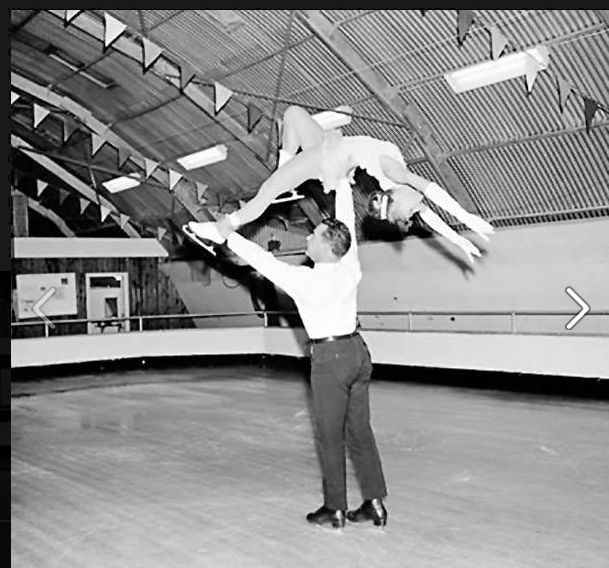
The weeks passed. They tried ice skating at the Glacarium at Wollongong Showground, Joanne clinging to the edges of the rink, too scared to let go.
Wollongong Glacarium, March 29, 1968 Illawarra Mercury
They watched ‘The Sand Pebbles’ and ‘The Good, the Bad and the Ugly’, sometimes walking the two miles home so they could extend the evening. He suggested seeing ‘Hair, the Musical’ in Sydney and she wondered aloud about seeing nude people on the stage. Then one Tuesday he didn’t come around. In fact she never saw him again. Her new friends rallied round and told her she was too good for him. Apart from hurt pride she realised she didn’t really mind.
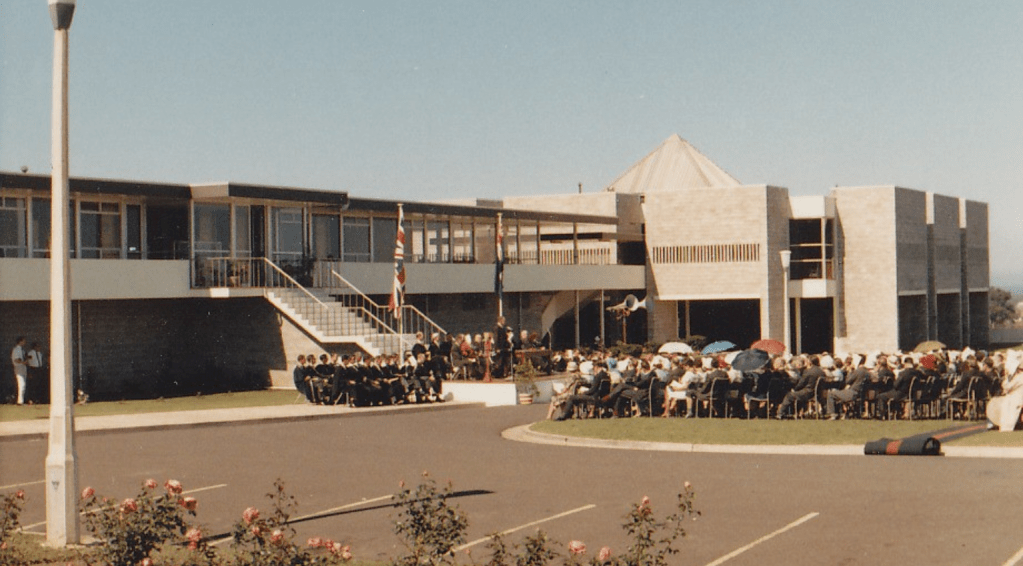
Day one of college dawned, the girls filled with excitement and trepidation. Margo and Joanne crossed Mount Ousley Road, walked past some new houses in ‘College View Estate’, through a grassy area intersected by a creek, past a tennis court with a sign saying ‘Whites only must be worn on the tennis court’ and arrived at an interesting sloping structure known as the music auditorium.
Wollongong Teachers College Music Auditorium (Wollongong University Archives)
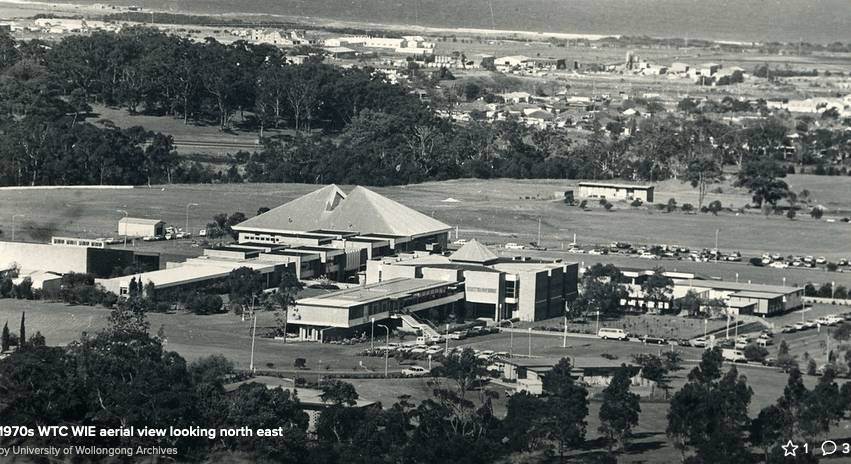
After a welcome assembly the students poured out into the sunshine and fresh air, eating their cut lunches in the area known as ‘the cloisters’. While the college liked to use traditional English names, and some of the lecturers walked around wearing black gowns, the buildings were very modern. The grey cement block construction was brutalist in design and very different to the sandstone buildings Joanne had envisaged at Sydney Uni. To make matters worse, there was not enough room for all the students so a bus was to run to the Technical College for some of the lectures.
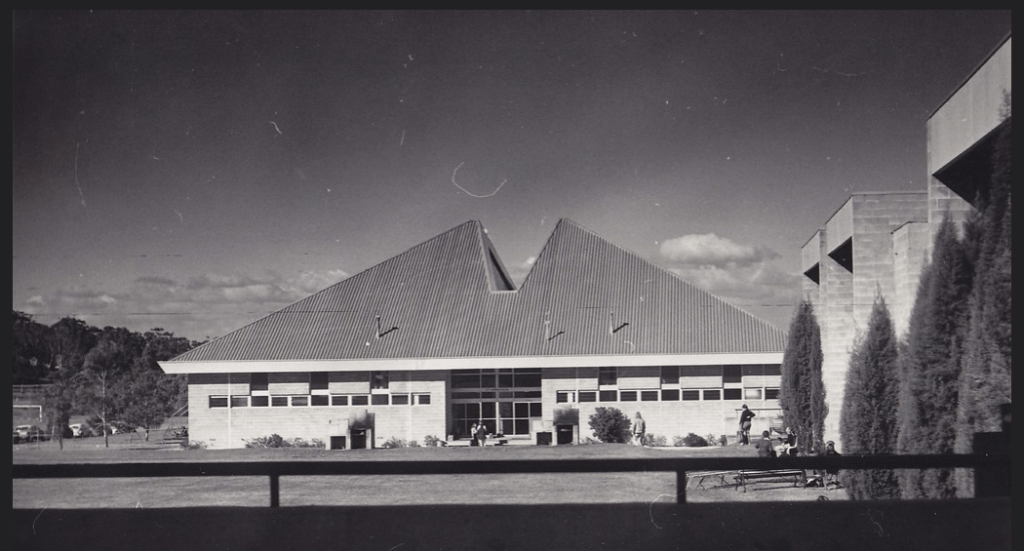
Next to the music auditorium was a double storey lecture block with a flat roof. A library with an unusual pointed roof sat next to the administration block, where they were to line up for their pay once a fortnight. They would receive a cheque which they could cash at the National Bank situated half a mile away at the University or in town at David Jones or Anthony Horderns. The remaining building was a gymnasium, also built in the pointed roof style and the pride of the college.
Wollongong Teachers College official opening 1965 (Wollongong University Archives)
Across grassy fields was the tiny Wollongong branch of the University of NSW. It consisted of two lecture blocks and specialised in the sciences needed to train employees of the steelworks.
The first week flew by with a barrage of tests; psychology, music, spelling and social statistics. A barbecue and sock hop on the precious gymnasium floor revealed the distinct shortage of boys but Joanne enjoyed dancing to the music with the other girls. The postal service efficiently delivered Joanne’s swimming costume after a panicked phone call to Annie so that on Friday she and Margo made their way by bus to the Continental Baths to swim laps of the 50 metre pool.
Packing their bags that afternoon, the two girls made their way to Wollongong Station, Margo travelling north to Sydney and Joanne filling in time until the rail motor bound for Moss Vale left at 5.40 pm. Joanne had been told by her section advisor that she had to have a chest X-ray to test for Tuberculosis. A mobile clinic was parked in Crown Street but they sent her away, requesting paperwork from the college.
For one hour and forty five minutes Joanne looked out the window as the little rail motor climbed the mountain. At first she could see Lake Illawarra and the ocean below her. The train stopped at tiny sidings called Dombarton, Mount Murray and St Anthonys. At some stops the guard did a ‘staff exchange’ with a railway employee and only then could the rail motor move forward. Robertson was the first major stop, followed by the end of the line, Moss Vale. Joanne talked to Annie all the way home and all evening until her throat was sore.
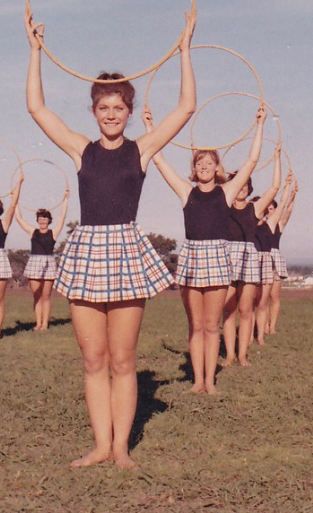
The college had supplied Joanne with a piece of material reminiscent of a tablecloth, with yellow, red and blue stripes screen printed on a white background. It took Joanne all of Saturday to turn it into a gym skirt, to be worn over black leotards. On Sunday everyone at Church wanted to know about college, so that Joanne again found she couldn’t stop talking. On Sunday afternoon they visited an elderly friend in a nursing home who also wanted to hear all the news. A missed train ended Joanne’s weekend and meant Annie had to drive her back down Macquarie Pass on Monday morning.
The Boeing 707 had just arrived from Wellington, New Zealand. As the passengers climbed carefully down the mobile stairs, a small, elderly man waited on the tarmac, a white envelope clutched in his hand.
Joanne’s mother saw him as soon as she stepped onto the ground.
‘Thank you for meeting us, Mac. Everything all right at home?’
‘No, no it’s not good. She didn’t get Sydney. She’s going to Wagga.’
Secretly Joanne was delighted. Mac had organised for her to live with his sister in a gloomy inner-city terrace while she attended Sydney Teachers College, but it wasn’t going to happen.
‘Wagga!’ exclaimed Joanne’s mother. ‘I’ll never see you. It would be at least five hours by train so you could hardly come home for the weekend.’
Annie wasn’t having that. Bravely she marched into Blackfriars in Sydney the next day.
‘I am a widow with only one child. I run a small business on my own in a country town. If my daughter goes to Wagga I will only see her in the holidays. I’ve already arranged accommodation in Sydney for her which is only two hours from home. Would it be possible to change the offer to a Sydney college?’
No, no, that couldn’t be done, but there was another solution. Wollongong Teachers College still had vacancies so would that be a possibility?
The rail motor from Wollongong to Moss Vale took an hour and a half. Annie was delighted. Joanne was happy that she was going somewhere away from home. Only Mac grumbled that his sister was very upset about losing her star boarder.
The steep highway that wound down the escarpment showed tantalizing glimpses of ocean. To her right Joanne could see Wollongong Teachers College and the University College of the University of NSW.
Her mother turned left into the suburb of Mount Ousley and pulled up beside a small green fibro house with a butterfly roof. This was to be her home for the next eleven months, from Monday to Friday. They met the landlady, Mrs Kruger, and her cat Ludwig (Luddy for short). A girl about her own age but a good six inches shorter, smiled and introduced herself as Margo. She would also be attending the college. Joanne would have someone to share the experience of being away from home.
Alone at last! Her mother had driven away to stoic farewells. Margo wanted to ring her boyfriend in Sydney to let him know about her day so they followed Mrs Kruger’s directions to find the nearest public phone box.
Suddenly Margo clutched Joanne’s arm tightly.
‘What’s the matter?’
‘It’s a dog. I‘m terrified of dogs. Let’s go another way.’
An hour later, carefully avoiding all dogs, they found a phone box. As Margo chatted to her boyfriend, Joanne wondered what tomorrow would be like. At high school she had been reserved and quiet with few friends. Mostly that didn’t worry her because she was happy in her own company, but now she had an opportunity to meet new people and with the chatty Margo by her side she felt optimistic about the future.
Mrs Kruger cooked dinner for the girls each night. Also she made a cooked breakfast. This, she said, was unusual and not normally called for but Annie had insisted. Each girl had her own room and a shared bathroom. Of the $42 a fortnight they received for their scholarship, $22 would go on board. That would leave the remaining $20 to cover lunches, the train trip home and any other incidentals. Once the money was spent they could appeal to their mothers for a helping hand.
Having Margo right beside her was such a godsend. They discussed what they would wear to college and decided on stockings and low heels, skirts and blouses. They would maintain a strict standard of neat, tidy attire as students. Little did they know how much their world would change in the next two years.

















 The Curry Apple Orchard