F for Far from the Madding Crowd

On previous visits to England we visited the homes of Jane Austen, the Bronte Sisters and DH Lawrence. This time (2012) our plan was to explore the countryside made famous by Thomas Hardy’s novels. We decided to stay near Dorchester where the novel The Mayor of Casterbridge is based.

Just before our arrival in Dorchester we noticed the figure of a man carved on the hill in chalk.  He is known as the Cerne Abbas Giant and his origins are uncertain.  Some believe he represents the Roman god Hercules and is over 1500 years old. Others say it is a caricature of Oliver Cromwell and is only about 350 years old. It is one of three white figures cut into chalky hillsides, the others being the Long Man of Wilmington in East Sussex and the Uffington White Horse in Berkshire.

In Dorchester we found the building reputed to be the home of the Mayor of Casterbridge in Hardy’s story of the same name.

To reach Thomas Hardy’s birthplace we took a ten minute walk through woodland from the National Trust car park in Upper Bockhampton . Hardy’s father was a builder and stonemason and Hardy in his early years was an architect.  After five years working in London he returned to this house because of failing health.  This is where he wrote Under the Greenwood Tree and Far from the Madding Crowd.

Hardy’s birthplace

We then visited Max Gate, the house Hardy designed himself, built by his father and brother.  Here he wrote Tess of the D’Urbervilles and Jude the Obscure (known as Jude the Obscene at the time) as well as lots of poetry.  The National Trust have taken over both houses and it was only recently (before 2012) that tenants had moved out.  Max Gate is a huge contrast to the thatched cottage and is a very comfortable “town home”.

Max Gate

 On the recommendation of the B&B owners we drove to The Saxon Arms at Stratton for some tasty sailfish on a bed of green weeds.

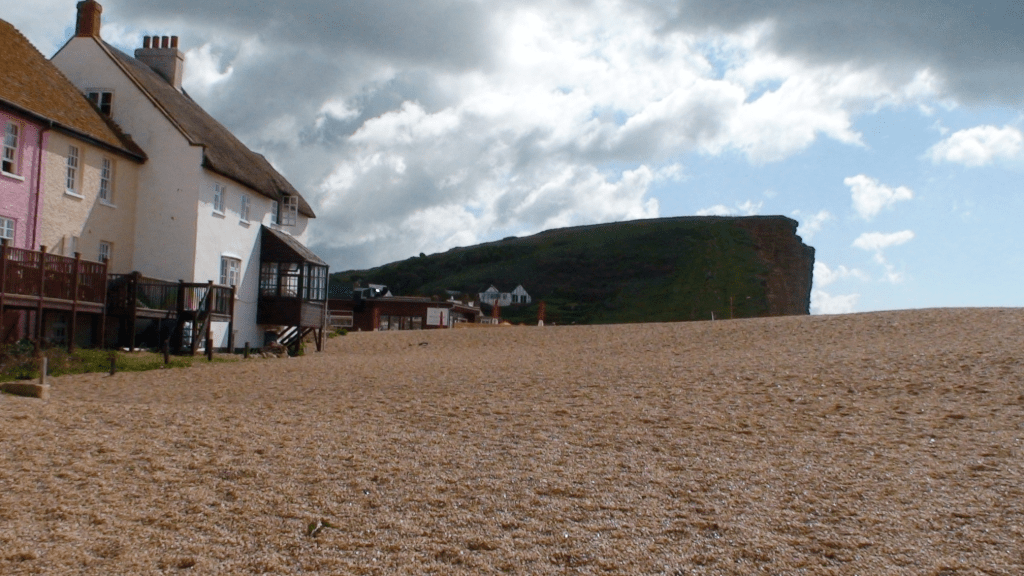
After another huge English breakfast where we chatted to a couple here for the trout fishing (or at least he was as she was about to hit the shops), we set off for Plymouth via the Jurassic Coast.  As we were driving we saw a sign to Chesil Beach so turned in along the three quarter mile track.  The size of the shingle varies from as big as oranges at the Portland end to the size of peas at the West Bay end.  It is said that in days of old smugglers could tell exactly where they were when they landed on the beach by the size of the pebbles. If you’ve ever read “On Chesil Beach” by Ian McEwen you might remember this was something the two main characters planned to investigate before fate stepped in. 
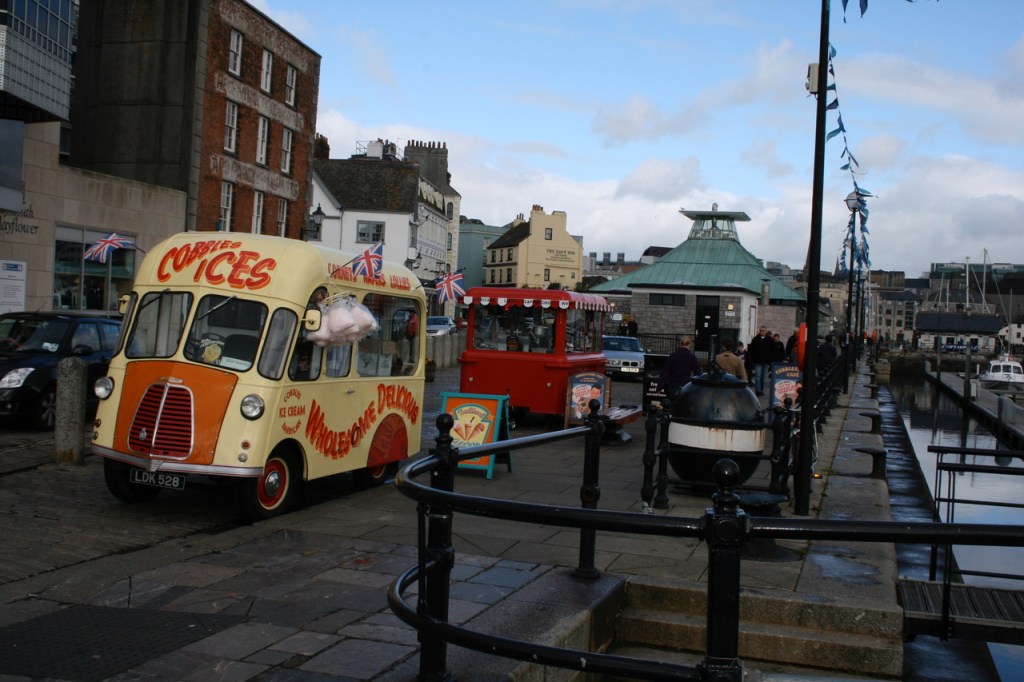
We bypassed Exeter and drove around the edge of Dartmoor Forest.  I couldn’t see any forest.  It was all rolling fields, hedges and stone walls.  Our Sat Nav brought us directly to the Premier Inn we had stayed in eight years ago.  It is right in the middle of Plymouth and across from the Barbican, accessed by a swing bridge.  The Barbican area consists of several streets which retain the character of the original fishing town as much of Plymouth was bombed to pieces in the Second World War.
After grabbing a quick lunch near our accommodation we dropped the car off at the Hertz depot.  John discovered he’d had a dodgy prawn so what should have been an enjoyable exploration of Plymouth became a rush to get back to the safety of our room.

We did manage to explore the waterfront and read the sad story of Raleigh’s Lost Colony, an early settlement in America which vanished between 1587 and 1590. Also saw the plaque to the Mayflower in 1620. So long ago!

I left him resting and went off to find dinner, avoiding the dodgy prawn place.  The Barbican was shaping up for a busy Saturday night with people dressed to kill disappearing up narrow laneways into interesting looking night spots.  I found what appeared to be a safe haven for a lone female at The Thai House and had a very tasty Pad Thai with a glass of white wine.

Fortunately John was well enough to sail across the Bay of Biscay to Spain the following day.

E for England’s Green and Pleasant Land

You might think that after living in England for twelve months in 2004 I might have seen enough to last me a lifetime but when an invitation arrived in 2011 for a Cotswold wedding in the following spring we didn’t have to think about it too long before accepting.

Leaving Sydney at 6.00 am we flew a total of 24 hours with a brief stop in Dubai. It was 10.35pm when we found our bed in a Premier Inn at Heathrow.  It had been a long day.
Of course we had to visit our former home in Chasetown, Staffordshire. It was good to catch up with Carol, the exchange teacher, admire her new kitchen and note the changes in the area.  It was also wonderful to meet up with her parents who had been so kind to us. Dinner had been booked by Carol at 1709 Brasserie in Lichfield. The building dated from the 1500s and had black beamed ceilings and lots of character. 

Next day we were on our way in our hired Ford Focus.  It was bliss to travel the countryside knowing I didn’t have to go back to work next week, next month or ever again. 

The first port of call was Whaddon where some of my ancestors had lived before emigrating to Australia in the 1860s.  I wanted to find the church where the family was married, christened and buried.  I couldn’t find any headstones with the names Ridgway or Colton but a local woman gave me the key to the church which was built in the 12th Century, so I stood in there and tried to imagine what life would have been like in this village one hundred and fifty years ago.  

Keys to the Whaddon Church

John was keen to see Bletchley Park where the breaking of the code for the German Enigma Machine took place.  

The tour begins at Bletchley Park

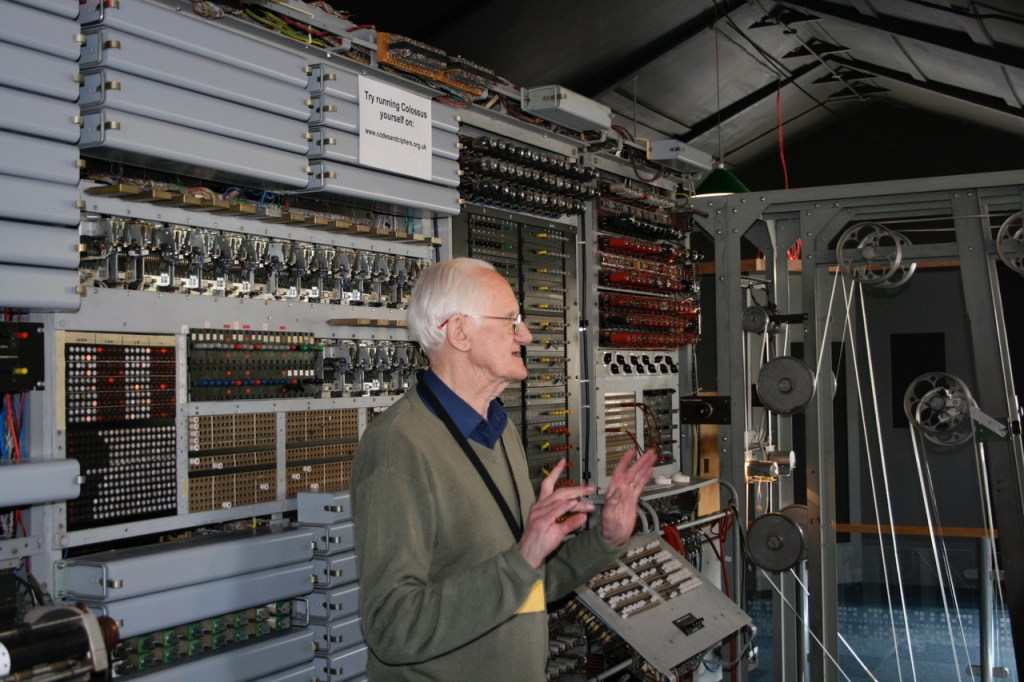
We joined a one-and-a-half-hour tour of the buildings which explained how the Enigma Code was cracked and showed us replicas of the machines which were able to do this – the Bombe and later The Colossus.  The latter was arguably the first ever computer.  Unfortunately the originals were scrapped at the end of the Second World War. 

A reconstruction of Colossus

Heading south we arrived at the Three Cups in Stockbridge around four o’clock and walked along the High Street. Tourists from London come here frequently for the fishing and the country air and the shops and cafes cater for them accordingly.  

The Three Cups, Stockbridge, Hampshire

Extract from diary

I am sitting on the bed in our 15th Century Coaching Inn called the Three Cups in Stockbridge, Hampshire.  The Cups are actually streams which run under the main street. The floor of our room veers in all directions.  The walls are white with black framework oak beams leaning at odd angles.  The ceiling is low on both our top floor and below so that the building looks quite squat.  Up until now I haven’t mentioned the food because there was nothing much to say but tonight it was worth talking about.  John had a pigeon on nettles entree with a red and a brown sauce.  I tasted some and it was very good.  We both had local trout with leeks and potatoes with a bowl of fresh vegetables – brilliant.  We shared a plate of three citrus desserts.  This was washed down with a French Cabernet Sauvignon.  

Our home for the next week was The Bakery Cottage at Ampney Crucis, near Cirencester. There was a very pretty stream flowing through the village (the Ampney), an old church and attractive gardens.  Every building was built from warm, brown stone, there was no graffiti, no rubbish and in every direction the scenery was idyllic. 

The Bakery Cottage (annexe to the main house)

The venue for the wedding (Cripps Barn) was perfect, nice and warm with heaters and a log fire.  The ceremony was held in the large stone barn.  Next to it was a new addition which had been sympathetically built to complement the original. This is where the tables were set for dinner.   We had drinks on the terrace in the one burst of sunshine. The ceremony was short, the bride looked radiant and elegant, the speeches were entertaining and the meal of smoked salmon, lamb with couscous and raspberry tart was tasty.  Guests danced away the evening in the stone barn, planning to regroup for lunch the next day.
Arlington Row

On Sunday morning we drove to Bibury, a picturesque village with a stream full of trout, a row of weaver’s homes called Arlington Row and the typical chocolate box houses of the Cotswolds.  We then parked at the Barnsley Pub in readiness for the after wedding lunch, taking a stroll around Barnsley House where the bride and groom stayed the previous night.  They happened to see Liz Hurley and Shane Warne walking out the door as this was a favourite watering hole of theirs.

Barnsley House

 Extract from diary

On this visit to the Cotswolds we have been able to differentiate between the villages as they all have their own individual character.  Nailsworth, on the way to our National Trust Mansion, Woodchester, is not one of the pretty towns although it is supposed to be “lively and artistic” and has the largest number of working water wheels per square mile in the country.  We were underwhelmed, especially as it was cold and wet.  The redeeming features was Hobbs Bakery. It was warm and cosy, the coffee was great and the hiker’s bar which we shared hit the spot.

 Fortified for what lay ahead we drove into Nympsfield where two walkers directed us to the Woodchester Mansion car park, about two kilometres further on.  Here we walked another mile (1.6km) 

“along a rutted track through the trees, at last to come upon the huge stone building hunched against the hill”. (Tourist brochure)

Woodchester Mansion

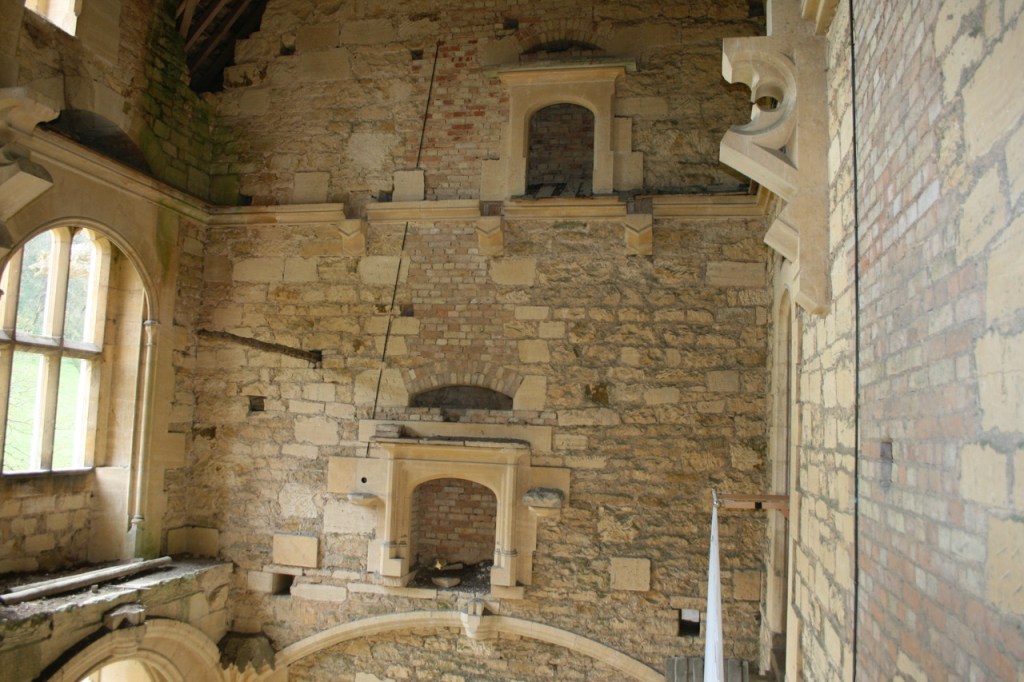
Woodchester Mansion was begun in the 1850s but never finished.  Because the interior walls were never lined the structure of the building can clearly be seen. There are no ceilings on the first or second floor and you can see fifty feet up to the roof. The owner ran out of money and died before he could complete the house.  It is one of the most amazing structures I have ever seen. 

Fireplaces in the mansion with no floors

We thought that as it was our last day in the Cotswolds we would revisit the Slaughters and Stow-in-the-Wold.  Driving into Lower Slaughter we parked opposite Lower Slaughter Manor.  At the front was a sign which advertised soup and sandwiches for two for 20 pounds.  As we walked in I decided on my next visit to the Cotswolds (after I win the lottery) I will stay here.  We were ushered into an elegant but comfortable sitting room with chess boards set up on tables and other games stacked on shelves. A seafood bisque with hot bread roll, a choice of salmon, tuna, chicken, cheese or ham sandwiches and coffee had me happy to stay there forever. Even the toilet was divine.

Lower Slaughter Manor

Tomorrow we move on to Thomas Hardy country!

D for Downsizing

I have often wondered why we are expected to downsize when the children have left and we no longer go to work.  I mean, we have spent our whole life working to achieve the ideal home subject to our financial limitations and then we are supposed to give that up, throw out half our belongings and move to something small and manageable.

It may have had something to do with the lockdowns during Covid, but two couples who are very good friends of ours made the move.  Both sold their large houses on quarter acre blocks and moved to quite different retirement situations.

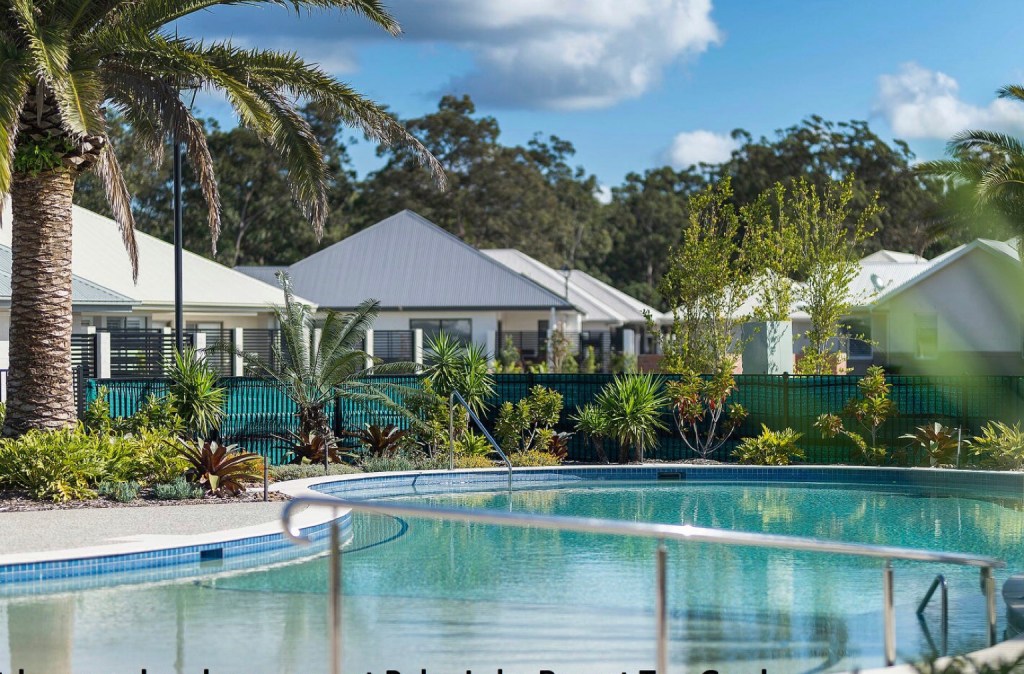
We visited Couple Number One in their new home.  It was two and a half hour’s drive north of Sydney and situated in a village with the dubious title of having the oldest population in Australia.  That said, it is situated in a beautiful area, with clean beaches, a large, protected bay and a river which leads to a series of lakes.  Their home was spacious and well designed, with an outdoor area situated to capture the winter sun, overlooking grassy paddocks dotted with kangaroos. The over 55s resort has many desirable features.  There is an indoor and outdoor swimming pool, gymnasium, bowling green, model yacht club with lake, library, theatre and as many group activities as the imagination would allow.  True, there were no water views but many people owned boats and caravans and stored them on the property. The beach was accessible by car or riding your bike along the designated bike path.

Courtesy of Palm Lakes Resort

Driving home we looked at the negatives.  Two things stood out in our minds.  One was access to health care. Maybe it’s not such a problem at first but the older one gets the need to be close to specialists increases. In an emergency a helicopter could arrive at a nearby heliport and transport the patient to hospital in forty minutes. Conversely, where we live we can drive to the hospital in five minutes.

The other consideration was access to family.  The extra time to visit the grandchildren would require planning.  They could no longer come visit for a day or even a weekend.  Our son’s travel time from Canberra would be doubled.

Then there were friends.  Yes, they could come and visit.  But how often would that happen?  There would be plenty of new friends to make but would we want to have them living all around us?

Still, it was definitely an attractive option.

Couple Number Two opted to move to an established “Over 55” village near to their old home in northern Sydney.  As a result they were able to keep all their existing contacts, friends and familiar places.  They completely gutted the two-bedroom unit so that it boasts all new kitchen, bathroom, carpet and curtains.  They also have a sunny courtyard with a small manageable garden area.  Surrounded by lush gardens they have a swimming pool, a gymnasium and meeting area for communal activities. However, they miss the space and privacy of their former home and not having their boat and van in close proximity.

Could we actually part from our home of 45 years?  We decided if we could find the right place for us we would do it.

Several Real Estate Agents were contacted and we agreed to go ahead with one who seemed to know the area well and was sure that the market was ready, with many Sydneysiders looking to move to the South Coast.

As we made a list of all our home’s assets we wondered if we could find anything to replace it. We discussed why we wanted to move.  The garden was a lot of work.  House maintenance was ongoing.  The neighbourhood had changed because of proximity to the university.  Many of the large older homes in our area were being rented to students so it had lost its sense of community.  Each weekend was spent visiting possible new homes but nothing spoke to us.  We were also cooling on the idea of an Over 55 Community with the financial implications and loss of freedom and space.

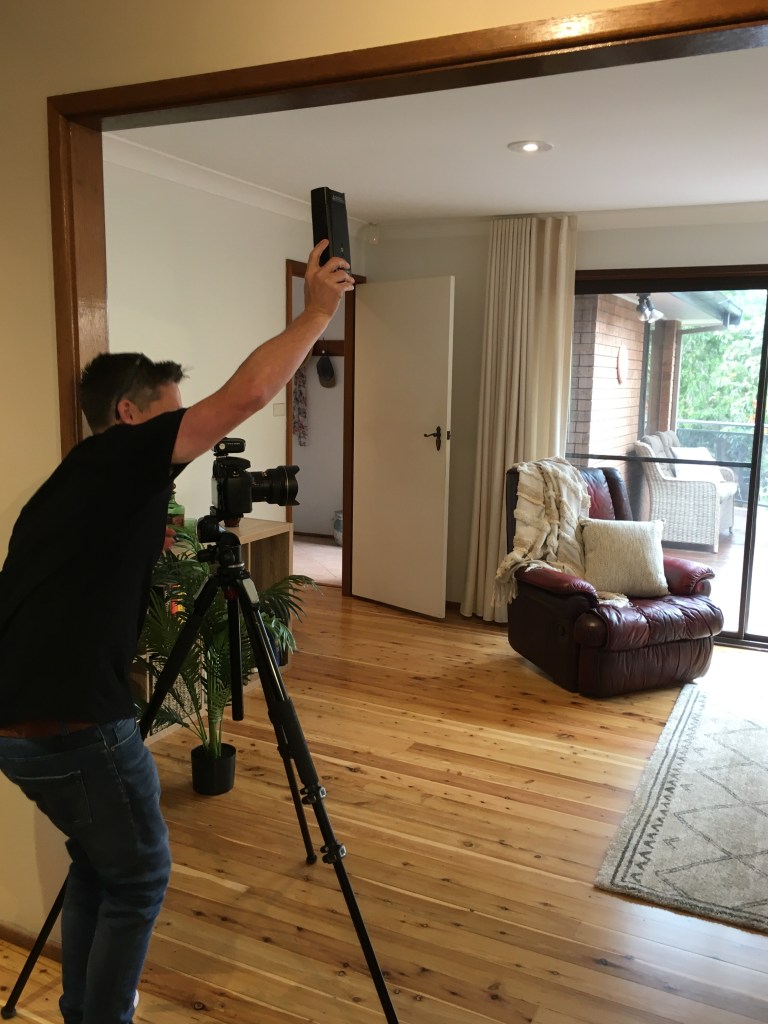
Relentlessly time marched on.  The cypress pine floors were repolished. I removed the ancient curtains from the family room. We borrowed and bought boxes, wrapped all but essential possessions in bubble plastic and stored them under the house.  We removed excess furniture and family pictures. A stylist visited with suggestions.  Photographs were taken.  

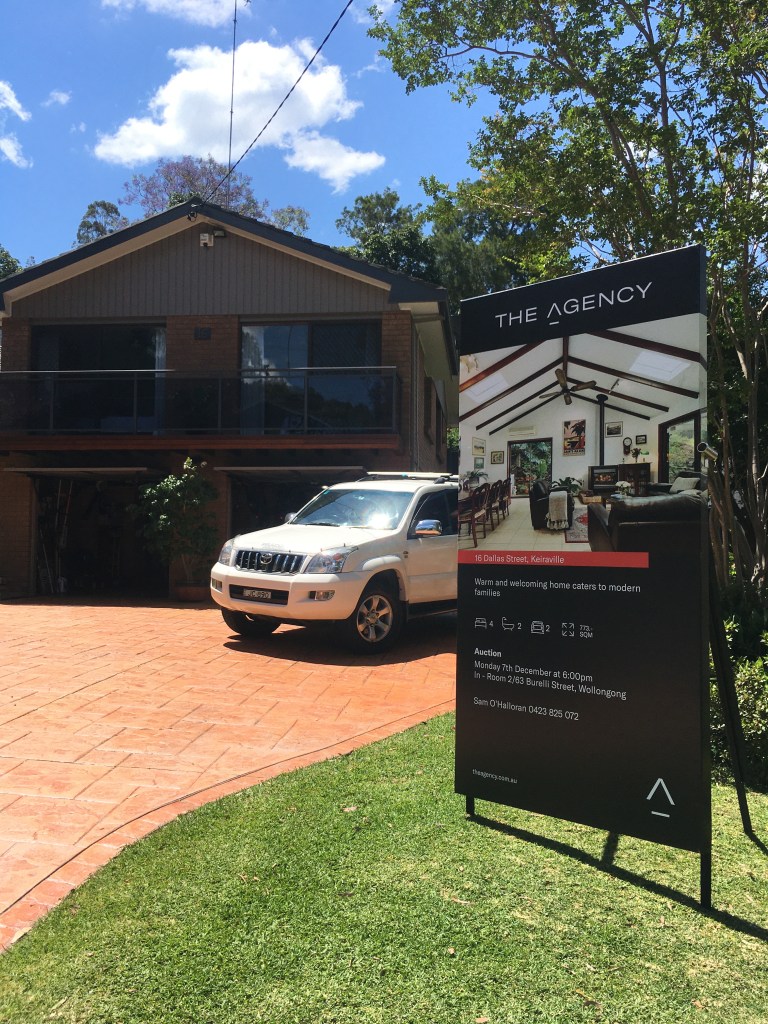
A large sign emerged on the front lawn.  It was one week to the first Open for Inspection!

The agent rang.  Someone wanted to visit immediately as they would only be in town one day.  All right, we said and raced around making last minute adjustments.

Suddenly it was pouring with rain.  Unbelievably, water  dripped from the skylight over the kitchen sink.  That skylight had been there for forty years and now it chose to leak!

The rain stopped and after a quick wipe to remove the evidence we exited the house and drove away for a well-earned coffee.

This was repeated every Saturday morning for the next few weeks without the torrential downpour, fortunately.  Offers were made but our agent said to wait as our house was worth more.  Then came the offer we couldn’t refuse. We decided we had come this far and felt ourselves irretrievably swept along a path of no return.

Alas, it was not to be. The buyer may have decided she might get it for a lower price if she waited for the auction so she rescinded her offer.  By this time we just wanted to call off the whole thing and go back to the nice little comfortable life we had before.  What were we thinking, selling our lovely home?

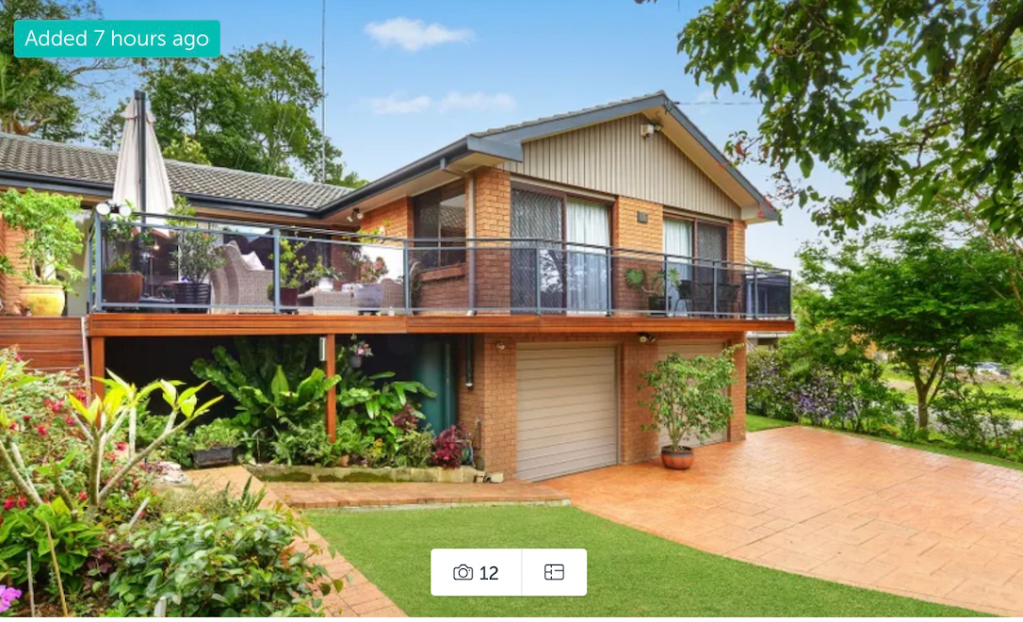
Seven hours on the market

On the night of the auction we were ushered into a little room with a closed circuit television so we could watch the proceedings in peace.  A few properties sold or were passed in before ours came up.  The auctioneer did a good job praising the street appeal, the proximity to university, Botanic Gardens, local village, the well-maintained house and gardens, but there was absolute silence.  A vendor’s bid was placed but still there was silence.

It was over!  John and I high-fived and drove home in a state of euphoria.  Despite the agent’s pleas next day to leave it on the market another few weeks we were adamant.  We were not selling.

It had taken the imminent loss of our home for us to realise how perfect it was for us.  So the garden gets too much for us, we will get a gardener.  While we have a boat and caravan, we will store them on our own land.  I know the theory is you downsize while you are fit enough to do so because if you leave it too long it will become an unpleasant job for someone else.  

On the other hand, why not continue living in a home you are pleased to come home to?  The costs of hiring help and maintaining an older house can be balanced by the not inconsiderable costs of moving.

Life goes on.  We did replace that skylight and had the roof cleaned, repointed and painted. We have re-stained the deck twice since the For Sale that didn’t happen and do battle with the garden which grows while you look at it in this wet, sub-tropical summer.  

We have no plans to do anything different.  For now.

C for Cycling

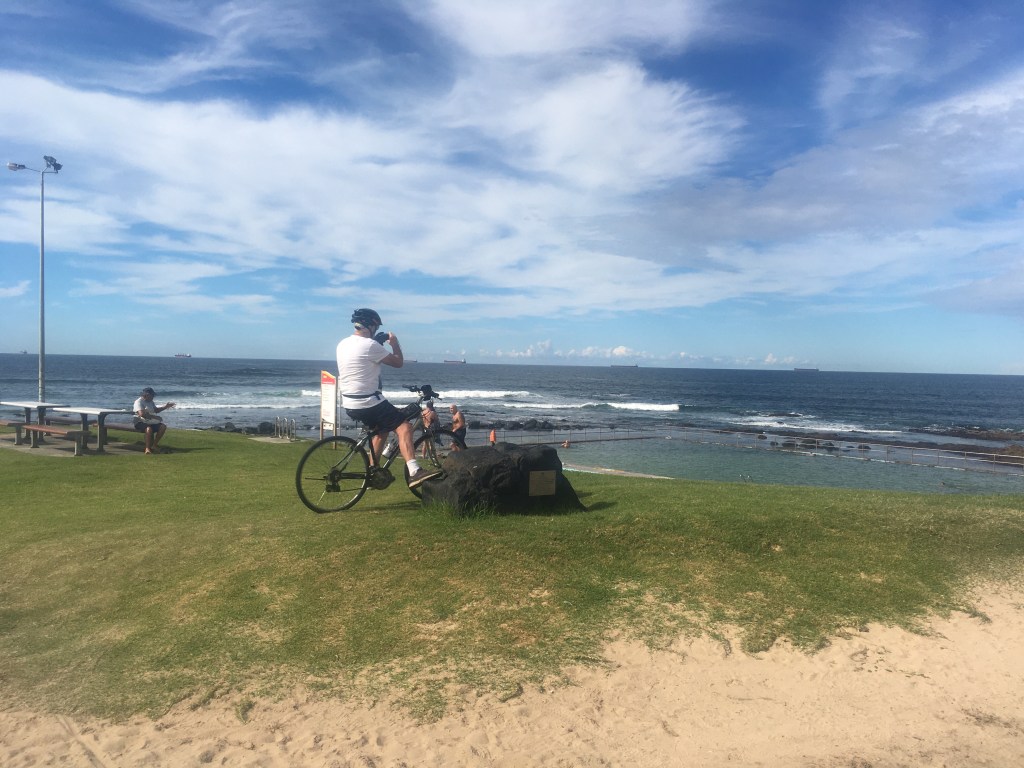
I must admit I’m not a great cyclist.  Flat, straight bike tracks are my ideal.  I hate roads with cars, hills, narrow bridges, spirals, people walking in front of me and out of control children on bikes.  I can’t stand up on my pedals and I do fall off occasionally.  That said I still love to go for a bike ride.  There is a lovely bike track from Wollongong to Bulli which follows the beaches and the ocean baths, but it can be very crowded, especially on weekends.  We recently discovered a bike track which partly circumnavigates Lake Illawarra and ends at a delicious coffee shop.  Best of all it is usually deserted.

On the Wollongong to Bulli bike track

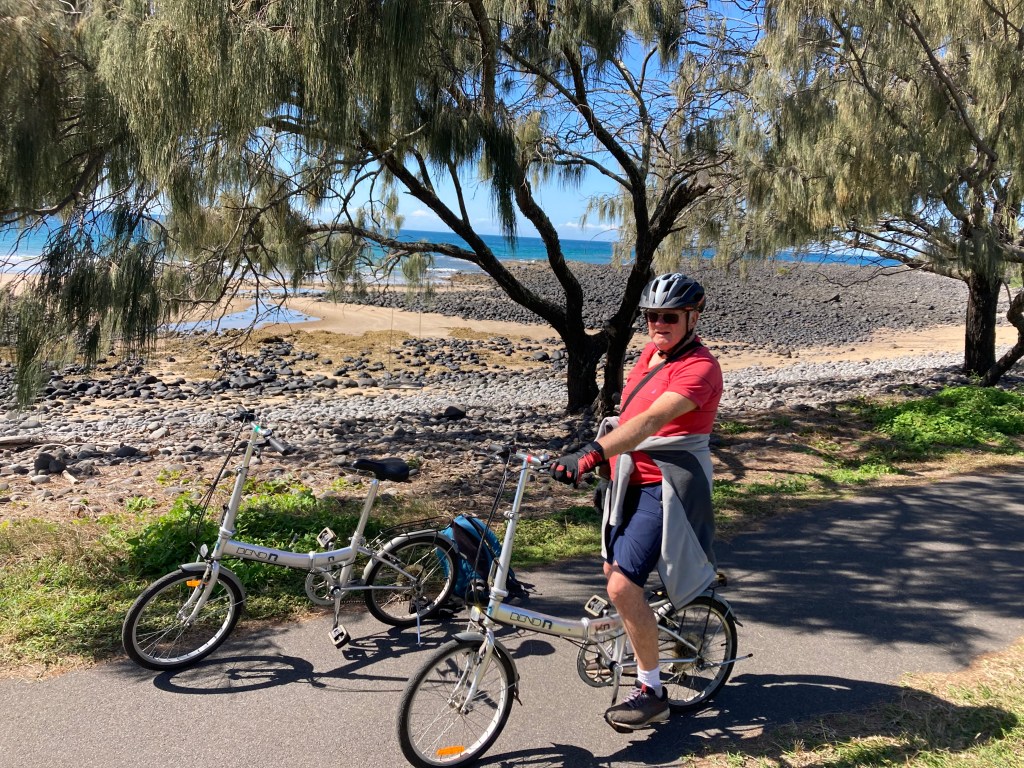
However we do most of our bike riding when travelling in the caravan.  In 2009 we bought two folding bicycles at Aldi and surprisingly they are still in good working order, fourteen years later.  

The folding bikes near Mon Repos, Queensland

Most of the towns where we camp have their own cycle tracks but when we stopped at Tumbarumba we decided to do something different.  There is a rail trail to Rosewood which is twenty-one kilometres long.  As there were some hills, especially at the start, we hired e-bikes for the first time. The temperature rose to 30 degrees Celsius so we were glad to have help from the batteries.  Finally reaching Rosewood we were gasping for a cold drink, a coffee and some cake but a blackout in the area meant that there was nothing open.  We had to make do with our bottles of luke-warm water, muesli bars and an apple. The twenty-one kilometres home again was a breeze on e-bikes and the scenery of cows, hills and farms was good for the soul.

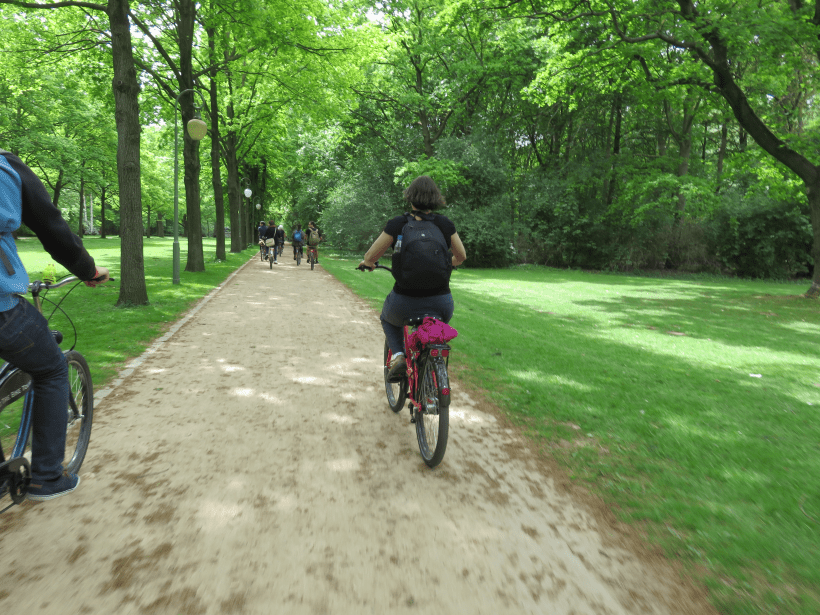
Our bike rides when travelling overseas have added a new dimension to our experience. Turning left across traffic in Hue, Vietnam with heart in mouth, riding along the outer wall of Xian in China (and crashing into my husband’s bike), experiencing Berlin (and hitting a kerb where again, I fell off), exploring the grounds of the Palace of Versailles, riding through vineyards and pretty villages in the south of France (where I found myself locked in the toilet at our lunch stop), and exploring the rice fields of rural Japan, were all memorable experiences.

Cycling in Japan

The closest I have felt to sheer terror had to be the 46 km (28 mile) bike ride down Mt Haleakala, a dormant volcano of 3,048 metres (10,056 feet) on the island of Maui in Hawaii.  It was mostly downhill which sounds a piece of cake, but it is a very windy, twisty road as you might imagine. They put the inexperienced riders like me towards the front and the bigger, more experienced men like John at the back.  The pressure was on to keep up the pace of 29 to 40 kph (18 to 25 mph)  when my instinct was to brake, brake, brake! If we crossed over the centre line of the road we were told we would be put in the back of the truck.  At the halfway point the front person gave up and retreated to the vehicle. We posed for some silly photographs which made it look like I was enjoying myself!  

Posing for the camera in Hawaii

I was ignominiously placed at the front to be “coached” down the mountain. We arrived at the sea at Pa’ia and sat on the beach to calm down. It was one of those experiences that is better viewed in retrospect. I’m so glad I did it!

Cycling is something adults can do with their children and their grandchildren. From tiny bikes with training wheels ours all graduated to full sized adult bikes. When they were small the grandchildren would pedal short distances from one children’s play area to the next. Now we can’t keep up.

Off on a bike ride with a grandchild

B for Boating

When I retired in 2006 we owned a beautiful trailer yacht called Blizzard.  It was a Spider 24 meaning it was 24 feet long (7.3 metres) and was towed behind our Toyota Prado.  It took us on many adventures, exploring the Gippsland Lakes, welcoming the year 2000 on Sydney Harbour as well as giving us endless fun on the many lakes and bays along the NSW coast.

Blizzard had many modern amenities.  The retractable keel came up at the press of a button, there were two single bunks and a V-berth, a small galley with a spirit stove and sink as well a private portable toilet.

The disadvantages were that rigging was time consuming, the mast was difficult to raise and the lightweight sandwich foam construction meant that great care had to be taken launching and retrieving so as not to damage the hull. 

As time went by we found we were using the caravan more often as the boat sat idle beside the house.  We advertised it and soon it was heading out the driveway behind someone else’s truck. Did we have any regrets? Not really, as we were planning overseas trips and felt if we wanted to be on a boat we could hire one.

Years passed. Then the months of lockdown arrived.  We couldn’t travel overseas, interstate or even out of our council area for a while. Idly flicking through boat ads I saw a familiar boat.  It was a Noelex 25 and belonged to someone we knew.  It wouldn’t hurt to take a look, would it? 

Boat for Sale

Slightly bigger than our last boat, it was the Rolls Royce of trailer yachts in the 1980s.  John used to fantasize about owning one but they were always too expensive.  Forty years later it looks a little dated but is still very functional.  The hull is solid fibreglass, the mast is relatively easy to raise and the roomy cabin features a combination fridge/freezer powered by two batteries and a solar panel permanently fixed above the stern of the boat.  The only disadvantage over our last boat is the keel which takes 99 turns of a handle to be fully retracted.

A week later Offshore Account was parked neatly beside our house. Although I’m not a great fan of the name I doubt we’ll change it.  Looking through the folder of paperwork that came with the boat I found snippets of information about its past.  Built in New Zealand in 1983 it was originally called New York New York but was renamed after it made its way to Australia.  For a time it sailed in the Whitsunday region before moving down to Brisbane where it roamed Moreton Bay.  Our friend David had driven up to Queensland to bring it home to Wollongong.   Now it was our turn to give it some new experiences.
The day we were to launch it on Lake Illawarra started well.  David showed us many of the tricks of rigging peculiar to this class of boat and I took a number of photos so we wouldn’t forget.  The mast was up, the sails were ready to raise, the motor was attached to the stern and we were ready to launch.  

Just check the motor first. Oh, it won’t start!  Just try again.  Still won’t start.  I think its flooded.

David was shocked.  It had worked perfectly last time he tried it.  He removed it from the boat and drove to a repair shop, returning empty handed.  They were keeping it overnight.  So all we could do was unrig the boat and drive it home.

Two days later we were on the water.  The motor was working brilliantly.  With the sails up and a gentle breezes blowing we felt we had made the right decision.  The only problem was it took us two hours to rig the boat and nearly as long to retrieve it, unrig, clean the hull and flush the motor, put the sails in the bags, tie the boat straps on the trailer, connect the lights and drive it home.
Freedom on the water

Best to take the boat to a lake and stay for a week on board.  Then we would only have to launch and retrieve once.  The trouble is it rained, and rained.  For months it rained.  Sick of waiting for good weather we bit the bullet and picked a date.  A good friend of ours would bring his Farr 6 and attempt to sail it single handed with a little bit of help from us.

The first thing that went wrong happened before we left.  John ran through water on the path in scuffs, slipped and fell on his back. Although he didn’t seem to have sustained major damage he was stiff and sore for some time.  The second problem was raising the mast on our friend’s boat.  The mast step broke so he was destined to spend the week unable to sail.

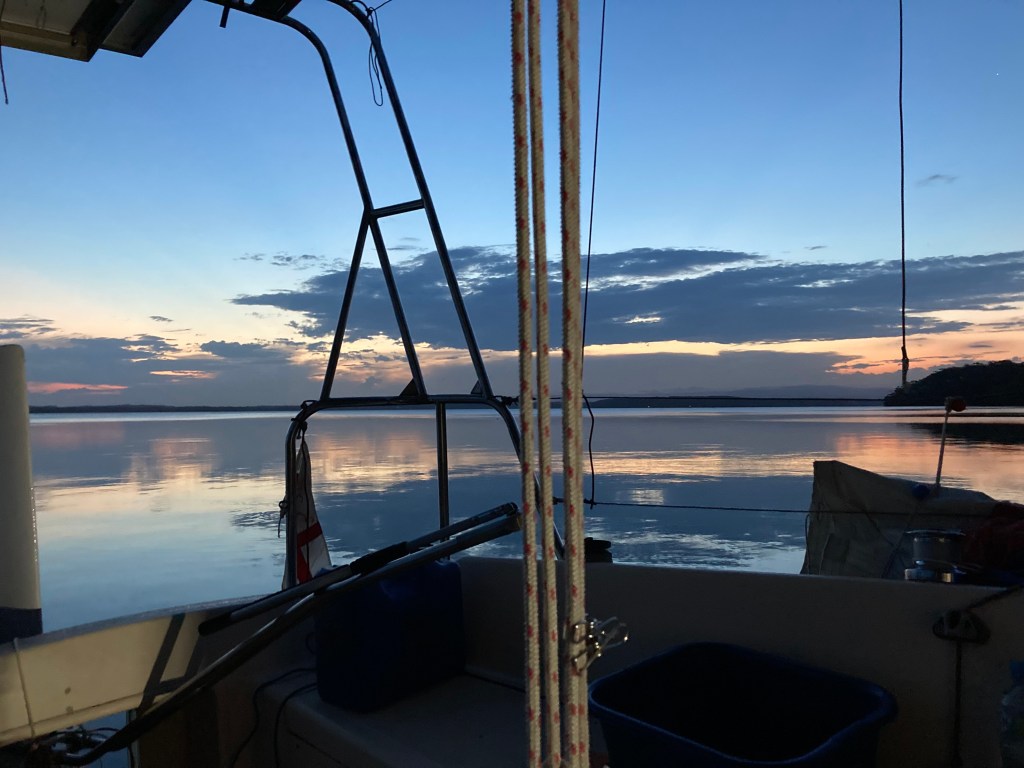
Sunsets were peaceful on the boat

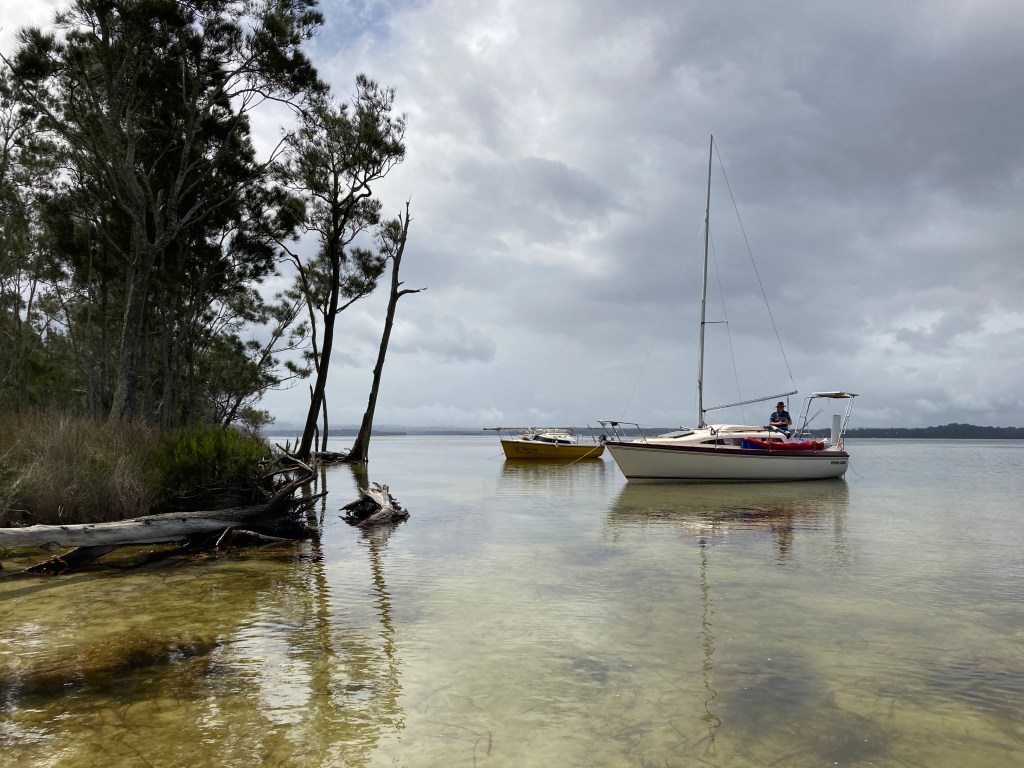
Despite all the problems we were soon motoring to our favourite sheltered creek in St Georges Basin. Alas someone was camped there in OUR SPOT!  Further up the creek we tied to a tree, put up our large boom tent for the first time and cracked the first beer. Then it poured.  All night.

Relaxing after a tough day

Our friend was worried about his trailer but after motoring back to Sussex we found we were the ones with a problem.  We had left the passenger side window down and the car was drenched. Some kind person had tried to cover the window with a garbage bag but it didn’t help.

In year’s past we had always tied up to an unused jetty.  However, we were chased off by someone who claimed it belonged to his rental. We were also chased away from a new unused jetty with fierce locals dialling their mobile phones and speaking loudly about two yachts tied up, and finished up under a big tree with a tricky climb ashore.

Jetties everywhere but no room for us

There were times when we were glad to be on the water.  The sunsets with cloud filled skies were spectacular. We swam in the shallow water of the sand island.  However the beaches showed the effects of flooding, with foam and driftwood spoiling the usually pristine sand.

Serenity at the sand island

Quite a few months later La Niña showed signs of abating.  We planned for the grandchildren to experience what their mother had grown up with.  Every school holiday our children had spent on the water, sleeping, eating and playing in the confines of the small cabin of an RL24.  How we all survived none of us knows.

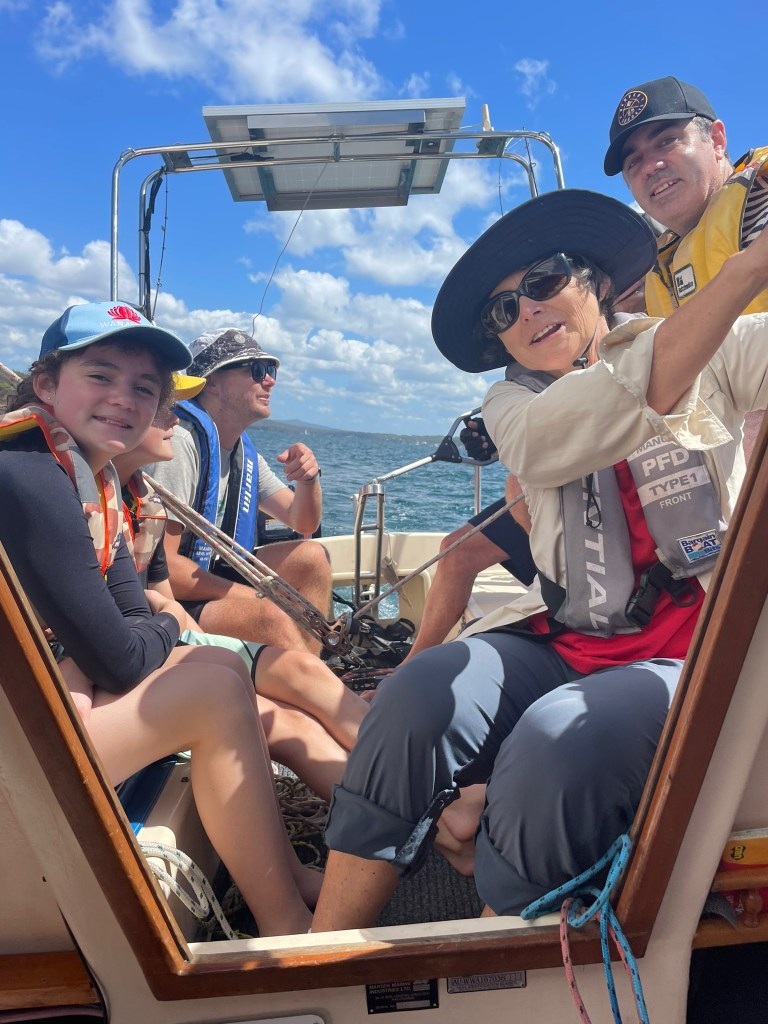
Lake Macquarie was the waterway of choice.  It is a deep, magnificent lake just south of Newcastle. The launch at Styles Point was uneventful and we noted children jumping off a jetty into a netted swimming area.  Perfect for the grandkids (and us, in the ensuing hot weather).  My daughter rented a cottage on a hill overlooking the lake and our son relived his childhood by spending two days sleeping on the boat. It was a good combination of sailing, landing on deserted islands, eating at lakeside clubs and pubs and most important of all, showering at my daughter’s B&B.

Family ahoy!

Pumped with our success we invited sailing friends to accompany us on a one day sail on our local lake. Having other sailors on board made life easy for me. Eating fresh prawns on crunchy bread rolls, sipping a crisp white wine and admiring the Illawarra escarpment from a comfortable seat was a brief respite before the sails were raised and we were flying across the lake towards home.

I must admit that sailing is not as easy on our aging bodies as it used to be.  Bruises and sore muscles, aching backs and stiff joints are part of the price we pay.  I think of it as equivalent to a serious workout at the gym. There is an old joke that says the two best days in a boat owner’s life are the day they buy a boat and the day they sell it. Hopefully we will have a few more happy experiences before we decide to pass Offshore Account onto the next owner.

A for Aqua Joggers

Retirement gives people an opportunity to become fitter and healthier.  Teaching is quite an active occupation but hours of sitting marking books, writing reports and eating unhealthy food on the run can take their toll.

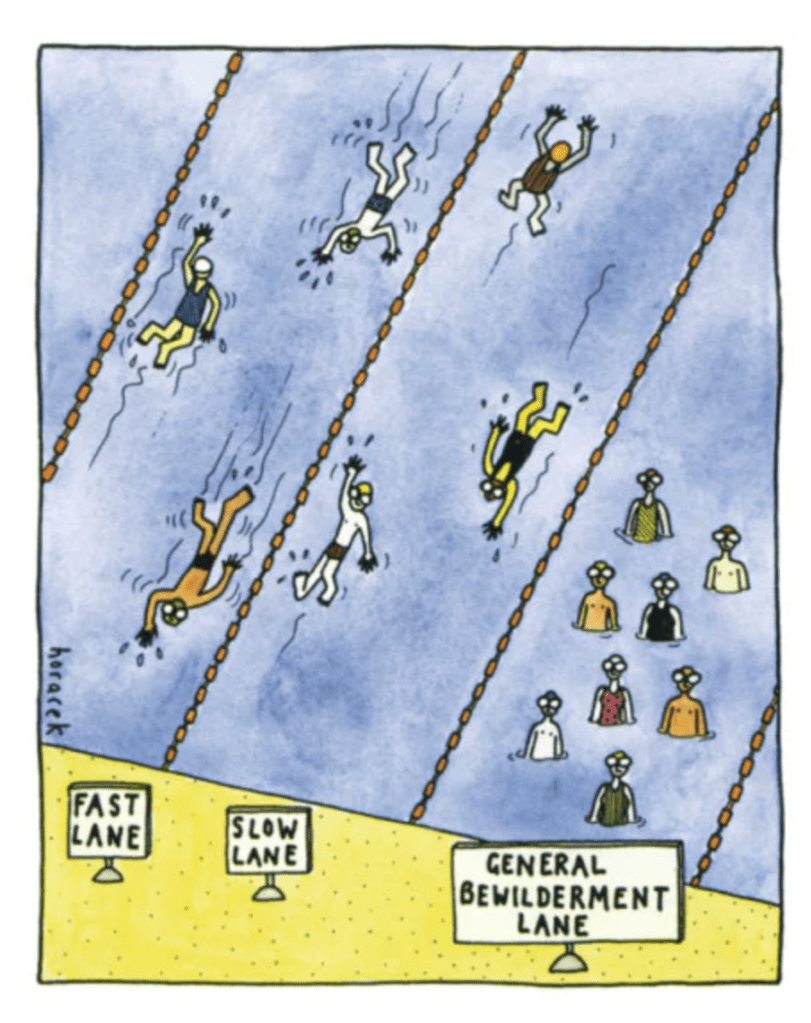
We are fortunate to live ten minute’s walk from the University of Wollongong.  They have a gymnasium and 50 metre heated outdoor swimming pool.  I can’t remember who first told me about Aqua Jogging but my husband and I decided to try it as a relatively painless way of improving our fitness.  We were very impressed with the t-shirts worn by some members.  Designed by Judy Horacek, an Australian cartoonist, artist, writer and children’s book creator, the image depicts the Fast Lane, the Slow Lane and our group of Aqua Joggers, the General Bewilderment Lane.

Designed by Judy Horacek

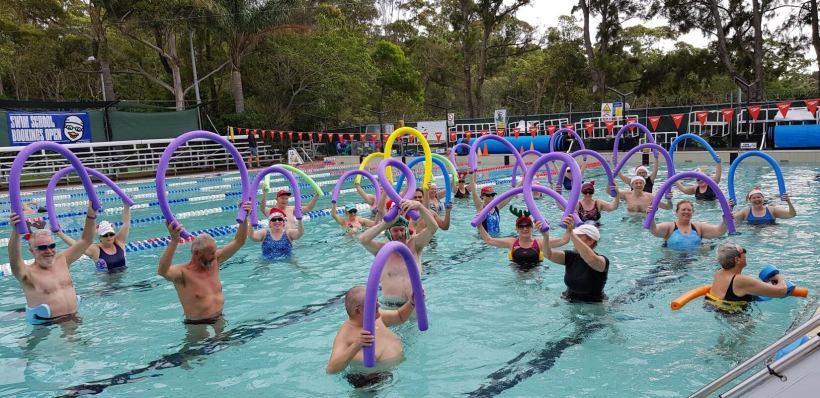
We found the group to be friendly and supportive. Far from being bewildered they came from a range of backgrounds and were happy to talk about any topic.  Whenever a new instructor arrived, it took time for them to realise that the group had the ability to listen to instructions and talk at the same time. In the background could be heard cassettes and thumb drives of personally chosen music, CDs playing Hits of the 60’s and 70’s, local radio and more recently Spotify Playlists.

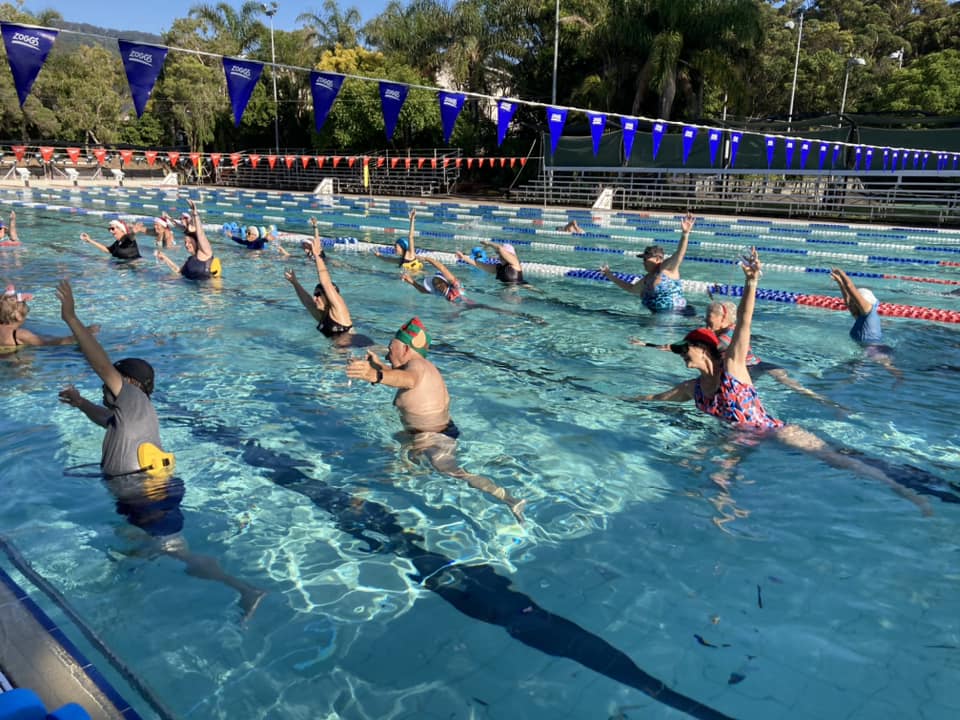
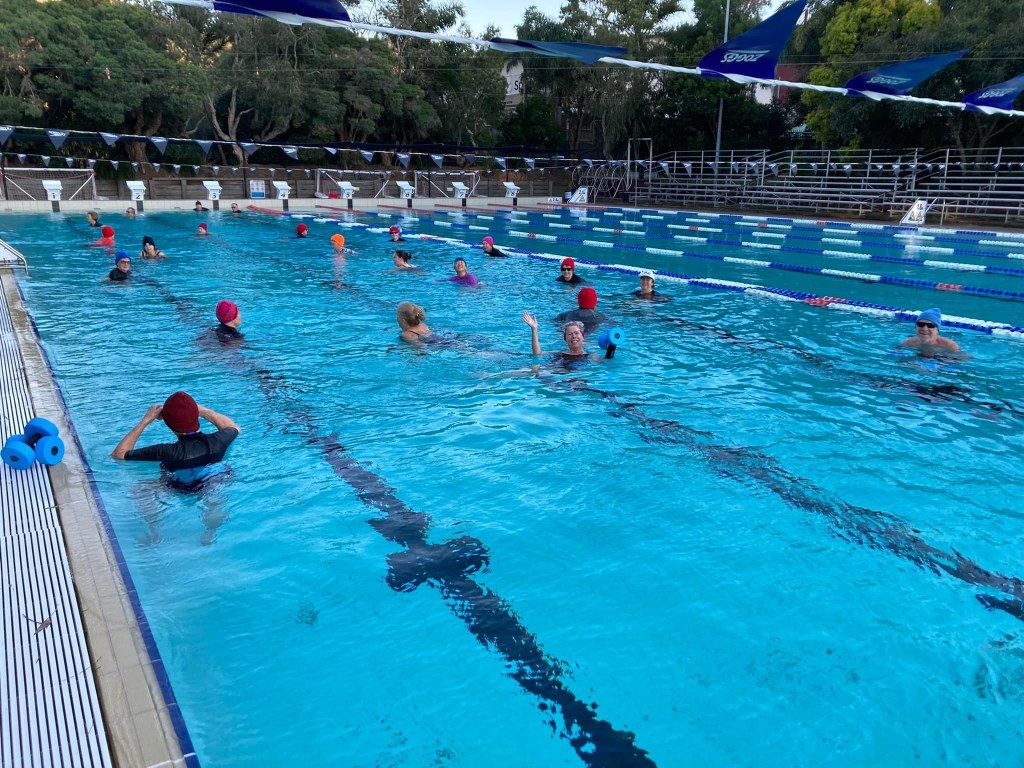
To begin with, Aqua Jogging was just that.  We would travel up and down the pool using arms and legs in various ways; jogging, cycling, skiing, ladder climbing.  We would also perform various movements in the deep water; windscreen wipers, pendulums, star jumps, around the world, first with the aid of a flotation device and later with polystyrene dumbells. There were push ups on the side of the pool or push and pulls.  For forty-five minutes we would keep moving and talking, starting at 7.15, with a rush for the hot showers at 8 o’clock.  This was all very well in the summer but getting up in the dark on a cold winter’s morning, walking in wind or rain to the pool, I often wondered if we were all crazy. The steam would be rising from the water which would usually be a balmy 26-28 degrees Celsius. Some of us wore Radiator vests made of a wetsuit material to keep our upper bodies warm as the cold wind hit our shoulders and faces.  On our heads we wore beanies for warmth while in the summer we wore hats and sunglasses to keep off the sun.

Wearing winter woollies Photo taken by Sue Martin

The coffee shop in the gym was a place to carry on conversations started in the pool. At nine o’clock everyone would be gone to avoid the paid parking, while we walked home observing the rapid expansion of the university over the years.

Then Covid arrived.  All gym sessions and aqua jogging ceased.  We still kept in contact online, using our chairs and improvised weights to keep fit. The sessions were sometimes from the instructor’s homes and sometimes from the empty gym. Then one magical day we were back.  The pool was still cold as the boilers hadn’t had time to heat the immense body of water but we couldn’t wait.  How wonderful to be back in the water after months of abstinence.

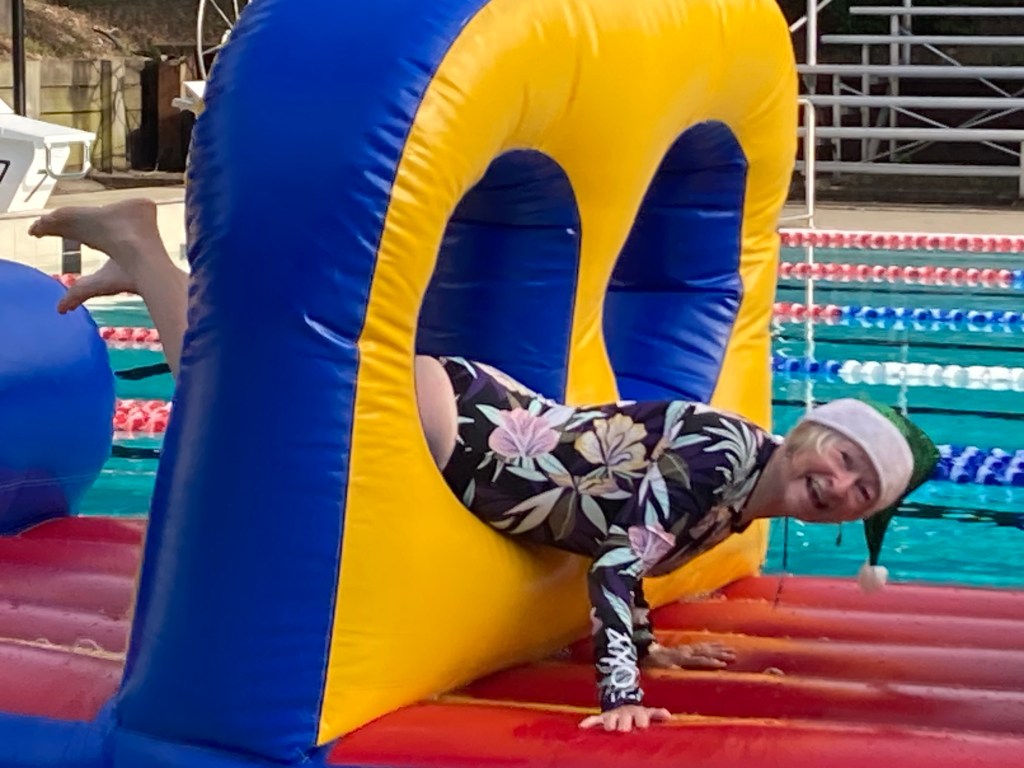
The powers that be decided to change the name to Aqua Fit to more aptly describe the nature of the exercises.  More time was spent in the shallow end to build up bone density and muscle tone much to the annoyance of some. This feisty group of mainly senior people was a confronting cohort for a young would-be instructor.  Only the brave remained and earned the respect of the group through sheer determination and adaptability. Much loved are the instructors who devise unusual activities like this pre-Christmas obstacle course challenge.

An Aqua Jogger getting into the Christmas spirit. Photo taken by Linda Curry

After the Covid lock down ended the group time changed to 7.30 am.  Sessions reduced from five to three days a week. Apps appeared on phones to prebook and numbers in the summer rose to well over 30 people.  We know that come winter, only the true believers will face the dark and the cold before slipping into the relatively warm water.  That is of course when the heaters are working which is most of the time.  Then it’s a cold dash to the showers before warming up again in the steaming hot water.  When the showers run cold on rare occasions the screams from the horrified Aqua Joggers can be heard far and wide.

The congeniality of the Aqua Joggers is something to be treasured.  If members have suffered a personal crisis they find generous support and friendship from the rest of the group. Outings are organised, camping trips, overseas travel. A book club has just restarted after a long Covid hibernation. Not everyone is involved of course but the option is always open for all to participate.

Photo taken by unknown person

I was never into sport and team games but now have found an activity that works for me.  When I first retired I said I would never get up before 7 o’clock but now we are both up at 6.30 am Monday to Friday, three days in the pool and two days in the gym. The 21/90 rule states that it takes 21 days to make a habit and 90 days to make it a permanent lifestyle change (Dr Maxwell Maltz 1960). It is now unthinkable to stay in bed when the alarm goes off as there are sunrises to see, people to greet, stories to tell and when warm and dry, a steaming double shot flat white to drink surrounded by good company and stimulating conversation.