Ted was unwilling to talk about how he earned his medal. According to the official war records “Turner was awarded the Military Medal on 26 August 1918 for remaining at his post and issuing supplies whilst under heavy enemy shellfire on 10, 20 and 21 April 1918”.
He preferred instead to tell the story of a glorious party in the cellar of the Corbie Chateau which took place around this time.
Ted was in charge of a platoon at Corbie which was told to go in and destroy everything of use to the Germans who were only a short distance away. They entered the chateau and were captivated by the opulence of the family home. They found an open cellar filled with marvellous wines and so proceeded to sample them. Laughing and talking they came up the stairs but were quickly subdued by the sound of a large group of Germans in the dining hall a few rooms away. Fortunately they were able to beat a hasty retreat and headed for the escape road. The Germans had taken the bridge they had to cross but with courage enhanced by good French wine they managed to blow it up, thereby stopping a heavy German transport from crossing.

When he first enlisted Ted thought that you would be put somewhere near the front line and fight it out until you were were either killed or the war finished. He was surprised at the extensive sections servicing the front line and that the infantry were so often withdrawn and spelled.
Despite efforts to transfer to other departments Ted seemed destined to remain with the 26th ASC (Army Service Corps) supply section. Corbie is 4 kilometres north of Villers-Bretonneux which became the focus of a series of great battles in 1918. During March and April the German offensive attempted to capture Villers-Bretonneux and open the way to Amiens.
Reading from his diary on March 25 he says “we passed a rather exciting time as rumours were current everywhere and there was a chance of being cut off”.
He goes on to say “Fritz has attacked with immense numbers and forced us to retire…Household articles are plentiful, as are also pigs, fowls etc and wine as the civilians have evacuated. Our brigade is doing fine work.”
On April 6th he writes,
Have had several shifts and are now comfortably established at Ebart in a large farm, the owners of which have evacuated. Shelling is very lively but not too close to us. The Brigade were badly caught yesterday morning and had several hundred casualties. The prevailing question is whether he will take Amiens. We seem to have no support here and our chaps are standing the brunt of the attacks all along the line.
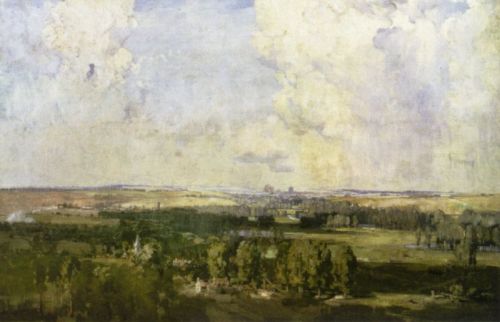
by Arthur Streeton
Painted while Streeton was an Australian official war artist during the First World War. The French city of Amiens was a critical British base that was an original objective of the German Spring Offensive. The painting depicts the view to the east, overlooking the city, with gunfire on the horizon. Australian and British troops halted the German advance east of Amiens at Villers-Bretonneux.
The diary then simply names places where Ted was stationed until April 17 when he says:
For some days I have been stationed at Corbie salvaging forage left close to the line. Corbie has been a fine town but has been cruelly wrecked. We have as a billet a fine house and have the best of carpets and furniture. We have a cut glass service for mess gear and live well. I have done some good salvaging which makes one feel more pleased. So far we have sent to the rear some thousands of bales of forage and several tons of potatoes.
From here Ted moved on to a coal dump facing Amiens. With shells hitting the water and marsh around he expresses hope that Amiens Cathedral will survive the relentless attack. In May he was in charge of 11 men gathering fresh vegetables from deserted plots in and around Amiens. In June he had to move again further along the river By July things were quiet, shelling had ceased, people were returning and some American divisions were in the village of Camon. Nothing personal is written about the next few months or the now famous battles which brought about the end of the war.
By the time the war officially ended on November 11, 1918, Ted was in England training for another role.
Peace has left me practically unmoved having experienced no emotion whatsoever, so apathetic have we become.
He returned to France and describes a cold, wet desolate country with the “wan, apathetic faces of returning prisoners” and the “dull, hopeless faces of the civilians”. Ted couldn’t wait to get out of there but he wasn’t quite ready to go home yet.
 The Curry Apple Orchard
It takes quite a few to support the front line and those supporters are not always in cushy jobs free from danger. I hadn’t thought about logistics very much but gathering vegetables in the countryside is more haphazard than I imagined for feeding the troops. Perhaps though it supplemented what had been supplied.
Regards
Anne
https://ayfamilyhistory.com/2018/04/14/m-is-for-mary/
LikeLiked by 1 person
Ted said when he first arrived he had to go and buy vegetables out of his own money as there wasn’t enough to eat.
LikeLike
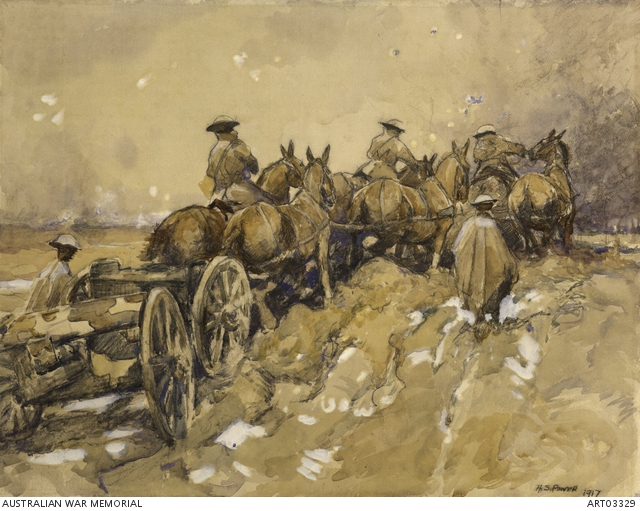
I loved the two paintings you chose. Streeton shows the magnificent big skies. Septimus Power does a great job of showing the horses straining through the mud.
LikeLiked by 1 person
I like the images that highlights “M for Military Medal.” Great post.
Thanks for stopping by my A to Z posts: https://writingiscommunication.wordpress.com/category/a-to-z-blogging/
LikeLiked by 1 person
Sounds like a remarkable life
Debbie
LikeLiked by 2 people
I hadn’t thought about foraging for vegetables on a big scale either. Makes sense as long as the crops are there.
LikeLiked by 2 people
Hari OM
a wonderful ‘snapshot’ of being on the ground in a conflict zone – that it is not all blood and guts, yet neither comfortable. What a valuable record… YAM xx
LikeLiked by 2 people
So strange to think of all these abandoned homes in the war zone being used by both sides. Glad Ted got to enjoy some good French wine. Weekends In Maine
LikeLiked by 1 person
Like many involved in the war he wrote about the good times and said little about the bad.
LikeLike