P is for Panorama

In her letter to my mother regarding the family pedigree Kay said of William Robbie.

“He was a wonderful artist with paintings in the Adelaide Art Gallery.  He toured Australia with the first Moving Picture Panorama, carving every figure and hand painting the scenes.  The figures moved and it was lit by a mill lamp.”

My grandmother continued, “He toured Australia for two years and coined money – then sold the lot for $1,500.  His great failing was drink.  He would stay sober for months and then go on a spree.  He was a terrible man in drink.  He would sit at the fireside and light his pipe with five pound notes just to upset his wife.”

He disappeared off to the Western Australian goldfields and according to my grandmother died of typhoid.

But what of the Australian Panorama? On the 2nd April 1890, “The Border Watch” of Mount Gambier reported:

Mr William Robbie, assisted by his son Mr J C Robbie, has just completed a series of 22 panoramic views of Australian scenes… four Mt Gambier views, four of Broken Hill mines, and one each of Adelaide, Port Darwin, Perth, Melbourne, Sydney, Brisbane, Hobart, the Frenchman’s Pass, the Wreck of the Admella, Black Thursday etc. They are each 14ft by 7 1/2 feet.  Arrangements are being made for their exhibition throughout the colonies.  Judging from a preliminary view we are able to say that the Panorama will be well worth a visit.  It is quite equal to anything we have seen in the colonies.

It goes on to say:

Mr Robbie mentioned that the Panorama, as it stood, had been sold to an Adelaide gentleman for one thousand, two hundred and fifty pounds and when it was completed the purchase money would amount to about two thousand pounds.  The Panorama was exhibited again on Monday evening to a large house.  On each evening several oil paintings were given away as presents.

I wondered about my grandmother’s description of it as a “Moving Picture Panorama” and found further information in the Border Watch, 9 Apr 1890.

The views were well lighted and the machinery for their display worked satisfactorily…As each view was presented, Mr H Barlow as lecturer gave a few interesting facts connected with it, which enhanced the interest in the view.  When Mr Robbie and his son Mr JC Robbie appeared on the platform… they were loudly cheered.

In 1891 things were going well for William.  In the South Eastern Star of 24 Nov 1891 a correspondent writes:

Mr Robbie of your town has several contracts for painting here and has now a staff of men employed carrying out the work.  Work is pretty brisk here just now in the building trade and all hands are fully employed.

My grandmother’s reference to William’s great failing – drink,  is hinted at in a report in 1882 that he was charged for using indecent language.  It seems his son George went into William’s house but was ordered out.  He came back with a police constable to stop a disturbance in the house.  The policeman heard William using abusive language to various members of the family.  The two daughters went out the front door. William testified that he was perfectly sober and the judge dismissed the case.  It certainly sounds like the Robbie household was not a happy one.

eliz
Elizabeth, William’s long suffering wife

Alas, this was the beginning of the end, as William had creditors knocking at the door and the much publicised sale of the Panorama did not eventuate.  The Panorama was used as security for the payment of his creditors in full.  In 1896 he left his family  and went to Western Australia looking for gold.  He died in the Perth suburb of Guildford of asthma and chronic alcoholism.

Very little of William’s work remains and he is not listed as one of Australia’s great artists, but there is no doubt he was industrious and tried very hard to make a living using his various skills.  On reflection it would seem he had grand ideas and over-extended himself too many times to make a comfortable living.  Had he stayed in Mt Gambier he may have lived much longer than his 62 years as he was respected by the community and was even nominated for Mayor in 1889!

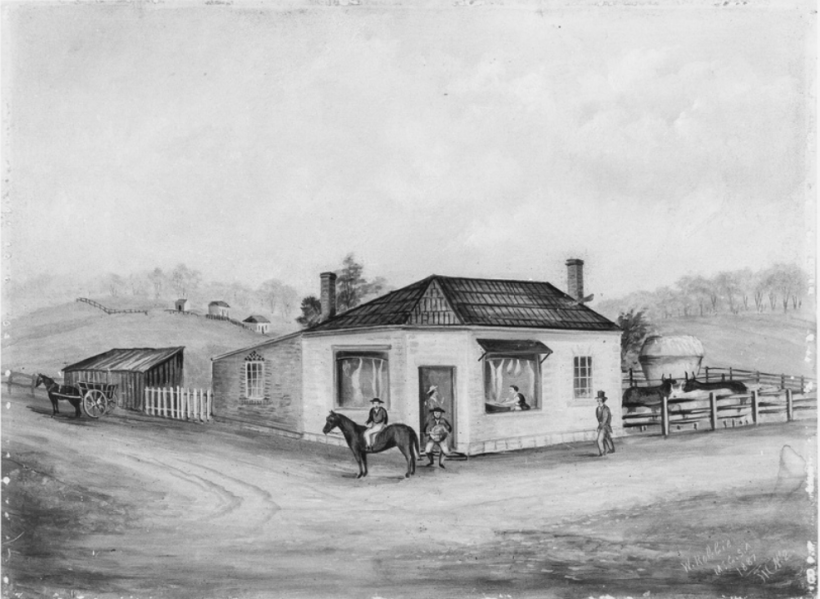
Searching on Trove I found this reproduction of a Robbie painting which was painted from a photograph.
Screen Shot 2017-04-16 at 3.19.06 PM
Butcher’s Shop in Mount Gambier

Oil painting of a butcher’s shop in Mount Gambier, with the inscription ‘W. Robbie / Mt. G. S.A. / 1887 (No. 2)’ in the bottom right hand corner.  From the back of a photographic copy we get the following information: ‘Schinckel and Milton’s butcher’s shop. Said to have been the first butcher’s shop in Mount Gambier.  Reproduced in 1926 from a painting in the possession of Mr. J.C. Meldrum, Commercial Street, Mount Gambier. The painting was executed in 1887 from a photograph taken in the eighteen sixties’.

O is for Oil Painting

William Robbie from Aberdeen was my favourite ancestor as a child.  According to my grandmother he married Elizabeth Steven who disgraced her very good family by running away with an artist, marrying secretly and coming to Australia with him. 

A few years ago we visited Mt Gambier and saw one of William Robbie’s painting in the house of Robert and Ethel Smith in Naracoorte.  The painting is called “The First Hunt”, and was painted at Comaum near Naracoorte around 1867.

w robbie hunt

 The couple told me he had painted the  living room ceiling of Hynam House,  on a property belonging to their family.  One hundred years to the day an earthquake cracked the ceiling.  Repairs necessitated the removal of the painting but they have still kept William Robbie’s signature exposed in one corner.

It all sounds quite plausible, but was William the impoverished artist who spirited away the wealthy Elizabeth from her privileged life? 

A Robbie Family History, written by Roslyn Brown of Bundoora, Victoria, shows that William and Elizabeth were married in 1859 at St Nicholas Church, Aberdeen.  He was a Seaman in the Merchant Service and she was  a Domestic Servant.  His father, George,  was a Wood Sawyer while Elizabeth’s  father’s occupation is listed as a House Carpenter.  There goes the story of the maiden seduced from her wealthy family by the dashing artist.

Thus, in 1865 William aged 28 and Elizabeth aged 33 departed Liverpool with three children aged 5, 3 and less than one year on the ship “Western Ocean”.

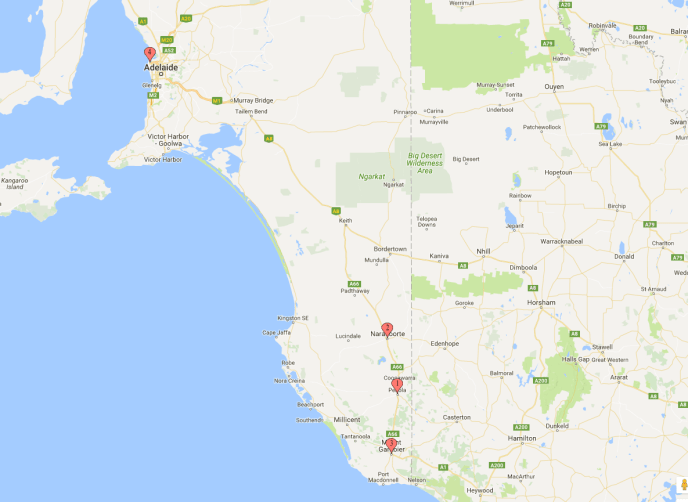
Screen Shot 2017-04-16 at 2.45.02 PM
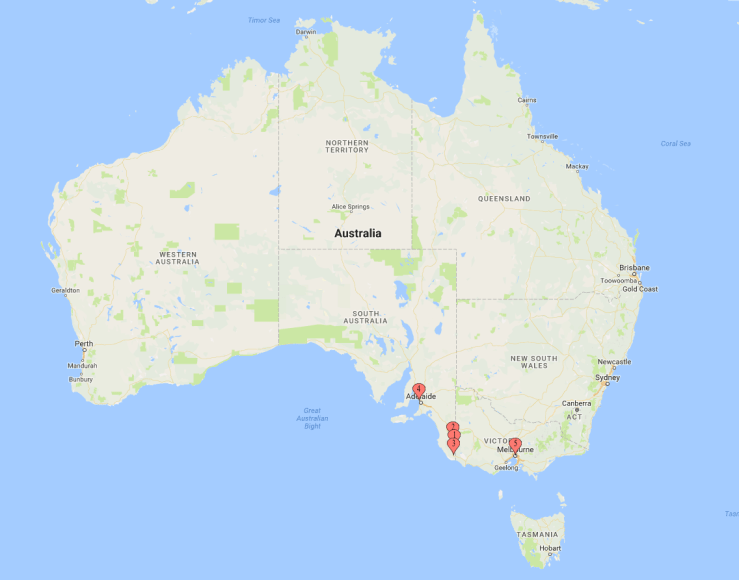
1. Penola  2. Naracoorte  3.  Mt Gambier 4. Adelaide 5. Melbourne

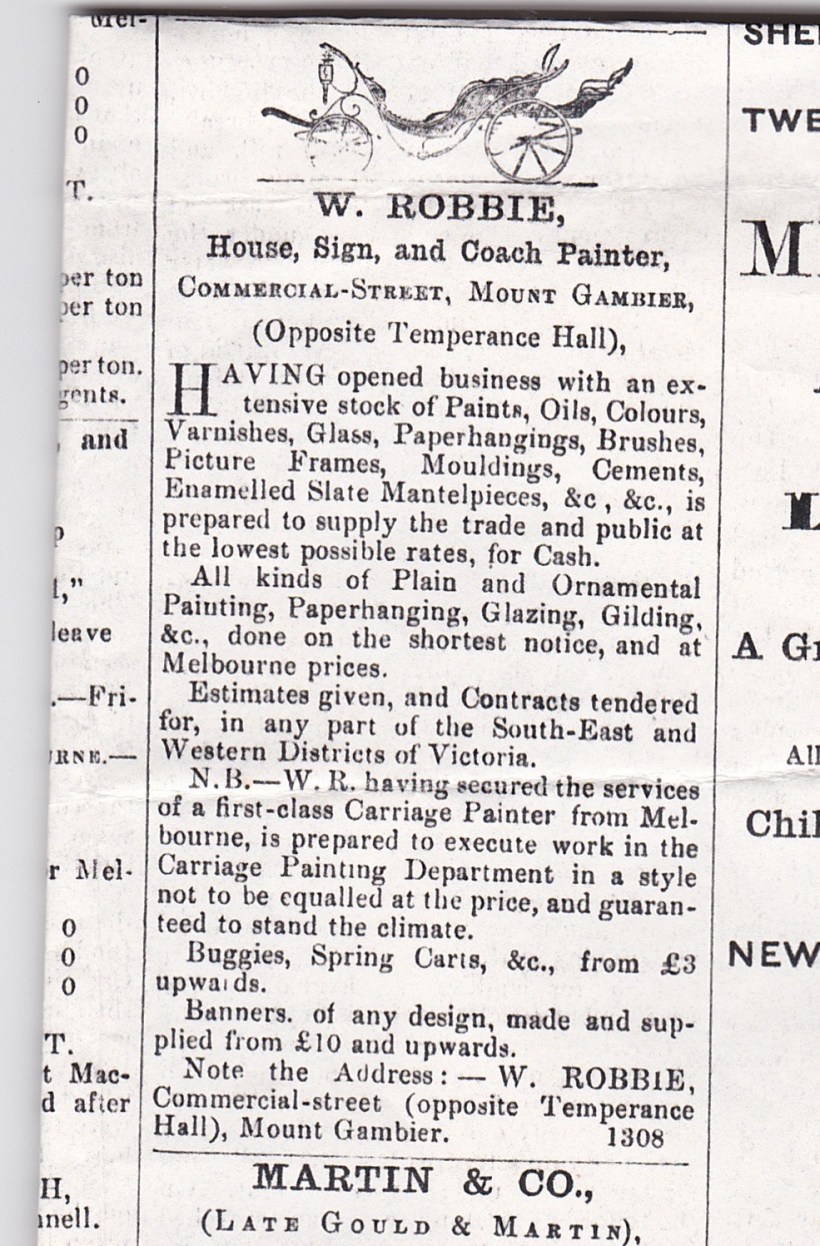
After arriving in Melbourne they travelled to Penola in South Australia where they had twin boys, two more sons and then my great grandmother Christina.  Between 1876 and 1880 the family lived in Penola and operated a shop in Market Square. In 1877 another child, Williamena was born. William expanded from the small town of Penola to the larger Mount Gambier where he opened a shop, advertising his services as a house, sign and coach painter, paper-hanger, gilder, grainer and scenic artist.  Opening a second shop in Mount Gambier he must have closed the Penola shop but still kept the house, which he rented out.

Ad in BW
Enter a caption

For some reason William decided to sell the contents of both shops and the businesses.  He sold the property in Penola in 1882  and moved to Glanville in Adelaide where he commenced business as a painter.  I  assumed this was as a house painter until I found the following articles in the Port Adelaide News, 17 July 1883 and the Port Adelaide News and LeFevre’s Peninsula Advertiser, 22 Aug 1884, respectively.

Despite the glowing accolades in these articles he was declared insolvent in 1884.    The girls Christina and Williamena enrolled at the local Le Fevre Primary School but were only there seven months when William took the whole family back to Mount Gambier.

Screen Shot 2017-04-16 at 2.40.54 PM
The move  to Adelaide and back

William may have been defeated but he did not stay down for long.  On the 17th November, 1885 he appears again in the local Mt Gambier newspaper with reference to the “Olde English Fayre” held at the Institute Hall in aid of the Holy Church.

“The Fayre will comprise every description of Old English Sports, organ and piano recitals, the trial scene from The Merchant of Venice, amongst other forms of entertainment… together with the OLD ENGLISH STREET, designed and executed by Mr William Robbie where goods of every description will be offered for sale.

William really put a tremendous amount of effort into his street of “Merry Englande” as the newspaper article of 20 Nov 1865 states:

The period was the 16th century and the buildings were all fashioned after the antique style of architecture in vogue in that period…the houses were designed to represent brick buildings touched with plaster and the ingenuity and special ability of the artist were specially noticeable in his attention to details.  The artist it should be mentioned was Mr W Robbie of Mt Gambier, whose work had obviously been a source of pleasure and to whom no higher praise can be awarded than that he acquitted himself most creditably of a difficult task.

in 1886 William lived in Mt Gambier and was listed as a painter.  He is reported in the newspaper as falling off his horse when colliding with a buggy one Sunday evening.  Dazed and shaken he was attended by the chemist who advised a few day’s rest.

The South Eastern Star reported on the play, “The Lady of the Lake” performed on four consecutive nights at The People’s Hall in September 1886.  It was directed by William Robbie and he also played the lead character, “Fitzjames”.  The newspaper reports diplomatically that it was no easy play for amateurs but as far as the scenery was concerned it was a great success.  There were eight scenes representing Lake Katrine, mountain passes, rocky dells and Loch Vennachar…where Roderich Dhu is slain by Fitzjames in mortal combat.

A newspaper review from around that time gives us an idea of the sort of man he was.

The concert in aid of the (Penola) institute took place on Monday evening last.  The hall has lately been painted and the scenery redecorated by Mr Robbie, and that gentleman, as is usual with him on occasions of this kind, offered his services in getting up an entertainment to assist the Committee in defraying the expense of the improvements.

After describing the lack of publicity, the haste in which the event was organised, the cold, wet and dark evening and the moderate attendance at the concert, the author, known as “Our Fat Contributor” wrote:

Mr Robbie as the bold outlaw, arrayed in the garb of Old Gaul, with kilt and sporran and eagle feathers, gave a recitation in capital style, and looked the character to perfection, so much so, indeed, that timid individuals might have taken him for the veritable Roderick Dhu himself.

In 1889 money must have been scarce as Elizabeth was advertising as a seamstress.  William was still trying to sell his paintings and came up with the idea of an Art Union.

The Border Watch of 24 August 1889 has the following advertisement:

Art Union of Robbie’s Works of Art, consisting of 51 oil paintings of European and Australian scenery.  Beautifully mounted in massive gilded frames, valued at 250 pounds…pictures now on view at the Art Gallery Institute.  Drawing to take place in the Institute Hall on January 8th 1890.  Tickets 2/6 each may be obtained from W Robbie & Son.

On the 7 Feb 1890 it was announced that Mr Eager, an employee on the railway, had won first prize.  Mr C Smith of Mt Gambier  was second.  The fifty winning numbers were listed in the in the newspaper.

Maybe life was looking up for the hapless artist William and his long suffering wife, Elizabeth.  Find out more in the next post – P is for Panorama.

N is for Norfolk Island

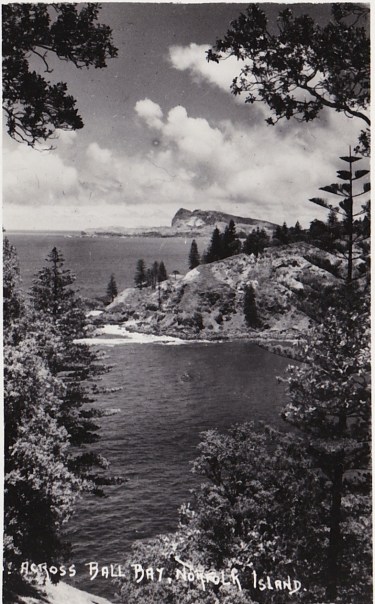
Ball Bay
Picture used for first postage stamp 1949

I always understood that Ella Price (my paternal grandmother) and Mr Munro spent the War Years on Norfolk Island, 1,670 kilometres north west of Sydney.  The only proof I have of their time on the island are the photos my grandmother took, the postcards she bought, her copies of the Norfolk Island Weekly that are still in my possession and the letters sent from friends who remained on the island after they left.

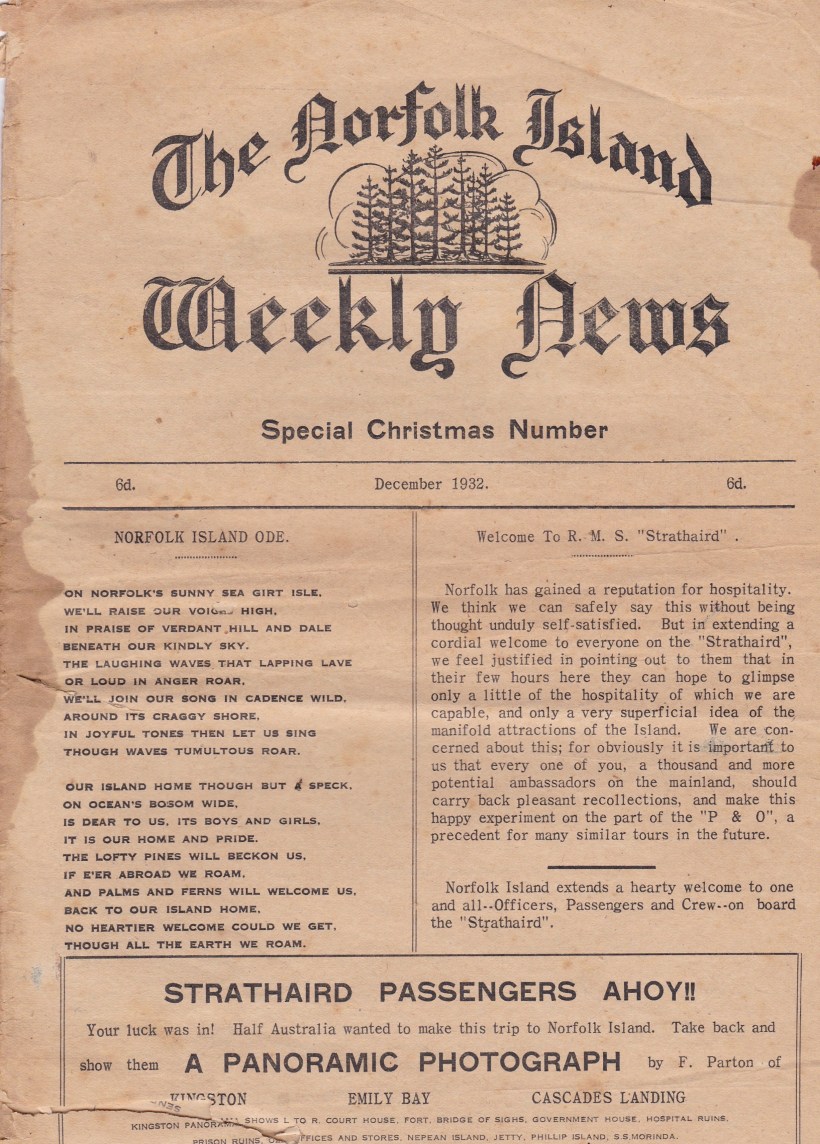
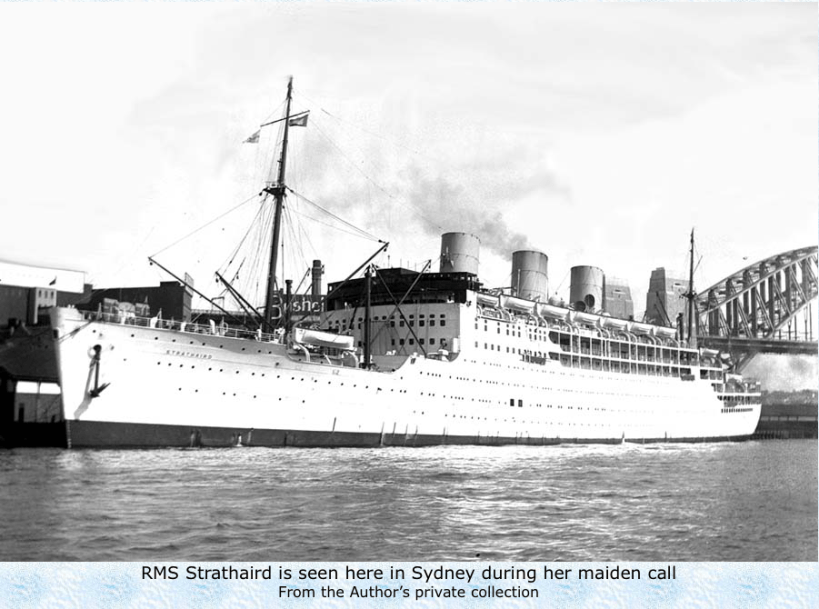
I really don’t know if they had been there before but my grandmother kept copies of the Norfolk Island Weekly from Christmas 1932 and 1933.  Significantly in 1932 the first cruise ship to leave Sydney Harbour, the “Strathaird”, is commemorated in the Dec 1932 issue of the “Weekly News”.

Weekly

strathaird

Knowing Alfred Munro’s excessive care with money I doubt they would have splurged on a cruise, but I remain eternally grateful for the financial help he gave my father.

In the March, 1939 edition of the Norfolk Island Weekly  the following announcement was made:

The Morinda arrived from Sydney yesterday with 85 bags of mail, 142 tons of cargo and the following passengers:-

Mrs Adams, child and infant, Misses C & M Barr, Mr D Buffett, Miss M Brett, Mr A Carter, Mr E C Fahey, Mr J W Jenkins, Mrs H Kelly, Mr and Mrs L Michaelis, Mr W Maher, Mrs G Menzies, Mr A Munro, Mr and Mrs J Part and infant, Mrs E Price, Mr K Robinson, Mrs R Raff, Mr and Mrs W Thornton, and child.

arrival norfolk

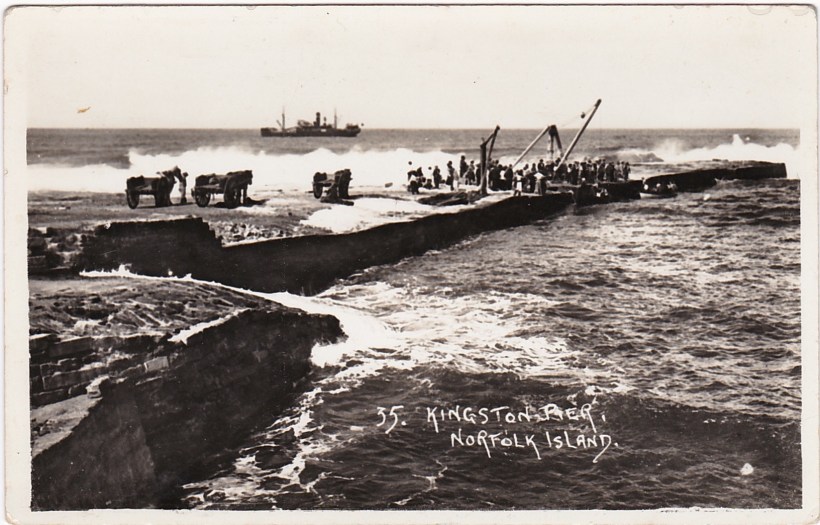
Note that Alfred and Ella were discretely separate.  The landing at Norfolk Island was tricky to say the least.  Depending on the prevailing winds the ships would send smaller boats (lighters) to either Kingston Pier or Cascade Landing on the opposite side of the island.

Merinda

Hinema
Cascade Pier       The ship is the Morinda

Until the Americans built a landing strip during World War 2 this was the only way to get on the island.

Norfolk Island has an amazing history.  The island was  settled by Polynesian Seafarers who came and went around the 14th Century.  When Captain Cook arrived on his second voyage in 1774 he was impressed by the tall pine trees and the flax plants.  The first convict settlement at Botany Bay wasted no time in establishing a penal settlement on Norfolk Island.  Alas no-one was skilled to process the flax and the pines proved unsuitable for masts.  Eventually the convicts were moved out so that the island lay abandoned to nature between 1814 and 1825.

In 1824 the British Government gave instructions to send “the worst description of convicts” to the island. This was a period of well documented harsh treatment and brutality.  The last convicts were moved to Tasmania in 1855 as convict transportation from Britain ceased.

convict ruins NI

Norfolk Island was peaceful again.

A new wave of settlers arrived in 1856 from Pitcairn Island.  These were the descendants of the Bounty Mutineers and the Tahitian men and women who accompanied them. One hundred and ninety four people moved from their remote tiny island in the South Pacific after petitioning the British Government for help.

During World War 2 the island became a key airbase and refuelling depot between Australia, New Zealand and the Solomon Islands. It was garrisoned by a New Zealand Army unit known as N Force at a large Army camp. The island proved too remote to come under attack during the war and N Force left the island in between 1944 and 1946.

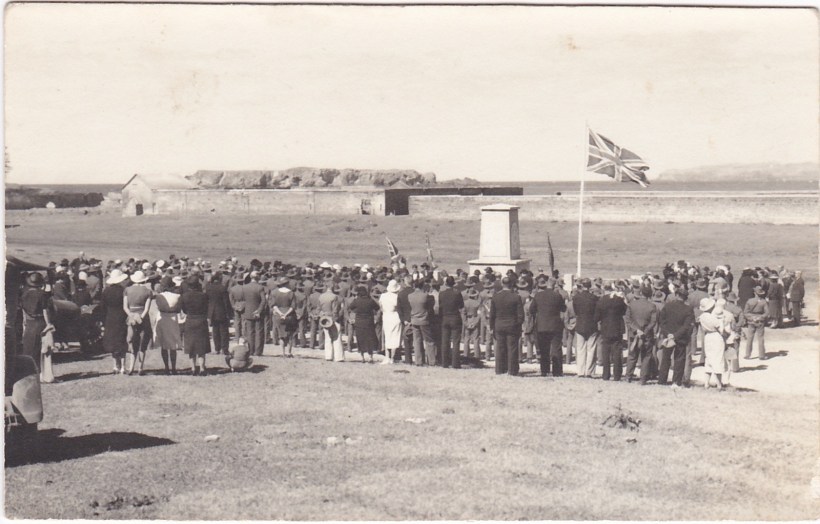
Anzac day
ANZAC Day early part of WW2

In 1942 the much admired trees in Pine Avenue were sacrificed for an airstrip as the Pacific War escalated.

Postcards from friends on the island show that Mr Munro and Ella must have returned to Australia in 1940.  The War in the Pacific had not started so the airfield and the army camps were a thing of the future.  Mr Munro would have enjoyed the peace, beautiful scenery, friendship and a game of bowls during his time on the island.  My grandmother, Ella, I am sure, would have relished living in an environment far removed from the outback of Australia.

So it looks as though I got it completely wrong  about Ella and Mr Munro spending the war years on Norfolk Island as it appears they arrived in March 1939 before World War 2 began and left before the War in the Pacific started.


M is for Master Mariner

When researching my husband’s family tree the occupation “Master Mariner” caught my eye.  James Burns, husband of Isabella Muirhead, was reported by John’s family to be a Master Mariner and a ship’s captain.  He was said to come from Dundee, Scotland and married Isabella in Sydney in 1861.

Isabella came out to Australia with her parents on the ship “John Bunyan” in October 1857.

That gave her four years to meet James and marry him.  The first record of James I can find is his birth and later baptism in Dundee, Angus, Scotland on 21st September, 1839.  His parents are listed as James Burns and Jean Anderson.  This is important because James Burns is not exactly an uncommon name and I had great difficulty differentiating him from other mariners with the same name.

In 1866, five years after his marriage, he is listed as an AB on the steamer “Auckland” on the Auckland to Sydney run.  An AB or Able Seaman is a naval rating indicating more than two year’s experience at sea and considered “well acquainted with his duty”.

In 1868 he is a “trimmer” on the ship “Black Swan” travelling between Maryborough in Queensland and Sydney.

A coal trimmer or trimmer is a position within the engineering department of a coal-fired ship which involves all coal handling tasks starting with the loading of coal into the ship and ending with the delivery of the coal to the stoker.

The trimmers worked inside the coal bunkers located on top of and between the boilers. Trimmers used shovels and wheelbarrows to move coal around the bunkers in order to keep the coal level, and to shovel the coal down the coal chute to the firemen below, who shoveled it into the furnaces. If too much coal built up on one side of a coal bunker, the ship would actually list to that side.

Trimmers were also involved in extinguishing fires in the coal bunkers. Fires occurred frequently due to spontaneous combustion of the coal. The fires had to be extinguished with fire hoses and by removing the burning coal by feeding it into the furnace. Wikipedia

Screen Shot 2017-04-14 at 4.34.47 PM
The Black Swan State Library of Queensland

The Black Swan was an Iron steamship with two cylinders of 60 horsepower and  two masts, schooner rigged. She was a regular on the Bass Strait run when she collided with the Paddle steamer Luna in Port Phillip Bay, Victoria and sank. However she was raised, repaired and purchased in July 1868 by ASN Co. As a matter of interest she was broken up November 1880.

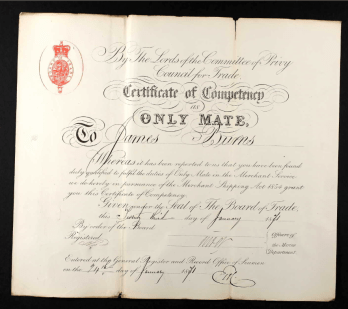
The following certificates could be those of our James Burns but I do not have enough information to be absolutely sure.

Screen Shot 2017-04-14 at 6.47.40 PM

 An “ONLY MATE” must be nineteen years of age, and have been five years at sea.  In addition to the qualifications required for a Second Mate, an Only Mate must be able to find longitude using a chronometer, use a sextant, understand tides, know how to moor the boat, keep a log, know how to use mortar and rocket lines etc.      

If family lore is correct James received his Certificate of Competency as Master.  In the year 1874 he worked on the “Rebecca and Jane” on the McKay to Sydney route as an Able Seaman.

Screen Shot 2017-04-14 at 5.32.08 PM

Meanwhile he and Isabella had four children, all born in Newcastle.  James was born in 1862, Robert in 1863, Elizabeth in 1866 and Hugh in 1868.

Elizabeth is my husband John’s ancestor.  She married Robert Muirhead.  Her mother’s maiden name was Muirhead so I’m still trying to get my head around that how they are related. Their son Hugh was John’s grandfather so there are quite a few generations descending from James and Isabella.

There are so many unanswered questions.  I have searched but can’t find a record of the deaths of James Burns or his wife Isabella.  Nor can I find any shipping records after 1874 so I still don’t know if James ever became captain of his own ship.

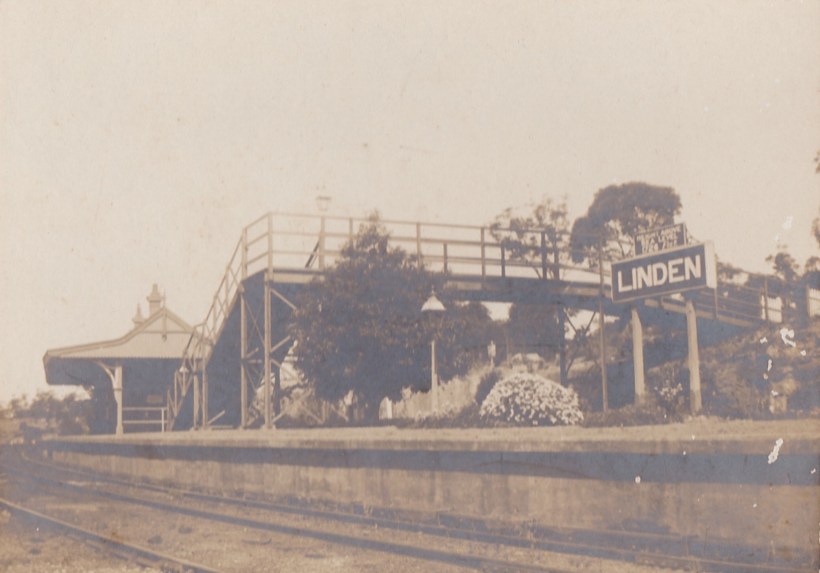
L is for Linden Railway Station

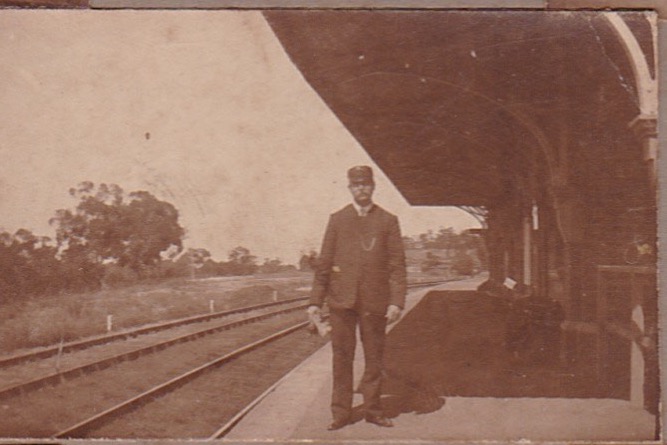
This is not about Linden, my father, as I wrote about him in last year’s A to Z.  Rather, this is about the small railway stations where my ancestors, the Prices and the Ridgways, worked and died. As I said in F for Fermanagh, William Price worked in the railways of NSW, ending up as the Stationmaster at Rooty Hill.  William had lost five children by the time of his death.  His son William, stationmaster at Wee Waa, was one of them.

Alderman Price, on returning from Mrs Brown’s funeral on Monday afternoon, received a rude shock by the receipt of a telegram announcing that his eldest son William had died that day.  The deceased, who served several years at the Parramatta Station, was, at the time of his death, Stationmaster at Wee Waa.  He contracted rheumatic fever, and was only ill a few days.  Late in November, Alderman Champion met him at Wee Waa, looking in perfect health.  The body is being brought to Parramatta, and the funeral will leave Alderman Price’s residence, Harris Park.

Ella told me that her husband John was Stationmaster at Linden when my father  was born in 1907 so they named him after the town.  Imagine my surprise when I read the Probate documents for John Price after his death from heart failure at Bogan Gate.  One of the signatories was Ella’s brother Arthur Ridgway, Stationmaster at Linden!

Linden1
Probably Arthur Ridgway at Linden

A search on Trove unearthed the even more surprising information in the Nepean Times that on Saturday, 24th February, 1917, after 19 years as stationmaster at Linden, “he (Arthur Ridgway) was tendered a send off on Saturday evening last” as “he has been appointed to Mt Druitt”.

Linden4
Linden Railway Station in the Blue Mountains circa 1907

So the story that my grandfather was stationmaster is not true.  Checking my father’s birth certificate I found that John was “night porter” at Linden.  Ella may have followed her brother to Linden to housekeep for him, his wife and three children after the death of her father in 1896.  There she would have met the night porter, John Price, and married him in 1904.

He did however get to be a stationmaster at Illabo.

ilibo
Illabo Railway Station circa 1910

Another Trove gem states:

Mr Price, railway stationmaster at Illabo for the past three years has received an appointment with a rise of £10 per annum and has gone to Bogan Gate, and he has been relieved by Mr Bansfield.  It is the intention of the many friends of Mr Price to make him a handsome presentation in the near future.

Cootamundra Herald, Tues 20 Feb 1912 p 2

Illabo1
My father as a small child (L) and John Price (R) Illabo

My grandmother, Ella, showed me the silver plated cutlery set with the initial P on the handles as well as the silver plated coffee pot, teapot, sugar and milk bowls which she said were gifts from the people of Linden when they left.  Maybe they were from Illabo!

Considering I knew nothing about my grandfather it is comforting to read a description of him after his death.

The sudden death of our stationmaster, Mr Price, is deeply regretted.  He was a sterling man, and one Bogan Gate could ill afford to lose.  He never spared himself when duty called, and was a prominent worker on behalf of the local Church of England.  His death came as a great blow to his wife and sorrowing parents.  A short funeral service was held at the late Mr Price’s residence by the Rev. A.S. Champion before the remains were removed to the train for interment at Parramatta.The Forbes Advocate Fri 7 Nov 1913 p 8

I was astonished to find in graphic detail, the last moment of John Price’s life.

Mr Price, stationmaster at Bogan Gate, died suddenly on Wednesday evening.  About 6.30 he was at work in his office, when he complained of feeling unwell (says the “Western Champion”).  Leaving his chair he lay down on the floor and asked the junior porter, who was in the office, to bring him a drink.  The lad hastened to comply with the request and on his return found that Mr Price was dead.  The deceased gentleman had been about two years in charge of Bogan Gate station.  He leaves a wife and one child, who were absent in Sydney when the final signal came.  The late Mr Price was a courteous and popular officer and his untimely demise is deeply regretted.

The Forbes Advocate Fri 14 Nov 1913 p 8

Earlier in the A to Z I was speculating as to where Ella and Linden went after the loss of their husband and father.  Now I know.

Messrs Kearney and Keast held a very successful sale of Mrs Price’s furniture and effects on Saturday and highly satisfactory prices were realised.  Mrs Price left by mail train on Monday for Linden, on the Mountains, where she will reside with her brother, who occupies the position of stationmaster there.

Western Champion Thu 27 Nov 1913 p 19

Of course I don’t know how long Ella and Linden stayed with Arthur but I can speculate that when Arthur went to Mt Druitt in 1917 he met someone new because he divorced his wife, Emma in 1921 and remarried in 1922.

The grandfather who died 38 years before I was born has become real to me for the first time.  The struggles and triumphs of his short life now will not be forgotten and there is some comfort in the fact that his genes live on in me and my descendants.

K is for Kay’s Family

My mother was an only child.  My father was an only child.  I was interested to find relatives of any sort all my life.  Research has shown that all my paternal grandmother’s sisters and brothers had died by the time I was born.  However on Kay’s side there were living sisters and brothers and I got to meet two of them.  These were the children of Reuben Benjamin Lock and Christina Cameron Robbie.

C Robbie
Christina Cameron Robbie

Kay was born Myrtle May Lock in 1896.  Next came Daphne, who lived for less than a year.

Ruby was born in 1900, followed by Charles in 1902 and Claude in 1905.

The first time I met any of them was about 1959 when my father and I were despatched post haste to deliver Claude from the clutches of Mr Whiting, dairy farmer.  Kay decided he was being exploited so we travelled in a sleeper to Albury, changed to the Spirit of Progress which ran on the wider gauge rail to Melbourne and then caught another train to Terang.  Claude was released from Mr Whiting’s employ and returned with us to Yerrinbool, living  with us for many years.

claude1
Claude with Ruby’s baby, Haydon

I met Ruby about 1970.  My boyfriend John (now husband) and I took her for a drive around Sydney when she visited from Melbourne.  Apparently she and Kay had not spoken for years but now were reconciled.  Charles I never met.  A rift in the family meant that he and Kay did not communicate until late in life.

This is enough to make any only child glad not to have siblings but I always think I could have done it better!

Kay and Ruby clashed continually.  As the eldest,  Myrtle (called Millie and later Kay), was called upon to take the place of her mother in so many ways.  When her little brother Claude was sick she had to stay home from school.  This happened often as Claude was a delicate child.  She told me about the arrival of a milking cow in the family.  All the children wanted to learn how to milk it but Kay refused.  She saw it as another job she would be expected to do when the novelty wore off for the others.

Ruby1
Basil and Ruby Craddock

When she left school Kay took up dressmaking as a trade.  Ruby opted for millinery.  They both married at the age of 20.  In 1916 Kay married Walter Sydney Hall and in 1920 Ruby married Basil William Craddock.

Ruby and Basil had a child, Haydon but the marriage was obviously unhappy.  This police report appeared in 1921.

craddockcraddock2

Basil disappeared from the scene and remarried in New Zealand.  Ruby then married Tom Sharp and had a daughter Betty.  After Tom’s death she married a third time.

Charles
Charles and Frederica Lock

Meanwhile Charles Cameron Lock married Frederica Roberts Green.  They had three children, Joan born 1926, George born 1928 and Donald born 1931. Unfortunately I was never told anything about them although I met their son Donald at a Robbie reunion.  Despite having a maiden name of Green, Frederica was from Europe.  Maybe she was from Germany and the anti German sentiment following World War I was instrumental in the family rift?

I have photos of Christina, the mother of this rather volatile brood of children, visiting her sister May in Adelaide.

The photos were taken in 1925 and sadly she was dead the next year, suffering a stroke.  Her husband Reuben Benjamin Lock, son of the intrepid Emma Moore and hard working Henry Lock, was a shadowy figure in family stories.  He outlived his wife by many years and ended up in an unmarked grave.  Why didn’t his children care enough to bury him properly?  What I found about  Reuben will be dealt with later under the letter R.

J is for John Curry

John Curry was born in Ancroft, Durham, England in 1831.  The 1841 Census shows that he lives with his parents James and Elizabeth and his two sisters and four brothers.  Their home is in Adderstow, Bells Hall, Bamburgh, Northumberland.  In 1851 he is 20, still living at home and is now an agricultural labourer, like his father and three brothers.  The remaining sister is a farm servant and the youngest boy is still a scholar.  They have a servant living with them but whether she works for them or the estate is not clear.

Ten years later John is a married man of 30.  He is now a coal miner in Weetslade in Northumberland at Seaton Burn Colliery House.

Seaton b
Seaton Burn Colliery from Seaton Burn Memories Project

His wife Margaret Patton is two years his senior and gave birth to Andrew in Doddington in 1852, two years before their marriage.  She was a servant in 1851  in the house of Richard and Elizabeth Thompson who farmed 1500 acres.  On some other family trees  both  parents died around 1851 although they were still living with their son John at the time of the Census.  I have still to find an official record of their deaths.

The ship’s record on The “Percy” shows John aged 39, a miner, Margaret aged 42 and John aged 9.  Ellen Curry, 14, is on another page, listed as a servant.  The two boys Andrew, 17 and James, 12, are on another page again.

In the Blog “C for Curry” I described the voyage from England to Australia.  The ship sailed to Pernambuco, Brazil before heading South East, past Prince Edward Island (1900 kilometres south of Cape Town) and assisted by the Roaring Forties it arrived in Melbourne after 104 days.

There had been nine deaths on the voyage from suspected typhus, fever and the effects of overcrowding.  The ship was placed in Quarantine at the Sanitary Station  on arrival in Melbourne on 17th April, 1870 until 25th April.

We noted on the shipping list that four people were detained for another week after the rest of the passengers were towed on board the ship to Hobson’s Bay.

birth of marg
The reference is to John and Margaret and indicates confinement

Two of those were Margaret and John Curry!  Trying to decipher the almost illegible handwriting we found from other sources that on the 21st April Margaret gave birth to a baby girl, Margaret.  I wonder what happened to the rest of the family  (aged 17, 14, 12 and 9) while the parents stayed at the Sanitary Station?

Family legend has it that the family tried their luck in Ballarat or Bendigo, looking for gold.  They moved on to Newcastle, NSW where black gold proved more readily available than the shiny stuff.

andrew curry
Andrew Curry and Emily Jones

John and James joined the Police Force in 1882.  Ellen married in 1876 and Margaret, (born at the Sanitary Station), married in 1888. Both women  moved to Western Australia after their marriages in Newcastle, NSW.  Andrew mined for coal in the Newcastle area, became a delegate for the Northern District Miner’s Association, then was the District Registrar of Birth’s, Death’s and Marriages.  He was elected Mayor of Merewether in 1888 and filled the mayoral position on and off until 1917.

As for John, the man who brought his family to Australia to strike it rich in the goldfields, he died in Merewether in 1904 followed by Margaret in 1907.  Maybe he went back to mining.  It would be a bitter blow after seeking a new life in a new land.

I is for Ixia and Ilex

holly
Ilex

These were the pen names used by Ella (my father’s mother) when she wrote for various magazines.  Ilex, I found, is another name for Holly.

ixia2
Ixia

Ixia is a Greek word for bird droppings, and is apparently a reference to the sticky sap of the Ixea plant, a South African relative of the Iris.

I read through the various articles trying to get a feel for the person who was my grandmother.  Her description of Christmas Present and Past comes from the 1920s.

Today (Santa Claus) brings works of art and skill – costly and beautiful.  But mechanical motor cars and trains, meccanos, life-like animals and talking porcelain dolls receive no greater welcome … than the wooden rocking horse, Noah’s Ark of ill shaped animals, wooden doll, whose rosy cheeks paled at the touch of water, to the more exclusive wax that the summer heat distorted.

Ella1
Ella with lamb

Ella writes a rather prim article entitled “Banish Fairy Tales”

To my mind they are foolish and injurious to the young.  Nothing creates fear in a child more than the Unknown or the Unseen; and so long as a child’s mind is filled with elves and goblins … darkness will hold fear.


Something women of her time would relate to are these words from “Homely Talk”.

If we women had less furniture in the home, fewer mirrors to polish, dispensed with the gimcracks, and cut all necessary household articles out of the weekly laundry, we would not allow our home to wreck our health and temper, and absorb our individuality.

In “Children in the Home” “Ilex” Deprecates Modern Trend

The modern child, encouraged by adoring parents, is nowadays first heard and first seen.  The castle .. is now a bedlam of noise and rebellion and temper.  Grandmother prefers to live in a room  rather than share her son’s or daughter’s home.

Ella’s stories of life on the land are interesting but rarely personal.  Here she writes as “Ixia” of the animals in her environment.

During my absence from home a friend undertook to lock my house and take charge of the key.  A week later I opened the front door to meet a procession of eight skeleton chickens staggering towards me… On the floor was a box of soap and the poor creatures had attacked it to allay their hunger.

Hearing a commotion in the poultry yard the other day I suspected a snake but saw a river turtle…I found she had dug a hole, tunnelled it at the bottom and was squatting over it, laying.  When an egg made its appearance her flipper caught it and stowed it in the tunnel.

tank
Windmill by E.M. Price

“The Station Woodheap” tells of the life of the swaggie.

It was known to the swaggies as a sure source of tea, sugar, beef and flour, if they wielded the axe in return.  The “old timer” picked solid pieces that would last and packed his heap neatly.  His modern brother chose those that broke most easily with the back of the axe and threw them on another man’s foundation.

“Drought in the Outback” talks about the lack of preparation for the rain after two year’s of drought.

To our dismay we saw the water running in cascades over the guttering and tanks, and flooding the verandahs and dusty patches that had once been gardens.  In our zeal to catch raindrops we had overlooked the leaf choked guttering and strainers and the dislocated down spouting.  Without waiting to get waterproofs we clambered onto verandah railings, boxes, or anything that gave reach, and clawed at the leaves and twigs that had collected during the past two years.  Almost drowned and shivering with cold, we battled on until we heard the precious water running into the tanks and then darted indoors and got into dry clothes.

Ilex goes on to describe in graphic detail, the horror of drought.

By the next morning a green sheen was visible on the paddocks and before midday the creek overflowed its banks and spread like a huge lake over the paddocks.  With grass up to the horses’ flanks and cattle resting in full contentment under the shady trees, it is hard to recall the scenes of the drought of the long months just ended, and picture the unhappy cattle, whose bones now lie hidden in the abundant grass, tottering with sagging hind quarters across the barren plains, in search of grass; or to drink at the stagnant pools in the river, where hundreds bogged and perished, or fell forward and smothered in the mud.  Hundreds went down on the plains, the merciless sun contracting the muscles of their necks, and torturing their wasted frames.  In the homestead paddocks the posts still stood where special cows had been “slung” and efforts made to save them; but the nearly bleaching bones told of labor lost.  Men were busy skinning; and at sundown the air would be heavy with the odour of putrefying bodies.

drought
Drought by E.M.Price

Some months later, when the station team drew up at the hide house, and loaded up with the last bundles, and when the waggon rolled away over the waving grass plains, one felt a mistiness in the eyes, and a tightening at the throat.  It was the final act in that drought tragedy.


H is for Hall – Sarah and George

My grandmother wrote to my mother, “Your father’s parents on your father’s side were married at Westminster Abbey, London and had two children when they sailed for Australia.”

“Grandfather Hall was the first man to open a drapery business where Bourke Street, Melbourne is now – somewhere about where the GPO stands.  Bourke Street was all tents at that time.  His people before him were all business people.  Grandma Hall was noted for her wonderful personality and business ability.  They were in the drapery business all their life, the latter being at Williamstown where your own father was born and died.  They had seven children.  George died in early manhood.”

Sarah’s early life was a far cry from weddings in Westminster Abbey.  She was born in Norwich, Norfolk in 1835.  When she was 4 her sister Agnes died.  Aged 7 she lost her father to Asthma.  That year her sister Elizabeth also died of Whooping Cough.  When she was 12 her sister Susannah died of Consumption and a year later she lost her mother, also to Consumption.  Three years later she was a lodger in Norwich working as a shop assistant.  Her siblings, Emma (7), Edmund (8) and Robert (10) were boarding with two sisters,  Caroline and Mary Williams and another sister Victoria (11) was living with her Aunt Mary and Uncle Robert Barker.

Things improved for Sarah when in 1857 at the age of 22 she married George Hall and 16 days later they left Liverpool on the ship, “Planter” bound for Melbourne.  I noted the marriage took place in Norwich, Norfolk, not Westminster Abbey!  Also there were no children at that stage.  Much to my frustration there is no mention of George Hall in the 1851 Census although his parents were by then Inn Keepers.  He appeared in the 1841 Census along with seven brothers and sisters when his father was a Carpenter.  His father George died in 1855, two years before Sarah and George’s departure to Australia. Also of interest is Sarah’s sister Emma, who married William Banham in the same year as Sarah’s marriage but who stayed in England.

Sarah
Sarah Barker Hall

The first child, Sophia,  was born in Richmond, Victoria and subsequent children were born in Williamstown so they were not in Bourke Street for very long.  Walter Sydney Hall (my grandfather) was born in Williamstown in 1870.

When searching on Trove I found a rather disturbing article titled “Inquest at Williamstown” dated Tuesday, 12 February, 1861. It concerned the death of Agnes Victoria Elizabeth Hall, the infant daughter of a draper from Williamstown.

It appears she died from complications of measles and was not attended by a doctor, although a prescription was written sight unseen.

After consulting for half an hour, the jury returned the following verdict : ” That the deceased died from natural causes ; that, without wishing to impugn the affection of the parent, they consider it was an error of judgement not to have called in medical assistance ; that they are of opinion that there is no blame attachable to Mr. Beaney, but that the practice of giving prescriptions in dangerous cases, without seeing the patient when possible, is open to great objection.”

I was fortunate to receive some information from Janet Hall several years ago.  She was fascinated by Sarah’s early childhood and ordered death certificates to find out what happened to the family.

Janet sent me a copy of the Probate  Form on George Henry Brown Hall, who died in 1896.  That would make him 69 which is hardly “Early Manhood”.  He didn’t seem to own property or much of any value but Sarah doesn’t strike me as  the type to give up.  She was 59 when she lost her husband but lived on to 72.

When she was 42 she gave birth to her last child, Edgar.  Not long before she died, Sarah asked that this cameo be given to “Baby” Edgar’s future wife (he would have been 30 by then).

Sarah's cameo

It has been passed down through the generations and given to the wife of the eldest son.  Janet told me the cameo was called a “Mourning Locket”, made in South Australia 1870-88.  I can’t tell if the photo in the locket is of Sarah butI doubt it was her mother as photography was in its infancy at the time of her mother’s death.

G is for Great Britain

I thought this would be easy.  I will just find all the ships on which all the ancestors came out to Australia and show the various parts of Great Britain from which they came.

Linda's ancestry
1. (Willoughby) Andover 2. (Ridgway) Nash  3. (Hall)(Drake) Norwich  4. (Moore) Bedworth  5. (Price)(Elliot) Fermanagh          6. (Robbie)(Stephen) Aberdeen 7. (Lock) Sussex (not marked)

Not so easy.  I started with my family. By some strange quirk of fate they were mainly near the end of the litter.  This led them to skip a generation and so I have less research to do.  First came the Ridgways – Mary (nee Willoughby)  and John Ridgway from Andover, Hampshire  and Nash Buckinghamshire on the “Aloe” in 1857 to Sydney. Then came Sarah (nee Drake) and George Hall from Norwich, Norfolk on the “Planter” in 1858 bound for Melbourne.  Henry Lock from Sussex came out in 1861 on the “Anglesea” followed by his bride to be Emma Moore from Bedworth,  on the “Shackamaxon” a year later, both to Melbourne.  Margaret (nee Elliot) and William Price left Fermanagh in Ireland for Sydney on the “Trebolgan” in 1865 and finally Elizabeth( nee Stephen) and William Robbie left Aberdeen for Melbourne on the “Western Ocean” in 1866.  In less than ten years  my entire ancestry emigrated from Britain.

Now John’s family is more difficult but arguably more interesting.  I was completely bamboozled by the first emigrants, John and Ann Paul.  They arrived on the “China” in 1841 but the census records show that their three year old daughter, (Amy) Esther was with Ann’s father in Yorkshire.  I can’t find when she came out but another daughter was born in Australia in 1844.  Alas John Paul also died that year so hours of research remain to solve that problem.

John's ancestry
1.  (Paul) (Walbran) (Barrett) Yorkshire  2. (Sutton)  Kent  3.  (Muirhead) (Porteous) Edinburgh  4.  (Burns) Dundee  5.  (Jones) Midsomer, Somerset  6.  (Pring) Wellington, Somerset  7.  (King) London  8.  (Curry)(Patton) Ancroft/Doddington 9. (Todman) Nottingham

James Sutton, from Kent, arrived with his parents John, born in London and Anne (nee Todman), born in Nottingham on the “Marchioness of Bute” in 1842.  Amy Esther Paul must have somehow crossed the oceans because she married him in 1858 in Sydney.

When I started researching the Muirheads I almost had a meltdown.  Hugh, from Borthwick, Midlothian, Scotland, came out on the “John Bunyan” in 1857 and married Jane Porteous from Edinburgh who in 1862 ventured out in the “Peerless”.  Then I found James Burn’s wife Isabella was also a Muirhead so was she Hugh’s sister?  If so she also came out on the “John Bunyan” in 1857.  Her husband James Burns, from Dundee, was a Master Mariner so the references to him at sea are too numerous to mention here.

Next we have Harriet and James Jones from Midsomer in Somerset who arrived in Sydney in 1858 on the “Fitzjames”.  As well as bringing two children from England, Harriet gave birth on the ship to a daughter, Emily, who later became the wife of Andrew Curry.

Fanny Pring, from Wellington,  Somerset, arrived on the “Hornet” in 1859 and George King the following year on the “Cairngorn” after which time they married in Sydney. Their son William married into the Sutton family which married into the Curry family.

Then in 1869 The Currys, John and Margaret, arrived in the “Percy” from Plymouth.  They came from Ancroft and Doddington in Northumberland, brought three children with them and landed in Melbourne just in time to have another.

Finally in 1879 the “Nineveh” brought John and Sidney (nee Waldram) Barrett from Durham, Yorkshire to Sydney, NSW where their daughter Sarah married into the Muirhead family.  The  great migration of John’s ancestors was over.