F is for First Memories

Although I lived in several houses in Mildura and Sydney, 35 Edgerton Street, Lidcombe is the first home I can remember.  Situated on a large corner block it was a weatherboard house with an imposing brick verandah across the front.

old fridge
Fridges like this one were death traps for some unfortunate children

The owner had divided it into two flats and another family lived in the other half.  It was in a semi-industrial area with a clothing factory next door and normal suburban houses over the road.  It suited my father well as he was gathering second hand steel and piping with a plan to sell fencing and gates to farmers and graziers.  In the backyard was a cement swimming pool, sadly now empty but useful for riding my tricycle.  My father was never one to pass by a bargain so the block was littered with finds that might bring a good return one day.  It was a wonderful playground for small children in the neighbourhood.  Our favourite game for a time was locking each other in a disused fridge and seeing how long we could bear to stay in the pitch dark without begging to be released.  Fridges in those days had external handles and so could not be opened from the inside.  It was only later when I heard of a child suffocating in a fridge where they had been left too long that I realised what a dangerous game we had been playing.

When I was five and a half I started school.  Why I started in September I don’t know as it would have been usual to start at the end of January.  In those days there were no orientation classes to prepare children for school.  I arrived after the school holidays in the last term of the year while all the other children had been there for two terms.  Auburn South Infants School  seemed large and frightening.  When I got into trouble I was made to eat my lunch with the boys.  I never understood why I was in trouble.  It often had something to do with Folk Dancing.
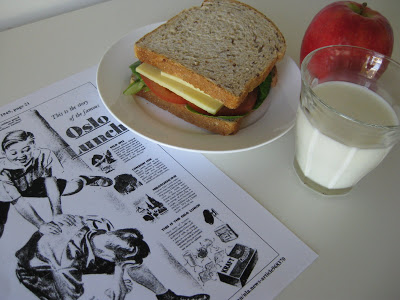
oslo lunch
They must have run out of apples the day I had my Oslo Lunch

One day my mother decided I could order an Oslo Lunch from the school canteen.  The Oslo Lunch was a Swedish invention which consisted of a cheese and salad sandwich on wholemeal bread with fruit to follow.  It was found to considerably improve the health of children who ate it for six months.  To get my lunch I had to walk across an enormously wide playground, a daunting expedition for a small child.  I remember there was a whole tomato with the lunch which I could not bring myself to eat.  Not knowing what to do with it I hid it under the seat.  More trouble ensued and more lunches were spent sitting with the boys.

Living in Sydney in the 1950s was a time where the bread was delivered by horse and cart, the toilet was out the back and emptied by the dunny man, mumps and measles were rites of passage for children and immunisation was a terrifying experience as one waited in long lines outside schools or health centres for the dreaded needle.  Visiting the dentist was also deeply traumatic as teeth were pulled without regard for the effect on subsequent spacing and alignment. My fear of the dentist began when aged about five I was asked to take a tablet before the extraction.  I drank an entire bottle of orange drink and still the tablet would not go down.  My mother had to hold me down screaming as the dentist pulled and pulled.

stag
The stag heads made a big impression

My father was keen to move away from Sydney as he had recently been declared bankrupt and wanted a fresh start.  One rainy, foggy day we travelled to the Southern Highlands to inspect a derelict guest house.  The low, L-shaped building had stag’s heads on the walls and a dark, cavernous  kitchen. In the overgrown garden was a maypole. A piano sat forlornly in an open sided outhouse.  I was familiar with maypoles from my nursery rhyme books and could imagine what fun people must have had in days past.  We didn’t buy this property but it wasn’t long before we were to leave Sydney forever.

 
Photo credit: Corvair Owner via Foter.com / CC BY-SA
Photo credit: Internet Archive Book Images via Foter.com

E is for Empire Day

sparkler
Writing in the air with sparklers

The most exciting day of the year apart from Christmas was Empire Day.  It was established to honour Queen Victoria after her death in 1901 and was celebrated throughout  the British Empire on the 24th May.

Having a half day holiday was excitement enough but when we reached home we raced out to the paddock where the pile of wood, tyres and anything that would burn had been growing in size for weeks.  It was often a community activity as there always seemed to be other people, adults and children, arriving with their boxes of crackers just before dark.
After the bonfire was lit and burning nicely our attention was drawn to the crackers.  There were Jumping Jacks which had us all running from their irregular path, Catherine Wheels that had to be nailed to a post, Tom Thumbs which crackled like gunfire and Skyrockets standing in their bottles ready for the finale.

Flower Pots sent balls of colour into the frosty night sky and Golden Rains cascaded onto the ground.  The wonder of this is that we were not just spectators.  We had bought the crackers weeks before, choosing them carefully and storing them in a dry safe place.  We lit them ourselves, supervised by our parents.  As the stores of fireworks dwindled we put potatoes in the coals.  Coated in hard black burnt skin, the insides, with a dab of butter, were soft and delicious.  Potatoes have never tasted so good.

children-swinging-firecrackers-for-funNext morning I would scour the paddocks to find where the rockets had fallen.  When unwrapped they displayed Chinese writing which provided endless fascination as to their origin.
In 1958 Empire Day became Commonwealth Day.  Still the Cracker Nights continued until 1986 when the sale of fireworks to unlicensed individuals was banned in NSW.  There were good reasons for the decision although many derided the “nanny state”.  The day after Cracker Night there would be newspaper articles about children who had lost a finger or an eye when playing about with the mini explosives.  Letterboxes were blown up with penny bungers.  Cats and dogs were terrified.  There were even horrifying stories of children left in the back seat of cars setting fire to themselves with the lethal combination of a bag of fireworks and a cigarette lighter.

I will grant that watching the fireworks display over Sydney Harbour on New Years’ Eve is spectacular, but for me, nothing can rival the pure exhilaration of a backyard Cracker Night in the 1950s.

Photo credit: EpicFireworks via Foter.com / CC BY

Photo credit: challiyan via Foter.com / CC BY-NC-SA


D is for Dogs, Cats and other Pets


spot
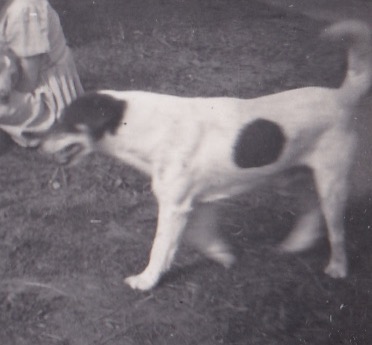
Spotty adopted us and travelled with us to the country

Before we moved to the country we lived in the Sydney suburb of Lidcombe.  The first animal that came into our lives was Spotty, a portly fox terrier with the long wavy tail.  One day he trotted into our front garden and just stayed.  He moved with us to Yerrinbool and lived a long and happy life chasing rabbits, cornering  them in pipes which lay in abundance on our property.  My father would upend the pipe and next thing the rabbit would be skinned and cooking in a camp oven over a fire.  The rabbits were always fed to the dogs as my mother couldn’t bear the smell of them cooking.


trixie
Trixie in a basket – the only photo I have of her

Trixie, the tortoiseshell cat, became my friend in a hotel in Cowra.  As usual, I accompanied my father on one of his business trips and got to know Trixie so well after three days that I begged to take her home.  The hotel owners were glad to be rid of a stray cat.  My mother was not so pleased as Trixie was female and produced litters of kittens with monotonous regularity.


Other cats and dogs came and went, usually meeting with their deaths on the busy Hume Highway which ran past our property, but Trixie and Spotty were smart and outlived them all.


lamb
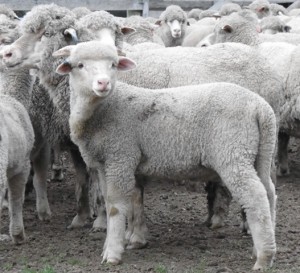
A merino lamb with a tail

My father brought home a newly born lamb he found on the highway.  We fed it with an eye dropper and then a bottle with a teat attached.  Paddy had a tail which was unusual for a sheep as they are usually docked to prevent flystrike.  Every day I would move him out of his cage to a new piece of grass.  He became very strong and would pull me over as soon as he was set free.

sputnik
Sputnik, the first artificial world satellite launched by the Soviet Union in 1957


We had another sheep we called Sputnik because she would run round and round her post until the rope became too short for her to move.


white orp
These White Orpingtons are the same breed as our hens although they look a bit fluffier

When we moved to the country my father bought hens and ducks.  We had to shut them away at night so the foxes wouldn’t get them.  The hens were easy to look after and produced eggs which were fun to collect.  Once they stopped laying they lost their heads on the chopping block and were transported to the laundry where they were dipped in the boiling hot water of the copper, plucked and cleaned.  I was always intrigued and revolted by the varying colours of their intestines.

muscovy
We had white Muscovy ducks like these

The ducks were harder to look after as they produced little ducklings which seemed to die at an alarming rate.  We took them into the warm kitchen and kept them at the side of the stove in an attempt to keep them alive.  The ducks finally disappeared, whether eaten by foxes or escaping from their compound, but the hens continued to produce eggs and obediently hopped on their perches.

C is for Coalcliff

coalcliff1
Our wonderful holiday shack

Every summer, on Boxing Day, my mother and I would travel to the NSW south coast to spend a blissful two weeks in the shack at Coalcliff.  Even getting there was an adventure.  My grandmother’s car had to be left in a car park and all clothes, food and other necessities carried across a bridge over Stoney Creek, along a track and up some stone steps.  The shack was one of hundreds of similar dwellings on a hillside overlooking the beach and sea.  A simple reinforced canvas rectangle with one bedroom it was graced with louvred glass windows, striped awnings and a stone courtyard facing the beach. Mobiles of cut glass tinkled in the sea breeze and the constant roar of the surf made for a soothing background as I drifted off to sleep in the fold up bed.  We thought our shack was the best and prettiest of all the cabins on the hillside.  It even had its own toilet.

coalcliff4
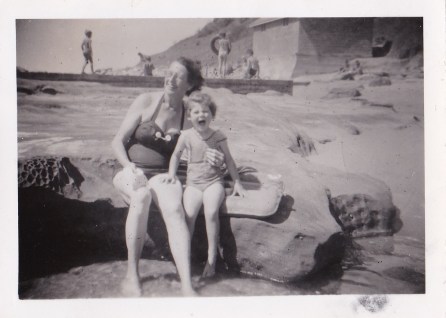
Having fun with my grandmother

I remembered being really difficult one day when my grandmother was looking after me.  She had asked the teenage daughter of a friend to watch me on the beach but as soon as I saw her looking the other way I gave her the slip and ran back to the shack.  Now that I have grandchildren of my own I can imagine the terror they felt when they scanned the beach and sea looking in vain for a little six year old girl.  When they finally found me hiding under a bed in the shack I was given a belting followed by a glass  of orange cordial. 

Pam
My friend Pam on the left was badly sunburned

My parents never holidayed together because of the demands of their business but I do recall one occasion when my father came to Coalcliff in his truck.  It was quite a surprise to me that he could swim and dive.  He took my friend and me by the hands and jumped with us in the waves.  An extra large wave took away his false teeth which were never seen again.  The next day we drove up Macquarie Pass in the truck and my friend was returned to her family, her fair skin covered in sunburn.

A Christian group of men and women provided entertainment for the children holidaying at Coalcliff.  We made huge words on the beach out of flowers, threaded popcorn in long strings in the hall and  walked through the darkness with lanterns on poles over our shoulders on New Years’ Eve.  I don’t remember making any friends and I detested the folk dancing in the hall and refused to take part.

coalcliff
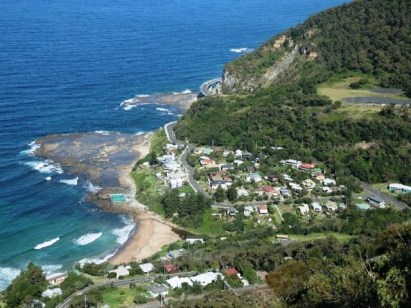
Coalcliff as it is today

I didn’t know at the time that the shack was my grandmother’s escape from her unhappy marriage.  During the week she worked in her Frock Shop in Mortdale but whenever she could she left the poisonous atmosphere of home and visited her hideaway. Some years later, all the shacks were removed and now there is only the Surf Life Saving Club where once hundreds of holiday makers packed the hillside.  On the southern side million dollar houses look out across the ocean, the rock platform and the ocean baths.  The Seacliff Bridge winds around the edge of the cliffs where once rock falls closed the road and the Coalcliff Coke Works is just a rusting ruin.

Until I travelled the world I thought all beaches had yellow sand, rock platforms at each end, a lagoon, surf and ocean baths.  To me this is still the definition of a beach..

B is for Books

Can you remember the first time you became aware that the black squiggles on pages represented the spoken word?  I can still recall that lightbulb moment well before I started school but it was quite a process before I could read confidently myself.

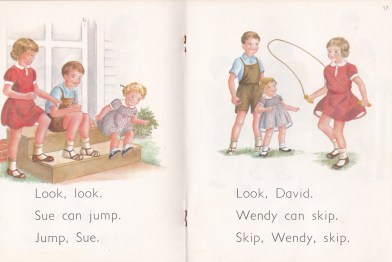
Sue david wendy
A Book to Read NSW Department of Education

Reading in the 1950s was taught using phonics and sight words and  by the use of school readers and work books.  There was a lot of repetition and very little variety in the stories as Wendy, Sue and David ran, jumped, skipped and played with Nip.  By the end of second class we completed Travelling On and were ready for the School Magazine.

school mag
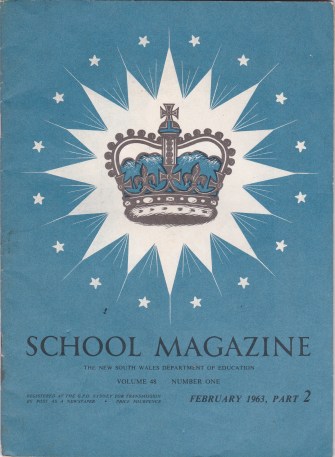
The School Magazine arrived each month to supply us with reading material and was always welcome.


The magazine shown here reflects the excitement of Australians anticipating the arrival of Queen Elizabeth.  Her Majesty and Prince Philip were to enter Sydney Harbour in the Royal Yacht Britannia while the adoring public waved flags and sang “God Save the Queen”.


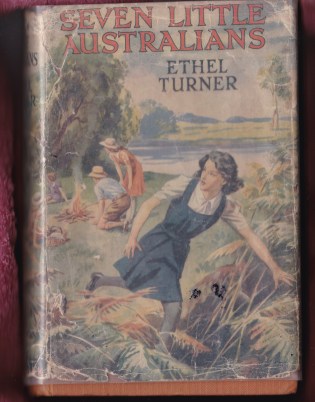
Seven Little Aus
This is Judy who was killed by a falling tree while protecting her little brother.

I wasn’t a precocious early reader and can still recall at the age of seven struggling to read Seven Little Australians aloud to my grandmother, Ella.  She would take over when I grew tired but would only read selected parts, such as the death of Judy, which reduced me to tears every time.


Despite our isolation in the country my father would occasionally take me to Sydney to visit Greenwood’s Second Hand Bookshop in Castlereagh Street.  I was allowed to buy about half a dozen books which would last me until the next visit and be read many times.  A Little Bush Maid and the subsequent Billabong books by Mary Grant Bruce were great favourites.

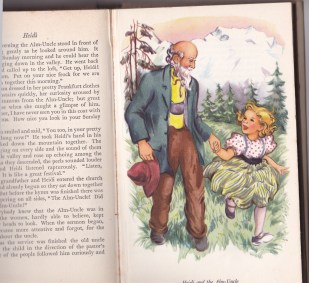
heidi
Heidi had a great life in the Alps eating bread and cheese and drinking goat’s milk.

What Katy Did, Heidi, Anne of Green Gables and Little Women were devoured.  One of my early books was The Adventurous Four by Enid Blyton.  Of all her Famous Five, Secret Seven and Malory Towers books, this one remained my favourite.

Advent 4
To think four children would be allowed to go to sea in a boat!  No wonder they were shipwrecked.


Our one teacher school had a very small library.  It was only a bookcase  of five shelves but the Department of Education sent a new box of books once a month.  The downside was they had to be returned on time and we were not allowed to take them home.  Too bad if we were halfway through a book when it came time to pack up the box.

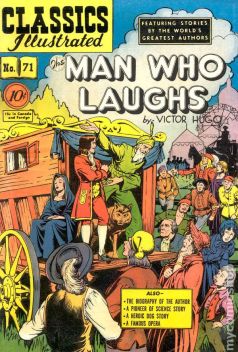
Man who laughs


Comic Books were popular but because my father didn’t really approve of them he bought me Classics Illustrated.  From them I became familiar with The Tale of Dorian Grey, Around the World in Eighty Days and The Man Who Laughs, to name a few.

blackberry


Two little second hand books I adored were “Flower Fairies of the Autumn” and “Flower Fairies of the Wayside” by Cicely Mary Barker.  The plants and weeds were English but where I lived in the Southern Highlands of NSW they were quite common.  I matched the fairies with my friends but the one I picked for myself was the Blackberry Fairy.  Not only did I love blackberries but I thought I looked a bit like her with my mop of dark, curly hair.