P is for Playtime

Freedom to choose where to go and what to do was the essence of play in the 1950s.  Beyond the township of Yerrinbool was the Bargo State Conservation Area leading down to a tributary of the Bargo River.  It was a magical place, with sandy beaches, overhanging caves carved out of the sandstone and large rocky areas leading to small waterfalls and deep pools.  When I was younger I would be accompanied by older children from the local farms as we explored the untamed bushland. Later I would explore it on my own or take a friend to show them the secret places.

Our property had a large grove of Scots pine trees about thirty year’s old.  They were excellent for climbing and from the top I could see across all our paddocks to the busy Hume Highway and the Sydney to Melbourne train line. I placed a “memory box” at the top of one of those trees.  It is probably still there.

smokey dawsonAt night we would listen to serials on the wireless including Smoky Dawson, with his horse Flash and his sidekick Jingles.  In conjuction with Kellogg’s Cornflakes we all joined the Smoky Dawson Wild West Club and received our Deputy Sheriff badge in the mail.

Influenced by the Famous Five books my friends and I would always be looking for adventures, often snooping on some of the lonely characters living in their huts on outlying farms. One day an older boy from school arrived with his home made bow and arrow and suggested we go hunting rabbits. We were unsuccessful, although we saw a few as we scouted the paddocks.  My father nearly exploded when he found that the “arrow” actually had a nail embedded in the end.  Poor Jimmy was sent home after an earbashing.

toys
Friends, dogs, dolls and teddy

As well as tomboy activities I also adored dressing up.  Pre-loved dresses, hats and gloves discarded by my mother and grandmothers were great adjuncts to journeys of the imagination.  My playground was a yard full of strange objects, such as the enclosed back of a truck which made a great cubby house and  wooden shelves under the trees for storing pipe fittings which acted as a boarding school for my dolls and teddy bears.  Pets were roped in as pretend dolls and suffered being dressed up and wheeled around in prams.

bild1b
Is this where my interest in building houses began?

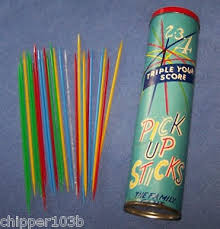
There were a few toys like the Bilda-brix set of red and white bricks for making houses and the Pick-Up Sticks where the black one had to be retrieved without moving the others.

.pick up
zorroZorro was very popular for make believe as a black cape, sword and mask could easily be made.  I loved my Zorro jigsaw which was something like this one.

My greatest desire was a real doll’s house with proper wooden furniture so I didn’t properly appreciate the home made version with matchbox furniture made by some unknown friend of the family.

Pogo sticks were all the rage.  I tried to make one with a spring and a piece of timber but it didn’t work.  I didn’t get a bicycle until my teens but bought an old scooter for 15 shillings from a girl at primary school.  I then proceeded to wear out the sole of my left shoe as I rode it along the gravel road to school each day.

As an only child I was never bored.  If I had no friends to play with I invented them.  The imaginary ones were usually much more accommodating than real life people which probably accounts for some difficulties I had relating to others in my High School years.
O is for One Teacher School

After leaving Auburn South Infants School and relocating to Yerrinbool I was given the choice of attending Mittagong Primary School eight miles away from our home or the local one teacher school.  Although I preferred the idea of the larger school the hour long bus journey each way was enough to convince my parents otherwise.

school
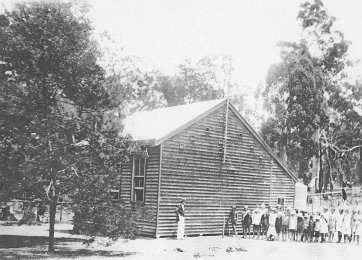
Sadly there are no photos of Yerrinbool School.  This is the closest I could find.

Yerrinbool Public School was a cream coloured weatherboard box on brick piers, first opened in 1922.  It had a corrugated iron roof, a closed in verandah and a cloak room where we left our bags and washed our hands.

Inside the classroom there were rows of wooden desks, upper division on the left and lower division on the right.   As we moved up a grade, we moved one row closer to the front.  The desks held inkwells that were filled by ink monitors when the need arose.  Two blackboards on easels stood at the front of the room, each side of a fireplace and the teacher’s desk.  Mr Scott would have all the work for the morning written up on the two boards.  At the time of my arrival in First Class there were about thirty students.  They were the children of apple orchardists and poultry farmers, itinerent railway workers and a few business people working in the bigger towns.

I soon settled into life at the new school. Playtime and lunchtime were periods of great freedom as Mr Scott stayed inside to eat his lunch and listen to Blue Hills, (a long running serial) on the wireless.  There were cubbies built in the scrub and destroyed by opposing gangs, there were episodes of marbles and hoops and once a year Redback Town would come to life.  This was a hard clay depression in the ground which for a few short weeks sported houses and shops made from bark and leaves, joined by dusty roads on which we placed our toy cars.  Then as quickly as it started it would vanish.  We played Simmonds and Newcombe, the names of two Long Bay Gaol escapees and told jokes about them.

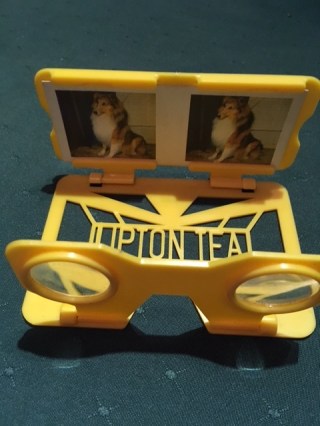
IMG_4569Collecting cards was the craze when I first arrived.  Beautiful bird cards from Lipton Tea became a most desirable possession and swapping took place every playtime.  Over the years we collected 3-D cards from Weet-Bix and Lipton Tea, Birds, Beetles and Sea creatures from Shell Service Stations, plastic cars, trains and boats from Kellogg’s Cornflakes.  They were all free but we had to consume large quantities of the product to complete our collections.
Sport consisted of rounders every Friday afternoon.  This was quite exciting because Sir would come out to bowl.  He was, as the local mothers put it, “past retiring age” so as my years at Yerrinbool progressed he became increasingly less active.  Even our annual “Bird Walk”, the only excursion we ever had, was indefinitely postponed in our final year.

The wireless was our main source of entertainment and diversion at school.  “Tales of Many Lands”, “Health and Hygiene”, “Let’s Sing Together” were some of the programs.  They must have been a great help to a teacher trying to manage seven classes, but we ended up all learning the same things as we couldn’t help but listen. Our visitors were few, but a Bowral Real Estate Agent drove out once a week to give us our Scripture lesson.

As we had no homework I would memorise songs from my Broadcast Book or learn poems.  The long dreamy afternoons were spent reciting, drawing and painting, weaving baskets and singing or listening to Mr Scott reading extracts from Perseus and Medusa.  There seemed to be little money spent on the school but I remember Mr Scott purchasing a set of illustrated Social Studies books on  early Australian explorers.  Adding pictures to the words made them slightly more interesting as we followed the often disastrous journeys of these driven men.   The only time I was motivated by my drab Social Studies book was the description of the voyage by ship from Sydney to London via the Suez Canal. The exotic ports of Singapore, Colombo, Aden and Port Said, the mysterious pyramids of Egypt and ancient treasures of Greece and Rome eventually led to England, the country of my ancestors, so familiar and yet so distant.

copp
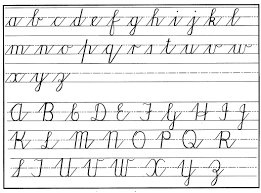
We went from this

To my annoyance my teacher insisted we write business letters or letters to friends for Composition every second week.  The other week we were allowed to use our imagination.  He said we would write far more letters than stories when we were adults.  Handwriting changed significantly over the years.

m curs (1)
to this

Not long after  we progressed from printing in pencil to copperplate with pen and ink, a new handwriting syllabus appeared.  The new writing was called Modified Cursive which meant we had to relearn our letters. No longer were we encouraged to use thin upstrokes and thick downstrokes.  Capital letters became simpler and loops were removed.  To help us the Department provided us with new pens with small reservoirs which meant less dipping in the ink.  Ball point pens and fountain pens were unknown until I reached High School.  Every week we would do Mapping with a special fine mapping pen, choosing a country from an atlas where many of the countries were coloured red, drawing  in freehand, trying not to smudge the ink.

map.jpg
The World in 1957

Arithmetic was my father’s specialty.  He had been caned at school for making one mistake in an important exam.  The pressure was on to get a perfect score which I rarely did.  We were still using Pounds, Shillings and Pence, often multiplying these amounts by three figures.  Strange and useless tables were learnt like  “pounds in a bushel of wheat, oats, barley” (they were all different).  Rods, poles and perches, chains, yards and feet all became obsolete a few years later when the metric system was introduced.

The only other change in the school over the  six years was a square slab of cement poured onto the hard baked clay at the front of the building.  Mr Scott would clap his hands at the top of the step and we would line up on the new surface, say good morning and march into school.  We even had Folk Dancing on the cement broadcast from the wireless but that stopped when the numbers became too low.  By the time I reached sixth class there were four children in my year and two in Kindergarten.  Once we four went to High School the school was permanently closed and Mr Scott retired.

I left Primary School determined to do two things.  One was to become a teacher and the other was to travel the world.

N is for Nothing Beats Messing About in Boats

“Nice? It’s the only thing,” said the Water Rat solemnly as he leant forward for his stroke. “Believe me, my young friend, there is nothing—absolutely nothing—half so much worth doing as simply messing about in boats.”

from The Wind in the Willows by Kenneth Grahame

One of my happiest memories of the few years I had with my father was our fishing trip to Sussex Inlet.  Waving goodbye to my long suffering mother we drove down Macquarie Pass in the truck, singing “Gone Fishin’” all the way.

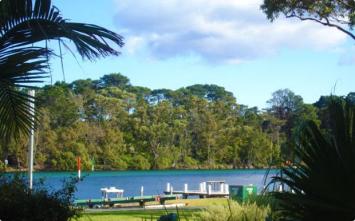
view form rsl
The view from the current RSL Club

Our accommodation was a cut above the basic hotels where we usually stayed.  It was a guest house called Heimdall spread out along the waterfront on beautiful Sussex Inlet.  The gardens were filled with exotic trees and the octagonal dining room looked out across the water to another famous guest house, Christian’s Minde.

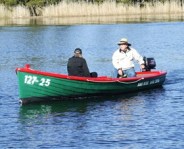
motor boat
The boats haven’t changed in 60 years

My father hired a motor boat and fishing equipment.  We motored towards the sea past magnificent sandhills which I loved to climb and roll down.  Then we turned around and headed towards the entrance of St George’s Basin.  The colour of the water was unbelievable with the clean yellow sand below the clear water.  I caught the first fish of my life, a leatherjacket and learned how to take it off the hook.

cm2
Ready to go fishing

So began my love of boats and Sussex Inlet.  As an adult I have returned many times.  Alas, the guest house had gone and has been replaced by an RSL Club.  Development has changed the town but not too much.  It is still a great place to launch your boat and go fishing, swimming, sailing, paddling or pedalling.

I was interested to discover that Heimdall belonged to the same family as Christian’s Minde so I have written a very abbreviated history of the family based on information provided by the Sussex Inlet Computer Club.

chris mind
Christian’s Minde as it is today

The oldest existing building in the Sussex Inlet district is the Christian’s Minde complex located on the north shore of the Inlet.In 1880 Jacob Ellmoos, a seaman from Denmark, was granted a selection of 1200 acres in an unspoilt fisherman’s paradise.  He enthusiastically invited his parents and siblings in Denmark to join him.  Despite hardship and family tragedies, a guest house was opened in 1890, the only one between Port Hacking and Twofold Bay. The home was given the Danish name of Christian’s Minde meaning “To the memory of Christian”, the name of both Jacob’s father and his late brother, during a traditional Danish wreath-laying ceremony.

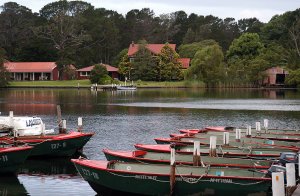
Sussex-Inlet
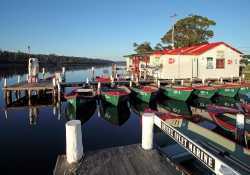
Wooden boats for hire

In 1915 the Commonwealth took over the Inlet and part of the land bordering St Georges Basin as a part of the Australian Capital Territory (ACT).  Jacob was compensated by the government and bought land on the southern bank.  On a part of this site, he established another famous guest house Heimdall which he and his family controlled until the site was purchased by the Sussex Inlet RSL Club.

Christian’s Minde is currently being renovated but a small house in the complex can be rented for a short holiday break.

M is for Mother

Will..house
I am standing with my children in front of the house where Elsa was born


wedding
Walter and Myrtle, Elsa’s parents

Life was never easy for my mother. Born in Williamstown, Victoria in 1917, she attended Williamstown North Public School between the ages of 6 and 8 until her mother took her away from her home and father and resettled in Glebe Point.  There she attended Forest Lodge Public School. At the age of 11 she moved again to Charleville in Queensland. Kay arranged for Elsa to board with a family and attend the local high school in Roma, Queensland.  My mother felt she was being exploited as she was asked to do increasing amounts of housework and ironing so when she turned 15 she begged to leave school and the family she lived with.

She must have a trade, of course, so like her mother she became a dressmaker.  After six months as an apprentice  in Charleville she was able to obtain a position with Lucy Seekers in Melbourne and boarded with her Aunt Harriet and Uncle Ed in Williamstown.  She told me how she would spend weeks  perfecting one skill, such as collars, before moving onto another, like buttonholes.  This way all the machinists worked together to make garments.

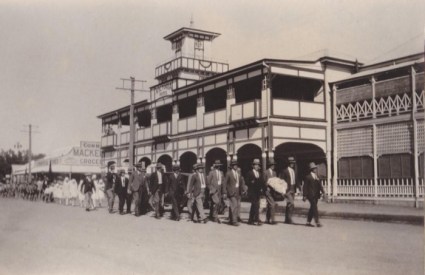
victoria-hotel-in-19334
The Victoria Hotel in Goondiwindi in 1934

Why she was working at the Victoria Hotel in  Goondiwindi at the age of 17 I don’t know, but that was where she met my father.  She insisted she wasn’t a barmaid.  She would have been too prim and proper for that.  Her job was at reception where one of the guests she checked into the hotel was Linden Price. 

Six months later they were married.  It must have been a much more exciting life than she had experienced.  Linden drove fancy cars, went to the races and ate out at the best restaurants.  Life with Linden was a roller coaster but it wasn’t boring.

E and MrM
Elsa with Mr Munro before I was born
E35
Elsa looking very smart

I used to think my mother was the most beautiful, courageous and capable woman in the world.  When my father died she had a lot of decisions to make.  The business was running at a loss and the bank was owed a large amount of money.  One option was to sell the property and move to Sydney near her mother in Mortdale.  She contemplated getting a job in a hardware store as she jokingly said her knowledge of crosses, tees and elbows, male and female threads, nipples, couplings and unions was second to none.   Then again, she had spent years running a steel and piping business, as my father was often away so why not stay on at The Waterhole?

piping
My mother with a piece of piping

Within a year she had repaid the overdraft.  No-one was allowed to buy on credit. She travelled widely through NSW and bought second hand piping whenever it became available.  Because she was a widow and a woman she was afforded unexpected respect from her male counterparts.  The men who worked for my father were asked to leave and she outsourced jobs such as welding for making gates.  She employed a house cleaner so she could devote herself to the business.  She had a large bedroom built on the back of our house so she keep a watchful eye on her mother-in-law and Mr Munro who were by now living with us.

E in SydneyLife was not easy.  Ella was devastated by the loss of her only son, Linden, and eventually became bedridden.  Every night she rang a bell three or four times asking for my mother. Elsa was sleep deprived and exhausted.  Finally Ella moved to a convalescent home in Oatley, near my other grandmother so we visit her every school holidays.   My mother had a new kitchen built to replace its dark and dingy predecessor and redecorated the lounge room.  Mr Munro relocated to a renovated building on the property.
Despite the loss of my father I had a secure childhood and felt loved and wanted by my mother.  Our relationship had a closeness that she had never experienced with her own mother.

L is for Linden

Linden RS
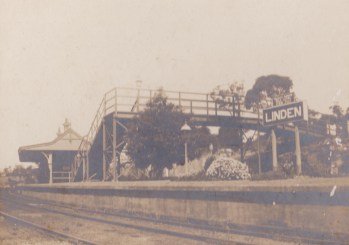
Linden Railway Station circa 1907

Linden is a small town in the Blue Mountains of NSW.  It was here my father was born in 1907.  His father was the stationmaster, a role held in high esteem in those days.  When the family left Linden they were given a silver cutlery set with their initials  on the handles and a silver tea set similarly engraved. That the local community would go to so much trouble beggars belief from a modern viewpoint.

linden as a boy
Linden as a boy
Ella and John
Linden’s parents, Ella and John Price

My father’s name was also Linden, although he found it didn’t fit well in the rough and tough world of the Australian bush, so he was later known as Bill.  When his father died he was only six and his mother had to find a way to make ends meet.  Working as a housekeeper on a rural cattle station was a way she could keep her son with her and earn enough money to plan for his future.


newington
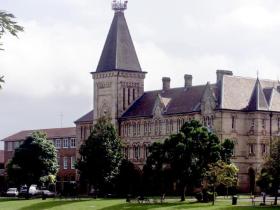
Newington College

Linden was sent to Newington College in Stanmore, Sydney, probably with the help of my grandmother’s employer, Mr Munro.  It was not a happy time as teasing and bullying was common in those days.  Because he had no father or wealth he was looked down upon by the other boys.  He told me of initiation ceremonies where he was pelted with sand in the showers.  On his arm he showed me  a scar where  he had been caught in a door.  A group of tormenting  boys thought it very amusing to lean on the door so that he was trapped.  The agony was excruciating and he thought he would lose his arm.  Along came his saviour, a fellow student who happened to be the Crown Prince of Tonga*.  He used his not inconsiderable strength to remove the boys and release my father’s arm.

linden on horse
Linden was happier on a horse than at boarding school.

In the year he was due to sit for the Intermediate Certificate he spent several weeks off school with an illness.  He refused to go back so that was the end of his formal education.

With advice from Mr Munro he went off to train as a wool classer.  He was not suited to this occupation.  The rest of his life was spent seeking business opportunities as he was determined to be his own boss.

When he met my mother he had made the local Goondiwindi newspaper for being the man with most shirts in town.  He would buy a shirt, wear it for a couple of days and then buy a new one.  He was dabbling in various money making occupations, owning a racehorse, working as a bookmaker and always in the background was Mr Munro, offering work on his sheep and cattle properties.

Linden and Elsa
Linden and Elsa

He was 28 and my mother was 18 when they married in 1936.  They became graziers, leasing 3000 acres from Mr Munro.  Drought, footrot and World War 2 forced them off the land.  They moved to Sydney and had a stint of operating first a guest house and a then a milk bar. In 1949 they moved to Mildura in Victoria  where Linden marketed irrigation equipment, supplying many soldier settlers who were establishing new farms.  Elsa, meanwhile, surprised everyone by becoming pregnant with me, after 15 years of marriage.

Moving back to Sydney Linden pursued some more unsuccessful business opportunities culminating in his bankruptcy in 1956.  It seems Mr Munro loaned him the money to buy the twelve acres at “The Waterhole” in Yerrinbool.  Here he was able to set up his steel and piping business but a businessman he was not.  People owed him money far and wide and the collection of watches in the bowl on the dresser was testament to the IOUs which were never paid.

Before his death Linden was dreaming of a new enterprise.  He had bought land at Mulgoa and was planning on operating a Truckie’s Café.  My mother, however, was not thrilled with the idea of cooking steak and eggs every morning for passing truck drivers.

Linden was not well.  Finally he went to the doctor and the news was bad.  He had a heart condition.  Nothing could be done for it except rest and extreme care.  In modern times he could have had a heart bypass but they were almost unheard of in 1961.  In January of 1962 he began to rake some gravel in one of the outhouses and fell.  My mother found him some time later and I watched from the corner of the building as she cradled him in her arms.  His face was grey and he was already cold.  He was only 54.


  • the only Crown Prince of Tonga I could find who went to Newington was born in 1918 so the dates do not add up.  Is this a case of wishful thinking or was there some other Tongan attending the school at the time?  The ties between Tonga and the school are very close.  How many other family stories are exaggerations of the truth?

K is for Keepsake

bracelet after
The bracelet is on Myrtle’s left hand.  Here she is aged 18

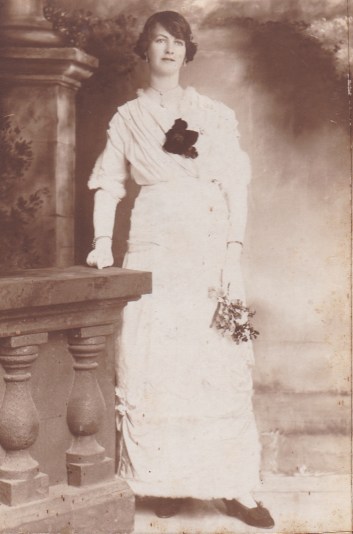
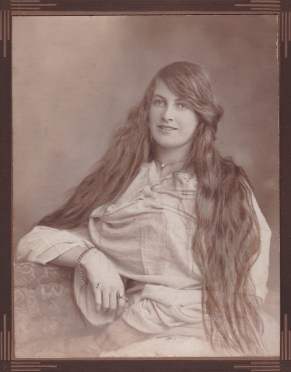
When my grandmother Myrtle was 16 she was tall, graceful and attractive.  She was  asked by Myer, the big  Melbourne Department Store, to be a model.  Of course her father would not allow it but she was not short of admirers.  One man adored her so much he asked for a lock of her long hair and had it made into a bracelet.  On it is engraved “From S.E.B.  8-9-13”. 

A crest at the front is engraved with MML for Myrtle May Lock. Six plaited strands of hair are held in place by engraved gold bands.  It is an exquisite piece of jewellery.IMG_6066

IMG_6063
The padded bracelet box is showing its age – 103 years old

When I was 16 my mother gave it to me, telling me that it was a family tradition to pass it on to the first born daughter of each generation when she turned 16.  When my daughter turned 16 I gave it to her but she asked me to keep it for her as she was travelling and she  probably wouldn’t wear it anyway as she wore silver, not gold.  In ten years my granddaughter will be 16 so it will be time for the bracelet to move on to the next generation.

IMG_6068
I wonder who S.E.B. was?

J is for Jobs

My workload was not onerous as a child but I was expected to make my bed, set the table correctly and help with the dishes.  The animals had to be fed so the dogs were given dog biscuits and pollard mixed with hot water in the morning and Tuckerbox (canned dog food) in the afternoon.  The hens were also given pollard and hot water in the morning and wheat in the afternoon.  Feeding them was usually my job but I enjoyed the reception I received from the animals when their food arrived.  I would let the dogs off their chains and they would scamper madly up and down the drive.  As their job was to bark when a customer arrived they were chained to a long wire which gave them room to run up and down during the day.


vegetable-garden
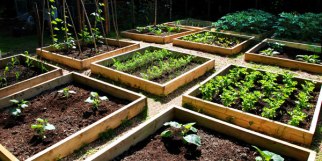
Our veggie garden had raised beds just like this one.

My father and mother had a large vegetable garden and I was given a plot to grow radishes as they matured quickly.  I moved onto carrots and corn which took longer but were more useful.  Often when I was in fantasyland making my own fun I would be dragged back to reality and told to do some work in the garden. Indoor activities were frowned upon during the day. Even reading books was an evening activitiy.

warmray
A Warm Ray identical to ours.


Collecting woodchips for the Warm Ray from the woodheap  was another job and as I grew older splitting wood with the tomahawk was added to my chores.  I learnt how to set the fire in the winter and clean the ash out of the tray.  At night we filled hot water bottles.  Each morning, now cold, they were emptied onto the garden.


huntsmen
Australian Geographic Magazine April 2016

On the other side of the road, across the Hume Highway, was a deep waterhole which had originally been a blue metal pit.  Beside it was a water pump which channelled water under the highway to a dam on our side. I was keen to learn how to operate the pump on my own and found it fairly simple, with just the flick of a few levers.  The scariest thing about it was when the metal door of the pump was opened a dozen or so long legged huntsman spiders ran around over the surface of the control board.  It was necessary to wait patiently until they had calmed down after the intrusion and then gingerly set the controls and switches to set the pump in motion.

Huntsmen spiders were treated with respect as they ate the insect pests in the home and garden.  They generally appeared inside during  wet weather.  My mother set a good example to her daughter by removing them with a broom and returning them to the outdoors.  I’m pleased to see my daughter does this too.  They are not venomous.  They just look scary.


I is for Insanity


The day the Pantechnicon drove into the circular driveway at “The Waterhole” was bleak with heavy rain and grey skies .  The tiny house was packed to its brown coved ceilings with furniture so my parents decided we would eat out.  The nearest eating place was Bimbos, a truckie’s rest and food stop.  My father said if truckies ate there it must be good.

house3.jpg
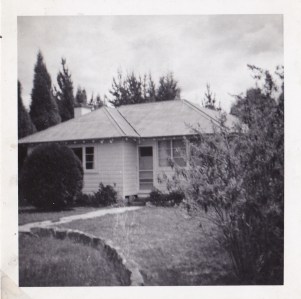
It wasn’t very grand but my mother was happy because it was hers.

We settled into our new home.  My parents had the one bedroom and I was in the enclosed verandah at the front.  The previous owners had planted avenues of trees.  Crab apples lined the driveway, orchards of plum grew beside the house and apple, pear, peach and cherryplum trees were spread around the property.  A grove of Scots pines grew to the south of the house and cypress pines to the west.  Unfortunately the former gardener was now in the Kenmore Mental Asylum as we had bought our property from the “Master of Lunacy” whose job was to “undertake the general care, protection and management … of estates of all insane persons and patients in New South Wales” (The Lunacy Act of 1878 ).


The previous owner had left his legacy.  Every wall and ceiling in the living area sported axe marks. My mother was so happy to have her own home at last that these small inconveniences didn’t worry her.  However my grandmother (Kay) suggested that brown paper and flour paste would at least cover the unsightly holes.

car
My grandmother’s car

She arrived on a Sunday as she always did in her little green and black Renault Dauphine.  The glue was mixed on the stove and the brown paper squares applied to the walls and ceiling.  It was with great satisfaction that they sat down to a cup of tea in the late afternoon.

It wasn’t long before holes started appearing in the patches.  Little footprints were dotted across the still wet paper.  The rats had discovered the flour paste and were devouring it with great gusto.  It was back to square one and the next problem was to get rid of the rats.rats


The incidence of mental instability in our small village of 100 people was disproportionately high.  I suppose the availability of cheap housing and relative isolation made it attractive to people with problems of various sorts.


H is for Hydrogen Bomb

The 1950s was a worrying time as the Cold War intensified and the Hydrogen Bomb was tested in various parts of the world, including Australia.

2-british-nuclear-tests-maralinga
Testing at Maralinga

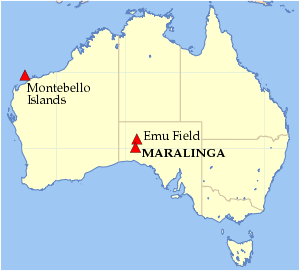
British Nuclear tests at Maralinga occurred between 1956 and 1963 in an isolated area 800 kilometres north-west of Adelaide. A total of seven nuclear tests were performed as well as many minor trials which littered the area with plutonium.  While they were not, strictly speaking, H-Bombs, they were highly radioactive Atom Bombs.

300px-AusNucTestSites.svg
Sites of British Nuclear Testing

The site was contaminated with radioactive materials and debate continued for many years over the safety of the site and the long-term health and social effects on the traditional Aboriginal owners of the land. The scientific and military personnel involved in the tests did not know at the time how the radiation they were exposed to as they watched the explosions would affect them. At the time all we knew was that Australia was “doing its bit” to help Britain in the fight against the Cold War.

Poster - On the Beach (1959)_11My father took me to see the movie “On the Beach”.  It was based on the book of the same name by Nevil Shute. It is a post-apocalyptic novel and film showing how a mixed group of people deal with the threat of impending death.  The story begins one year after  a nuclear war in the Northern Hemisphere which caused deadly radiation to spread relentlessly towards Australia.  Surely the stuff of nightmares for an eight year old!
My father’s experience at an elite private school had taught him that there is a great social divide between rich and poor.  Not wanting Australia to emulate the social class structure of Britain he saw Communism as a possible solution .  He was also sure we would be invaded by the Russians and bought me a book on the Russian language to increase my chance of survival after the invasion.  In hindsight it may have been better if he had read George Orwell’s “Animal Farm” where “All animals are equal, but some are more equal than others”.

RobertMenzies
Sir Robert Menzies, Australian Prime Minister 1939-41 and 1949 -1966

He didn’t go so far as to join the Communist Party but was an avid Labor supporter and spoke disparagingly of the Prime Minister Robert Menzies as“Pig Iron Bob”. This referred to an incident in 1938 when Port Kembla wharfies refused to load pig iron onto ships bound for Japan. They had been told, rather prophetically, that it would return to them in the form of bullets.  When the Prime Minister came to Wollongong to try and defuse the situation he was heckled by an onlooker and referred to as “Pig Iron Bob”.  The name stuck and was commonly used by his detractors.

In spite of or maybe because of his upbringing my father preferred to be his own master and initiated a number of largely unsuccessful business enterprises.

G is for Grandmothers

They left the vine-wreathed cottage and the mansion on the hill,

The houses in the busy streets where life is never still,

The pleasures of the city, and the friends they cherished best:

For love they faced the wilderness -the Women of the West.

from The Women of the West by George Essex Evans

My family was small but I had two wonderful grandmothers.  They were very different but their lives in some ways were remarkably similar.

kay
Myrtle May born in 1896

My mother’s mother was named Myrtle but she hated that name and called herself Kay.  The eldest of four children she was clever but had to miss school to care for her sickly brother.  The girls in the family were expected to learn a trade and be self supporting, so Myrtle chose dressmaking while her sister favoured millinery.  At the age of 18 she married a much older man largely to get away from the demands of her family.  When she was 21 she gave birth to my mother but had serious complications and was unable to have any more children.  Eight years later she left her husband and her neat little home in Williamstown, Victoria, taking my mother to Forest Lodge in Sydney, where she set up a dressmaking business from home.

This was 1925 where respectable married women did not run away from their husbands.  I wasn’t  told why she left but I do know she was very unhappy.  Sewing for the well to do in Sydney was demanding but paid well enough until The Great Depression.  I am guessing this was the reason Kay put my mother in boarding school and went to work on a cattle station as a housekeeper.

ella
Ella Maud born in 1875

My other grandmother was experiencing a similar trajectory in life.  Widowed and with a six year old son, she had no skills apart from domestic duties, so accepted the job of housekeeper with Mr Munro, an eccentric, unmarried landowner in the Moree area of northern NSW.  Any suggestion of an improper relationship between them was strictly denied by Ella, who preferred to be known as Maud but was called Ma.  I do suspect that it was with Mr Munro’s help that my father was sent to boarding school at Newington College in Sydney.

Ella and Mr Munro spent most of the war years until 1945 on Norfolk Island.  Some of Mr Munro’s land had been requisitioned by the Australian Government for war use so he decided the safest place to be was on an island 1700 kilometres out to sea.

My first memories of Mi-Me (as she was known to me) are of a very old lady with white hair, walking with the aid of crutches.  She had fallen over and broken her hip in the steep rocky backyard of Mr Munro’s home in Springwood.  She would have been about 70 by then. I was five and followed her slow progress as she walked, listening to her stories and poems.  She knew all the bush ballads and particularly loved to quote, “The Women of the West”.

I am fortunate that she was a keen writer and photographer because I have her articles and photos from The Australian Woman’s Mirror, The Grazier’s Review and other publications.

Meanwhile Kay had not found a benefactor like Mr Munro.  She told me stories of cooking huge cakes and meals for the shearers and life on far flung rural properties and may even have found happiness for a short while when she married a boundary rider.  He was never mentioned when I was a child so I imagine that the marriage did not end well.

Screen Shot 2016-04-07 at 1.29.32 PM
Google Instant Street View Image date 2014                 This is the building, now a veterinary hospital, where Kay lived and had her dress shop

When I first remember Kay, or Me-Ma as I called her, she owned a dress shop in Mortdale called Kay Muir Frocks.  Behind the shop was a large room with long tables for cutting patterns and sewing machines to make dresses.  Above the shop was the apartment where she and her third husband George, lived.  To me it was a palace as it was brand new and had the most wonderful bathroom imaginable.  The tiles were a mottled green and the bath, shower recess, flush toilet and pedestal basin all matched the tiles.  The kitchen was red and white with a large laminex table in the centre, the lounge room had a dining table which was never used, a television set, a pianola, a very uncomfortable green vinyl lounge and a magical display cabinet full of fascinating objects.  My grandmother had frequent disagreements with her husband and to cheer herself up would buy some ornament to place in her cabinet.  To me it was far more interesting than her TV set.

My grandmothers had hard lives but I am so proud of what they achieved.  One was reserved, somewhat haughty and demanding.  The other was outgoing, the life of the party and yet a disaster when it came to choosing men. Yet I felt they both loved me, their only grandchild. They showed me how important a grandparent can be to the life of a child and influenced the way I interact with my own grandchildren.